
GDCH(000976)

Search documents
开盘:三大指数小幅低开 兵装重组概念跌幅居前
Xin Lang Cai Jing· 2025-10-17 02:10
Market Overview - The three major indices opened slightly lower, with the Shanghai Composite Index at 3912.04 points, down 0.11%, the Shenzhen Component at 13060.24 points, down 0.20%, and the ChiNext Index at 3026.40 points, down 0.36% [1] Economic and Trade Developments - The Chinese Ministry of Commerce expressed an open attitude towards equal consultations based on mutual respect regarding potential new trade talks with the U.S. [2] - The Ministry of Industry and Information Technology is promoting a nationwide "millisecond computing" network construction initiative, aiming for comprehensive coverage and efficiency by 2027 [2] - The U.S. is considering extending the suspension of tariffs on China in exchange for delaying rare earth export controls, with China reiterating its stance on these issues [2] - Chinese Commerce Minister Wang Wentao met with Apple CEO Tim Cook, discussing U.S.-China trade relations and encouraging Apple to deepen cooperation and investment in China [2] - TSMC noted strong demand for AI applications, exceeding previous expectations, and is working to enhance Cowos capacity by 2026 [2] Company Announcements - Oriental Cable announced winning contracts totaling 2.374 billion yuan for ±500kV DC sea-land cable products and construction projects [3] - Zhaofeng Co. signed a strategic cooperation framework agreement with Nuoan Robotics [3] - TBEA announced a subsidiary's plan to acquire a 74.19% stake in Shuguang Cable for 946 million yuan [3] - Zhongtian Technology reported winning multiple marine project contracts totaling approximately 1.788 billion yuan [3] - Huatian Technology plans to acquire 100% of Huayi Microelectronics [3] - ZhiGuang Electric intends to purchase all or part of ZhiGuang Energy's minority equity [3] - ChipLink Integration plans to increase capital by 1.8 billion yuan to its controlling subsidiary [3] - Shijia Photon reported a 728% year-on-year increase in net profit for the first three quarters [3] - Rongzhi Rixin expects a net profit increase of 871%-908% year-on-year for the first three quarters [3] - Guangsheng Nonferrous anticipates a net profit of 100 million to 130 million yuan for the first three quarters [3] Corporate Changes - Fuyao Glass announced that its actual controller, Cao Dewang, resigned as chairman, with his son, Cao Hui, elected as the new chairman [4] - YTO Express reported that its third-largest shareholder, Hangzhou Haoyue, plans to transfer up to 2% of the company's shares through block trading [4] - Tongfu Microelectronics' largest shareholder, Huada Group, plans to reduce its stake by no more than 1% [4] - Debang Technology's largest shareholder, the National Big Fund, reduced its holdings by 1.5173 million shares from September 29 to October 15 [4] Regulatory Issues - Hainan Huatie announced that it is under investigation by the China Securities Regulatory Commission for suspected violations of information disclosure [5] U.S. Market Performance - The U.S. Senate failed to advance a temporary funding bill, increasing recession expectations [6] - U.S. stock indices closed lower, with the Dow down 0.65%, Nasdaq down 0.47%, and S&P 500 down 0.63% [7] Technology Developments - Apple is preparing to launch a new Mac computer featuring a touch screen, with the new MacBook Pro expected to include a touch display, a lighter body, and M6 series chips [8] - Oracle disclosed that its RPO has exceeded $500 billion, projecting $225 billion in revenue by fiscal year 2030, with adjusted earnings per share expected to reach $21 [9] Commodity Market - COMEX gold futures rose by 3.4% to $4344.3 per ounce, while COMEX silver futures increased by 3.99% to $53.43 per ounce, both reaching new closing highs [9] Market Sentiment - Zhongyuan Securities noted that the A-share market experienced slight fluctuations, with banking, automotive, communication equipment, and coal sectors performing well, while precious metals and wind power sectors lagged [10] - Dongguan Securities highlighted that the A-share market faced a pullback, with concerns over U.S. government "shutdown" increasing recession expectations [11]


10月15日增减持汇总



Xin Lang Cai Jing· 2025-10-15 13:51
Core Insights - On October 15, Haier Biomedical and Hainan Huatie disclosed shareholding increases, while 23 A-share listed companies announced shareholding reductions [1][3] Group 1: Shareholding Increases - Haier Biomedical's major shareholder, Jiusiyouxuan No.1 Private Securities Investment Fund, has become a shareholder with over 5% stake [3] - Hainan Huatie's second-largest shareholder, Hu Danfeng, completed a share increase plan, accumulating 6.448 million shares [3] Group 2: Shareholding Reductions - Ugreen Technology plans to reduce its shareholding by up to 1.5% [3] - Dongxin Peace's directors, Chen Zongchao and Huang Xiaopeng, plan to reduce their shareholdings [3] - Meilixin's director, Ma Minghai, and others intend to reduce their holdings by up to 0.34% [3] - Dongsoft Zhaibo's controlling shareholder, Lanhai Ruisheng, plans to reduce its stake by up to 1.06% [3] - Demingli's second-largest shareholder, Wei Hongzhang, intends to reduce its holdings by up to 1.32% [3] - Nanling Technology's shareholders plan to collectively reduce their holdings by up to 3.26% [3] - Lio Co., Ltd. plans to reduce up to 135 million shares of its repurchased shares [3] - Huizhiwei's second-largest shareholder, the National Fund Phase II, plans to reduce its holdings by up to 1% [3] - Hahuan Huadong's shareholder, Hexie Investment, plans to reduce its holdings by up to 1% [3] - Huichuangda's shareholder, Ningbo Tongjia, plans to reduce its holdings by up to 2.9999% [3] - Jinsong New Materials' shareholder, Ningbo Liyi, plans to reduce its holdings by up to 2% of the total share capital [3] - Feirongda's controlling shareholder and actual controller plan to reduce their holdings [3] - Deyi Culture's specific shareholder, Chen Lan, plans to reduce its holdings by up to 1% [3] - Sanfeng Intelligent's Dong Chenwei and his associates plan to reduce their holdings by up to 2.85% [3] - Yilian Forging's shareholder, Gaoxin Tonghua, plans to reduce its holdings by up to 3% [3] - Huada Jiutian's fourth-largest shareholder, the National Fund, has cumulatively reduced 2.7147 million shares [3] - Riyue Co., Ltd.'s director and vice president, Zhang Jianzhong, plans to reduce up to 156,900 shares [3] - Western Gold's second-largest shareholder, Yang Niurong, plans to reduce up to 18.22 million shares [3] - Yonghui Supermarket's vice president, Luo Wenxia, plans to reduce up to 109,000 shares [3] - Baobian Electric's shareholder, the financial arm of the military industry, plans to reduce up to 0.98% [3] - Keli Sensor's Lu Zhonggeng and Huang Zhaoxia plan to reduce their holdings by up to 0.4807% and 0.0359% respectively [3] - Shuhua Sports' shareholders plan to collectively reduce their holdings by up to 3% [3] - Jintuo Co., Ltd.'s shareholders, Pan Zhu He and others, plan to reduce their holdings by up to 2.95% [3]

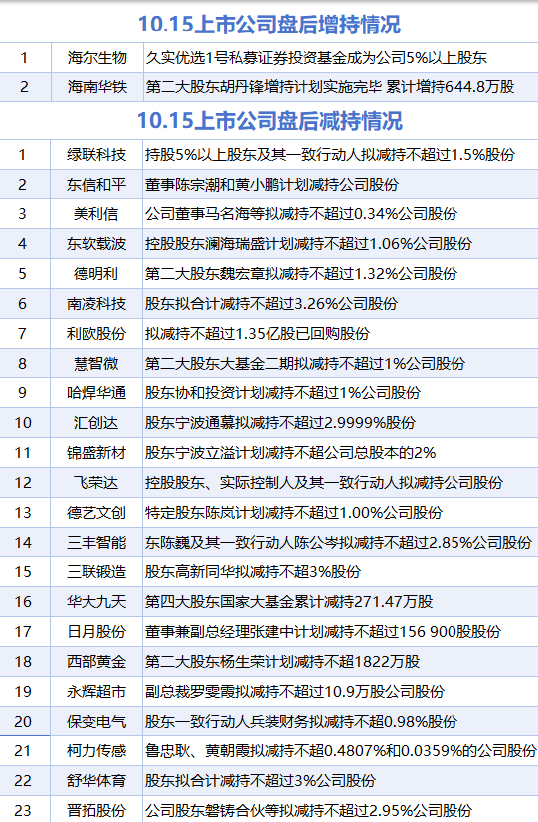
10月15日增减持汇总:海南华铁等2股增持 西部黄金等23股减持(表)
Xin Lang Zheng Quan· 2025-10-15 13:23
Core Insights - On October 15, several A-share listed companies disclosed their shareholding changes, with notable increases and decreases in holdings by major shareholders [1] Group 1: Increased Holdings - Haier Biomedical's major shareholder, Jiusiyouxuan No.1 Private Securities Investment Fund, has become a shareholder with over 5% stake [2] - Hainan Huate's second-largest shareholder, Hu Danfeng, completed a share buyback plan, accumulating 6.448 million shares [2] Group 2: Decreased Holdings - Ugreen Technology's shareholders plan to reduce their holdings by up to 1.5% [2] - Dongxin Peace's directors, Chen Zongchao and Huang Xiaopeng, are planning to sell shares [2] - Meilixin's director, Ma Minghai, and others intend to reduce their holdings by up to 0.34% [2] - Dongsoft Zhaibo's controlling shareholder, Lanhai Ruisheng, plans to reduce holdings by up to 1.06% [2] - Demingli's second-largest shareholder, Wei Hongzhang, intends to reduce holdings by up to 1.32% [2] - Nanling Technology's shareholders plan to collectively reduce holdings by up to 3.26% [2] - Liou Co. plans to reduce up to 135 million shares of repurchased stock [2] - Huizhiwei's second-largest shareholder, the National Fund II, plans to reduce holdings by up to 1% [2] - Other companies, including Hahai Transportation, Huichuangda, and others, have also announced plans for share reductions [2]


山东黄金前三季度净利同比预增84%—99%丨公告精选
2 1 Shi Ji Jing Ji Bao Dao· 2025-10-14 14:30
Performance Forecasts - Shandong Gold expects a net profit of 3.8 billion to 4.1 billion yuan for the first three quarters of 2025, representing a year-on-year increase of 83.9% to 98.5% due to optimized production layout and rising gold prices [1] - Xinda Co. anticipates a net profit of 180 million to 205 million yuan for the first three quarters of 2025, reflecting a year-on-year increase of 2807.87% to 3211.74% driven by significant price increases of its main product, acetamiprid [2] - Shenghe Resources forecasts a net profit of 740 million to 820 million yuan for the first three quarters of 2025, indicating a year-on-year growth of 696.82% to 782.96% due to favorable market demand and price increases in rare earth products [3] Corporate Governance and Management Changes - Guo Da Special Materials announced that its actual controller and chairman, Xu Weiming, has been placed under detention, with daily operations managed by the executive team [4] Shareholder Activities - Hainan Huatie's controlling shareholder increased its stake by acquiring 5.604 million shares, raising its ownership from 13.78% to 14.06% [5] - Shareholder Hu Danfeng also increased his stake by purchasing 6.38 million shares, increasing his ownership from 8.86% to 9.18% [5] Legal Matters - Longbai Group's subsidiary, Yunnan Xinli, has filed a lawsuit for technology infringement, claiming damages of 1.3105 billion yuan [7] Other Corporate Actions - Mindray Medical plans to issue H-shares and list on the Hong Kong Stock Exchange, pending shareholder and regulatory approvals [6]



北方稀土被内蒙古证监局出具警示函;依依股份筹划购买宠物食品公司股权|公告精选
Mei Ri Jing Ji Xin Wen· 2025-10-13 14:51
Mergers and Acquisitions - Meizhi Co., Ltd. plans to publicly transfer 51% equity of Guangdong Yingju Construction Engineering Co., Ltd. at a minimum price of 1.02 million yuan [1] - Yiyi Co., Ltd. is planning to acquire equity in Hangzhou Gaoye Family Pet Food Co., Ltd. through issuing shares and cash payment, with stock suspension starting from October 14 [2] - Meili Technology intends to acquire 10.1% equity stakes in Beijing Dayuan and Jiangsu Dayuan for 15 million yuan, increasing its ownership to 80.1% [3] Shareholding Changes - Tengya Precision plans to reduce its shares by up to 3%, equating to 4.24 million shares, representing 2.99% of total shares [4] - Hainan Huatie's controlling shareholder plans to increase its stake by 100 million to 200 million yuan within six months starting from October 14, 2025 [5] - Beichen Real Estate's controlling shareholder intends to increase its stake by 45 million to 90 million yuan over the next 12 months, not exceeding 2% of total shares [6] Earnings Reports - Yingwei reported a net profit of 183 million yuan for Q3, an increase of 8.35% year-on-year, with revenue of 1.453 billion yuan, up 25.34% [7] - Salt Lake Co. expects a net profit of 4.3 billion to 4.7 billion yuan for the first three quarters, a year-on-year increase of 36.89% to 49.62% [8] - Sanmei Co. anticipates a net profit of 1.524 billion to 1.646 billion yuan for the first three quarters, reflecting a growth of 171.73% to 193.46% year-on-year [9] Risk Matters - Northern Rare Earth received a warning letter from the Inner Mongolia Securities Regulatory Bureau for failing to disclose non-operating fund occupation by related parties, totaling 8.9485 million yuan [10]




10月13日增减持汇总:海南华铁等3股增持 天际股份等9股减持(表)



Xin Lang Zheng Quan· 2025-10-13 12:50
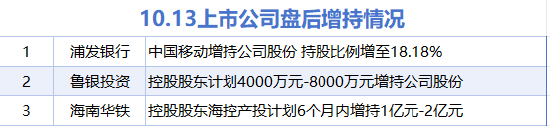
Group 1 - The core viewpoint of the news highlights the recent shareholding changes among various companies, with specific focus on both increases and decreases in shareholdings by major stakeholders [1][3] Group 2 - Shanghai Pudong Development Bank has seen an increase in shareholding by China Mobile, raising its stake to 18.18% [3] - Lu Yin Investment's controlling shareholder plans to increase its stake by 40 million to 80 million yuan [3] - Hainan Huate's controlling shareholder plans to increase its stake by 100 million to 200 million yuan within six months [3] Group 3 - Several companies have disclosed plans for share reductions, including Hengbo Co., Ltd., which plans to reduce up to 3.14% of its shares [3] - Tianji Co., Ltd. had a controlling shareholder initially planning to reduce up to 14.75 million shares [3] - Tengya Precision plans to reduce up to 3% of its shares by one of its actual controllers [3] - Sun Cable's shareholder, Yili Group, plans to reduce up to 3% of its shares [3] - Daymoon Ming's directors plan to reduce their shareholdings [3] - Guangdong Mingzhu has seen a recent reduction of 1.17% of its total share capital by shareholders [3] - Yongding Co., Ltd. has a controlling shareholder planning to reduce 3% of its shares [3] - Yunda Lifelike has seen a total reduction of 3.17 million shares recently [3] - Yingli Automotive's controlling shareholder has cumulatively reduced 47.57 million shares from July 18 to October 10 [3]
A股五张图:竟然以这样的形式关注起了业绩!
Xuan Gu Bao· 2025-10-09 10:30
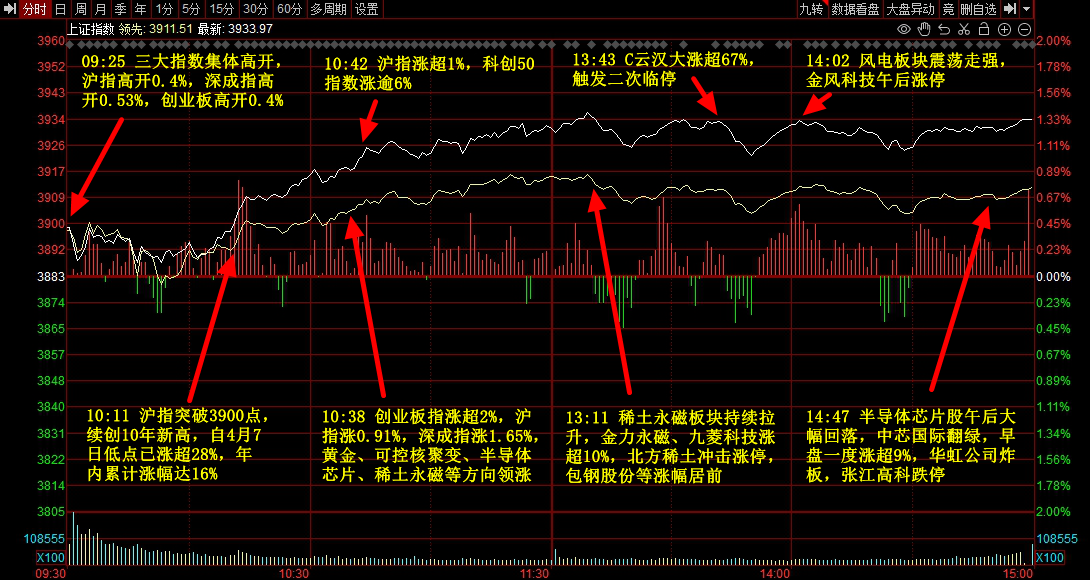
Market Overview - After the National Day holiday, the three major indices collectively rose, with the ChiNext experiencing a significant surge followed by a pullback [3] - The Shanghai Composite Index closed above 3900 points, reaching a nearly ten-year high, just shy of the 4000-point mark [4] - The market saw over 3100 stocks rise, with a trading volume exceeding 2.6 trillion [3] Semiconductor Sector - The semiconductor sector experienced volatility, with notable movements in major stocks such as Baiwei Storage and Zhongxin International [6] - Huahong Semiconductor's stock saw a significant drop after a strong opening, impacting related stocks like Huaxi Industry and Zhongwei Technology [7] - SMIC's stock hit a new high before dropping nearly 1%, attributed to its static P/E ratio exceeding 300, leading to a 0% margin calculation [8] Rare Earth Sector - The rare earth sector surged following the announcement of export controls on related technologies by the Ministry of Commerce [10] - Stocks like Northern Rare Earth and China Rare Earth saw significant gains, with the sector closing up 6.46% [10] Lighthouse Factory Concept - The "Lighthouse Factory" concept gained attention, referring to advanced manufacturing facilities that leverage technologies like AI and IoT [12] - Stocks related to industrial automation and new industrialization, such as Haide Control and Dingjie Smart, experienced notable price increases [18] Hainan Huatie - Hainan Huatie faced challenges after announcing the termination of a significant contract due to market changes, leading to a sharp decline in stock price [23][24] - Despite attempts to stabilize the situation through a buyback announcement, the stock still closed at a limit down [24]

退市绝非规避处罚的挡箭牌
Sou Hu Cai Jing· 2025-09-01 22:17
Core Viewpoint - The recent penalties imposed on companies that have been delisted highlight the regulatory body's commitment to enforcing accountability and ensuring that delisting does not exempt companies from legal repercussions [1][2]. Group 1: Regulatory Actions - The Guangdong Securities Regulatory Bureau has fined Huatie Co. 24.15 million yuan after its delisting, part of a broader trend where 44 delisted companies have faced a total of 1.2 billion yuan in fines since 2024 [1]. - A total of 63 executives have been permanently banned from the market, with around 20 more delisted companies still undergoing penalties [1][2]. - The regulatory framework has established a "three-punishment linkage" system, which includes administrative penalties, criminal accountability, and civil compensation [2]. Group 2: Corporate Governance Issues - Many companies that have faced delisting suffer from poor corporate governance and operational irregularities, often involving financial fraud, information concealment, and misuse of funds [1]. - The lack of diligence from executives and board members has led to significant failures in compliance, resulting in delisting [1][2]. Group 3: Recommendations for Improvement - There is a need to strengthen accountability for executives, particularly in cases of financial fraud, and to clarify the standards for their responsibilities [2][3]. - Companies should implement internal mechanisms to reclaim performance bonuses from executives if their actions lead to financial losses [3]. - The responsibility of controlling shareholders and actual controllers should also be enforced, ensuring they return any illegally obtained benefits [3]. - A robust mechanism for collaboration between regulatory bodies and law enforcement is essential to enhance the efficiency of criminal prosecutions related to securities violations [3][4]. - Prioritizing civil compensation for investors is crucial, allowing them to pursue legal actions against responsible parties effectively [4].
时评:退市不是“免责金牌”
Zheng Quan Ri Bao· 2025-08-24 23:45
Group 1 - Recent administrative penalties have been imposed on three delisted companies, highlighting that regulatory authorities will continue to pursue accountability regardless of a company's delisting status [1] - The delisting system is crucial for optimizing resource allocation in the capital market, aiming to remove companies that lack sustainable operational capabilities or engage in serious violations [1][2] - The number of delisted companies has significantly increased due to regulatory reforms, with more efficient delisting indicators being implemented [1] Group 2 - The legal framework for holding delisted companies accountable has become more comprehensive, with the China Securities Regulatory Commission (CSRC) having investigated 64 delisted companies for violations in 2024 alone [2] - Various channels for investor protection and compensation have been established, including representative litigation and administrative enforcement commitments [2] - The CSRC has intensified criminal referrals for serious violations, with 33 delisted companies referred to law enforcement for suspected information disclosure crimes in 2024 [2] Group 3 - A robust delisting mechanism and a strict accountability system are essential for the long-term healthy development of the capital market, ensuring market vitality and fairness [3]

退市不是“免责金牌”
Zheng Quan Ri Bao· 2025-08-24 16:14
Group 1 - Recent administrative penalties have been imposed on three delisted companies, namely Taihe Group, Huatie Co., and Meishang Ecology, due to violations of information disclosure laws during their listing period [1] - The regulatory authorities are committed to pursuing accountability for delisted companies, emphasizing that delisting does not equate to escaping responsibility [1][2] - The delisting system is crucial for optimizing resource allocation in the capital market, aiming to remove companies that lack sustainable operational capabilities or engage in serious violations [1][3] Group 2 - The legal framework for holding delisted companies accountable has become increasingly stringent, with the China Securities Regulatory Commission (CSRC) having investigated 64 delisted companies for violations since the beginning of 2024 [2] - Various channels for investor protection and compensation have been established, including representative litigation and administrative enforcement, providing robust support for investors seeking redress [2] - The CSRC has intensified criminal referrals for serious violations, with 33 delisted companies referred to law enforcement for suspected information disclosure crimes in 2024 [2]