
Sinoma Science & Technology (002080)

Search documents
中报逐步披露,关注下半年消费建材盈利改善
China Post Securities· 2025-08-25 09:20
Investment Rating - The industry investment rating is "Outperform the Market" and is maintained [1] Core Views - The construction materials industry is showing signs of improvement despite being under pressure. Leading companies in consumer building materials are beginning to collaborate on price increases, indicating a stabilization in competition. The profitability of companies like Sankeshu is improving due to better product structure and reduced costs. The industry is transitioning from a downturn to a recovery phase, with expectations of improved profitability across various categories in the second half of the year [3][4] - The cement sector is expected to see a price increase as it enters the peak season, with July's cement production at 146 million tons, down 5.6% year-on-year. The glass industry is facing a downward trend in demand, with prices continuing to decline due to supply-demand imbalances [4][8] - The report highlights key companies to watch, including Dongfang Yuhong, Sankeshu, Beixin Building Materials, and Tubao for consumer building materials, and Conch Cement and Huaxin Cement for the cement sector. In the glass sector, Qibin Group is noted for its performance [3][4] Summary by Sections Industry Overview - The construction materials industry index increased by 2.91% in the past week, ranking 8th among 31 sub-industry indices [5] - The closing point for the industry was 5240.54, with a 52-week high of 5240.54 and a low of 3435.69 [1] Cement Sector - The cement market is entering a peak season, with prices expected to rise in September. The production in July was 146 million tons, reflecting a year-on-year decline of 5.6% [4][8] - The implementation of policies to limit overproduction is anticipated to enhance capacity utilization in the cement industry [4] Glass Sector - The glass market is experiencing a continuous decline in demand, with prices dropping 1-4 RMB per weight box across various regions. The industry is facing significant inventory pressure [14] - The report suggests that the "anti-involution" sentiment has led to a significant drop in futures prices, with limited improvement in downstream demand [14] Key Company Announcements - Sankeshu reported a revenue of 5.816 billion RMB for the first half of 2025, a year-on-year increase of 0.97%, with a net profit of 436 million RMB, up 107.53% [18] - Zhongcai Technology achieved a revenue of 13.331 billion RMB, a year-on-year increase of 26%, with a net profit of 999 million RMB, up 115% [18] - Beixin Building Materials reported a revenue of 13.56 billion RMB, a slight decline of 0.3%, with a net profit of 1.93 billion RMB, down 12.9% [19][20]

民生证券:AI PCB技术演进 设备材料发展提速
智通财经网· 2025-08-25 09:14
Core Viewpoint - The report from Minsheng Securities highlights "speed" and "power" as the two core contradictions in current AI development, with PCB (Printed Circuit Board) being a crucial component in the AI industry chain, benefiting significantly from the ongoing advancements in PCB technology and processes [1] Group 1: PCB Industry Trends - The PCB industry is experiencing rapid development in advanced packaging and high-density interconnect technologies, transitioning from traditional HDI and substrate technologies to mSAP processes capable of sub-10μm line widths to meet the demands of high-speed signal transmission and large-scale integration [1] - New technologies such as CoWoP (Chip-on-Wafer-on-Panel) are changing the form of packaging substrates by using large-size PCBs to carry multiple chips, thereby reducing costs and enhancing interconnect density [1] Group 2: Upstream Material Demand - Driven by AI demand, leading PCB manufacturers like Shenghong Technology, Huitian Technology, and Pengding Holdings are actively expanding production, creating a resonance between material upgrades and capacity expansion [2] - Key upstream materials for PCBs include copper foil, electronic cloth, and resin, with upgrades in these materials to meet the requirements of high-speed signal transmission and lightweight designs [2] Group 3: Equipment Supply and Domestic Substitution - The core processes of PCB manufacturing, including drilling, electroplating, and etching, are critical for determining interconnect density, signal integrity, and production yield, with increasing demands for precision and reliability in these processes [3] - Domestic equipment manufacturers such as Dazhu CNC, Dingtai High-Tech, and Dongwei Technology are accelerating their layouts in advanced process equipment for high-layer boards, HDI, and mSAP, reflecting the industry's shift towards domestic substitution [3] Group 4: Investment Recommendations - Recommended PCB leading manufacturers include Shenghong Technology (300476.SZ), Pengding Holdings (002938.SZ), Huitian Technology (002463.SZ), Shenzhen South Circuit (002916.SZ), Guanghe Technology (001389.SZ), and Jingwang Electronics (603228.SH) [4] - In the materials sector, companies with core technologies and customer resources such as Honghe Technology (603256.SH), Zhongcai Technology (002080.SZ), Feilihua (300395.SZ), Defu Technology (301511.SZ), Longyang Electronics (301389.SZ), and Meilian New Materials (300586.SZ) are recommended [4] - For equipment, focus on domestic substitution in core segments with companies like Dazhu CNC (301200.SZ), Xinqi Microelectronics (688630.SH), Dingtai High-Tech (301377.SZ), and Dongwei Technology (688700.SH) [4]




特种电子布跟踪系列:一线新反馈
2025-08-25 09:13
Summary of Conference Call Records Company and Industry Overview - **Company**: 中材科技 (China National Materials Group Corporation) - **Industry**: Specialty Electronic Fabrics and Glass Fiber Industry Key Points and Arguments Financial Performance - 中材科技 reported a revenue of 13.3 billion yuan for the first half of 2025, representing a year-on-year growth of 26.5% [5] - The net profit attributable to shareholders was 1 billion yuan, up 115% year-on-year, driven by strong performance in fiberglass and blade businesses, as well as rapid growth in specialty electronic fabrics and electronic yarns [5][6] Market Demand and Trends - The demand for CTE (Coefficient of Thermal Expansion) products has significantly increased since Q2, with expectations for demand to double in Q4 and potentially continue to double in 2026 [13][14] - The low dielectric electronic yarn (DJ) market is experiencing strong demand and rising prices, particularly for first-generation fabric products [28] - The wind power industry remains robust, with high demand for high-strength and high-modulus glass yarns, driven by applications in electric vehicles and unmanned aerial vehicles [2][35] Production Capacity and Expansion Plans - 中材科技 plans to expand its production capacity from 300 weaving machines to 400-500 by the end of the year and to 800 by mid-2026, aiming to meet the growing market demand [16] - The company has completed small sample tests for 2.8 mm CTE products, with plans for larger-scale testing in the coming months [14] Export and Market Challenges - The export volume of fiberglass has significantly declined, with a 15% drop in July compared to previous months, although the exit of overseas production capacity may benefit domestic companies [23] - The company anticipates that European tax policies may impact exports in the second half of the year, but the overall effect is expected to be minimal [6] Future Outlook - 中材科技 expects to maintain revenue and profit growth, with projected fiberglass sales of approximately 1.3 million tons for the year [6] - The company is optimistic about the market demand driven by domestic computing power improvements and is actively adjusting supply to meet this growth trend [18] Emerging Technologies and Product Development - The industry is seeing a shift towards new products and technologies, particularly in the fields of AI and renewable energy, which are expected to drive future growth [24][36] - New materials such as quartz fiber and basalt fiber are gaining attention, with potential applications in high-end manufacturing and construction [24] Industry Dynamics - The glass fiber industry is experiencing a trend towards larger production scales and increased automation, which is expected to reduce production costs and improve competitiveness [25] - The market is also witnessing a focus on energy efficiency and environmental compliance, particularly in light of stricter carbon emission regulations [26] Additional Important Insights - The specialty electronic fabric industry is seeing strong performance, particularly with the push from domestic computing power, which is expected to further drive demand in the coming months [3] - The company has achieved significant milestones in the CTE and QBU product lines, being the only domestic company capable of mass delivery in the CTE sector [20] - The overall market sentiment is positive, with expectations for continued growth in emerging sectors such as electronics, wind power, and new energy vehicles [36]
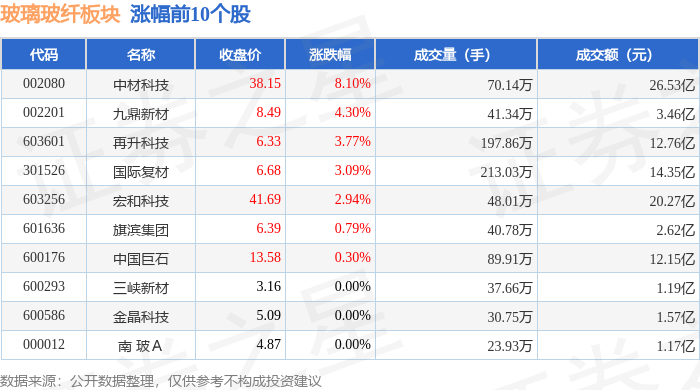
玻璃玻纤板块8月25日涨2.91%,中材科技领涨,主力资金净流出1794.27万元


Zheng Xing Xing Ye Ri Bao· 2025-08-25 08:47
Market Performance - The glass fiber sector increased by 2.91% on August 25, with China National Materials Technology leading the gains [1] - The Shanghai Composite Index closed at 3883.56, up 1.51%, while the Shenzhen Component Index closed at 12441.07, up 2.26% [1] Individual Stock Performance - China National Materials Technology (002080) closed at 38.15, up 8.10%, with a trading volume of 701,400 shares and a transaction value of 2.653 billion yuan [1] - Other notable performers included Jiuding New Materials (002201) with a 4.30% increase, and Zais Technology (603601) with a 3.77% increase [1] - The stocks of China Jushi (600176) and Sanxia New Materials (600293) showed minimal changes, with increases of 0.30% and 0.00% respectively [1] Capital Flow Analysis - The glass fiber sector experienced a net outflow of 17.9427 million yuan from institutional investors, while retail investors saw a net inflow of 12.2 million yuan [2] - The overall capital flow indicates a mixed sentiment, with institutional investors withdrawing funds while retail investors increased their positions [2] Detailed Capital Flow by Stock - Zais Technology (603601) had a net inflow of 125 million yuan from institutional investors, but a net outflow of 54.6421 million yuan from speculative funds [3] - China Jushi (600176) saw a net inflow of 60.8422 million yuan from institutional investors, while retail investors had a net outflow of 75.5654 million yuan [3] - Jiuding New Materials (002201) experienced a net inflow of 43.7267 million yuan from institutional investors, but a net outflow from both speculative and retail investors [3]

周观点:建材中的“抱团”与“切换”-20250825
GUOTAI HAITONG SECURITIES· 2025-08-25 07:11
Investment Rating - The report maintains a positive outlook on the building materials sector, highlighting potential opportunities in both "grouping" and "switching" strategies within the industry [2][11]. Core Insights - The building materials market is experiencing a shift in focus, with technology stocks gaining momentum while the building materials sector presents viable options for investment [2]. - The report emphasizes the importance of monitoring production capacity and quality improvements in key segments such as electronic fabrics and Q fabrics, which are expected to see increased demand due to advancements in AI and PCB technologies [3][4]. - The report identifies a growing confidence in infrastructure projects in regions like Xinjiang and Tibet, driven by government investments and the necessity of transportation infrastructure [11][12]. - The consumer building materials segment is showing signs of recovery, with expectations of improved revenue performance as the market stabilizes [24][25]. Summary by Sections Grouping in Building Materials - The electronic fabric sector is expected to maintain its performance, with leading companies like Zhongcai Technology reporting strong sales and production growth [3]. - The AI industry's production expectations are advancing, with key suppliers anticipating increased output of Q fabrics by the end of the year [4]. - The report highlights the importance of monitoring the production capacity and quality of Q fabrics, which will determine the actual supply capabilities of companies [4]. Switching in Building Materials - Infrastructure projects in Xinjiang and Tibet are gaining traction, with significant government backing and a strong demand for cement due to the region's unique geographical advantages [11][12]. - The consumer building materials sector is entering a recovery phase, with sales and construction data indicating a bottoming out of the market [13][14]. - The report notes that the cement industry is poised for potential growth, driven by policy improvements and governance enhancements [15][29]. Cement Industry - The cement sector is entering a peak season, but market performance remains subdued due to high comparative bases from the previous year [29][30]. - The report emphasizes the importance of policy measures to limit overproduction in the cement industry, which could enhance profitability [30][33]. - Companies like Conch Cement and Huaxin Cement are highlighted for their strong cash flow and potential for shareholder returns [34][38]. Glass Industry - The float glass market is experiencing price stabilization, with environmental regulations expected to impact production costs [40][41]. - The report indicates that the glass industry is facing cash flow challenges, with many companies operating at a loss [42]. - Companies like Xinyi Glass are expected to maintain competitive positions despite market pressures, with a focus on improving operational efficiency [43]. Photovoltaic Glass - The photovoltaic glass segment is seeing a decline in inventory levels, with prices remaining stable amid increased demand from downstream component manufacturers [48]. - The report notes that while domestic prices are under pressure, overseas markets are performing better, which could benefit leading companies in the sector [49]. Fiberglass - The fiberglass market is characterized by a divergence in production and sales, with electronic fabrics maintaining a favorable outlook [50].


从两家AI材料龙头报表中看出什么,以及关注量子计算进展 | 投研报告
Zhong Guo Neng Yuan Wang· 2025-08-25 01:43
Core Viewpoint - The report highlights the strong performance of leading companies in the electronic fabric and copper foil sectors, driven by AI contributions and improvements in core business operations, indicating a positive market outlook for these segments [1][2]. Group 1: Electronic Fabric and Copper Foil - Two leading companies in electronic fabric and copper foil have reported better-than-expected mid-year results, primarily due to AI's contribution to profits and continued improvement in their core businesses [2]. - For instance, Zhongcai Technology's AI electronic fabric products have seen increased shipments, and its wind power blade business has experienced both volume and price increases in Q2, with expectations for further improvement in Q3 [2]. - Copper Crown Copper Foil's HVLP series products have achieved bulk shipments, and the lithium battery copper foil segment has shown significant loss reduction and margin recovery [2]. Group 2: Market Trends and Opportunities - Market attention is shifting towards liquid cooling, power supplies, and generators, but electronic fabric and copper foil remain high-demand sectors, expected to lead in unit value enhancement [2]. - The report expresses optimism for the African building materials market and highlights Keda Manufacturing as a leading local player, with a strong growth forecast for the first half of the year [2]. Group 3: Quantum Computing Developments - The report notes advancements in quantum computing, with strategic partnerships aimed at integrating quantum computing with AI for practical applications [3]. - IBM's 2025 quantum roadmap indicates significant progress, with plans to deliver a large-scale fault-tolerant quantum computer by 2029 [3]. Group 4: Traditional Building Materials Transformation - Traditional building material companies are accelerating their core business transformations, with notable acquisitions and investments in generative AI [4]. Group 5: Market Data and Trends - Cement prices averaged 343 RMB per ton this week, showing a year-on-year decrease of 36 RMB, while the average utilization rate for concrete mixing stations was reported at 6.86% [5]. - The glass market saw a decline in prices, with the average price for float glass at 1205.78 RMB per ton, down 2.42% from the previous week [5].

“反内卷”+涨价受益股曝光,融资客大幅加仓的滞涨股仅5只
Zheng Quan Shi Bao· 2025-08-24 23:58
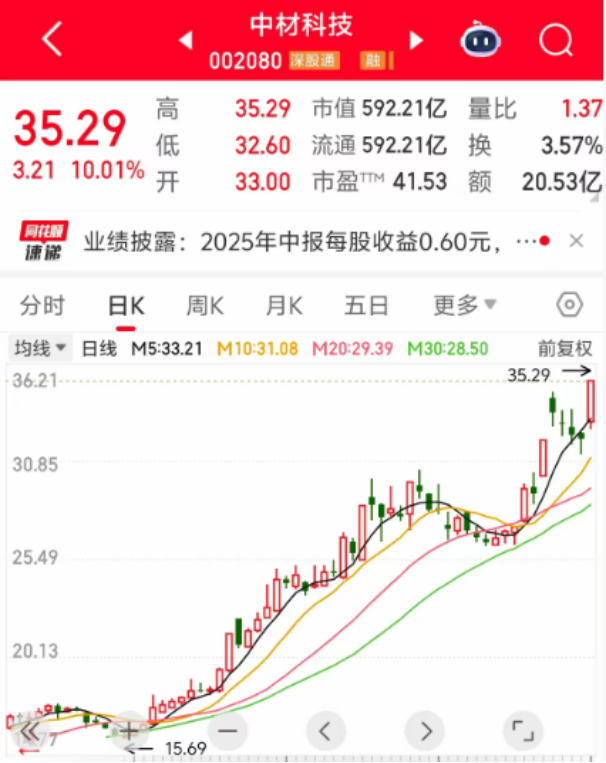
Group 1 - The "anti-involution" actions in China are promoting a healthier competitive environment, leading to inventory reduction and stable growth in the domestic market [1][4] - Companies are experiencing performance reversals or continued growth in the first half of the year, benefiting from rising prices and improved competition [1][4] Group 2 - Zhongcai Technology reported a net profit of 999 million yuan in the first half of the year, a year-on-year increase of 114.92%, driven by product price increases and structural optimization [2] - The company’s strong performance led to a stock price surge following the release of its semi-annual report [2] Group 3 - The price increase in various products, including those in the PCB industry, is driven by rising raw material costs and surging downstream demand, indicating a new growth cycle in the PCB sector [4] - Significant price increases were observed in commodities such as TDI, lithium carbonate, and rare earth oxides, with some prices rising over 20% within a month [4][5] Group 4 - A total of 64 stocks benefited from the "anti-involution" actions and price increases, with notable performance in the basic chemicals, non-ferrous metals, and construction materials sectors [6] - The agriculture, forestry, animal husbandry, and fishery sector saw a net profit increase of over 820% in the first half of the year compared to the previous year [6] Group 5 - Companies like Fujian Cement and Huaxin Cement reported significant profit increases, with Huaxin Cement achieving a median net profit growth of over 50% [8] - Several companies, including Huahong Technology and Xian Da Co., saw net profit increases exceeding tenfold, driven by favorable market conditions and price recoveries [9] Group 6 - Over 40% of the stocks in the "anti-involution" and price increase beneficiaries saw stock price increases of over 50% year-to-date, with some stocks doubling in value [10] - Companies like Zhongyi Da and Limin Co. reported substantial stock price increases, with Zhongyi Da's stock price rising over 220% [12] Group 7 - Among the 64 stocks, 52 are financing and margin trading targets, with a significant number experiencing increased financing balances, indicating strong investor interest [13] - Stocks such as Xiantong Development and Fujian Cement saw financing increases exceeding 100%, reflecting positive market sentiment [13]
中材科技,净利增长245%,玻纤、叶片、锂膜销量大增
DT新材料· 2025-08-24 16:04
Core Viewpoint - The article highlights the strong performance of Zhongcai Technology in the first half of 2025, showcasing significant revenue and profit growth driven by strategic focus on new energy, new materials, and green low-carbon industries [2][3]. Group 1: Financial Performance - Zhongcai Technology reported a revenue of 13.33 billion yuan, a year-on-year increase of 26% [2]. - The net profit attributable to shareholders reached 1 billion yuan, up 115% year-on-year [2]. - The net profit excluding non-recurring items was 810 million yuan, reflecting a 245% increase [2]. Group 2: Business Segments - **Glass Fiber Business**: - Sales of glass fiber and products reached 673,000 tons, generating revenue of 4.35 billion yuan, a 13% increase [3]. - The average price of glass fiber products rose by 14% year-on-year [3]. - **Wind Power Blade Business**: - Sales of wind power blades amounted to 15.3 GW, a 103% increase [3]. - Revenue from this segment was 5.2 billion yuan, up 84% year-on-year [3]. - **Lithium Battery Separator Business**: - Sales of lithium battery separators totaled 1.3 billion square meters, a 60% increase [3]. - Revenue from this segment was 930 million yuan, reflecting a 22% growth [3]. Group 3: Market Position and Strategy - Zhongcai Technology focuses on three main areas: special fibers, composite materials, and new energy materials, aiming to enhance its competitive edge in glass fiber, wind blades, and lithium membranes [2]. - The company has established a leading position in the hydrogen storage cylinder market, maintaining the highest market share domestically [4].
中材科技20250822
2025-08-24 14:47
Summary of Zhongcai Technology Conference Call Company Overview - **Company**: Zhongcai Technology - **Industry**: Composite materials, glass fiber, wind power blades, lithium battery separators, hydrogen storage cylinders Key Points and Arguments Business Performance - **Glass Fiber Business**: - Sales revenue reached 4.35 billion yuan, a year-on-year increase of 13% - Net profit was 580 million yuan, a significant increase of 216% - Gross margin improved significantly due to capacity release from the Taiyuan base and increased sales of specialty fiber products [2][6] - **Wind Power Blade Business**: - Sales volume reached 15.2 GW, a year-on-year growth of 103% - Sales revenue was 5.2 billion yuan, an increase of 84% - Net profit was 360 million yuan, a year-on-year increase of 282% - Lean management and cost control significantly enhanced profitability, with expectations for further improvement in the second half of the year [2][6] - **Lithium Membrane Business**: - Sold 1.3 billion square meters of lithium battery separators, a year-on-year increase of 60% - Despite intense competition and price pressure, the proportion of high-end products increased, leading to improved gross margins in the second quarter [2][6] - **Hydrogen Storage Cylinder Business**: - Sold 3,000 units, maintaining over 50% market share domestically [2][6] Strategic Developments - **Product Development**: - Launched AI low dielectric constant products and low expansion quartz cloth, achieving sales of approximately 8.95 million meters in the first half of the year [4][6] - Plans to expand production capacity to over 100 million meters by 2026-2027 for specialty cloth [3][31] - **International Expansion**: - Plans to establish an overseas Chinese building materials group to enhance global competitiveness, with a focus on Europe, North America, Southeast Asia, and Africa [5][12] Future Outlook - **Market Demand**: - Anticipated growth in demand for specialty fibers and composite materials, particularly in the fields of new energy materials and high-quality housing construction [9][15] - **Technological Advancements**: - Continued investment in R&D for advanced materials, including those for electric vehicles and aerospace applications [11][13] Industry Position - **Competitive Edge**: - Zhongcai Technology is the only domestic company capable of mass-producing LCTE and quartz cloth products, with a strong focus on high-end clients [5][20] - **Market Trends**: - The global demand for LCTE products is expected to double by mid-2026, driven by increased applications in packaging materials [21][31] Challenges and Risks - **Price Fluctuations**: - The company is facing challenges due to rising prices of LCTE products and is considering price adjustments to maintain competitiveness [18][19] - **Supply Chain Issues**: - Potential supply chain constraints for weaving machines and raw materials could impact production capacity [44][45] Additional Important Information - **Production Capacity**: - Currently, the company operates 300 weaving machines, with plans to increase to 800 by mid-2026 [40][41] - **Product Quality**: - The company has achieved significant improvements in the yield rates of its second-generation products, enhancing its competitive position [49][50] - **Market Dynamics**: - The specialty fabric industry does not operate on a monthly contract basis due to supply-demand imbalances, with prices determined over longer cycles [21] This summary encapsulates the key insights from the conference call, highlighting Zhongcai Technology's performance, strategic initiatives, market outlook, and challenges within the industry.
非金属建材周报:从两家AI材料龙头报表中看出什么,以及关注量子计算进展-20250824
SINOLINK SECURITIES· 2025-08-24 14:38
Investment Rating - The report maintains a positive outlook on the electronic fabric and copper foil sectors, highlighting their strong performance and market leadership in the AI industry chain [2][13]. Core Insights - The report emphasizes that two leading companies in electronic fabric and copper foil have exceeded expectations in their mid-year reports, driven by AI contributions, continuous improvement in core businesses, and strong market share positions [2][13]. - The report also highlights the growth potential in the African building materials market, particularly for local manufacturing companies like Keda Manufacturing, which is expected to benefit from high demand and favorable local recognition [14]. - The advancements in quantum computing are noted, with significant developments from IBM and Tsinghua University, indicating a growing interest and potential in this field [15]. Summary by Sections Weekly Discussion - Two leading companies in electronic fabric and copper foil have reported better-than-expected results, with AI contributing to profits and core businesses improving [2][13]. - Keda Manufacturing is highlighted as a leader in local production in Africa, benefiting from high demand and local support [14]. - Quantum computing advancements are being made, with IBM's roadmap and Tsinghua University's research indicating significant progress [15]. Market Performance - The building materials index showed a performance increase of 5.27%, with specific sectors like glass manufacturing and fiberglass performing particularly well [20]. - The report notes that the cement market is experiencing a slight price increase, with an average price of 343 RMB per ton, reflecting a 2 RMB increase from the previous period [17][28]. Price Changes in Building Materials - The report indicates that the national average price for cement has increased by 0.7%, with specific regions seeing price increases of 10-30 RMB per ton [28]. - The average price for float glass has decreased to 1205.78 RMB per ton, reflecting a decline of 2.42% [17][36]. Industry Trends - The report identifies a sustained high demand for AI materials, particularly in specialized fiberglass and high-grade copper foil, with expectations for continued growth in these areas [18]. - Traditional building material companies are accelerating their business transformations, with notable acquisitions and investments in AI-related fields [16].