Workflow
IFLYTEK(002230)
icon
Search documents
跨越科技奇点,布局AI新机
Ping An Securities· 2025-12-15 02:09
Group 1: Industry Overview - The computer industry has shown steady revenue growth and improved profit margins, with total revenue reaching 939.34 billion yuan in the first three quarters of 2025, a year-on-year increase of 9.4% [11] - The software development sub-industry has seen significant profit improvements, while the computer equipment sub-industry remains relatively high in terms of market sentiment [11] - The industry has experienced a volatile upward trend since the beginning of 2025, with the computer industry index rising by 18.54% as of November 28, 2025, outperforming the CSI 300 index by 3.5 percentage points [18] Group 2: Algorithm and Applications - The global landscape of large models is rapidly evolving, with significant competition among closed-source models from companies like Google, Anthropic, and OpenAI, while domestic open-source models like Kimi K2 and MiniMax-M2 maintain a leading position [27][30] - The focus of large model applications is shifting towards programming, enterprise services, and office productivity tools, indicating a convergence in the market [42] - The integration of multi-modal capabilities and AI agents is becoming a competitive focal point in the large model market, expanding the boundaries of model tasks [32][34] Group 3: Computing Power - The AI computing power market is experiencing high demand, with the global AI server market projected to grow at a CAGR of 15.5% from 2024 to 2028, while China's market is expected to grow at a CAGR of 30.6% during the same period [10] - The domestic AI computing power chip industry is poised for growth due to strong policy support and increasing downstream demand, with a clear trend towards self-sufficiency [10][22] Group 4: Intelligent Driving - The penetration rate of Navigate on Autopilot (NOA) features is increasing, indicating a rapid commercialization of the intelligent driving industry in China, with the market size expected to exceed 300 billion yuan by 2030 [4] - Major players like Tesla and Xpeng are advancing their intelligent driving technologies, with significant updates and new model releases enhancing their market positions [4][5] Group 5: Investment Recommendations - The report maintains a "stronger than market" rating for the computer industry, highlighting investment opportunities in AI computing power, algorithms, and intelligent driving sectors [5] - Specific stock recommendations include companies like Zhongke Chuangda, Haiguang Information, and Industrial Fulian in the AI computing power segment, and companies like Daotong Technology and Kingsoft Office in the AI algorithm and application space [5][6]
2026年度计算机行业投资策略:产业硬约束兑现,政策新蓝图展开
Soochow Securities· 2025-12-14 14:23
Group 1: Industry Changes - The computer industry in 2026 will witness a convergence of "industrial cycles" and "policy cycles," marking a decisive year for both existing tasks and new growth opportunities [2][3] - AI applications are expected to reach a critical point of explosion, transitioning from a phase of high expenditure to profitability, with significant scale deployment in vertical scenarios [11] - Domestic computing power has evolved from being a backup to becoming fully usable in training and inference for domestic large models, with 2026 anticipated to be a year of comprehensive replacement [12] - The completion of the "信创" (Xinchuang) initiative is set for 2027, making 2026 a peak year for bidding and delivery, with strong performance certainty for related companies [13] Group 2: Policy Changes - The "十四五" (14th Five-Year Plan) elevates commercial aerospace to a national strategic level, with 2026 expected to be a year of industry explosion driven by satellite networking and reusable rockets [6] - The low-altitude economy is transitioning from policy enthusiasm to industrial heat, with substantial construction expected in 2026 due to infrastructure standards and special bonds [6] - The integration of AI with various industries is emphasized in the "十四五" plan, aiming for deep integration in manufacturing, healthcare, transportation, and finance, which will enhance productivity and create greater economic value [20][36] Group 3: Investment Recommendations - Companies in the AI application sector should be selected based on their alignment with national policies and the "AI+" initiative, focusing on sectors like agriculture, industrial software, and healthcare [36] - Companies with strong foundational platforms and aggregation entry points for large models are recommended for long-term investment, such as Alibaba and iFlytek [37] - Data barrier companies that possess proprietary data to train models are crucial, with a focus on firms like 海天瑞声 (Haitian Ruisheng) and 同花顺 (Tonghuashun) [38] - Companies that dominate high-frequency usage scenarios, such as 金山办公 (Kingsoft Office) and 东方财富 (Eastmoney), are positioned to benefit significantly from AI integration [40]
招聘市场回暖!脉脉高聘:字节招聘量断层领先 AI科学家平均月薪12.7万元
Mei Ri Jing Ji Xin Wen· 2025-12-14 06:22
Group 1 - The report indicates that the average monthly salary for the top 20 high-paying positions in 2025 exceeds 60,000 yuan, with AI research and development roles dominating the list [1][2][3] - ByteDance leads in new job postings, followed by Meituan and Alibaba, with Tencent in fourth place and Xiaohongshu surpassing JD.com, NetEase, and Ant Group to enter the top five [1][6] - Chasing has the highest growth rate in new job postings, exceeding 300%, indicating a significant demand for talent in the AI sector [1][8] Group 2 - The job market is showing signs of recovery, with the talent supply-demand ratio in the new economy sector rising to 2.23, meaning 2.23 individuals are competing for one position [2] - From January to October 2025, the number of new AI job postings surged by 543% year-on-year, with a monthly increase of over 11 times in September alone [2] - The most in-demand technical positions in the new economy sector include algorithm engineers and large model algorithms, with high-performance computing engineers being the most scarce [2][3] Group 3 - AI positions dominate the high-paying job market, with AI algorithm engineers earning nearly 18% more than regular algorithm engineers, and AI product managers earning 20% more than their counterparts [2][3] - The average monthly salary for AI scientists/managers is 127,225 yuan, with large model algorithm positions and digital front-end engineers following closely [3][5] - Hardware technology roles such as integrated circuit design and IC verification engineers also maintain competitive salaries, reflecting the broad application of algorithm technology [5] Group 4 - The demand for AI talent is particularly strong in the smart hardware and internet sectors, with companies like Huawei, OPPO, and Xiaomi entering the top 20 for AI job demand [10] - The automotive and transportation industries, including companies like Xiaopeng Motors and Didi, are also showing significant demand for AI positions [10] - The transformation of organizational structures in the AI era is emphasized, with a call for HR to embrace advanced AI tools and redefine operational efficiency [10]
AIGC 行业专题报告:AI 技术演进视角下,智能内容生成的现在与未来
Sou Hu Cai Jing· 2025-12-12 23:09
Core Insights - The article discusses the transformative potential of Artificial Intelligence (AI) as the fourth industrial revolution, emphasizing its role in enhancing productivity and reducing costs across various sectors [1][5]. Group 1: AI Development Drivers - AI is driven by the need to improve efficiency and reduce costs, addressing pain points in consumer-related scenarios such as entertainment, travel, and health [3]. - The application of AI in consumer sectors includes labor replacement and productivity enhancement through technologies like voice recognition and intelligent customer service [3]. - In the business sector, AI is widely adopted in finance, public safety, and healthcare, reflecting a strong demand for efficiency improvements [3]. Group 2: Historical Context and Evolution - AI is positioned as the fourth productivity revolution, following the steam, electrical, and information technology revolutions, with significant historical milestones marking its development [5]. - The evolution of AI has seen three major waves of growth, each driven by breakthroughs in underlying algorithms, with the current wave characterized by deep learning advancements [8][12]. - The first wave of AI in the 1950s was limited by computational performance, while the second wave in the 1980s faced challenges due to the high costs of expert systems [9][11]. Group 3: AI Industry Structure - The AI industry can be segmented into three layers: foundational support (hardware and data), technology (algorithm development), and application (commercial solutions) [6][7]. - Major players in the foundational layer include international tech giants like Nvidia and Intel, while the technology layer features companies like Google and IBM focusing on specific AI applications [6][7]. - The application layer is where AI technologies are commercialized, with a relatively low entry barrier due to the global open-source community [6]. Group 4: Current AI Landscape - The current state of AI is classified as "weak AI," focusing on specific tasks such as speech and image recognition, with significant performance exceeding human capabilities in certain areas [30][33]. - AI's impact on global GDP is projected to be substantial, with estimates suggesting a 14% increase, translating to approximately $15.7 trillion in growth [37]. - The rapid advancement of deep learning algorithms and the availability of vast datasets are expected to drive widespread AI application across various industries [38][39]. Group 5: Future Opportunities - The article highlights the potential for AI to revolutionize content generation and distribution, particularly through platforms like TikTok and Douyin, which utilize AI-driven recommendation systems [46][52]. - The emergence of generative AI (AIGC) is seen as a significant opportunity, with advancements enabling the creation of diverse content types, including text, images, and videos [54][61]. - The integration of AI into various sectors is anticipated to accelerate, driven by technological advancements and supportive policies from governments [44][45].
计算机行业2026年投资策略:模型迭代驱动、应用突破与算力国产引领行业发展
GF SECURITIES· 2025-12-12 14:48
Core Insights - The report emphasizes that the computer industry is driven by model iteration, application breakthroughs, and domestic computing power leadership, with a buy rating for the sector [2][4][17]. Industry Overview - The AI infrastructure sector is transitioning from "testing and trial" to "large-scale rollout in 2026" for domestic AI chip replacements, with a narrowing gap between domestic and international leading models [8][17][26]. - The AI application sector is categorized into three types of companies: those with recognized benchmark clients but in early stages, those with long-term trends but uncertain timelines, and those leveraging AI with reachable inflection points [8][17][19]. - The EDA and R&D software sector is seeing rapid improvement in domestic product capabilities, with mergers and acquisitions expected to accelerate due to policy support [8][17][21]. - In the intelligent driving and robotics sector, the report suggests focusing on competitive chip tracks, overseas expansion, and new autonomous driving opportunities, recommending global AMR leader Geek+ [8][18][21]. - The report notes that traditional trust and innovation directions are facing funding delays, while the release of HarmonyOS PC in 2025 is seen as a catalyst for business growth and technological upgrades [8][18][21]. - The energy information sector is expected to benefit from stable capital expenditures and market reforms, although policy implementation timelines need to be monitored [8][18][21]. Key Companies - In the AI infrastructure sector, recommended companies include Cambricon, Inspur, and Unisoc, with attention to Sugon [8][19]. - For AI applications, notable companies are Jingtaikong, Rainbowsoft, and Kingdee International, with additional focus on Hancloud and Guangyun Technology [8][19][21]. - In the intelligent driving and robotics sector, key players include Geek+, Black Sesame Intelligence, and Rui Ming Technology, with recommendations to monitor Desay SV and SOTER [8][19][21]. - In the EDA and R&D software sector, companies like GigaDevice, Gexin Electronics, and BGI are highlighted, with attention to Zhongkong Technology and Haocen Software [8][19][21]. - For trust and innovation, recommended companies include Kingsoft and Softcom, with additional focus on Taiji Co. and China Software International [8][19][21]. - In the energy information sector, notable companies are Guoneng Rixin and Longxin Group, with attention to State Grid Information and South Grid Digital [8][19][22].
大摩预测了25家人形机器人公司将主导行业,没有宇树、智元
具身智能之心· 2025-12-12 07:59
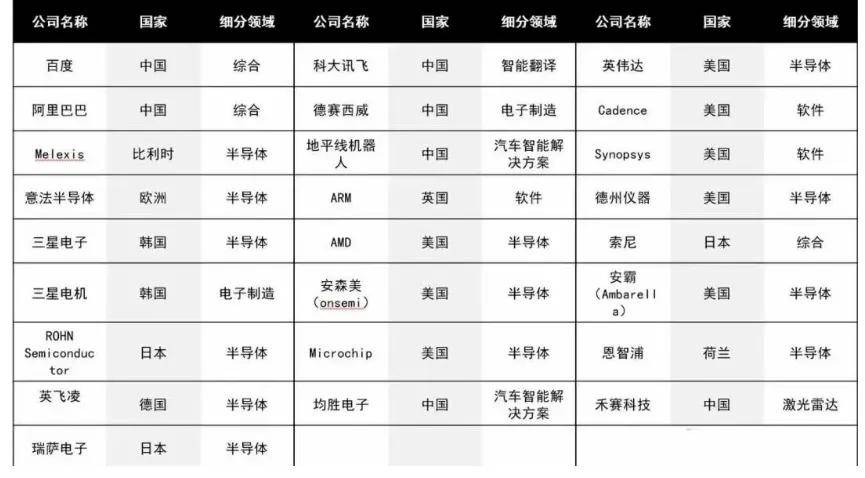
Core Insights - Morgan Stanley predicts that 25 humanoid robot companies will dominate the industry, with 7 Chinese companies listed [2][3] - The Chinese companies include Baidu, Alibaba, Horizon Robotics, Junsheng Electronics, iFlytek, Desay SV, and Hesai Technology, focusing on various sectors such as AI, automotive, and electronic manufacturing [3][4] - The report emphasizes the importance of component and module suppliers over traditional humanoid robot manufacturers, highlighting the critical role of companies providing AI chips, visual sensors, precision actuators, and power management chips [3][4] Company and Industry Summary - The 7 Chinese companies identified are significant players in their respective fields, with a focus on AI, automotive intelligence, language recognition, and electronic manufacturing [3] - The absence of companies like Yushun and Zhiyuan in the report raised questions about its professionalism, but Morgan Stanley justified this by focusing on the foundational components essential for the humanoid robot industry [4] - The Chinese market has seen the emergence of nearly 150 humanoid robot startups, indicating a growing interest and investment in this sector, regardless of potential market bubbles [4]
AI人工智能ETF(512930)涨近1%,京东招募端侧AI芯片领域人才
Xin Lang Cai Jing· 2025-12-12 05:33
Group 1 - The core index of artificial intelligence, the CSI Artificial Intelligence Theme Index (930713), has seen an increase of 0.78% as of December 12, 2025, with notable gains in constituent stocks such as Chipone Technology (688521) up 5.73% and Beijing Junzheng (300223) up 5.26% [1] - JD.com is actively recruiting talent in the edge AI chip sector, focusing on integrated storage and computing AI chips intended for use in robotics and smart home appliances [1] - The "Shandong Province Artificial Intelligence Industry High-Quality Development Action Plan (2025-2027)" aims for the core AI industry in the province to exceed 200 billion yuan by 2027, with an average annual growth rate of over 30% [1] Group 2 - Dongfang Caifu Securities anticipates that next year will be a significant year for the expansion of domestic storage, recommending attention to the overall opportunities in the domestic storage industry chain, including NAND & DRAM semiconductor equipment and HBM storage chips [2] - The CSI Artificial Intelligence Theme Index tracks 50 listed companies involved in providing foundational resources, technology, and application support for artificial intelligence, reflecting the overall performance of AI-related stocks [2] - As of November 28, 2025, the top ten weighted stocks in the CSI Artificial Intelligence Theme Index account for 63.92% of the index, including companies like Zhongji Xuchuang (300308) and Hikvision (002415) [2]
省政协委员张树彬:深耕数字经济,助力海南“向数图强”
Hai Nan Ri Bao· 2025-12-12 01:20
今年10月,科大讯飞海南自贸港总部基地项目(一期)正式投用,这是科大讯飞在海南战略布局的重 要一环。"我们将以总部基地为平台,发挥人工智能领军企业带动作用,协助政府有关部门积极开展招 商引资工作,努力引进更多人工智能产业链的上下游企业扎根海南。"张树彬说。 如何提升招引工作质效?张树彬介绍,海南声谷科技专门设置招商团队,认真分析目标企业的发展 方向等关键因素,为政府需求做好匹配;同时围绕已引进企业做好产业孵化服务,提供技术和商业辅 导,帮助企业降本增效。目前,海南声谷科技已引进20余家企业,有力助推崖州湾科技城高新区加快实 现数字经济产业集聚。 2017年,科大讯飞与海南省政府建立战略合作关系。同年,张树彬离开工作多年的深圳,来到海南 开启新的职业旅程,他推动成立了科大讯飞的全资子公司——海南声谷科技有限公司,为科大讯飞在海 南的资源配置及产业导入提供了有效载体。 在张树彬的带领下,多年来,海南声谷科技持续深耕教育、医疗、城市建设等领域,积极赋能当地 经济社会发展。比如,在智慧教育方面,海南已有400多所学校使用科大讯飞开发的人工智能屏幕、智 能评卷系统等产品,以人工智能助力教育数字化转型;在智慧城市方面,运 ...
沪指弱势三连阴,机器人板块三连阳后首度回调,机器人ETF基金(159213)收跌1.79%,资金逆势涌入!人形机器人明年迎“量产大考”,怎么看?
Sou Hu Cai Jing· 2025-12-11 09:28
Core Viewpoint - The A-share market experienced a pullback on December 11, with the Shanghai Composite Index showing weakness for three consecutive days. Despite this, the Robot ETF Fund (159213) saw a net subscription of 3 million shares, indicating a capital inflow of over 3.4 million yuan [1]. Group 1: Market Performance - The Robot ETF Fund (159213) closed down by 1.79%, ending its three-day upward trend. The majority of its constituent stocks also experienced declines, with notable drops including Yuntian Lifei down over 3%, and Stone Technology and Zhongkong Technology down over 2% [1][3]. - The top ten constituent stocks of the Robot ETF Fund showed negative performance, with declines ranging from -0.59% to -3.62% across various sectors, including machinery and computer technology [4]. Group 2: Industry Developments - On December 11, the Beijing Humanoid Robot Innovation Center announced the launch of the first fully autonomous humanoid robot tour guide solution in China, which integrates various advanced capabilities for diverse applications [5]. - TrendForce's report indicated that 2026 will be a pivotal year for the commercialization of humanoid robots, with expected shipments exceeding 50,000 units, representing a year-on-year increase of over 700% [5]. Group 3: Investment Recommendations - Huolong Securities suggested that the humanoid robot sector is entering a critical phase of mass production, recommending active investment in this area. The report highlighted the strengthening logic of the robotics industry, with significant developments from both international and domestic players [6]. - Open Source Securities projected that 2026 will see a surge in the humanoid robot market, driven by major companies entering the field and supportive policies, indicating a favorable investment window [7]. Group 4: Supply Chain and Policy Insights - Tesla's supply chain is becoming clearer, with plans for standardization and mass production of its robots by 2026. This includes a timeline for production milestones and supplier confirmations [8]. - Domestic policies are also fostering rapid advancements in the humanoid robot sector, with significant investments from companies like Xiaomi and Yushun, as well as the establishment of new companies focused on humanoid robot technology [9].
摩尔线程市值突破4000亿元,人工智能AIETF(515070)持仓股景嘉微大涨超3%
Mei Ri Jing Ji Xin Wen· 2025-12-11 06:01
Group 1 - The core point of the news is the significant rise in the stock price of domestic GPU company Moer Technology, which surpassed 800 yuan, leading to a market capitalization exceeding 400 billion yuan [1] - The artificial intelligence (AI) industry chain showed a mixed performance, with AI ETF (515070) holdings such as Jingjia Microelectronics rising over 3%, while other stocks like Xinyi Technology, Zhongke Xintu, and Xiechuang Data also performed well [1] - The National Space Administration has established a Commercial Space Administration and is promoting the launch of the first "Space Computing Power Experimental Satellite" within the year, aimed at alleviating energy consumption and heat dissipation bottlenecks of ground data centers, providing space-level computing power support for AI supercomputing [1] Group 2 - On December 8, the optical communication sector experienced a surge, with CPO, optical chips, and optical module indices each rising over 5% in a single day, driven by the increasing demand for high-speed data transmission for AI model training and inference [1] - Zhongyin Securities pointed out that the demand for AI computing power is extending from the ground to space, forming an "air-ground-space integrated" computing network with commercial space and optical communication, suggesting a three-year high prosperity cycle for optical modules, optical chips, and space computing infrastructure [1] - The AI ETF (515070) tracks the CS AI Theme Index (930713), selecting component stocks that provide technology, basic resources, and application end stocks for AI, focusing on the midstream and upstream of the AI industry chain, known as the "robot brain" creators and "ground" of the Internet of Everything [2]