QUNXING(002575)

Search documents
群兴玩具(002575) - 第五届董事会第二十四次会议决议公告
2025-10-27 12:06
证券代码:002575 证券简称:群兴玩具 公告编号:2025-040 广东群兴玩具股份有限公司 第五届董事会第二十四次会议决议公告 本公司及董事会全体成员保证信息披露的内容真实、准确、完整,没有虚假记载、 误导性陈述或重大遗漏。 一、董事会会议召开情况 广东群兴玩具股份有限公司(以下简称"公司")第五届董事会第二十四次 会议于2025年10月27日在公司会议室以现场和通讯相结合的方式召开。本次会议 由公司董事长张金成先生主持,会议通知于近日以通讯和专人送达方式发出。本 次会议应出席董事6人,实际出席董事6人。公司高级管理人员列席了本次会议。 本次会议的召开符合《公司法》等法律法规和《公司章程》等有关规定。 二、董事会会议审议情况 经与会董事认真审议,本次会议采用记名投票表决的方式通过了如下决议: 1、审议通过了《关于公司<2025年第三季度报告>的议案》 表决情况:6 票同意,0 票反对,0 票弃权。 本议案已经第五届董事会审计委员会审议通过。 具体内容详见在指定信息披露媒体《证券时报》《上海证券报》和巨潮资讯 网(www.cninfo.com.cn)披露的《2025 年第三季度报告》(公告编号:2025- ...

群兴玩具(002575) - 监事会关于2023年限制性股票激励计划首次授予部分第二个解除限售期解除限售条件成就的核查意见
2025-10-27 12:05
广东群兴玩具股份有限公司 监事会关于 2023 年限制性股票激励计划首次授予部分 第二个解除限售期解除限售条件成就之核查意见 三、本次激励计划的激励对象不存在《管理办法》第八条所规定的不得成为 激励对象的情形: (一)最近 12 个月内被证券交易所认定为不适当人选; (二)最近 12 个月内被中国证监会及其派出机构认定为不适当人选; (三)最近 12 个月内因重大违法违规行为被中国证监会及其派出机构行政 处罚或者采取市场禁入措施; (四)具有《公司法》规定的不得担任公司董事、高级管理人员的情形的; (五)法律法规规定不得参与上市公司股权激励的; (六)中国证监会认定的其他情形。 广东群兴玩具股份有限公司(以下简称"公司")监事会依据《中华人民共 和国公司法》(以下简称"《公司法》")、《中华人民共和国证券法》《上市 公司股权激励管理办法》(以下简称"《管理办法》")及《公司章程》等有关 规定,对《广东群兴玩具股份有限公司 2023 年限制性股票激励计划》(以下简 称"本次激励计划")首次授予部分第二个解除限售期解除限售条件成就相关事 项进行了核查,并发表核查意见如下: 一、公司符合《管理办法》和本次激励计划等 ...
群兴玩具(002575) - 关于2023年限制性股票激励计划首次授予部分第二个解除限售期解除限售条件成就的公告
2025-10-27 12:05
本公司及董事会全体成员保证信息披露的内容真实、准确、完整,没有虚假记载、 误导性陈述或重大遗漏。 证券代码:002575 证券简称:群兴玩具 公告编号:2025-043 广东群兴玩具股份有限公司 重要内容提示: 1、广东群兴玩具股份有限公司(以下简称"公司"或"本公司")2023 年 限制性股票激励计划(以下简称"本次激励计划")首次授予部分第二个解除限 售期解除限售条件已经成就,本次符合解除限售条件的激励对象共计 12 名,可 解除限售的限制性股票数量为 719.70 万股,占公司当前总股本的 1.17%。 关于2023年限制性股票激励计划首次授予部分第二个解除 限售期解除限售条件成就的公告 2、本次解除限售事宜需在有关机构的手续办理结束后方可解除,届时公司 将另行公告,敬请投资者注意。 公司于 2025 年 10 月 27 日召开了第五届董事会第二十四次会议、第五届监 事会第十七次会议,审议通过了《关于 2023 年限制性股票激励计划首次授予部 分第二个解除限售期解除限售条件成就的议案》。根据《上市公司股权激励管理 办法》(以下简称"《管理办法》")和本次激励计划的相关规定,公司本次激 励计划首次授予部分 ...
群兴玩具(002575) - 董事会薪酬与考核委员会关于2023年限制性股票激励计划首次授予部分第二个解除限售期解除限售激励对象名单的核查意见
2025-10-27 12:05
核查意见 首次授予部分第二个解除限售期解除限售激励对象名单的 广东群兴玩具股份有限公司 董事会薪酬与考核委员会关于 2023 年限制性股票激励计划 (五)法律法规规定不得参与上市公司股权激励的; (六)中国证监会认定的其他情形。 三、本次激励计划首次授予部分第二个解除限售期的激励对象具备《公司法》 等法律、法规和规范性文件以及《公司章程》规定的任职资格,符合《管理办法》 等法律、法规和规范性文件规定的激励对象条件,符合本次激励计划规定的激励 对象范围。激励对象均为与公司建立正式劳动或聘用关系的在职员工。 广东群兴玩具股份有限公司(以下简称"公司")董事会薪酬与考核委员会 依据《中华人民共和国公司法》(以下简称"《公司法》")、《中华人民共和 国证券法》《上市公司股权激励管理办法》(以下简称"《管理办法》")及《公 司章程》等有关规定,对《广东群兴玩具股份有限公司 2023 年限制性股票激励 计划》(以下简称"本次激励计划")首次授予部分第二个解除限售期可解除限 售激励对象名单进行了核查,并发表核查意见如下: 一、公司符合《管理办法》和本次激励计划等相关法律法规及规范性文件规 定的实施本次激励计划的情形,公司具 ...
群兴玩具(002575) - 上海君澜律师事务所关于广东群兴玩具股份有限公司2023年限制性股票激励计划解除限售条件成就之法律意见书
2025-10-27 12:05
上海君澜律师事务所 关于 广东群兴玩具股份有限公司 2023 年限制性股票激励计划解除限售条件成就 之 法律意见书 二〇二五年十月 上海君澜律师事务所 法律意见书 上海君澜律师事务所 关于广东群兴玩具股份有限公司 2023 年限制性股票激励计划解除限售条件成就之 法律意见书 致:广东群兴玩具股份有限公司 1 上海君澜律师事务所 法律意见书 或对会计报告、审计报告等专业报告内容的引用,不意味着本所及经办律师对这些引 用内容的真实性、有效性做出任何明示或默示的保证。 本法律意见书仅供本次解除限售之目的使用,不得用作任何其他目的。 本所律师同意将本法律意见书作为群兴玩具本次解除限售所必备的法律文件,并 随其他材料一同向公众披露,并依法对所出具的法律意见承担责任。 本所律师按照律师行业公认的业务标准、道德规范和勤勉尽责精神,在对公司提 供的有关文件和事实进行了充分核查验证的基础上,出具法律意见如下: 上海君澜律师事务所(以下简称"本所")接受广东群兴玩具股份有限公司(以下 简称"公司"或"群兴玩具")的委托,根据《上市公司股权激励管理办法》(以下简 称"《管理办法》")及《广东群兴玩具股份有限公司 2023 年限制性 ...
群兴玩具(002575) - 2025 Q3 - 季度财报
2025-10-27 12:00
证券代码:002575 证券简称:群兴玩具 公告编号:2025-042 广东群兴玩具股份有限公司 2025 年第三季度报告 广东群兴玩具股份有限公司 2025 年第三季度报告 本公司及董事会全体成员保证信息披露的内容真实、准确、完整,没有虚假记载、误导性陈述或重大遗漏。 重要内容提示: 1.董事会、监事会及董事、监事、高级管理人员保证季度报告的真实、准确、完整,不存在虚假记载、误导性陈述或重 大遗漏,并承担个别和连带的法律责任。 2.公司负责人、主管会计工作负责人及会计机构负责人(会计主管人员)声明:保证季度报告中财务信息的真实、准确、 完整。 3.第三季度财务会计报告是否经过审计 □是 否 1 广东群兴玩具股份有限公司 2025 年第三季度报告 一、主要财务数据 (一) 主要会计数据和财务指标 公司是否需追溯调整或重述以前年度会计数据 | 项目 | 本报告期金额 | 年初至报告期期末金额 | 说明 | | --- | --- | --- | --- | | 除同公司正常经营业务相关 的有效套期保值业务外,非 | | | | | 金融企业持有金融资产和金 | 173,409.41 | 611,740.64 | ...
群兴玩具跌2.04%,成交额1.19亿元,主力资金净流出2097.66万元
Xin Lang Cai Jing· 2025-10-24 02:53
Group 1 - The stock price of Qunxing Toys has decreased by 24.39% this year, with a recent drop of 10.49% over the last five trading days and 28.80% over the last 20 and 60 days [1] - As of October 24, the stock is trading at 6.23 CNY per share, with a market capitalization of 3.841 billion CNY [1] - The company has seen a net outflow of 20.9766 million CNY in principal funds, with significant selling pressure observed [1] Group 2 - Qunxing Toys, established on September 2, 1996, is located in Suzhou, Jiangsu Province, and was listed on April 22, 2011 [2] - The company's main business includes liquor sales (80.56%), intelligent computing services (10.32%), and property leasing and management (9.12%) [2] - For the first half of 2025, Qunxing Toys reported revenue of 176 million CNY, a year-on-year increase of 38.40%, but a net loss of 17.0617 million CNY, a decrease of 158.63% compared to the previous year [2] Group 3 - Since its A-share listing, Qunxing Toys has distributed a total of 60.21 million CNY in dividends, with no dividends paid in the last three years [3] - As of June 30, 2025, the number of shareholders has decreased by 12.04% to 37,400, while the average circulating shares per person increased by 16.21% to 15,825 shares [2][3] - The top ten circulating shareholders have seen changes, with the Caifeng Value Momentum Mixed Fund exiting the list [3]
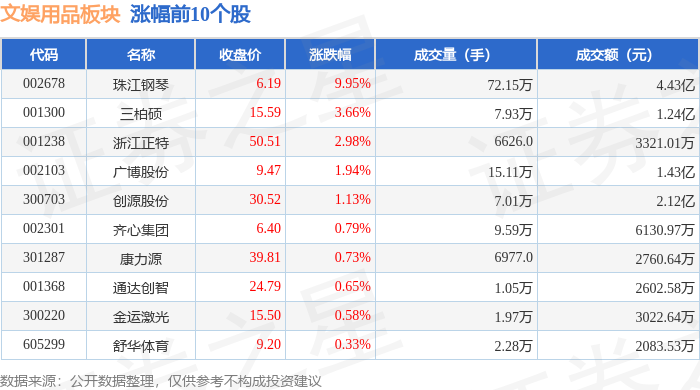
文娱用品板块10月23日涨0.8%,珠江钢琴领涨,主力资金净流出9373.01万元
Zheng Xing Xing Ye Ri Bao· 2025-10-23 08:20
Market Overview - The entertainment products sector increased by 0.8% on October 23, with Zhujiang Piano leading the gains [1] - The Shanghai Composite Index closed at 3922.41, up 0.22%, while the Shenzhen Component Index closed at 13025.45, also up 0.22% [1] Top Performers - Zhujiang Piano (002678) closed at 6.19, up 9.95% with a trading volume of 721,500 shares and a transaction value of 443 million [1] - Sanbai Shuo (001300) closed at 15.59, up 3.66% with a trading volume of 79,300 shares and a transaction value of 124 million [1] - Zhejiang Zhengte (001238) closed at 50.51, up 2.98% with a trading volume of 46,626 shares and a transaction value of 33.21 million [1] Underperformers - Qunxing Toys (002575) closed at 6.36, down 3.49% with a trading volume of 450,700 shares and a transaction value of 288 million [2] - Gao Le Co. (002348) closed at 4.15, down 3.04% with a trading volume of 358,800 shares and a transaction value of 149 million [2] - Tianyuan Pet (301335) closed at 30.30, down 1.46% with a trading volume of 22,900 shares and a transaction value of 69.39 million [2] Capital Flow - The entertainment products sector experienced a net outflow of 93.73 million from institutional investors, while retail investors saw a net inflow of 70.65 million [2] - The sector's overall capital flow indicates a mixed sentiment, with institutional investors withdrawing funds while retail investors are actively buying [2] Individual Stock Capital Flow - Source Pet (001222) had a net inflow of 18.69 million from institutional investors, but a net outflow of 9.57 million from speculative funds [3] - Guangbo Co. (002103) saw a net inflow of 18.66 million from institutional investors, but a significant net outflow of 19.70 million from retail investors [3] - Zhejiang Zhengte (001238) had a net inflow of 1.46 million from institutional investors, while speculative funds and retail investors experienced net outflows [3]




第五次跨界重组再失败 “炒壳王”控制下的群兴玩具将何去何从?
Xin Lang Cai Jing· 2025-10-23 02:27
Core Viewpoint - The company, Qunxing Toys, has announced the termination of its fifth major asset restructuring attempt since its listing, primarily due to failure to reach consensus on key terms of the transaction [1][7]. Group 1: Company Background and History - Qunxing Toys was established in 1996 and initially focused on toy research and production, but has since attempted multiple cross-industry transformations, all of which have failed [1][8]. - The company’s revenue peaked at 493 million yuan in 2011 but plummeted to 54 million yuan by 2017, and further declined to 19 million yuan in 2018 [2][8]. - Wang Sanshou became the actual controller of Qunxing Toys in November 2018, but his tenure was marred by personal financial issues that worsened the company's situation [2][3]. Group 2: Restructuring Attempts - Qunxing Toys has made five unsuccessful attempts at cross-industry restructuring since its listing, targeting various sectors including mobile gaming, nuclear equipment, energy technology, and electronics [7][8]. - The latest attempt involved acquiring at least 51% of Hangzhou Tiankuan Technology Co., which was terminated due to disagreements on transaction pricing and terms [1][9]. Group 3: Financial Issues and Management Changes - Wang Sanshou's management led to significant financial mismanagement, with 327 million yuan misappropriated, representing 44% of the company's net assets as of 2019 [2][3]. - Zhang Jincheng took over as chairman and general manager in late 2020, successfully stabilizing the company and shifting its focus to alcohol sales, which contributed 337 million yuan to revenue in 2024 [3][5]. Group 4: Future Prospects and Strategic Moves - Following the restructuring failure, Qunxing Toys is exploring acquisitions in high-tech fields like artificial intelligence, despite skepticism about the viability of its current computing power business [1][10]. - The company has begun emphasizing its computing power leasing business, which has attracted new investors, although it currently operates at a loss [10][11].
5次筹划并购,5次无疾而终,“玩具第一股”群兴玩具:继续寻找算力优质标的
3 6 Ke· 2025-10-22 13:01
Core Viewpoint - The acquisition plan by Qunxing Toys to purchase a majority stake in Hangzhou Tiankuan Technology has been terminated due to failure to reach agreement on key terms such as transaction price and scheme [1][4]. Group 1: Acquisition Details - Qunxing Toys intended to acquire at least 51% of Tiankuan Technology for a cash consideration, with an estimated valuation of Tiankuan's 100% equity not exceeding 800 million yuan, translating to approximately 400 million yuan for the stake [2][3]. - The termination of the acquisition is stated to not have a significant adverse impact on Qunxing Toys as the transaction was still in the planning stage and no substantial agreement was reached [1][4]. Group 2: Financial Performance - In 2024, Qunxing Toys reported revenue of 370 million yuan and a net loss of 18.4 million yuan, with cash reserves of only 30.2 million yuan, indicating a significant funding gap for the acquisition [2][4]. - The company has faced a continuous decline in performance, transitioning from profit to loss, with a net loss of 17.1 million yuan in the first half of 2025, nearing the total loss for 2024 [4][5]. Group 3: Historical Context - Since its listing in 2011, Qunxing Toys has attempted five major acquisitions across various sectors, including mobile gaming, nuclear power, and new energy, all of which have failed [3][4]. - The company's repeated attempts to pivot towards trending sectors have raised doubts about its strategic direction and execution capabilities [2][3]. Group 4: Future Strategy - Despite the termination of the acquisition, Qunxing Toys maintains that the computing power business remains a key focus, with plans for systematic strategic development in this area [5][7]. - The company has already engaged in contracts for computing power services, including a significant agreement with Tencent worth 113 million yuan, contributing to 10.32% of total revenue in the first half of 2024 [7].