SXLY(002627)

Search documents
三峡旅游:参股公司宜昌至喜弘仁主要负责运营湖北宜昌市养老综合服务PPP示范项目,目前该项目已试营业
Mei Ri Jing Ji Xin Wen· 2025-11-27 10:35
三峡旅游(002627.SZ)11月27日在投资者互动平台表示,公司参股设立了宜昌至喜弘仁健康养老服务 有限公司,该公司主要负责运营湖北宜昌市养老综合服务PPP示范项目(公建民营模式),目前该项目 已试营业。 每经AI快讯,有投资者在投资者互动平台提问:贵公司是否涉及康养产业? (记者 张明双) ...

三峡旅游:接受国海证券等投资者调研
Mei Ri Jing Ji Xin Wen· 2025-11-27 10:21
Company Overview - Sanxia Tourism (SZ 002627) announced an investor research meeting scheduled for November 27, 2025, from 10:00 to 11:30, with participation from the company's board secretary and securities affairs representative [1] Revenue Composition - For the first half of 2025, the revenue composition of Sanxia Tourism is as follows: - Travel agency business: 35.76% - Waterway tourism passenger transport: 27.58% - Passenger travel services: 20.23% - Trade logistics: 19.24% - Tourism port services: 9.21% - Vehicle extension services: 8.89% [1] Market Capitalization - As of the report, Sanxia Tourism has a market capitalization of 4.6 billion yuan [1]

三峡旅游(002627) - 2025年11月27日投资者关系活动记录表
2025-11-27 10:10
Group 1: Visitor Reception Growth - The company experienced a significant increase in visitor reception in the first three quarters of 2025 due to enhanced marketing efforts, product supply expansion, increased transportation capacity, and favorable weather conditions [3][4]. - The marketing team actively promoted brand awareness and product offerings, making core products essential for tourists visiting Yichang [3]. - New products such as "Premium All-Region Tour" and "Sturgeon VIP Experience" were introduced, contributing to the growth [3]. Group 2: Cruise Development - The first two inter-provincial cruise ships are under construction, with expected operational dates by June 2026 and December 2026 [3][4]. - The company has established a management and marketing system for the inter-provincial cruise business, with a focus on building a competent operational management team [3]. Group 3: Financial Performance and Dividend Policy - The company has maintained a high cash dividend ratio, with a cash dividend of CNY 68.94 million in 2024, representing 58.63% of the net profit [5]. - The annual cash distribution ratio has been increased from 10% to 30%, and the cumulative cash distribution over the last three years will be at least 50% of the average distributable profit [5]. Group 4: Asset Depreciation and Infrastructure - The depreciation period for the company's tourism vessels is set at 20 years, in line with industry standards [6]. - Yichang has seen improvements in transportation infrastructure, including expanded airport routes and new high-speed rail connections, enhancing accessibility for tourists [7][8]. Group 5: Strategic Goals - The company aims to become a leader in Yangtze River Three Gorges tourism and a pioneer in China's inland cruise tourism [8]. - Strategies include leveraging the parent company's resources for mergers and partnerships, and expanding the cruise fleet to enhance tourism offerings [8].
三峡旅游涨2.11%,成交额5618.13万元,主力资金净流出422.91万元
Xin Lang Cai Jing· 2025-11-24 06:29
Core Viewpoint - The stock of China Three Gorges Tourism has shown a year-to-date increase of 27.51%, despite a recent decline of 1.72% over the last five trading days, indicating volatility in its performance [1]. Company Overview - China Three Gorges Tourism Group Co., Ltd. is located at No. 5 Gangyao Road, Yichang City, Hubei Province, established on August 10, 1998, and listed on November 3, 2011 [2]. - The company's main business includes passenger station operations, inter-provincial bus services, domestic express delivery, insurance agency services, port machinery leasing, ticketing services, and tourism operations [2]. Revenue Composition - The revenue composition of the company is as follows: - Tourism comprehensive services: 34.47% - Comprehensive transportation services: 21.36% - Travel agency business: 15.80% - Sightseeing cruise services: 12.18% - Passenger travel services: 8.94% - Trade logistics: 8.50% - Port services: 4.07% - Vehicle extension services: 3.93% - Tourism transportation services: 2.19% - Other services: 0.50% - Scenic area business: 0.24% [2]. Stock Performance and Shareholder Information - As of November 10, the number of shareholders for China Three Gorges Tourism is 28,400, a decrease of 1.31% from the previous period, with an average of 25,282 circulating shares per person, an increase of 1.33% [3]. - For the period from January to September 2025, the company achieved a revenue of 609 million yuan, representing a year-on-year growth of 9.48%, while the net profit attributable to shareholders decreased by 23.29% to 85.87 million yuan [3]. Dividend and Institutional Holdings - Since its A-share listing, China Three Gorges Tourism has distributed a total of 508 million yuan in dividends, with 138 million yuan distributed over the last three years [4]. - As of September 30, 2025, notable institutional shareholders include: - Penghua Quality Governance Mixed Fund (LOF) A, holding 15.59 million shares, ranked as the fourth largest shareholder and a new entrant - Fortune CSI Tourism Theme ETF, holding 10.39 million shares, ranked as the ninth largest shareholder and a new entrant - Penghua Industry Select Mixed Fund A, holding 9.43 million shares, ranked as the tenth largest shareholder and a new entrant [4].
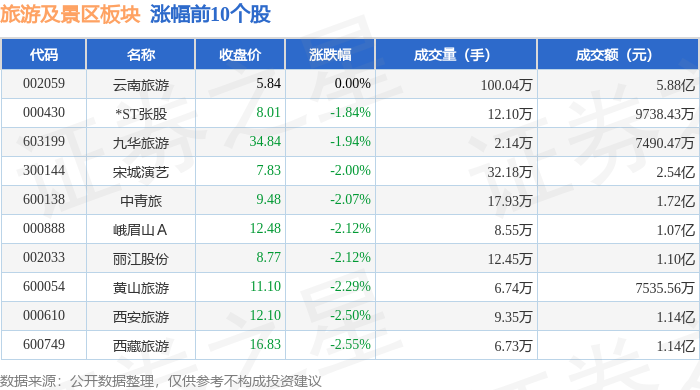
旅游及景区板块11月21日跌3.08%,大连圣亚领跌,主力资金净流出4.86亿元
Zheng Xing Xing Ye Ri Bao· 2025-11-21 09:33
Market Overview - The tourism and scenic spots sector experienced a decline of 3.08% on November 21, with Dalian Shengya leading the drop [1] - The Shanghai Composite Index closed at 3834.89, down 2.45%, while the Shenzhen Component Index closed at 12538.07, down 3.41% [1] Stock Performance - Dalian Shengya saw a significant drop of 10.00%, closing at 47.34, with a trading volume of 147,500 shares and a transaction value of 714 million [2] - Other notable declines included Tianfu Culture Tourism (-4.18%), Changzi Mountain (-4.08%), and Qujiang Culture Tourism (-3.93%) [2] Capital Flow - The tourism and scenic spots sector experienced a net outflow of 486 million from main funds, while retail investors saw a net inflow of 461 million [2] - The sector's overall capital flow indicates a mixed sentiment, with institutional investors pulling back while retail investors increased their positions [2] Individual Stock Capital Flow - Yunnan Tourism had a main fund net inflow of 10.99 million, while it faced a retail net outflow of 32.27 million [3] - Huangshan Tourism and Sanxia Tourism experienced significant net outflows from main funds, at 10.61 million and 11.62 million respectively, while both saw positive retail inflows [3]


旅游股集体下跌
Mei Ri Jing Ji Xin Wen· 2025-11-20 03:12
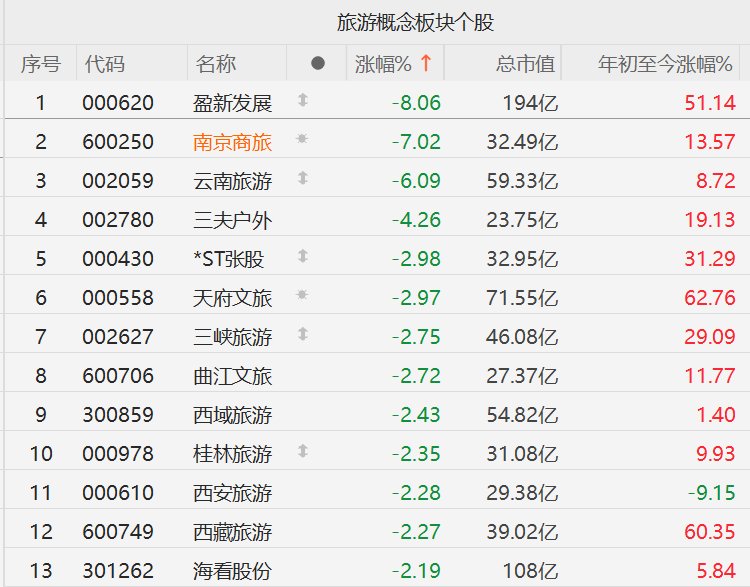
Group 1 - The tourism sector experienced a collective decline on November 20, with several companies showing significant drops in stock prices [1] - Yingxin Development fell over 8%, while Nanjing Commercial Travel and Yunnan Tourism dropped by 7% and 6% respectively [1] - Other companies such as Sanfu Outdoor, Tianfu Cultural Tourism, and others also saw declines exceeding 2% [1]





A股旅游股集体下挫,云南旅游跌6%
Ge Long Hui A P P· 2025-11-20 03:01
Core Insights - The A-share market saw a collective decline in tourism stocks, with notable drops in companies such as Yingxin Development, Nanjing Business Travel, and Yunnan Tourism [1] Group 1: Stock Performance - Yingxin Development experienced a decline of 8.06%, with a total market value of 19.4 billion [2] - Nanjing Business Travel fell by 7.02%, with a market capitalization of 3.249 billion [2] - Yunnan Tourism decreased by 6.09%, with a market value of 5.933 billion [2] - Sanfu Outdoor dropped over 4.26%, with a market capitalization of 2.375 billion [2] - Other companies such as Tianfu Cultural Tourism, Sanxia Tourism, Qujiang Cultural Tourism, and Xiyu Tourism also saw declines exceeding 2% [1][2] Group 2: Year-to-Date Performance - Despite the recent declines, Yingxin Development has a year-to-date increase of 51.14% [2] - Nanjing Business Travel has risen by 13.57% year-to-date [2] - Tianfu Cultural Tourism shows a significant year-to-date increase of 62.76% [2] - Xizang Tourism has a year-to-date increase of 60.35% [2]

三峡旅游(002627) - 关于使用闲置募集资金进行现金管理的进展公告
2025-11-19 10:01
证券代码:002627 证券简称:三峡旅游 公告编号:2025-058 湖北三峡旅游集团股份有限公司 关于使用闲置募集资金进行现金管理的 进展公告 本公司及董事会全体成员保证信息披露内容的真实、准确、 完整,没有虚假记载、误导性陈述或重大遗漏。 湖北三峡旅游集团股份有限公司(以下简称"公司")于 2025 年 6 月 27 日召开的第六届董事会第十九次会议审议通过了《关于使用闲 置募集资金进行现金管理的议案》,根据公司募投项目的建设进度及 实际资金安排,同意公司及实施募投项目的子公司在确保不影响募集 资金按投资计划正常使用的情况下,使用不超过 7 亿元的闲置募集资 金进行现金管理,上述额度内资金可滚动使用,使用期限不超过 12 个月。《关于使用闲置募集资金进行现金管理的公告》《第六届董事 会第十九次会议决议公告》详见 2025 年 6 月 28 日的巨潮资讯网 (www.cninfo.com.cn)及《证券时报》《中国证券报》《上海证券报》 《证券日报》。 近期,公司使用闲置募集资金办理的部分定期存款已到期,并计 划继续进行现金管理,现将相关事项公告如下: 三、关联关系说明 的措施,控制投资风险; 3. 公司 ...
2026年社会服务行业投资策略:数智破局,暖意新生
Shenwan Hongyuan Securities· 2025-11-16 14:59
Main Points - The report highlights three main investment themes: market recovery and supply-demand balance favoring leading companies, the role of AI in enhancing efficiency and generating secondary revenue, and the complexity of tourism investment driven by resource endowment and product refinement [5][6][17]. Group 1: Market Recovery and Supply-Demand Balance - The hotel market is expected to see a slight recovery, with average daily rates (ADR) showing positive trends [18][25]. - Luxury, mid-range, and economy hotels are experiencing a rebound after supply adjustments, with an increase in chain hotel ratios and mid-range hotel market share [7][26]. - The construction of the Hainan Free Trade Port is anticipated to significantly reduce import costs for businesses, enhancing the attractiveness of the region for tourism and hospitality investments [7]. Group 2: AI Applications in Recruitment - AI applications in recruitment are not solely focused on cost reduction but are increasingly aimed at generating additional revenue through enhanced efficiency [5][45]. - AI technologies are transforming recruitment processes, including job description generation, resume screening, and video interview analysis, leading to improved matching and efficiency [46][50]. - The recruitment service market is expanding rapidly, with high growth potential in the mid-to-high-end online recruitment sector [50]. Group 3: Tourism Investment Dynamics - The tourism investment landscape is complex, requiring a combination of resource endowment and product refinement to navigate economic cycles successfully [6][17]. - The luxury cruise market is gaining traction among older demographics, with high-quality experiences driving demand despite higher pricing [8]. - Policy changes promoting school holidays and flexible work arrangements are expected to boost service consumption, particularly in the tourism sector [8][11]. Group 4: Consumer Trends and Market Potential - The service consumption market is showing structural vitality, with service retail sales growing by 5.3% year-on-year, outpacing goods consumption [11]. - The "new silver-haired" demographic is emerging as a significant consumer group, with a growing focus on travel and leisure spending [68]. - The domestic tourism market is recovering steadily, with a projected 56.2 billion domestic trips in 2024, reflecting a 14.8% year-on-year increase [62].






旅游及景区板块11月14日跌0.54%,西域旅游领跌,主力资金净流出3.59亿元
Zheng Xing Xing Ye Ri Bao· 2025-11-14 08:58
Core Insights - The tourism and scenic spots sector experienced a decline of 0.54% on November 14, with Xiyu Tourism leading the drop [1] - The Shanghai Composite Index closed at 3990.49, down 0.97%, while the Shenzhen Component Index closed at 13216.03, down 1.93% [1] Fund Flow Analysis - On the same day, the tourism and scenic spots sector saw a net outflow of 359 million yuan from main funds, while retail investors contributed a net inflow of 404 million yuan [2] - The table provided indicates specific fund flows for various companies, showing that: - Caesar Travel had a main fund net inflow of 40.13 million yuan, but a net outflow from retail investors of 0.39 million yuan [2] - Jiuhua Tourism experienced a main fund net inflow of 5.51 million yuan, with a net outflow from retail investors of 0.28 million yuan [2] - Guilin Tourism had a main fund net inflow of 3.91 million yuan, but a significant net outflow from retail investors of 1.53 million yuan [2] - Other companies like Emei Mountain A and Huangshan Tourism faced net outflows from both main and retail funds [2]