
BANK OF QINGDAO(002948)

Search documents
城商行板块9月15日跌0.85%,西安银行领跌,主力资金净流出7.97亿元
Zheng Xing Xing Ye Ri Bao· 2025-09-15 08:43
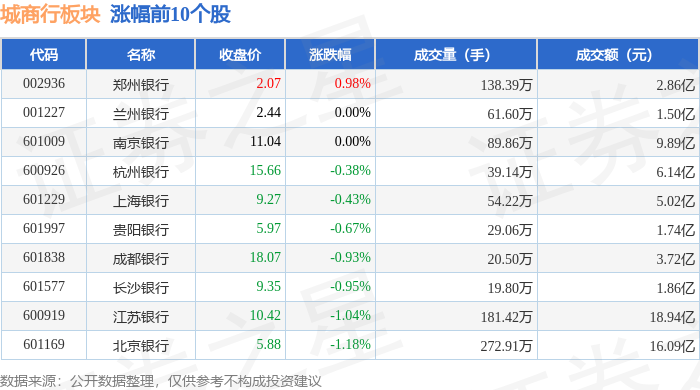
Market Overview - On September 15, the city commercial bank sector declined by 0.85% compared to the previous trading day, with Xi'an Bank leading the decline [1] - The Shanghai Composite Index closed at 3860.5, down 0.26%, while the Shenzhen Component Index closed at 13005.77, up 0.63% [1] Individual Bank Performance - Zhengzhou Bank closed at 2.07, up 0.98% with a trading volume of 1.38 million shares and a transaction value of 286 million yuan [1] - Xi'an Bank closed at 4.19, down 1.87% with a trading volume of 438,000 shares and a transaction value of 184 million yuan [2] - The highest decline was observed in Chengdu Bank, which closed at 18.07, down 0.93% [1] Capital Flow Analysis - The city commercial bank sector experienced a net outflow of 797 million yuan from institutional investors, while retail investors saw a net inflow of 348 million yuan [2] - The main capital inflow and outflow for individual banks varied, with Hangzhou Bank seeing a net inflow of 61.64 million yuan from institutional investors [3] - Conversely, Suzhou Bank experienced a net outflow of 11.76 million yuan from institutional investors [3]




青岛银行跌2.11%,成交额1.39亿元,主力资金净流入741.37万元
Xin Lang Cai Jing· 2025-09-12 06:27
Group 1 - Qingdao Bank's stock price decreased by 2.11% on September 12, trading at 5.11 CNY per share with a total market capitalization of 29.742 billion CNY [1] - The bank's stock has increased by 37.37% year-to-date, but has seen a decline of 3.77% over the last five trading days [1] - The bank's main business segments include corporate banking (47.29%), financial market business (26.27%), retail banking (21.87%), and other unallocated projects (4.57%) [1] Group 2 - As of June 30, the number of shareholders for Qingdao Bank increased to 51,100, with an average of 61,038 circulating shares per person [2] - For the first half of 2025, Qingdao Bank reported a net profit of 3.065 billion CNY, representing a year-on-year growth of 16.05% [2] Group 3 - Since its A-share listing, Qingdao Bank has distributed a total of 6.341 billion CNY in dividends, with 2.794 billion CNY distributed over the last three years [3]
A股银行股走弱,浦发银行跌超3%
Ge Long Hui A P P· 2025-09-12 05:51
Group 1 - A-shares of bank stocks weakened, with notable declines in several banks including Shanghai Pudong Development Bank, which fell over 3% [1] - Qilu Bank experienced a decline of 2%, while other banks such as Chongqing Rural Commercial Bank, Chengdu Bank, and others saw drops exceeding 1% [1] - The overall market performance for these banks indicates a bearish trend in the banking sector [1] Group 2 - Shanghai Pudong Development Bank reported a decline of 3.68%, with a total market capitalization of 414.8 billion [2] - Qilu Bank's stock decreased by 2.07%, with a market value of 35 billion [2] - Other banks like Chongqing Rural Commercial Bank and Chengdu Bank also reported declines of 1.81% and 1.67% respectively, with market capitalizations of 73.8 billion and 77.6 billion [2]




调研速递|青岛银行接受申万宏源等6家机构调研,信贷与净息差成关注要点
Xin Lang Cai Jing· 2025-09-11 11:29
Core Viewpoint - Qingdao Bank is focusing on optimizing its asset-liability structure and increasing loan issuance to support the real economy in 2025, with a target for stable growth in credit throughout the year [1] Group 1: Loan Issuance and Strategy - As of mid-2025, Qingdao Bank's total customer loans reached 368.406 billion yuan, an increase of 27.716 billion yuan from the end of the previous year, reflecting an 8.14% growth since the beginning of the year [1] - The bank plans to continue increasing credit issuance, aligning with national policy requirements and focusing on eight key sectors: technology finance, inclusive finance, green finance, blue finance, pension finance, quality manufacturing, public utilities, and rural revitalization [1] Group 2: Net Interest Margin Performance - In the first half of 2025, Qingdao Bank's annualized net interest margin was 1.72%, a slight decrease of 0.01 percentage points compared to the entire year of 2024 [1] - To stabilize the net interest margin, the bank has implemented various measures, including optimizing resource allocation and enhancing the proportion of high-yield assets in its interest-earning assets [1] Group 3: Cost Management - The bank is focused on reducing costs on the liability side by optimizing the structure of major liabilities and managing deposit costs through various strategies, including pricing adjustments and market-based interest rate regulation [1]

银行股震荡回调,多家上市银行股东、董监高“趁机”增持
Sou Hu Cai Jing· 2025-09-11 10:19
Core Viewpoint - Several major shareholders and executives of listed banks have taken the opportunity to increase their holdings during the recent stock price fluctuations, reflecting confidence in the banks' fundamentals and future prospects, as well as highlighting the long-term investment value of bank stocks at current valuations, particularly their high dividend yields [2][5]. Group 1: Shareholder Actions - Since August, multiple listed banks, including Huaxia Bank, Chengdu Bank, Suzhou Bank, Nanjing Bank, Qingdao Bank, and Shanghai Bank, have announced plans or progress regarding share buybacks by major shareholders or executives [2][5]. - For instance, Nanjing Bank's major shareholder, Zijin Group's subsidiary, increased its holdings by 56.78 million shares, accounting for 0.46% of the total share capital, between July 18 and September 10 [2]. - Huaxia Bank completed its buyback plan by acquiring 4.23 million shares for a total of 31.9 million yuan, after initially announcing a plan to buy back at least 30 million yuan worth of shares [3][4]. Group 2: Market Context - The banking sector index has experienced a significant decline since reaching a peak around July 10, with smaller banks facing even larger drops [3][4]. - The stock price of Huaxia Bank fell from a high of 8.72 yuan per share on July 10 to 7.28 yuan per share by September 9 [4]. - Chengdu Bank's buyback plan was delayed due to its stock price exceeding the set upper limit, but it resumed with a total investment of 170 million yuan over a short period [4]. Group 3: Investment Sentiment - Analysts suggest that the recent buybacks by major shareholders and executives signal their recognition of the banks' long-term investment value and confidence in future operations, which can help stabilize stock price expectations [5][6]. - The banking sector is viewed as a defensive investment during market downturns due to its low valuations and high dividend characteristics, providing relatively stable returns [6]. - The banking sector index has seen a 64% increase from December 2023 to July 2025, with a maximum drawdown of over 10% in 2023 [7]. Group 4: Institutional Investment Trends - Insurance funds have increasingly targeted undervalued, large-cap, low-volatility banks, with several banks experiencing multiple stake increases from these funds [7]. - Public funds have also shown a rising interest in bank stocks, with the proportion of active public funds in bank stocks reaching 4.9% by the end of Q2, the highest since Q2 2021 [8]. - Despite the inflow of funds, there are concerns regarding net interest margin pressures and potential asset quality issues due to the real estate downturn, leading to some portfolio adjustments [8].




青岛银行(002948) - 2025年9月11日投资者关系活动记录表
2025-09-11 09:50
Group 1: Loan Growth and Structure - As of mid-2025, the total customer loans of Qingdao Bank reached CNY 368.406 billion, an increase of CNY 27.716 billion from the end of the previous year, representing a growth of 8.14% [2] - The loan-to-asset ratio is 49.58%, up by 0.2 percentage points compared to the end of the previous year [2] - The bank plans to continue increasing credit investment to support the real economy, with a focus on eight key sectors including technology finance and rural revitalization [2][3] Group 2: Net Interest Margin Performance - The annualized net interest margin for the first half of 2025 is 1.72%, a slight decrease of 0.01 percentage points from the full year of 2024 [4] - The bank has implemented various measures to address the pressure of narrowing interest margins, including optimizing asset structure and increasing loan investments [4] - On the liability side, the bank aims to reduce costs by optimizing the structure of major liabilities and managing deposit costs effectively [4]
重要股东和董监高频出手 上市银行获增持释放积极信号
Zhong Guo Zheng Quan Bao· 2025-09-10 22:25
Group 1 - Major shareholders and executives of several banks, including Suzhou Bank, Qingdao Bank, and Nanjing Bank, have announced plans to increase their holdings in their respective banks, reflecting confidence in the future development prospects of the banks and the Chinese capital market [1][2] - Suzhou Bank's chairman and other executives plan to collectively purchase at least 4.2 million yuan worth of shares from September 8 to December 31, using their own funds [2] - Qingdao Bank's major shareholder plans to acquire between 233 million and 291 million shares, increasing their stake to between 19.00% and 19.99% within six months of the announcement [2] Group 2 - The overall performance of the banking sector has shown improvement, with a year-on-year increase in operating income and net profit of 1.0% and 0.8% respectively, indicating a recovery in the banking industry [3] - Non-interest income growth has played a significant role in supporting the improvement of bank performance [3] - Insurance capital has shown a preference for bank stocks, with over 700 stocks in the top ten circulating shareholders list, and six of the top ten heavyweights being bank stocks [4] Group 3 - The investment logic for bank stocks has shifted from a macroeconomic growth cycle to a focus on asset scarcity and stable, sustainable returns [4] - State-owned banks are viewed as core dividend assets due to their high dividends, low valuations, and defensive characteristics, while quality small and medium-sized banks can provide growth and dividend opportunities at certain stages [4]
重要股东和董监高频出手上市银行获增持释放积极信号
Zhong Guo Zheng Quan Bao· 2025-09-10 20:18
Group 1 - Recent announcements from banks such as Suzhou Bank, Qingdao Bank, and Nanjing Bank indicate that major shareholders and executives plan to increase their holdings in their respective banks, reflecting confidence in the long-term prospects of the Chinese capital market and the banks' investment value [1][2] - Suzhou Bank's chairman and other executives intend to collectively purchase at least 4.2 million yuan worth of A-shares between September 8 and December 31, funded by their own resources [1] - Qingdao Bank's major shareholder plans to acquire between 233 million and 291 million shares, increasing their stake to between 19.00% and 19.99% within six months from the announcement [1] Group 2 - Nanjing Bank's shareholder, Nanjing Gaoke, increased its stake from 8.94% to 9.00% by purchasing 7.5077 million shares between July 24 and August 4, demonstrating confidence in the bank's future development [2] - More than ten listed banks have reported similar plans for share buybacks this year, indicating a broader trend of confidence among bank executives and major shareholders regarding future growth and profitability [2] - The overall performance of the banking sector has improved, with a year-on-year increase in operating income and net profit of 1.0% and 0.8%, respectively, supported by growth in non-interest income [2] Group 3 - Insurance capital has shown a preference for bank stocks, with over 700 stocks appearing in the top ten circulating shareholders of A-share listed companies, and six of the top ten heavyweights being bank stocks [3] - The stability and quality of bank assets have attracted long-term funds, as banks provide high and stable dividend yields, making them appealing in the current "asset scarcity" environment [3] - The investment logic for bank stocks has shifted from a "growth cycle" based on macroeconomic factors to a focus on "low volatility dividends" driven by asset scarcity, with state-owned banks being core dividend assets due to their high yields and low valuations [3]
拟申请发行不超过280亿元金融债券!青岛银行透露资本补充计划
Zhong Zheng Wang· 2025-09-09 11:43
Group 1 - Qingdao Bank plans to hold a temporary shareholders' meeting on September 26 to report and review several important proposals [1] - The bank intends to issue up to 28 billion yuan in financial bonds, including 15 billion yuan in non-capital financial bonds and 13 billion yuan in capital financial bonds [1] - The non-capital financial bonds aim to optimize the long-term asset-liability matching structure, while the capital financial bonds are intended to enhance the bank's capital support for its development [1] Group 2 - As of June 30, Qingdao Bank's total assets reached 743.03 billion yuan, a year-on-year increase of 7.69% [2] - The bank reported operating income of 7.66 billion yuan for the first half of the year, a year-on-year growth of 7.50%, and a net profit attributable to shareholders of 3.07 billion yuan, up 16.05% year-on-year [2] - The capital adequacy ratio stood at 13.52%, down 0.28 percentage points from the end of the previous year, while the core tier 1 capital adequacy ratio was 9.05%, a decrease of 0.06 percentage points [2]
青岛银行(03866) - 於2025年9月26日(星期五)举行之2025年第一次H股类别股东大会之...
2025-09-08 13:16
Bank of Qingdao Co., Ltd.* * H 3866 於2025年9月26日(星期五)舉行之 2025年第一次H股類別股東大會之代表委任表格 與本代表委任表格有關的H股股份數目 (附註1) 本人持有的全部H股股份中質押股份數目 本人持有的全部H股股份中質押股份所佔比例 本人╱吾等 (附註2) 地址為 為青島銀行股份有限公司(「本行」)股本中每股面值人民幣1.00元的H股 股 茲委任大會主席或 (附註4) 地址為 為本人╱吾等的代表,代表本人╱吾等出席本行謹定於2025年9月26日(星期五)緊接2025年第一次臨時股東大會及 2025年第一次A股類別股東大會於中國山東省青島市嶗山區秦嶺路6號舉行的2025年第一次H股類別股東大會及其任 何續會(「2025年第一次H股類別股東大會」),並在2025年第一次H股類別股東大會及任何續會上代表本人╱吾等投票 及行使法律、法規及本行章程賦予代表的一切權利。本人╱吾等希望本人╱吾等的代表按以下指示就將於2025年第 一次H股類別股東大會上提呈的各項決議案投票 (附註5) 。 | | 特別決議案 | (附註5) 贊成 | 反對 | (附註5) | 棄權 | ...