Dowstone(300409)

Search documents
道氏技术(300409.SZ):碳纳米管材料暂未涉及PEEK材料方面的对接
Ge Long Hui· 2025-09-22 07:17
Group 1 - The company, Dao's Technology (300409.SZ), stated on the investor interaction platform that its carbon nanotube materials have not yet been involved in the integration with PEEK materials [1]

道氏技术(300409.SZ):芯培森APU算力芯片及服务器主要针对原子级科学计算进行加速
Ge Long Hui· 2025-09-22 07:10
Core Viewpoint - The company Daoshi Technology (300409.SZ) indicates that its investee company Chip-Peison's APU chips and Cambricon's chips have overlapping applications in the field of scientific computing [1] Group 1: Company Insights - Daoshi Technology's investee company Chip-Peison focuses on APU chips and servers that accelerate atomic-level scientific computing [1] - Cambricon's chip products are utilized in the Nanjing Intelligent Computing Center, covering various applications including scientific computing [1]
道氏技术(300409.SZ):硫化物和氧化物电解质正在积极与多家头部企业进行送样测试,并且部分客户已经通过测试
Ge Long Hui· 2025-09-22 07:10
Core Viewpoint - Daoshi Technology (300409.SZ) is actively supplying single-walled carbon nanotubes to multiple battery cell customers and is engaged in large-scale production efforts while testing samples with well-known companies in the lithium battery sector [1] Group 1: Product Development - The company has successfully supplied single-walled carbon nanotubes to several battery cell clients and is conducting tests with various renowned enterprises in the lithium battery field [1] - The silicon-carbon anode product layout covers multiple sectors including consumer batteries, digital batteries, power batteries, and solid-state batteries, with ongoing evaluation and sample cooperation with numerous industry players [1] - Sulfide and oxide electrolytes are being tested with several leading companies, with some clients already passing the tests and providing positive feedback on performance metrics, indicating that they are at an advanced industry level [1]
道氏技术股价跌5.16%,中邮基金旗下1只基金重仓,持有5万股浮亏损失6.75万元
Xin Lang Cai Jing· 2025-09-19 06:15
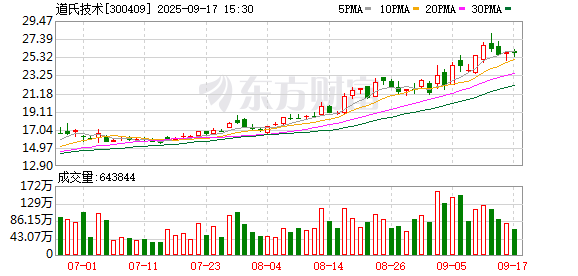
Group 1 - The core point of the news is the decline in the stock price of Dao Shi Technology, which fell by 5.16% to 24.82 CNY per share, with a trading volume of 1.563 billion CNY and a turnover rate of 8.98%, resulting in a total market capitalization of 19.415 billion CNY [1] - Dao Shi Technology, established on September 21, 2007, and listed on December 3, 2014, is based in Foshan, Guangdong Province. The company specializes in the production and sales of building ceramic glaze materials, along with providing related technical services and product design, commercial factoring, and new energy materials [1] - The revenue composition of Dao Shi Technology includes: Other 47.44%, Lithium battery materials 34.70%, Carbon materials 9.00%, and Ceramic materials 8.85% [1] Group 2 - From the perspective of major holdings, one fund under Zhongyou Fund has a significant position in Dao Shi Technology. The Zhongyou Absolute Return Strategy Regular Open Mixed Fund (002224) held 50,000 shares in the second quarter, accounting for 1.88% of the fund's net value, making it the largest holding [2] - The estimated floating loss for the fund today is approximately 67,500 CNY [2] - The Zhongyou Absolute Return Strategy Regular Open Mixed Fund (002224) was established on December 30, 2015, with a latest scale of 45.0702 million CNY. Year-to-date return is 15.09%, ranking 5056 out of 8255 in its category; the one-year return is 11.41%, ranking 6823 out of 8060; and the return since inception is 4.5% [2]
资本涌入脑机接口:融资频创新高,企业格局一览
Sou Hu Cai Jing· 2025-09-19 04:16
Core Insights - The brain-computer interface (BCI) sector is experiencing a significant surge in investment and financing activities, with notable examples including Shanghai Brain Rhythm Technology's angel round financing and Guangdong Daoshi Technology's investment in Qiangnao Technology [1][2] - In 2024, the financing activities in the BCI field accelerated, with the total investment in the first half of the year surpassing the entire previous year, and a notable $650 million raised by Neuralink in its Series E funding round [1][2] Investment Trends - Domestic companies are also showing strong performance, with Beijing Zhiruan Medical Technology completing over 300 million RMB in Series A financing and other companies like BrainCo and Boryu Kang securing significant funding to advance their BCI technologies [2] - The largest domestic financing in the implanted BCI sector to date was completed by JieTi Medical, raising 350 million RMB to accelerate clinical trials and technology development [2] Industry Chain and Market Outlook - The BCI industry chain in China has been established, covering components from chips to terminal applications, with a clear direction for development outlined in a report by the China Academy of Information and Communications Technology [3] - The report emphasizes the importance of a closed-loop system connecting research, clinical applications, and industry, with ongoing clinical trials and technological advancements [3] Technological Diversity and Healthcare Focus - BCI technology is expanding into various fields, including medical rehabilitation and cognitive enhancement, with non-invasive optical BCI technologies gaining significant attention due to their safety and scalability [4] - The first prospective clinical trial of an invasive BCI in China has been successfully conducted, showcasing the potential for AI-assisted BCIs to improve patient capabilities [4] Corporate Innovations and Compliance - Companies are actively exploring compliant business models, with innovations such as closed-loop stimulators for Parkinson's disease treatment and high-density flexible electrode systems [5] - Huichuang Medical has developed a complete closed-loop BCI system and is collaborating with hospitals to establish BCI assessment clinics [5] Consumer Applications - In the consumer electronics sector, BCIs are enhancing user experiences through non-invasive devices that monitor brain activity and provide personalized interventions for mental health and cognitive training [7] Policy and Standardization - The establishment of the Brain-Computer Interface Standardization Technical Committee by the Ministry of Industry and Information Technology aims to optimize standards and accelerate technological development [8] - Recent policies are set to foster innovation in the BCI industry, with goals to establish a competitive ecosystem by 2030 [8]
固态电池深度报告:固固界面 - 聚焦本征界面问题,材料设备体系革新
2025-09-17 14:59
Summary of Solid-State Battery Conference Call Industry Overview - The focus is on the solid-state battery industry, particularly addressing the solid-solid interface issues and innovations in materials and equipment systems [1][2][3]. Key Points and Arguments 1. **Manufacturing Techniques**: Solid-state batteries utilize dry forming, isostatic pressing, structured materials, and laser equipment to enhance ionic conductivity and reduce side reactions, thereby improving overall performance and commercialization [1][7]. 2. **International vs. Domestic Strategies**: - International companies like QuantumScape and Solid Power have advanced in high-end equipment and are in pilot to small-scale production stages, employing Atomic Layer Deposition (ALD) technology for interface modification [1][5]. - Domestic companies focus on technological innovation using cost-effective methods such as dry processes and structured materials, currently in small-scale to pilot stages [5][11]. 3. **Key Manufacturing Processes**: - **Solvent-free Dry Forming**: This method has the highest application certainty and is valued at tens of millions, with high technical barriers and a significant degree of localization [11]. - **Isostatic Pressing**: This technology addresses interface contact issues systematically and is also valued at tens of millions, currently in the technical verification or small-scale procurement phase [11]. - **Structured Materials**: These include structured copper foils and supporting membranes, which are in the scale testing or introduction phase, valued in the tens of millions [11]. - **Laser Equipment**: Used for cutting and processing, currently in scale testing or introduction stages, with a high degree of localization [11]. - **Atomic Layer Deposition (AOD)**: Although primarily used in semiconductor or photovoltaic fields, its potential in lithium batteries is significant, with domestic leaders collaborating with top companies [12]. 4. **Interface Modification Techniques**: - Techniques such as coating, doping, controlled reactions, and alloying are crucial for enhancing performance by increasing contact area and blocking adverse reactions [13][14]. - ALD is highlighted as one of the most effective methods for improving interface stability and ionic conductivity [15]. 5. **Challenges in Solid-State Batteries**: - Key challenges include ionic conduction barriers due to the absence of liquid electrolytes, side reactions from active materials, mechanical matching issues, high interface resistance, and dendrite growth risks [9][10]. - Solutions require advanced material selection, precise processing techniques, and innovative design to ensure reliability, safety, and long cycle life [10]. Additional Important Insights - **Market Leaders**: Companies like QuantumScape and Solid Power are leading the global solid-state battery development due to their deep ties with automotive manufacturers and measurable progress [12]. - **Emerging Players**: Domestic companies such as CATL and BYD are beginning sample trials and pilot line setups, indicating a slower but growing presence in the market [12]. - **Key Equipment Suppliers**: Companies like Xian Dai Intelligent and Li Yuan Heng are significant players in the dry and isostatic equipment sectors, contributing to the supply chain [17][18]. - **Potential Growth Companies**: Firms like DeLong Laser and Yanhang Precision are noted for their roles in the solid-state battery supply chain, with potential for growth despite some uncertainties [23][24]. This summary encapsulates the critical aspects of the solid-state battery industry as discussed in the conference call, highlighting the technological advancements, market dynamics, and key players involved.



道氏技术:参股公司芯培森的APU芯片已实现销售
Xin Lang Cai Jing· 2025-09-17 08:57
Group 1 - The core product of the company, APU chips developed by its affiliate Chip-Peison, is specialized for atomic scientific computing, significantly enhancing computational speed compared to traditional CPU/GPU by 1-3 orders of magnitude [1] - The energy consumption of the APU chips is reduced by 2-3 orders of magnitude, making them more efficient for applications in molecular dynamics (MD) and density functional theory (DFT) [1] - The products and services of the company have already achieved sales, indicating market acceptance and potential revenue generation [1]
道氏技术:固态和半固态电解质正积极与头部企业进行合作开发送样测试,部分客户已通过测试
Mei Ri Jing Ji Xin Wen· 2025-09-17 08:52
Core Insights - The company is actively advancing its solid-state battery materials technology and is making progress in research and market promotion [1] - The company has successfully supplied single-walled carbon nanotubes and silicon-carbon anodes to downstream solid-state battery manufacturers [1] - Collaborations with leading companies for solid and semi-solid electrolytes are ongoing, with some clients having passed testing and are now focusing on capacity construction to meet demand [1]
道氏技术:公司硅碳负极产品布局覆盖消费电池、数码电池、动力电池及固态电池等多个领域
Mei Ri Jing Ji Xin Wen· 2025-09-17 08:39
Core Viewpoint - The company has established a comprehensive layout for solid-state battery core materials, demonstrating significant technological advancements and competitive advantages in the industry [1]. Group 1: Solid-State Battery Materials - The company has developed a full material solution for solid-state batteries, including single-walled carbon nanotubes, high-nickel ternary precursors, lithium-rich manganese-based precursors, silicon-based anodes, solid electrolytes, and metallic lithium anodes [1]. - The performance of the company's single-walled carbon nanotube products is comparable to imported products in terms of purity, specific surface area, and G/D value, with superior viscosity and solid content metrics due to self-developed dispersants [1]. - The company has successfully overcome the challenge of scaling up the production of high-quality and low-cost single-walled carbon nanotubes, establishing a stable mass production technology [1]. Group 2: Silicon-Carbon Anodes - The company's new gas-phase silicon-carbon anode features a self-developed porous carbon matrix, which provides advantages such as high initial efficiency, low expansion, and long lifespan, placing it at an industry-leading level [1]. - The product layout for silicon-carbon anodes covers various fields, including consumer batteries, digital batteries, power batteries, and solid-state batteries [1]. Group 3: Solid Electrolytes - The company has achieved high ionic conductivity and good chemical compatibility with its sulfide and oxide electrolytes, which maintain high capacity and efficiency after multiple cycles, showcasing excellent rate performance and long cycle stability [1]. - Client feedback indicates that the performance metrics of the solid electrolytes are at an advanced level within the industry [1]. Group 4: Metallic Lithium Anodes - The company has innovatively adopted a slurry coating process similar to that used for lithium-ion battery anode sheets, moving away from traditional methods [1]. - This liquid-phase coating technology enables efficient production of ultra-thin lithium anodes, offering lower costs, strong adhesion to copper foil substrates, and superior electrochemical performance compared to other technologies [1].
道氏技术:公司已布局的单壁碳纳米管等固态电池核心材料在人形机器人领域都具有广阔的应用前景
Mei Ri Jing Ji Xin Wen· 2025-09-17 08:25
Group 1 - The company has signed a strategic cooperation agreement with Suzhou Nengsida Electronic Technology Co., Ltd. and its affiliated company Guangdong Chiperson Technology Co., Ltd. to enhance collaboration in the field of robotic materials [2] - The collaboration will focus on the research and market development of key components required for humanoid robots, such as electronic muscles, electronic skin, and joints [2] - The company has already laid out core materials for solid-state batteries, including single-walled carbon nanotubes, high-nickel ternary precursors, lithium-rich manganese-based precursors, silicon-based anodes, solid electrolytes, and metallic lithium anodes, which have broad application prospects in the humanoid robot sector [2]