
CCEM(300655)

Search documents
晶瑞电材:控股股东拟减持公司不超2%股份
Zheng Quan Shi Bao Wang· 2026-01-21 11:31
人民财讯1月21日电,晶瑞电材(300655)1月21日公告,公司控股股东新银国际计划通过集中竞价、大 宗交易方式减持公司股份,减持数量不超过2145.94万股(占公司总股本的2%)。 ...
晶瑞电材:新银国际有限公司计划减持公司股份不超过约2146万股
Mei Ri Jing Ji Xin Wen· 2026-01-21 11:20
(记者 王瀚黎) 每经头条(nbdtoutiao)——特朗普强要格陵兰岛,丹麦一养老基金率先清仓美债,美国资产全线下 跌!欧洲手握"金融核按钮",双方会"鱼死网破"吗?专家解读→ 每经AI快讯,晶瑞电材1月21日晚间发布公告称,持有公司股份约1.65亿股(占公司总股本比例为约 15.39%)的股东新银国际有限公司计划通过集中竞价、大宗交易方式减持公司股份,减持期间自本公 告披露之日起十五个交易日后的三个月内(即2026年2月12日至2026年5月11日,减持数量不超过约2146 万股(占公司总股本比例为2%)。 ...
晶瑞电材(300655) - 关于控股股东减持股份计划的预披露公告
2026-01-21 11:12
| | | 晶瑞电子材料股份有限公司 关于控股股东减持股份计划的预披露公告 公司控股股东新银国际有限公司保证向本公司提供的信息内容真实、准确、 完整,没有虚假记载、误导性陈述或者重大遗漏。 本公司及董事会全体成员保证公告内容与信息披露义务人提供的信息一致。 特别提示: 1、持有本公司股份 165,176,124 股(占本公司总股本比例为 15.3942%)的 股东新银国际有限公司(以下简称"新银国际")计划通过集中竞价、大宗交易 方式减持本公司股份,减持期间自本公告披露之日起十五个交易日后的三个月内 (即 2026 年 2 月 12 日至 2026 年 5 月 11 日,根据法律法规等相关规定禁止减持 的期间除外),减持数量不超过 21,459,400 股(占本公司总股本比例为 2.0000%)。 2、本公告中涉及的公司总股本均为截至 2026 年 1 月 20 日收市后公司总股 本 1,072,974,957 股。 晶瑞电子材料股份有限公司(以下简称"公司"、"本公司"及"发行人")于近 日收到公司控股股东新银国际出具的《关于公司股份减持计划的告知函》,现将 相关情况公告如下: | 股东姓名 | 持股数量( ...
晶瑞电材(300655) - 国信证券股份有限公司关于公司持续督导2025年度培训情况的报告
2026-01-21 09:46
国信证券股份有限公司 一、培训基本情况 本次培训的主要内容包括介绍上市公司董事、高级管理人员合规减持和上市 公司资金占用行为界定、后果及解决途径等相关法律法规及案例分析。 1、保荐机构:国信证券股份有限公司 2、保荐代表人:刘伟、庞海涛 3、培训时间:2026 年 1 月 9 日 4、授课人员:庞海涛 5、参加培训人员:晶瑞电材董事、高级管理人员、中级管理人员、证券部、 财务部等相关人员 二、培训内容 关于晶瑞电子材料股份有限公司 持续督导 2025 年度培训情况的报告 晶瑞电子材料股份有限公司(以下简称"晶瑞电材")以简易程序向特定对 象发行股票于 2022 年 2 月 7 日在创业板上市,向特定对象发行股票于 2024 年 4 月 22 日在创业板上市。国信证券股份有限公司(以下简称 "国信证券")作为 持续督导机构,根据《深圳证券交易所上市公司自律监管指引第 13 号——保荐 业务》《深圳证券交易所创业板股票上市规则》及《深圳证券交易所上市公司自 律监管指引第 2 号——创业板上市公司规范运作》等有关规定,对晶瑞电材进行 了 2025 年度持续督导培训,具体情况汇报如下: 三、本次培训的效果 通过此次培 ...
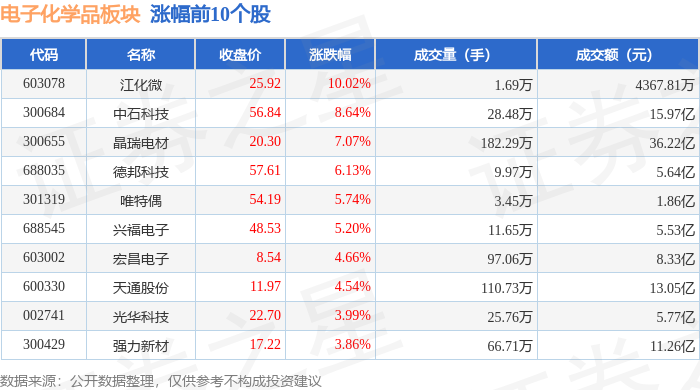
电子化学品板块1月21日涨1.65%,江化微领涨,主力资金净流入8.78亿元
Zheng Xing Xing Ye Ri Bao· 2026-01-21 08:53
Group 1 - The electronic chemicals sector increased by 1.65% on January 21, with Jianghuai Micro leading the gains [1] - The Shanghai Composite Index closed at 4116.94, up 0.08%, while the Shenzhen Component Index closed at 14255.12, up 0.7% [1] - Jianghuai Micro's stock price rose by 10.02% to 25.92, with a trading volume of 16,900 lots and a transaction value of approximately 43.68 million yuan [1] Group 2 - The electronic chemicals sector saw a net inflow of 878 million yuan from institutional investors, while retail investors experienced a net outflow of 643 million yuan [2] - The trading data indicates that Zhongshi Technology and Jingrui Electric Materials had significant price increases of 8.64% and 7.07%, respectively [1][2] - The overall trading volume for the electronic chemicals sector was substantial, with notable transactions in stocks like Zhongshi Technology, which had a transaction value of 1.597 billion yuan [1][2] Group 3 - The main net inflow for Jingrui Electric Materials was 387 million yuan, while it faced a net outflow of 225 million yuan from retail investors [3] - Zhongshi Technology had a net inflow of 130 million yuan from institutional investors, with a net outflow of 81.98 million yuan from retail investors [3] - The data reflects a mixed sentiment in the electronic chemicals sector, with some stocks attracting institutional interest while others faced retail selling pressure [3]




晶瑞电材股价涨5.59%,华夏基金旗下1只基金位居十大流通股东,持有460.64万股浮盈赚取488.28万元
Xin Lang Cai Jing· 2026-01-21 03:49
Group 1 - The core viewpoint of the news is that Jingrui Electric Materials Co., Ltd. experienced a stock price increase of 5.59%, reaching 20.02 CNY per share, with a trading volume of 1.313 billion CNY and a turnover rate of 6.45%, resulting in a total market capitalization of 21.481 billion CNY [1] - Jingrui Electric Materials, established on November 29, 2001, and listed on May 23, 2017, specializes in high-purity chemicals, photoresists, functional formulation materials, lithium battery materials, pharmaceutical intermediates, electronic-grade materials, and other products, widely used in the semiconductor and new energy industries [1] - The main revenue composition of Jingrui Electric Materials includes high-purity chemicals (58.69%), photoresists (13.79%), lithium battery materials (13.68%), industrial chemicals (9.61%), energy (4.01%), and others (0.23%) [1] Group 2 - From the perspective of the top ten circulating shareholders, Huaxia Fund's Huaxia CSI 1000 ETF (159845) reduced its holdings by 6,300 shares in the third quarter, now holding 4.6064 million shares, which accounts for 0.43% of the circulating shares, with an estimated floating profit of approximately 4.8828 million CNY [2] - The Huaxia CSI 1000 ETF (159845) was established on March 18, 2021, with a latest scale of 45.469 billion CNY, achieving a year-to-date return of 7.74% (ranking 1567 out of 5542) and a one-year return of 40.9% (ranking 1752 out of 4243) [2] - The fund manager of Huaxia CSI 1000 ETF is Zhao Zongting, who has been in the position for 8 years and 282 days, managing a total fund asset scale of 355.865 billion CNY, with the best fund return during his tenure being 121.93% and the worst being -32.63% [3]
全球半导体材料市场复苏提速 中国产业突围 “卡脖子” 难题
Quan Jing Wang· 2026-01-20 07:23
Core Insights - The global semiconductor materials market is experiencing a strong recovery, with a market size of $66.7 billion in 2023 and expected to exceed $73 billion by 2025, driven by demand from AI and wafer fab expansions [1] - China is becoming a key growth engine in the semiconductor materials market, with a sales figure of $13.1 billion in 2023, marking a year-on-year growth of 3.8% and increasing its global market share to 20% [1] Market Structure - Semiconductor materials are divided into wafer manufacturing materials and packaging materials, with wafer manufacturing materials dominating the market at 62.2% share ($41.5 billion) in 2023 [2] - Silicon wafers hold the largest share in wafer manufacturing materials at 33%, followed by electronic specialty gases (14%) and photomasks (13%) [2] - The market is highly concentrated, with major players in silicon wafers and photolithography materials predominantly from Japan and the U.S. [2] Core Material Breakthroughs - Domestic companies are making significant progress in wafer manufacturing materials, with local firms achieving breakthroughs in 12-inch silicon wafers and photolithography materials [3][4] - The domestic market for electronic specialty gases is also advancing, with companies like Huate Gas entering the TSMC supply chain [4] Packaging Materials - The global packaging materials market saw a decline of 10.1% to $25.2 billion in 2023, but advanced packaging is driving growth, with a projected increase of 19.62% [5] - Domestic companies are rapidly iterating technology in advanced packaging materials, with significant market shares in lead frames and packaging substrates [5] Import Dependency and Policy Support - China still faces significant import dependency in key categories like photolithography materials and electronic specialty gases, with over 90% reliance on imports for high-end materials below 14nm [6][8] - The government is focusing on critical areas through initiatives like the National Big Fund, aiming for 70% self-sufficiency in core materials by 2030 [6][8] Challenges and Future Outlook - Despite notable advancements, the industry faces challenges such as reliance on foreign technology for EUV-grade silicon wafers and high-end photolithography materials [7] - The advanced packaging materials market is expected to reach $39.3 billion by 2025, indicating a significant growth opportunity for domestic companies [7]



晶瑞电材1月16日获融资买入2.26亿元,融资余额9.86亿元
Xin Lang Cai Jing· 2026-01-19 01:33
Group 1 - The core viewpoint of the news is that Jingrui Electric Materials has shown significant fluctuations in its financing activities and stock performance, indicating a high level of market activity and investor interest [1][2]. - As of January 16, Jingrui Electric Materials' stock price decreased by 0.71%, with a trading volume of 2.699 billion yuan. The net financing buy was -49.0384 million yuan, with a total financing and securities balance of 988 million yuan [1]. - The financing balance of Jingrui Electric Materials is 986 million yuan, accounting for 4.72% of its circulating market value, which is above the 90th percentile level over the past year, indicating a high financing level [1]. Group 2 - As of September 30, the number of shareholders of Jingrui Electric Materials increased by 19.81% to 111,400, while the average circulating shares per person decreased by 10.67% to 9,585 shares [2]. - For the period from January to September 2025, Jingrui Electric Materials achieved an operating income of 1.187 billion yuan, representing a year-on-year growth of 11.92%. The net profit attributable to the parent company was 128 million yuan, showing a remarkable year-on-year increase of 19,202.65% [2]. - Since its A-share listing, Jingrui Electric Materials has distributed a total of 248 million yuan in dividends, with 117 million yuan distributed in the last three years [3]. Group 3 - As of September 30, 2025, among the top ten circulating shareholders of Jingrui Electric Materials, the Guotai CSI Semiconductor Materials Equipment Theme ETF ranked as the fifth largest shareholder, increasing its holdings by 4.9362 million shares to 8.8061 million shares [3]. - The Southern CSI 1000 ETF ranked as the seventh largest shareholder, reducing its holdings by 67,800 shares to 7.7554 million shares [3]. - The Hong Kong Central Clearing Limited has exited the list of the top ten circulating shareholders [3].
1300+份新材料报告下载:做新材料领域的「攻坚者」
材料汇· 2026-01-15 15:38
Core Viewpoint - The article discusses the rapid growth and investment opportunities in the advanced packaging materials sector, highlighting the potential for domestic companies to replace foreign imports in critical areas of technology [7][8]. Market Overview - The global market for advanced packaging materials is projected to reach $2.032 billion by 2028, with the Chinese market expected to grow to 9.67 billion yuan by 2025 [8]. - Specific materials such as PSPI and Al-X photoresist are identified as key growth areas, with PSPI's market size in China estimated at 7.12 billion yuan in 2023 [8]. Investment Opportunities - The article outlines various advanced packaging materials and their projected market sizes, indicating significant growth potential in sectors like conductive adhesives, chip bonding materials, and epoxy encapsulants [8]. - For instance, the conductive adhesive market is expected to reach 3 billion yuan by 2026, while the epoxy encapsulant market is projected to grow to 99 million USD by 2027 [8]. Competitive Landscape - The article lists both domestic and international players in the advanced packaging materials market, emphasizing the competitive dynamics and the potential for domestic companies to capture market share from established foreign firms [8]. - Companies such as 鼎龙股份, 国风新材, and 三月科 are highlighted as key domestic players in the PSPI segment, while international competitors include Fujifilm and Toray [8]. Investment Strategies - Different investment stages in the new materials industry are discussed, with a focus on the varying risk levels and investment strategies appropriate for each stage, from seed funding to pre-IPO [10]. - The article emphasizes the importance of assessing team capabilities, market potential, and product maturity when considering investments in this sector [10].


光刻胶国产替代迎来机会!美国关税倒逼+政策红利护航+头部企业技术破壁,头部企业A+H股上市助力行业加速
Xin Lang Cai Jing· 2026-01-15 14:09
Group 1 - Nanda Optoelectronics is a core enterprise in the semiconductor materials field, focusing on the R&D and mass production of ArF photoresists, having achieved breakthroughs that disrupt the monopoly of Japanese and American companies in the mid-to-high-end photoresist market [1][38][39] - The company has established deep cooperation with foundries in the Yangtze River Delta and has successfully validated its ArF photoresist for 28nm processes, leading to significant order growth and capacity expansion following the introduction of U.S. semiconductor tariffs in 2026 [1][39] - The National Big Fund has provided financial support for its photoresist projects, enhancing its first-mover advantage in the domestic photoresist market [1][39] Group 2 - Tongcheng New Materials, based in Shanghai, is a leading domestic rubber additive company that has entered the photoresist market through the acquisition of Beixu Electronics, focusing on the R&D and production of KrF photoresists [2][40] - The company has established stable partnerships with major domestic foundries, achieving large-scale production of KrF photoresists widely used in memory chips and power devices [2][40] - Plans for an H-share listing in 2026 aim to raise funds for high-end photoresist R&D and capacity expansion, further enhancing its competitive edge in the domestic market [2][40] Group 3 - Dinglong Co., headquartered in Wuhan, is a leader in printing and copying consumables, diversifying into semiconductor materials with a focus on polishing pads and supporting materials for photoresists [3][41] - The company has established close cooperation with major foundries like SMIC, achieving import substitution for its CMP polishing pads, which supports its photoresist business [3][41] - Following the U.S. semiconductor tariffs, there has been a surge in demand for localized supporting materials, leading to increased orders for its photoresist and related products [3][41] Group 4 - Yake Technology, located in Jiangsu, has entered the semiconductor photoresist market through the acquisition of South Korea's UP Chemical, focusing on KrF and ArF photoresists [4][42] - The company has integrated the technical advantages of the Korean team with domestic market resources, positioning itself as a core supplier of mid-to-high-end photoresists in the global semiconductor supply chain [4][42] - The electronic specialty gas business complements its photoresist offerings, providing a one-stop material solution for foundries [4][42] Group 5 - Dongcai Technology, based in Sichuan, specializes in high polymer resin materials for photoresists, leveraging its chemical industry foundation in the Southwest [5][43] - The company has achieved batch supply of resin products for various photoresist models, including G/I line and KrF, validated by multiple domestic photoresist manufacturers [5][43] - The demand for localized raw materials has surged following the U.S. semiconductor tariffs, leading to increased production capacity and a focus on high-end resin materials for ArF photoresists [5][43] Group 6 - Lianhong New Materials, located in Shandong, produces core raw materials such as monomers and solvents for photoresists, achieving low-cost production with quality meeting import standards [6][44] - The company has established long-term partnerships with downstream photoresist manufacturers, enhancing product adaptability and market share [6][44] - The acceleration of domestic substitution due to U.S. tariffs has led to a significant increase in orders for its photoresist raw materials [6][44] Group 7 - Shengquan Group, based in Shandong, focuses on developing phenolic and epoxy resins for photoresists, achieving breakthroughs in green and high-performance materials [7][45] - The company has become a core supplier for downstream photoresist manufacturers, benefiting from the growing demand for upstream resin materials following the U.S. semiconductor tariffs [7][45] - Increased R&D investment aims to develop high-end resin materials for KrF photoresists, further extending its position in the semiconductor materials industry [7][45] Group 8 - Shanghai Xinyang, a leader in semiconductor cleaning liquids, has diversified into the photoresist market, focusing on G/I line and electroplating photoresists [8][46] - The company has achieved large-scale production of G/I line photoresists, becoming a major supplier for domestic packaging applications [8][46] - The introduction of U.S. tariffs has accelerated the domestic adoption of photoresist materials, significantly increasing order volumes for its products [8][46] Group 9 - Jingrui Electric Materials, located in Jiangsu, is a leader in microelectronic materials, with its photoresist business covering multiple models including G/I line and KrF [9][48] - The company has accumulated extensive experience in photoresist R&D and production, with KrF photoresists entering the customer validation phase [9][48] - The U.S. semiconductor tariffs have led to a significant increase in domestic procurement of photoresists, resulting in notable revenue growth for the company [9][48] Group 10 - Huamao Technology, based in Fujian, has entered the photoresist market through the acquisition of XuZhou Bokan, focusing on ArF photoresist R&D [10][49] - The company aims to leverage its technical reserves to achieve breakthroughs in the production of mid-to-high-end photoresists, particularly in automotive semiconductor applications [10][49] - The acceleration of domestic substitution due to U.S. tariffs positions the company favorably in the ArF photoresist market [10][49] Group 11 - Jingfang Technology, headquartered in Jiangsu, specializes in semiconductor packaging and testing, relying on photoresists as a core consumable in its processes [11][50] - The company is enhancing cooperation with domestic photoresist manufacturers to optimize supply chain costs amid the push for domestic substitution [11][50] - The growth in demand from automotive electronics and AIoT sectors is driving the expansion of its packaging business, indirectly benefiting from the photoresist market [11][50] Group 12 - Xinlai Yingcai, based in Jiangsu, is a leader in ultra-pure fluid equipment, providing clean production equipment for photoresist manufacturing [12][51] - The company is expanding its product offerings to include ultra-clean equipment suitable for ArF and EUV photoresist production [12][51] - The demand for clean equipment has surged following the U.S. semiconductor tariffs, leading to significant order growth [12][51] Group 13 - Hubei Yihua, located in Hubei, is a leader in basic chemicals, producing raw materials for photoresists such as chlorobenzene and phosphorus trichloride [13][53] - The company has achieved large-scale production of photoresist raw materials, benefiting from the growing demand for localized supply following U.S. tariffs [13][53] - Its integrated chemical industry advantages help reduce production costs, enhancing its competitiveness in the photoresist supply chain [13][53]


