
Ligao Foods (300973)

Search documents
立高食品(300973) - 2026年1月7日投资者关系活动记录表
2026-01-07 10:00
Group 1: Company Operations - The current capacity utilization rate is high, with the company entering a peak stocking period since November 2025, and plans to complete expansion construction based on anticipated order growth, but not more than one year in advance [2] - New products, including tart and bread varieties, have been launched in core supermarket clients ahead of the Spring Festival, with more new products planned for the year [2] - The new national standard cream will be priced higher than the previous cream products due to improvements in quality and formulation, targeting higher-end market segments [3] Group 2: Product Development and Market Response - Blind tests conducted on the new national standard cream showed that most customers could not distinguish it from a European imported product, indicating strong market acceptance and confidence in the product's quality [4] - The sales team will not differentiate between the 360PRO and the new national standard cream, as both products are used in similar applications like cakes and beverages [4] Group 3: Strategic Partnerships and Market Expansion - The joint venture with Feihe aims to develop domestically sourced, deep-processed raw materials, complementing the company's needs for key ingredients like milk fat [5] - The company sees potential in expanding baked goods in buffet settings, enhancing consumer experience while reducing costs for operators [6] Group 4: Financial Performance and Cost Management - Sales and management expense ratios have significantly decreased in the first three quarters of 2025, with expectations for continued cost reduction through scale effects and improved logistics efficiency [7] - The company has reduced the number of external warehouses from over thirty to around ten, improving inventory turnover efficiency [7] Group 5: Industry Trends - Overall baking consumption is still on the rise, with a persistent trend towards domestic substitution of key baking ingredients [9]

立高食品(300973) - 关于2025年第四季度可转换公司债券转股情况的公告
2026-01-05 07:42
| 证券代码:300973 | 证券简称:立高食品 | 公告编号:2026-001 | | --- | --- | --- | | 债券代码:123179 | 债券简称:立高转债 | | 立高食品股份有限公司 关于 2025 年第四季度可转换公司债券转股情况的公告 本公司及董事会全体成员保证信息披露内容的真实、准确和完整,没有虚假记载、 误导性陈述或重大遗漏。 特别提示: | 证券简称:立高食品 | | --- | | 1、证券代码:300973 | 根据《深圳证券交易所创业板股票上市规则》和《深圳证券交易所上市公司自律监 管指引第 15 号——可转换公司债券》的有关规定,立高食品股份有限公司(以下简称"公 司")现将 2025 年第四季度可转换公司债券(以下简称"可转债")转股及公司总股本变 化情况公告如下: 一、可转债基本情况 (一)可转债发行情况 经中国证券监督管理委员会《关于同意立高食品股份有限公司向不特定对象发行可 转换公司债券注册的批复》(证监许可〔2023〕43 号)予以注册,公司于 2023 年 3 月 7 日向不特定对象发行了 9,500,000 张可转债,每张面值为人民币 100 元,发行 ...
休闲食品板块12月31日涨0.37%,元祖股份领涨,主力资金净流出857.81万元
Zheng Xing Xing Ye Ri Bao· 2025-12-31 08:59
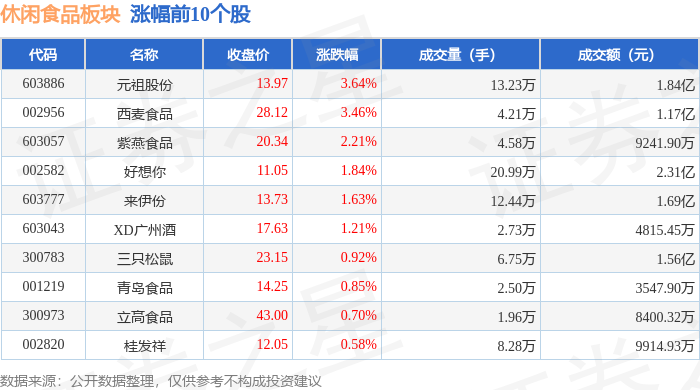
Core Viewpoint - The leisure food sector experienced a slight increase of 0.37% on December 31, with Yuanzu Co., Ltd. leading the gains. The Shanghai Composite Index closed at 3968.84, up 0.09%, while the Shenzhen Component Index closed at 13525.02, down 0.58% [1]. Group 1: Stock Performance - Yuanzu Co., Ltd. (603886) closed at 13.97, up 3.64%, with a trading volume of 132,300 shares and a transaction value of 184 million yuan [1]. - Ximai Food (002956) closed at 28.12, up 3.46%, with a trading volume of 42,100 shares and a transaction value of 117 million yuan [1]. - Ziyan Food (603057) closed at 20.34, up 2.21%, with a trading volume of 45,800 shares and a transaction value of 92.42 million yuan [1]. - Other notable stocks include Haoxiangni (002582) at 11.05, up 1.84%, and Laiyifen (603777) at 13.73, up 1.63% [1]. Group 2: Capital Flow - The leisure food sector saw a net outflow of 8.58 million yuan from institutional investors and a net outflow of 32.76 million yuan from speculative funds, while retail investors contributed a net inflow of 41.34 million yuan [2]. - Notable capital flows include Sanzhi Songshu (300783) with a net inflow of 6.78 million yuan from institutional investors, while it experienced a net outflow of 11.79 million yuan from retail investors [3]. - Lihai Food (300973) had a net inflow of 5.45 million yuan from institutional investors but faced a net outflow of 1.45 million yuan from retail investors [3].





休闲食品板块12月30日跌0.89%,来伊份领跌,主力资金净流出5697.76万元
Zheng Xing Xing Ye Ri Bao· 2025-12-30 09:00
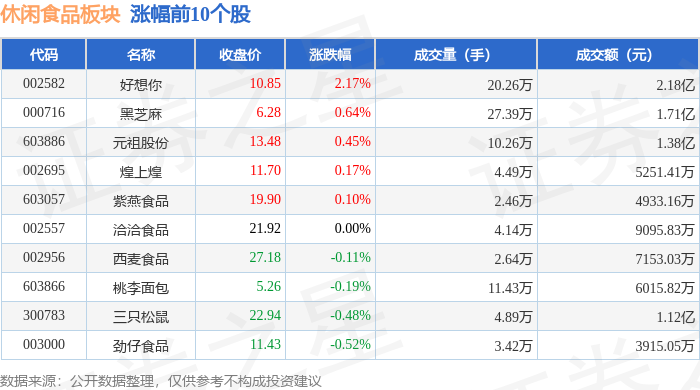
Market Overview - The leisure food sector experienced a decline of 0.89% on December 30, with Laiyifen leading the drop [1] - The Shanghai Composite Index closed at 3965.12, down 0.0%, while the Shenzhen Component Index closed at 13604.07, up 0.49% [1] Individual Stock Performance - Key stocks in the leisure food sector showed varied performance, with the following notable movements: - Haoxiangni (002582) increased by 2.17% to close at 10.85, with a trading volume of 202,600 shares and a turnover of 218 million yuan [1] - Hezhima (000716) rose by 0.64% to 6.28, with a trading volume of 273,900 shares and a turnover of 171 million yuan [1] - Laiyifen (603777) fell by 4.25% to 13.51, with a trading volume of 175,400 shares and a turnover of 240 million yuan [2] Capital Flow Analysis - The leisure food sector saw a net outflow of 56.98 million yuan from main funds, while retail investors contributed a net inflow of 31.61 million yuan [2] - Notable capital flows for specific stocks include: - Yuanzu (603886) had a net inflow of 18.19 million yuan from main funds, but a net outflow of 24.81 million yuan from retail investors [3] - Haoxiangni (002582) saw a net inflow of 13.99 million yuan from main funds, with a net outflow of 20.91 million yuan from retail investors [3]


立高食品(300973) - 关于召开2026年第一次临时股东会的通知
2025-12-29 08:15
证券代码:300973 证券简称:立高食品 公告编号:2025-087 债券代码:123179 债券简称:立高转债 立高食品股份有限公司 关于召开 2026 年第一次临时股东会的通知 本公司及董事会全体成员保证信息披露的内容真实、准确、完整,没有虚假记载、 误导性陈述或重大遗漏。 一、会议召开的基本情况 1、股东会届次:2026 年第一次临时股东会 2、会议召集人:董事会 3、会议召开的合法、合规性:公司于 2025 年 12 月 29 日召开第三届董事会第二十 次会议,审议通过《关于提请召开 2026 年第一次临时股东会的议案》,本次股东会会议 召集程序符合有关法律、行政法规、部门规章、规范性文件和《公司章程》的有关规定。 4、会议召开时间: (1)现场会议时间:2026 年 1 月 23 日 14:30 (2)网络投票时间:通过深圳证券交易所系统进行网络投票的具体时间为 2026 年 1 月 23 日 9:15-9:25,9:30-11:30,13:00-15:00;通过深圳证券交易所互联网投票系统投票 的具体时间为 2026 年 1 月 23 日 9:15 至 15:00 的任意时间。 5、会议的召开方 ...
立高食品:12月29日召开董事会会议
Mei Ri Jing Ji Xin Wen· 2025-12-29 08:11
Group 1 - The core point of the article is that Lihigh Food (SZ 300973) held its 20th meeting of the third board of directors on December 29, 2025, to discuss the proposal for the "Compensation Management System for Directors and Senior Management" [1] - For the first half of 2025, Lihigh Food's revenue composition shows that the baking food industry accounts for 99.43%, while other businesses account for 0.57% [1] - As of the time of reporting, Lihigh Food has a market capitalization of 7.4 billion yuan [1] Group 2 - The article also highlights a significant event involving Moutai's distributor conference, where over 2,000 attendees gathered to discuss major changes related to Moutai's pricing and distribution [1] - Chairman Chen Hua emphasized that distributors can no longer rely on passive income [1]
立高食品(300973) - 中信建投证券股份有限公司关于立高食品股份有限公司2026年度日常关联交易预计的核查意见
2025-12-29 08:00
中信建投证券股份有限公司 关于立高食品股份有限公司 2026 年度日常关联交易预计的核查意见 中信建投证券股份有限公司(以下简称"中信建投证券"或"保荐机构")作为立 高食品股份有限公司(以下简称"立高食品"、"上市公司"或"公司")向不特定对 象发行可转换公司债券并在创业板上市的保荐机构,根据《公司法》《深圳证券交易所创 业板股票上市规则》《深圳证券交易所上市公司自律监管指引第 2 号——创业板上市公司 规范运作》《深圳证券交易所上市公司自律监管指引第 7 号——交易与关联交易》等相关 法律法规、规范性文件和《立高食品股份有限公司章程》(以下简称"《公司章程》") 的要求,对立高食品 2026 年度日常关联交易预计情况进行了核查,具体情况如下: 一、日常关联交易基本情况 (一)日常关联交易概述 立高食品股份有限公司结合日常经营和业务发展需要,预计 2026 年度公司及子公司 将与关联方广东坚朗五金制品股份有限公司(以下简称"坚朗五金")及其合并报表范围 内子公司发生日常关联交易金额不超过 6,000 万元,有效期为 2026 年 1 月 1 日至 2026 年 12 月 31 日。上述关联交易是与公司董事白 ...
立高食品(300973) - 中信建投证券股份有限公司关于立高食品股份有限公司使用部分闲置募集资金暂时补充流动资金的核查意见
2025-12-29 08:00
中信建投证券股份有限公司 关于立高食品股份有限公司 使用部分闲置募集资金暂时补充流动资金的核查意见 中信建投证券股份有限公司(以下简称"中信建投证券"或"保荐机构")作为立 高食品股份有限公司(以下简称"立高食品"、"上市公司"或"公司")首次公开发 行股票及向不特定对象发行可转换公司债券并在创业板上市的保荐机构,根据《上市公 司募集资金监管规则》《深圳证券交易所创业板股票上市规则》及《深圳证券交易所上市 公司自律监管指引第 2 号——创业板上市公司规范运作》等有关规定,对立高食品使用 部分闲置募集资金暂时补充流动资金情况进行了核查,具体情况如下: 一、募集资金的基本情况 1、首次公开发行股票 经中国证券监督管理委员会《关于同意立高食品股份有限公司首次公开发行股票注 册的批复》(证监许可[2021]489 号)同意注册,公司获准向社会首次公开发行人民币普 通股(A 股)股票 42,340,000 股,每股面值 1.00 元,每股发行价格为人民币 28.28 元, 募集资金总额为人民币 1,197,375,200.00 元,扣除发行费用(不含增值税)人民币 91,507,294.92 元后,募集资金净额为 1, ...
立高食品(300973) - 中信建投证券股份有限公司关于对立高食品股份有限公司持续督导的培训报告
2025-12-29 08:00
中信建投证券股份有限公司关于对立高食品股份有限公司 持续督导的培训报告 深圳证券交易所: 根据《深圳证券交易所上市公司自律监管指引第 13 号——保荐业务》等相 关规定,中信建投证券股份有限公司(以下简称"中信建投"、"保荐人")作为 立高食品股份有限公司(以下简称"立高食品"、"上市公司"或"公司")首 次公开发行股票及向不特定对象发行可转换公司债券并在创业板上市的保荐人 及持续督导机构,项目组成员于 2025 年 12 月 17 日对立高食品股份有限公司到 场及线上参与培训的董事、高级管理人员、中层以上管理人员及公司控股股东和 实际控制人等相关人员进行了专门培训,并对未到场的相关人员派发了相关培训 资料,督促其认真学习培训内容,本次培训的具体情况如下: 一、培训时间 2025 年 12 月 17 日 翁嘉辉 周祎飞 二、培训地点 培训地点:广州市增城区石滩镇兴石一路 3 号立高食品会议室 培训形式:现场培训和线上远程会议相结合的形式 三、培训内容 围绕《上市公司募集资金监管规则》《上市公司股东减持股份管理暂行办法》 《上市公司董事和高级管理人员所持本公司股份及其变动管理规则》等近期更新 出台的重要法律法规 ...
立高食品(300973) - 立高食品股份有限公司董事和高级管理人员薪酬管理制度
2025-12-29 08:00
立高食品股份有限公司 董事和高级管理人员薪酬管理制度 第一章 总 则 第一条 为进一步完善立高食品股份有限公司(以下简称"公司"或"本公司") 董事、高级管理人员的薪酬管理,建立科学有效的激励与约束机制,有效调动董事 和高级管理人员的积极性,公司根据《中华人民共和国公司法》《上市公司治理准 则》等相关法律、法规、规章、规范性文件和《立高食品股份有限公司章程》(以 下简称《公司章程》)的相关规定,结合公司实际情况,特制定本制度。 第二条 本制度所称董事包括公司非独立董事、独立董事以及由职工代表担任的 董事。 本制度所称高级管理人员是指公司的总经理、副总经理、财务总监、董事会秘 书以及经董事会决议确认为公司高级管理人员的其他人员。 第三条 公司董事、高级管理人员薪酬遵循以下原则: (一)公平原则,体现收入水平符合公司规模与业绩的原则,同时与外部薪酬 水平相符; (二)责、权、利统一原则,体现薪酬与岗位价值高低、履行责任义务大小相 符; (三)长远发展原则,体现薪酬与公司持续健康发展的目标相符; (四)激励约束并重原则,体现薪酬发放与考核、与奖惩挂钩、与激励机制挂 钩。 参照《上市公司独立董事管理办法》的有关规定, ...