
ADP(ADP)

Search documents
“小非农”意外萎缩!美国9月ADP就业减少3.2万人,预期为增加5.1万人
Hua Er Jie Jian Wen· 2025-10-01 15:06
Core Viewpoint - The unexpected decline in U.S. private sector employment in September signals economic cooling and increases the likelihood of two interest rate cuts by the Federal Reserve before the end of the year [1][3]. Employment Data Summary - In September, U.S. private sector employment decreased by 32,000, with the previous month's data revised to a decrease of 3,000, contrasting sharply with the market expectation of an increase of 51,000 [1][3]. - The decline in employment is partly attributed to ADP's annual data benchmark adjustment, which revealed that the original data from the Quarterly Census of Employment and Wages (QCEW) had "higher than normal levels of missing or revised values" [3][4]. - The recalibration led to a reduction of 43,000 jobs in September before adjustments [3]. Industry and Regional Breakdown - Employment changes by industry showed: - Goods-producing sector: decreased by 3,000 jobs - Service-providing sector: decreased by 28,000 jobs - Notable declines included: - Trade/transportation/utilities: -7,000 - Financial activities: -9,000 - Professional/business services: -13,000 - Leisure/hospitality: -19,000 - Education/health services saw an increase of 33,000 jobs [5][6]. - Regional employment changes indicated: - Northeast: +21,000 - Midwest: -63,000 - South: +3,000 - West: +15,000 [6]. Market Reaction - Following the weak employment report, traders increased bets on interest rate cuts, with the market closely aligning with the Fed's guidance on potential cuts before December [3][7]. - The report supports a dovish stance from the Federal Reserve, suggesting that a weak labor market may provide more policy space for rate cuts in response to economic slowdown [7][8].


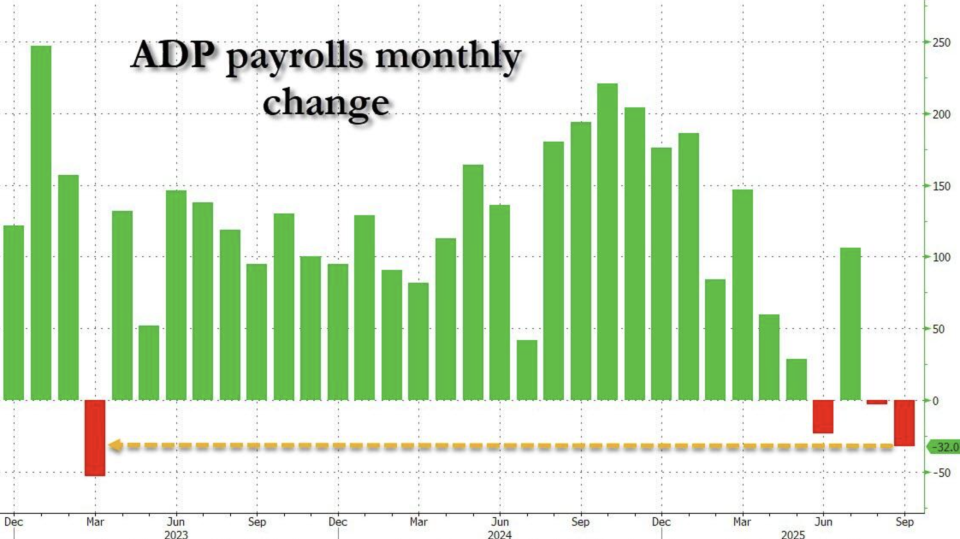
Stocks drop, gold surges as Wall Street on edge at start of US government shutdown
New York Post· 2025-10-01 15:02
Core Insights - The S&P 500 and Nasdaq indexes experienced declines as Wall Street assessed the implications of a federal government shutdown on the US economy [1][4] - The S&P 500 rose over 3.5% in September, but private-sector job cuts reported by ADP fell short of expectations, indicating potential economic weakness [2][3] - Historical data suggests that the S&P 500 has generally performed well during past government shutdowns, with notable gains in several instances [5][8][9] Market Performance - The S&P 500 dropped 0.2% and the Nasdaq Composite fell 0.3% at the start of Wednesday's trading session [1] - The Dow Jones Industrial Average remained near flat after an initial decline of 52 points [1] - Gold prices reached all-time highs above $3,900 per ounce as investors sought safe-haven assets amid market uncertainty [5] Employment Data - ADP reported a loss of 32,000 jobs in September, contrasting with economists' expectations of a 45,000 job gain, marking the steepest decline since March 2023 [2][3] - The August job figures were revised from a reported increase of 54,000 to a loss of 3,000, further indicating labor market weakness [2] Government Shutdown Impact - The Labor Department's closure during the shutdown means the September nonfarm payrolls report will not be released, increasing reliance on private surveys for economic indicators [3] - Market sentiment appears to be influenced by the lack of progress in resolving the government shutdown, raising investor concerns [3] Historical Context - Historical performance of the S&P 500 during government shutdowns shows resilience, with gains recorded during various shutdown periods, including a 10.43% increase during the longest shutdown from December 2018 to January 2019 [6][8]

Private payrolls declined in September by 32,000 in ADP report coming amid shutdown data blackout
Youtube· 2025-10-01 14:53
Core Insights - The ADP private payroll data reported a decrease of 32,000 jobs, significantly lower than the estimated increase of 45,000 jobs, indicating a slowdown in hiring momentum [1][9] - Revisions from the Bureau of Labor Statistics (BLS) have impacted the ADP numbers, with previous estimates for August revised down from 54,000 to a loss of 3,000 jobs [2][9] - The report highlights that small and medium businesses saw declines in employment, while large businesses added 33,000 jobs, particularly in education and health services [3][28] Employment Trends - The service sector experienced a notable decline, with 28,000 jobs lost, while the leisure and hospitality sector saw a decrease of 19,000 jobs [1][3] - Job stayers' wages increased by 4.5%, while job changers' wages rose by only 6.6%, down from 7.1% in August [3][4] - The overall trend indicates a slowdown in hiring momentum from the beginning of the year, consistent across various data sources [9][11] Economic Indicators - Initial jobless claims remain low, suggesting a stable job market despite the recent job losses [11] - Consumer spending is identified as a key driver of economic growth, but its strength may not be sufficient to support job growth in the labor market [12][13] - The ADP data is seen as a complement to government statistics, providing insights into private sector hiring trends [23][24] Future Outlook - The potential impact of government employment changes on the private sector is acknowledged, particularly regarding contractors who may be affected by federal layoffs [27] - Large companies are still hiring, particularly in information technology and healthcare, indicating some resilience in specific sectors [28] - A definitive assessment of whether the labor market is reaccelerating will require additional months of data [29]
Hedge America Trade Speeds Up On Government Shutdown; Plan To Buy Any Big Drop; Blind Money Buying Ahead - Apple (NASDAQ:AAPL)
Benzinga· 2025-10-01 14:36
Core Insights - The article discusses the current market dynamics, particularly focusing on the "Magnificent Seven" stocks and the implications of recent economic data on investment strategies [5][6][11]. Group 1: Market Trends - Money flows in major tech stocks (Apple, Amazon, Alphabet, Meta, Microsoft, NVIDIA, Tesla) are currently negative, indicating potential challenges for these companies [6]. - The SPDR Gold Trust (GLD) is highlighted as a popular ETF for gold, reflecting a growing interest in gold as a hedge against economic uncertainties [7]. Group 2: Economic Indicators - API crude inventories reported a draw of 3.674 million barrels, slightly less than the previous draw of 3.821 million barrels, indicating a tightening oil market [8]. - The ADP employment change showed a decline of 32,000 jobs, contrasting with a consensus expectation of an increase of 40,000, suggesting a weakening employment landscape [11]. - The Conference Board's Consumer Confidence Index came in at 94.2, below the consensus of 96.0, further indicating declining consumer sentiment [11]. Group 3: Investment Strategies - Investors are advised to consider maintaining long-term positions while also preparing for potential market dips, particularly in the context of a 4% to 7% decline in the stock market [10][11]. - The article suggests that a protection band strategy should be employed, adjusting cash and hedge levels based on individual risk preferences [11][12].







Private Payrolls Show Weakness as U.S. Government Shuts Down
Youtube· 2025-10-01 13:30
Economic Data Summary - The 30-year mortgage rate increased from 6.34% to 6.46%, leading to a 12.7% decline in mortgage applications, with purchases down 1% and refinances down 20.6% [1][2] - The ADP employment report indicated a loss of 32,000 jobs, with the previous month's figure revised down from an increase of 54,000 to a decrease of 3,000 [2][3] - The annual rebenchmarking of the national employment report resulted in a reduction of 43,000 jobs for September, highlighting ongoing weakness in the labor market [3][4] Labor Market Insights - The ADP data showed that all company sizes except those with 500 or more employees experienced job losses, with larger companies gaining 33,000 jobs [4] - Jobless claims remain relatively strong, but there is a lack of hiring, indicating a stall in the labor market [10][4] - The overall labor market is not improving, with the ADP report suggesting a negative trend in government hiring that may affect future employment numbers [8][9] Market Reactions - The markets are slightly lower but have recovered from pre-market lows, with historical context suggesting that government shutdowns have not significantly impacted market performance [5][7] - Lower dollar values, decreasing yields, and falling crude oil prices indicate a rally in bonds, despite the labor market's stagnation [9][10]
关键时刻“两眼一抹黑”!“小非农”爆冷创两年半最大降幅 政府数据还“停摆”
智通财经网· 2025-10-01 13:22
Core Insights - In September, the U.S. private sector experienced the largest decline in employment in two and a half years, indicating a weakening labor market, exacerbated by a government shutdown that has led to data reporting issues [1][3] - The ADP report revealed a loss of 32,000 jobs in September, contrasting with economists' expectations of an increase of 45,000 jobs [1][3] - The August employment data was revised down from an initial increase of 54,000 to a decrease of 3,000 [1] Employment Sector Analysis - Multiple sectors saw job reductions in September, with the education and healthcare sectors adding 33,000 jobs, partially offsetting the overall decline [3][4] - The leisure and hospitality sector lost 19,000 jobs due to the end of the vacation season, while other service sectors decreased by 16,000 jobs, professional and business services by 13,000, trade, transportation, and utilities by 7,000, and construction by 5,000 [3][4] - Service providers reduced 28,000 jobs, while goods-producing industries saw a decrease of 3,000 jobs [4] Business Size Impact - Small businesses with fewer than 50 employees lost 40,000 jobs, while larger companies with 500 or more employees added 33,000 jobs [4] Economic Growth Context - Despite a strong economic growth rate of 3.8% in Q2, the employment data reflects a cautious hiring attitude among U.S. employers [4] - The Atlanta Fed's GDPNow tool projects a Q3 growth rate of 3.9% [4] Labor Market Concerns - The current unemployment rate remains relatively low at 4.3%, but concerns about the labor market are increasing, with risks of labor demand falling below supply [6] - The market had anticipated an increase of 51,000 jobs in the upcoming Bureau of Labor Statistics (BLS) non-farm payroll report, which includes government jobs [6] Wage Growth Insights - Despite the slowdown in hiring, wages grew by 4.5% year-over-year in September, remaining stable compared to August, although the wage growth rate for job switchers fell to 6.6%, down 0.5 percentage points from August [6] Data Reporting Adjustments - The unexpected decline in employment numbers may also be attributed to data analysis issues, with ADP recalibrating past employment statistics based on the BLS's September benchmark data [6][7] - The QCEW data, which is used for annual adjustments of overall employment data, indicated a significant reduction of 911,000 jobs as of March this year [7]
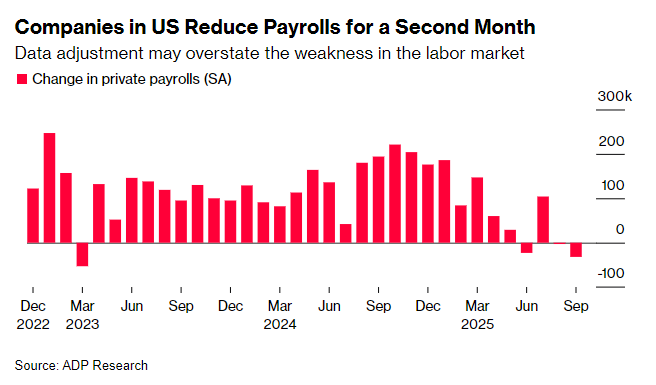
Private sector lost 32,000 jobs in September, ADP says
Fox Business· 2025-10-01 13:01
Group 1: Job Market Overview - Private sector companies lost 32,000 jobs in June, which is below economists' expectations of a gain of 50,000 jobs [1] - The previous month's payrolls were revised down from a gain of 54,000 to a loss of 3,000 [1] - Despite strong economic growth in Q2, U.S. employers remain cautious with hiring [2] Group 2: Sector Performance - The education and health services sector gained 33,000 jobs, while leisure and hospitality lost 19,000 positions [3][5] - Other sectors such as natural resources and mining added 4,000 jobs, and information gained 3,000 [3] - Professional and business services lost 13,000 jobs, financial activities shed 9,000, and trade, transportation, and utilities lost 7,000 jobs [5][7] Group 3: Business Size Impact - Large businesses (500 or more employees) added 33,000 jobs, while businesses with 50 to 499 employees lost 20,000 jobs [9] - Establishments with fewer than 50 employees shed 40,000 jobs [9] Group 4: Wage Growth - Wage growth remained little changed, with pay for those staying in their roles climbing 4.5% year-over-year [9] - Pay gains for those remaining in their jobs slowed to 6.6% from 7.1% in August [9] Group 5: Economic Data Release Concerns - The ADP data is released prior to the Labor Department's nonfarm payrolls report, which is expected to show an increase of 50,000 positions [10] - Due to a partial government shutdown, the Labor Department will halt all economic data releases, including jobless claims and nonfarm payrolls data [10] - The Chicago Federal Reserve President indicated that alternate data sources will be considered for the October meeting if official data is not available [11]

ADP report: Private employers unexpectedly shed 32,000 jobs as labor market continues pullback
Yahoo Finance· 2025-10-01 12:37
US private employers shed 32,000 jobs in September, the latest sign that the labor market is in a serious pullback. The data out Wednesday from payroll processor ADP was far below economists’ expectations of 51,000 jobs added. Private payrolls for August were also revised sharply lower to a loss of 3,000, after data initially showed a gain of 54,000. “Despite the strong economic growth we saw in the second quarter, this month's release further validates what we've been seeing in the labor market, that ...
Gold comes off highs after ADP says net 32K jobs were lost in September
KITCO· 2025-10-01 12:35
Group 1 - The articles do not provide any relevant information regarding companies or industries [1][2][3][4]
ADP National Employment Report: Private Sector Employment Shed 32,000 Jobs in September; Annual Pay was Up 4.5%
Prnewswire· 2025-10-01 12:15
Core Insights - Private sector employment decreased by 32,000 jobs in September 2025, with year-over-year pay growth at 4.5% [1][4][8] - The ADP National Employment Report indicates a cautious hiring approach by U.S. employers despite strong economic growth in the previous quarter [2] Employment Changes - Total job loss in September was 32,000, with goods-producing sectors losing 3,000 jobs and service-providing sectors losing 28,000 jobs [5][4] - Job losses were observed across various regions: Northeast gained 21,000 jobs, Midwest lost 63,000, South gained 3,000, and West gained 15,000 [5] - Small establishments saw a loss of 40,000 jobs, while large establishments (500+ employees) gained 33,000 jobs [5] Industry-Specific Changes - Notable job losses by industry included leisure/hospitality (-19,000), professional/business services (-13,000), and financial activities (-9,000) [7] - Education/health services added 33,000 jobs, indicating growth in that sector [7] Pay Insights - Year-over-year pay growth for job-stayers remained stable at 4.5%, while pay growth for job-changers decreased to 6.6% from 7.1% in August [8] - Median annual pay change for job-stayers varied by firm size, with large firms (500+ employees) showing a median change of 4.8% [9] Benchmarking and Revisions - ADP conducted a preliminary rebenchmarking of the National Employment Report, resulting in a reduction of 43,000 jobs compared to pre-benchmarked data [4][11] - The number of jobs created in August was revised from 54,000 to a loss of 3,000 [11]