AMD(AMD)

Search documents
Prediction: This Unstoppable BlackRock ETF Will Beat the S&P 500 Again in 2026
The Motley Fool· 2026-01-02 10:01
Core Viewpoint - The iShares Expanded Tech Sector ETF has shown strong performance driven by major technology companies, particularly in the AI sector, and is expected to continue outperforming the S&P 500 in 2026 [2][12]. Group 1: ETF Performance - The iShares Expanded Tech Sector ETF achieved a return of 27.5% in 2025, significantly surpassing the S&P 500's 17.5% return [2]. - Since its inception in 2001, the ETF has consistently outperformed the S&P 500, with a compound annual return of 11.6% compared to the S&P 500's 8.5% [12]. - Over the last decade, the ETF's accelerated compound annual return reached 22.9%, while the S&P 500 grew by 13.4% annually [12]. Group 2: Portfolio Composition - The ETF holds 291 stocks, primarily in the technology sector, with nearly 27% of its portfolio invested in semiconductor stocks [4]. - The top 10 holdings of the ETF account for 56% of its total weight, including major companies like Nvidia (8.92%), Microsoft (8.87%), and Apple (8.55%) [5][6]. - Other notable AI-related stocks in the ETF include Palantir Technologies, which saw a 139% stock gain due to high demand for its AI software products [10][11]. Group 3: Market Trends and Future Outlook - Major tech companies are expected to increase spending on AI data centers and infrastructure in 2026, which will likely benefit stocks like Nvidia, Broadcom, AMD, and Micron [13]. - Cloud platforms operated by Alphabet and Microsoft are experiencing accelerating revenue growth, indicating successful investments in AI infrastructure [13]. - The dynamic nature of the tech sector suggests that even if the AI boom slows, other technologies such as robotics and quantum computing could drive growth for the ETF [14].







U.S. Markets Pause for New Year’s Day, Eyeing 2026 Kickoff After Strong 2025 Gains
Stock Market News· 2026-01-01 19:07
Core Viewpoint - U.S. financial markets are experiencing a pause for the New Year's Day holiday, with trading set to resume on January 2nd, 2026. Despite a recent pullback, 2025 was a strong year for major stock indexes, which posted significant gains. Market Performance - On December 31st, 2025, major U.S. stock indexes closed lower, continuing a four-session losing streak. The Dow Jones Industrial Average fell 0.6% to 48,063.29, the S&P 500 declined 0.7% to 6,845.50, and the Nasdaq Composite dropped 0.8% to 23,241.99. Trading volume was light as many institutional investors had closed their books for the year [2][3]. - Sector performance was predominantly negative, with technology stocks being a major drag. The Energy Select Sector SPDR rose 0.8%, while the Information Technology Select Sector SPDR, Financials Select Sector SPDR, and Industrials Select Sector SPDR all declined by 0.3% [4]. Notable Stock Movements - Ares Management Corporation saw a share decline of 3.4%. Micron Technology and Western Digital experienced drops of 2.5% and 2.2%, respectively. Corcept Therapeutics shares plunged significantly after the FDA did not approve its treatment. Conversely, Nike shares rose 4.1% following the CEO's purchase of approximately $1 million in company stock [5]. Year-End Market Drivers - The strong performance in 2025 was largely driven by optimism surrounding artificial intelligence, with companies like Micron Technology, Palantir, Advanced Micro Devices, Alphabet, and Nvidia being significant contributors. The S&P 500 finished 2025 up approximately 16.4%, the Nasdaq Composite surged around 20.4%, and the Dow Jones Industrial Average added roughly 13% [6]. Upcoming Economic Data - Key economic data releases are scheduled for early January, including Initial Claims data and Construction PDF on January 2nd, ISM Manufacturing index on January 5th, and various employment reports on January 7th. Important inflation indicators like the Consumer Price Index and Producer Price Index will be released on January 13th and 14th, respectively [8]. Federal Reserve Meeting - The U.S. Federal Reserve's Federal Open Market Committee meeting is set for January 28th, where market participants will seek guidance on monetary policy for 2026, particularly regarding inflation and potential interest rate adjustments [9]. Upcoming Earnings Releases - The earnings season for Q4 2025 will begin to gain momentum later in January, with notable companies like BHP Group, JPMorgan Chase, and Bank of America expected to report. These earnings will provide critical insights into corporate performance and outlooks for the new year [10].



U.S. Markets Observe New Year’s Day Holiday, Reflect on a Strong 2025 and Eye 2026’s Opening Week
Stock Market News· 2026-01-01 15:07
Market Overview - U.S. financial markets closed on January 1st, 2026, for New Year's Day, with trading resuming on January 2nd, 2026, allowing investors to reflect on a strong 2025 and strategize for the new year [1] - The final trading day of 2025 saw a modest decline in U.S. equities, with major indexes still concluding the year with impressive double-digit gains driven by optimism around artificial intelligence and strong corporate profits [2] Index Performance - On December 31st, the S&P 500 fell 0.7% to close at 6,845.50, the Nasdaq Composite dipped 0.8% to 23,241.99, and the Dow Jones Industrial Average decreased by 0.6% to 48,063.29, with light trading volume as many institutional investors had closed their books for the year [3] - The S&P 500 surged over 16% in 2025, marking its third consecutive year of double-digit gains and setting 39 record highs, while the Nasdaq Composite gained 20.4% and the Dow Jones climbed 13% [4] Economic Indicators - Investors will focus on key economic data releases in early January 2026, including the Construction Spending report, ISM Manufacturing Index, and Employment Situation Report, which will provide insights into the U.S. economy and influence market sentiment and Federal Reserve policy [5][6] Company News - Meta Platforms (META) shares rose by 1.1% following its acquisition of AI startup Manus, highlighting the strategic importance of AI for tech giants [8] - Intel (INTC) shares gained 1.7% after NVIDIA Corporation (NVDA) completed a $5 billion investment in the chipmaker, emphasizing partnerships within the semiconductor industry [8] - Boeing Company (BA) saw a 0.6% increase in stock after securing an $8.58 billion U.S. Air Force contract [8] - Citigroup Inc. (C) shares fell 0.8% after approving the sale of its Russian unit, expected to result in a $1.2 billion pre-tax loss [12] - Nike (NKE) advanced 4.1% after its CEO purchased approximately $1 million worth of shares, signaling confidence in the company's future [12] AI Sector Performance - AI-related firms had significant gains in 2025, with Micron Technology (MU) up 239%, Palantir (PLTR) up 135%, Advanced Micro Devices (AMD) up 77%, and Alphabet (GOOGL) up 65% [12] - Despite strong annual performance, Micron was one of the worst-performing stocks on December 31st, down 2.5% [12]

Comparative Study: Intel And Industry Competitors In Semiconductors & Semiconductor Equipment Industry - Intel (NASDAQ:INTC)
Benzinga· 2026-01-01 15:01
In today's rapidly evolving and fiercely competitive business landscape, it is crucial for investors and industry analysts to conduct comprehensive company evaluations. In this article, we will undertake an in-depth industry comparison, assessing Intel (NASDAQ:INTC) alongside its primary competitors in the Semiconductors & Semiconductor Equipment industry. By meticulously examining crucial financial indicators, market positioning, and growth potential, we aim to provide valuable insights to investors and sh ...


Competitor Analysis: Evaluating Micron Technology And Competitors In Semiconductors & Semiconductor Equipment Industry - Micron Technology (NASDAQ:MU)
Benzinga· 2026-01-01 15:01
Core Insights - Micron Technology is a major player in the semiconductor industry, focusing on memory and storage chips, primarily DRAM, with a global customer base across various sectors [2] Financial Metrics Comparison - Micron's Price to Earnings (P/E) ratio is 27.82, which is below the industry average by 0.29x, indicating potential undervaluation [3] - The Price to Book (P/B) ratio stands at 5.60, significantly lower than the industry average by 0.6x, suggesting untapped growth prospects [3] - Micron's Price to Sales (P/S) ratio is 7.81, which is 0.64x the industry average, further indicating possible undervaluation based on sales performance [3] Profitability and Growth - The Return on Equity (ROE) for Micron is 9.28%, which is 3.87% above the industry average, reflecting efficient use of equity to generate profits [5] - Micron's revenue growth rate is 56.65%, surpassing the industry average of 32.03%, indicating strong sales expansion and market share gain [5] Financial Health - Micron has a debt-to-equity (D/E) ratio of 0.21, which is lower than its top four peers, indicating a stronger financial position and less reliance on debt financing [8]

Navigating the New Year: Market Outlook as 2026 Begins Amidst Holiday Closure
Stock Market News· 2026-01-01 14:07
Market Overview - U.S. stock markets closed for New Year's Day on January 1, 2026, with no trading activity, leading to cautious investor sentiment following a strong 2025 [1] - Futures markets indicated a slight decline, with S&P 500 futures down 0.2%, Dow Jones futures down 0.1%, and Nasdaq futures down 0.3% as of December 31, 2025 [2] 2025 Market Performance - Major U.S. stock indexes closed lower on December 31, 2025, with the Nasdaq Composite down 0.8%, S&P 500 down 0.7%, and Dow Jones down 0.6%, marking a modest pullback [3] - Despite the late-year dip, 2025 was a strong year for Wall Street, with the Nasdaq gaining approximately 20%, S&P 500 rising roughly 16%, and Dow Jones climbing about 13% [4] - Notable performers included Micron Technology with a 239% increase, Palantir up 135%, AMD gaining 77%, Alphabet rising 65%, and Nvidia increasing by 39% [4] Upcoming Economic Data - Key economic data releases include U.S. Construction Spending for November on January 2, ISM Manufacturing Index for December on January 5, ADP Employment Report and ISM Non-Manufacturing Composite on January 7, and U.S. Employment Report on January 9 [6] Company Developments - NIO Inc. reported record deliveries of 48,135 vehicles in December, a 54.6% year-over-year increase, and total deliveries for 2025 reached 326,028 vehicles, up 46.9% [11] - Trump Media & Technology Group announced a partnership with a cryptocurrency exchange, resulting in a 5% share price increase [11] - Nike shares advanced 4.1% after its CEO purchased approximately $1 million worth of shares [11] - Disney entered a partnership with OpenAI, becoming the first major content licensing partner for Sora, and made a $1 billion equity investment in OpenAI [11] - Micron Technology's shares declined by 2.5% despite strong annual performance [11]



3 High-Conviction AI Stocks With 10x Potential by 2036
The Motley Fool· 2026-01-01 12:30
Core Industry Insights - Investors are increasingly recognizing the potential of AI capabilities in various companies, with notable stock gains in the AI sector, such as Palantir's increase of over 32-fold from its 2022 low [1] - The AI market is projected to grow at a compound annual growth rate (CAGR) of 31% through 2033, indicating that the current AI investment trend is just beginning [1] Company Highlights 1. Advanced Micro Devices (AMD) - AMD has seen a remarkable increase of over 13,000% from its 2015 lows and is positioned to potentially catch up to Nvidia in the AI accelerator market with its upcoming MI450 accelerator [4] - The company forecasts a long-term revenue CAGR of 30%, with a 60% CAGR specifically for its data center segment that designs AI accelerators [5] - AMD's stock has risen over 70% in the past year, with a current forward P/E ratio of 53, making it an attractive option for investors despite a high P/E ratio of 105 [7] 2. CoreWeave - CoreWeave is emerging as a leading AI cloud platform, specifically tailored for AI workloads, and has built a competitive advantage by working with Nvidia's GPUs [8] - The company reported a 204% year-over-year revenue increase to nearly $3.6 billion in the first nine months of 2025, although costs surged by 263% during the same period [9] - Despite a net loss of $771 million in the first three quarters of 2025, down from $857 million the previous year, the stock is currently trading at a significant discount, with a price-to-sales (P/S) ratio just above 7 [10][12] 3. Upstart Holdings - Upstart is leveraging AI for loan evaluations, presenting a disruptive opportunity in a market dominated by Fair Isaac's FICO score since 1989, with a potential market opportunity of $1 trillion [13] - The company's AI model utilizes over 2,500 variables and can make 91% of assessments without human intervention, potentially approving 101% more applicants than traditional methods in 2024 [14] - Upstart's revenue for the first nine months of 2025 was $685 million, a 57% increase from the previous year, and it returned to profitability with earnings of $35 million during the same period [15][17]


Gavin Newsom Says Trump Making Gaming More Expensive Amid Chip Price Surge - Sony Group (NYSE:SONY)
Benzinga· 2026-01-01 11:18
Group 1 - Governor Gavin Newsom criticized President Donald Trump for making gaming more expensive due to rising chip prices and semiconductor tariffs [1][2] - Sony Group Corp. is reportedly delaying the launch of the PlayStation 6 gaming console because of concerns over increasing chip prices [2] - Nvidia Corp. and Advanced Micro Devices Inc. are considering raising prices of GPUs, which has been highlighted by Newsom's press office [3] Group 2 - The Trump administration has decided to maintain tariffs on semiconductor imports from China until June 23, 2027, with the exact tariff rate to be disclosed 30 days prior to implementation [4] - Chinese authorities have expressed strong opposition to the planned tariffs and are reviewing potential shipments of Nvidia's AI chips to China, raising concerns among U.S. policymakers [5] - Nvidia is facing strong demand for its H200 AI chips in China but is struggling with limited chip capacity and regulatory uncertainty, having received orders for over 2 million units for 2026 while only having 700,000 units available [6] Group 3 - ByteDance, the parent company of TikTok, is planning to invest over 100 billion yuan (approximately $14 billion) in acquiring Nvidia chips next year [7]


英伟达、AMD的GPU即将进入“全年涨价周期”
财联社· 2026-01-01 04:52
Core Viewpoint - The price of computing products, particularly GPUs, is set to rise significantly in early 2026 due to a surge in memory prices, impacting both consumer and data center markets [4][5]. Group 1: Price Increases - Nvidia and AMD are expected to implement phased price increases for various GPUs starting in early 2026, with AMD potentially raising prices as early as January and Nvidia around February [4]. - The flagship RTX 5090 GPU is projected to see a substantial price increase, potentially reaching $5000, compared to its initial suggested retail price of $1999 [4]. - The increase in GPU prices is attributed to a doubling of memory prices over the past six months, which has raised manufacturing costs for graphics cards by 80% [5]. Group 2: Market Impact - The price surge is anticipated to affect the latest generation of GPUs, including the RTX 50 Blackwell series and AMD's RX 9000 series [4]. - Market research firm Counterpoint predicts that memory prices will rise by an additional 40% before the second quarter of 2026, further exacerbating the situation [5]. - The AI industry is impacting consumer-grade GPUs, leading to shortages of certain models as chip manufacturers stockpile memory for gaming GPUs to be used in AI applications [5].

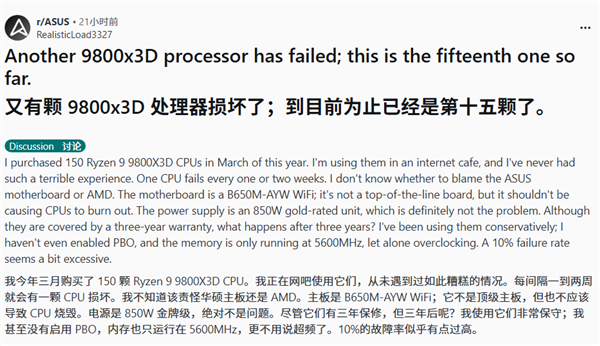
一两周就坏一颗9800X3D!网吧老板哭诉:甚至没敢开任何超频
Xin Lang Cai Jing· 2026-01-01 04:27
Core Viewpoint - The AMD Ryzen 7 9800X3D, known for its top-tier gaming performance, has faced significant reliability issues as reported by a gaming cafe owner who experienced a high failure rate of the CPUs purchased in bulk [1]. Group 1: Product Performance and Issues - The gaming cafe owner purchased 150 units of the Ryzen 7 9800X3D in early 2025, but since deployment in March, 15 CPUs have completely failed, resulting in an average failure rate of approximately 1.6 CPUs per month [1]. - The failures occur without warning, with one CPU failing every 1 to 2 weeks [1]. Group 2: System Configuration - To ensure stability, the owner did not enable Precision Boost Overdrive (PBO) and kept the memory running at a conservative frequency of 5600MHz [3]. - The failures were previously concentrated on ASRock motherboards, but the recent failures occurred on an ASUS B650M-AYW WiFi motherboard, which is considered a cost-effective mid-range option [4]. Group 3: Power Supply and BIOS - The system utilized a newer BIOS version 3283 (98.81.0) released in September, aimed at improving system stability [5]. - The power supply used was a 850W Gold-rated unit from HEC, with some comments suggesting that voltage fluctuations might be a contributing factor to the CPU failures [5].