Amazon(AMZN)

Search documents
亚马逊开始收网:中国卖家的红利期到头了
3 6 Ke· 2026-01-21 10:44
Core Viewpoint - Amazon is proactively pressuring suppliers for discounts of up to 30% to mitigate potential tariff impacts, particularly targeting Chinese suppliers, indicating a significant shift in its operational strategy amidst ongoing trade uncertainties [1][4][5]. Group 1: Amazon's Pricing Strategy - Amazon's discount demands vary significantly, with reductions ranging from a few percentage points to as high as 30%, particularly affecting categories like electronics and home goods [4]. - The urgency of Amazon's actions is notable, as negotiations with suppliers were expedited to complete before a Supreme Court ruling on tariffs, with some deadlines set as early as January 1 [4]. - The majority of the burden from these discount requests falls on Chinese suppliers, who account for over 50% of Amazon's seller base and approximately 60% of its sales [4][14]. Group 2: Financial Implications - Goldman Sachs estimates that if the tariffs from the Trump era are upheld, Amazon's annual operating profit could decline by 6% to 12%, translating to a potential loss of $5 billion to $10 billion [5]. - In a low-margin e-commerce environment, Amazon's strategy to recover previously granted supplier concessions is seen as the only viable path to maintain its low-price promise while managing policy risks [6]. Group 3: Competitive Landscape - The rise of aggressive pricing strategies from competitors like Temu, TikTok Shop, and SHEIN is intensifying pressure on Amazon, prompting it to launch Amazon Haul, which offers products at significantly lower prices [10][11]. - Despite the launch of Amazon Haul, consumer adoption has been low, with only 16% of U.S. consumers using the low-price platform monthly, indicating that Amazon's pricing may still not be competitive enough [11]. Group 4: Supplier Dynamics - The pressure on Chinese sellers is exacerbated by their heavy reliance on Amazon, with nearly 70% of sellers limited to a single market, making them vulnerable to price negotiations [14]. - Amazon's recent layoffs, particularly in its seller management teams, reflect a strategic shift towards automation and AI, which may further impact the support available to suppliers [15][16]. Group 5: Long-term Outlook - The ongoing cost negotiations and Amazon's pricing strategies signal a broader reallocation of power within the supply chain, with potential long-term risks for smaller sellers who may struggle to survive under increased pressure [19]. - The decline in new seller registrations on Amazon, which dropped by 44% year-over-year, suggests a shrinking marketplace that could lead to reduced product diversity and user experience [19][21].

亚马逊CEO达沃斯受访:美政府关税推高商品价格
Xin Lang Cai Jing· 2026-01-21 10:20
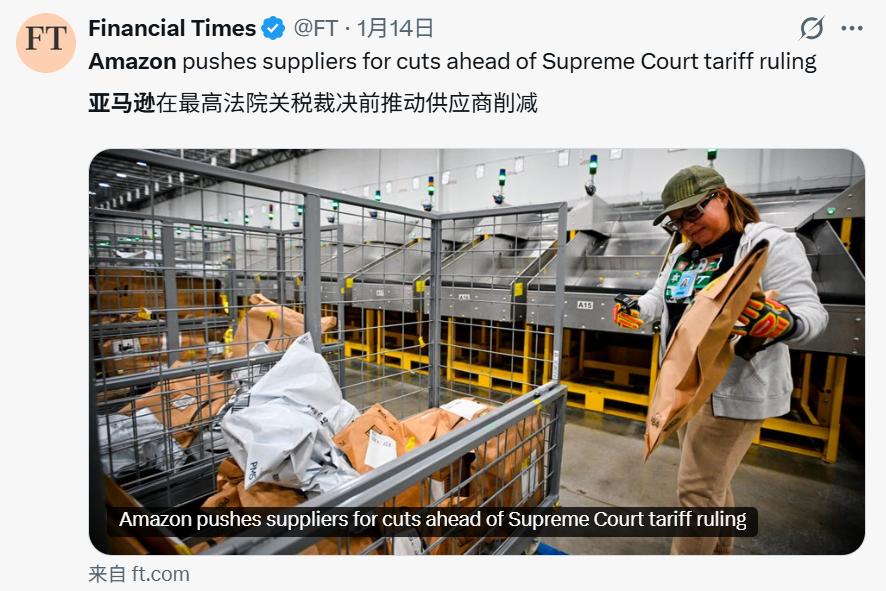
中新网1月21日电 当地时间20日,亚马逊首席执行官安迪·贾西在瑞士达沃斯世界经济论坛期间接受美媒 采访表示,美国政府关税政策的影响已开始在部分商品价格中显现出来。 亚马逊公司的标志。 据美国消费者新闻与商业频道(CNBC)报道,去年春季关税政策推出之前,亚马逊及其诸多第三方商家 囤积了库存,以尽可能保持低价。但到去年秋季,大部分库存都已售罄。当前,不少卖家正在权衡如何 消化关税带来的额外成本。 他还表示,亚马逊正"尽可能为消费者保持低价",但在某些情况下,提价不可避免。因为零售业的利润 通常有限,如果成本上升10%,企业几乎无力消化。 贾西称,关税影响了部分消费者的购买习惯,一些人开始购买价格较低的商品,或寻找折扣商品,其他 消费者则推迟购买价格较高的非必需品。 美媒注意到,除了亚马逊,沃尔玛、塔吉特和家得宝等多家美国零售商都公开表示,关税正在使商品变 得更加昂贵。 今年1月,美联储最新发布的"褐皮书"显示,所有联邦储备区都持续面临关税带来的成本压力。许多企 业表示,由于库存耗尽或保持利润率的压力加大,其已经开始将关税成本转嫁给消费者。 资料图: "因此,一些关税正在逐步反映到部分商品的价格中。"贾西表示, ...

Amazon Joins Microsoft In Pledge To Self-Fund Power Grids, While CEO Andy Jassy Questions OpenAI's 'Ambitious' Spending - Amazon.com (NASDAQ:AMZN)
Benzinga· 2026-01-21 10:04
Core Viewpoint - Amazon.com Inc. CEO Andy Jassy has committed to self-funding the company's energy needs for artificial intelligence, aligning with a similar commitment from Microsoft Corp. amid political pressure to protect consumers from rising electricity costs [1][2]. Self-Funding Commitment - Jassy emphasized that Amazon will not rely on others to cover its energy costs, stating, "We expect to fund the power that we need" [2]. - This commitment follows Microsoft's pledge to adopt a "community-first" approach to infrastructure expansion, responding to pressure from the Trump administration [2]. Addressing Grid Constraints - Jassy acknowledged the global power crunch due to the AI boom, noting that while conditions have improved, energy remains "still not as plentiful as we all need" [4]. - Amazon's strategy includes investments in nuclear capabilities and maintaining its position as the largest corporate purchaser of renewable energy over the last five years [4]. Skepticism On OpenAI's Spending - Jassy expressed skepticism regarding reports that OpenAI has signed deals for $1.4 trillion in infrastructure, questioning the validity of those figures [5]. - He described OpenAI's plans as "ambitious" but noted uncertainty about the guaranteed nature of the spending [5]. Financial Reality of AI Investments - Jassy warned that not all substantial investments are successful, highlighting the variable success rate of such investments [6]. - Amazon's stock has shown a slight increase of 0.08% in 2026, with a 2.15% rise over the last six months and a 2.24% increase over the past year [6].
Chinese tech giants enter the 'agentic commerce' race as AI reshapes super apps
CNBC· 2026-01-21 09:40
Core Insights - China's technology giants, including Alibaba and ByteDance, are entering a new phase of the AI race termed 'agentic commerce,' focusing on transforming chatbots into comprehensive shopping and payment tools [1] Group 1: Alibaba's Qwen AI Chatbot Update - Alibaba has updated its Qwen AI chatbot, enabling users to complete transactions directly within the interface, such as ordering food and booking air tickets [2] - The update integrates Qwen with Alibaba's broader e-commerce ecosystem, allowing users to compare tailored product recommendations from platforms like Taobao and Fliggy, and complete payments through Alipay without leaving the chatbot [2][3] - Previously, Qwen could only make recommendations based on user prompts, requiring users to navigate multiple platforms for purchases [3] Group 2: Shift to Agentic AI - The update signifies a broader shift among global AI firms from foundational AI models to "agentic AI," which performs tasks on behalf of users with minimal supervision [3] - The transformation of commercial services through agentic AI enhances user engagement and builds a sustainable competitive advantage, often referred to as a business moat [4] Group 3: E-commerce as a Use Case - E-commerce is emerging as one of the earliest and most widespread applications of agentic AI, with payment and tech giants in the U.S. also launching their initial versions recently [5] - Alibaba is well-positioned to lead in agentic commerce due to its advanced large language model capabilities and extensive e-commerce network covering various sectors such as clothing, food, housing, and transportation [6]


美股大型科技股盘前小幅上涨




Ge Long Hui A P P· 2026-01-21 09:21
格隆汇1月21日丨伟达涨1%,特斯拉涨0.8%,Meta、亚马逊涨0.4%,微软涨0.2%,苹果涨0.1%。 ...
亚马逊称关税推动商品涨价,卖家也计划上调价格
Di Yi Cai Jing· 2026-01-21 09:04
Core Viewpoint - Amazon's CEO Andy Jassy acknowledged that the impact of U.S. tariff policies is now reflected in rising prices on the platform, despite previous assurances that average product prices had not significantly increased [1][4]. Price Trends and Influences - Amazon sellers reported that price increases are influenced by multiple factors and are likely to become a trend, emphasizing value over price competition [3]. - The price hikes are attributed to the depletion of inventory that sellers had stockpiled before tariff changes, leading to unavoidable price increases [4]. - The average tariff rate for certain products has increased from 8.8% to 28.8%, significantly affecting pricing strategies for sellers [4]. Market Dynamics - Rising prices are also influenced by increases in raw material costs and currency fluctuations, with significant price hikes observed in materials like copper, aluminum, and silver [5]. - Competitors in the awning industry, primarily Chinese sellers, are facing similar pressures, and price adjustments are expected to have limited impact on business [6]. Seller Strategies - Amazon has observed varied responses from sellers regarding cost management, with some opting to pass costs onto consumers while others absorb costs to stimulate demand [9]. - Sellers' pricing strategies are influenced by market competition and the nature of their products, with standardized goods often seeing sellers absorb costs to retain customers, while unique products can more easily pass costs to consumers [10]. Consumer Behavior - Consumer spending behavior is shifting, with some shoppers seeking cheaper options and discounts, while others are postponing purchases of non-essential items [11]. - A report indicated that average planned spending for consumers in the fourth quarter decreased by 10% year-on-year, reflecting a trend of consumer downgrading [11]. Economic Sentiment - Consumer confidence has shown slight improvement among low-income groups, while high-income consumers have become more cautious, indicating a mixed outlook on the economic environment [12].
看高至320美元!法巴银行力挺亚马逊(AMZN.US)第四季度AWS增速将碾压市场预期
智通财经网· 2026-01-21 06:53
智通财经APP获悉,亚马逊(AMZN.US)将于2026年2月5日(星期四)美国市场收盘后公布2025财年第四季 度财报。法国巴黎银行分析师指出,亚马逊在第四季度的表现将超出市场预期,主要驱动力来自其云计 算部门 AWS(Amazon Web Services) 和 生成式人工智能(Generative AI) 业务的强劲增长。 法国巴黎银行分析师尼克·琼斯在给客户的报告中指出:"我们正密切关注亚马逊网络服务(AWS)的增长 情况,以及其与微软Azure和谷歌云之间的竞争态势。同时,我们也重视其资本支出强度,以及由此对 利润率产生的影响。此外,我们还关注AWS在云计算、人工智能、物流、杂货等领域持续投资的影 响,特别是这些投资对利润率的影响。此外,我们也在观察亚马逊的电商业务和广告业务的发展趋 势。" 琼斯为亚马逊设定的目标价为320美元。他指出,预计亚马逊网络服务(AWS)的年同比增长率将达到 22%至23%,这一数字高于市场普遍预期的21%,而人工智能领域的布局将成为推动其增长的重要因素 之一。 琼斯进一步补充道:"在我们看来,亚马逊在2025年第四季度于核心业务领域占据着有利态势,有望斩 获强劲业绩。考 ...
商业航天行业系列五:太空光伏:逐日天穹,叩问千亿星辰市场
GF SECURITIES· 2026-01-21 06:27
Investment Rating - The industry investment rating is "Buy" [2] Core Insights - The report highlights that the development of reusable rocket technology has significantly reduced launch costs, creating a golden opportunity for space photovoltaics [5] - The competition in commercial space between China and the US is accelerating, with low Earth orbit (LEO) communication satellites driving short-term demand for solar wings [5] - AI giants are increasingly recognizing the potential of deploying computing power in space, which is expected to benefit space photovoltaics [5] - The report emphasizes the importance of gallium arsenide as the current mainstream technology for space photovoltaics, while also highlighting the potential of silicon-based batteries and perovskite technology in the long term [5] - Investment recommendations include focusing on HJT/perovskite equipment suppliers and companies covering various segments of the photovoltaic supply chain [5] Summary by Sections 1. Space Photovoltaics: The Main Energy Source in Space - Space photovoltaics convert solar energy into electrical energy in space environments, which are harsher than ground conditions [12][13] - Solar panels are the core component of spacecraft power systems, essential for converting solar energy into the electricity needed for satellite operations [12][13] 2. Downstream Scenarios: Commercial Space Boom Leading to a Trillion-Dollar Market - The report notes a significant increase in global satellite launches since 2020, with a projected 4000 launches by 2025, driven by reduced costs from reusable rockets [38] - The US currently dominates the satellite market, with 11,688 satellites in orbit, while China and Russia lag behind [38] - The competition for orbital resources is intensifying, with both the US and China making substantial satellite deployment plans [44][45] 3. Technology Pathways: Gallium Arsenide as the Current Mainstream, with Potential for Silicon-Based Batteries and Perovskite Breakthroughs - Gallium arsenide solar cells are currently the most efficient option for space applications, with over 30% efficiency [65] - The report discusses the evolution of solar cell technologies, including silicon and multi-junction cells, and the potential for future advancements in perovskite technology [65] 4. Investment Recommendations: Focus on HJT/Perovskite Core Equipment Suppliers - Companies such as Maiwei, Aotwei, and Jiejia Weichuang are highlighted as key players in the HJT/perovskite equipment supply chain [5] - The report suggests monitoring companies that cover the entire photovoltaic supply chain, including polysilicon, batteries, and modules [5]




Nightview Capital 2025 Annual Letter
Seeking Alpha· 2026-01-21 06:05
Core Insights - The Nightview Fund ETF (NITE) achieved a gain of 22.56% in 2025, outperforming the S&P 500's total return of 17.88% [7] - The fund's strategy focuses on a 20-stock "best ideas" portfolio aimed at long-term investment opportunities rather than following specific trends [8] - The rise of artificial intelligence (AI) has created both opportunities and risks, with AI startups capturing 50% of all venture capital in 2025, a 37% increase from the previous year [13] Investment Strategy - The fund is bullish on AI as a transformative force in the global economy, believing it will lead to significant infrastructure changes [12] - The investment approach is barbelled, balancing exposure to technological advances with investments in sectors rooted in human experiences, such as travel and entertainment [38] - The fund has invested in Alibaba, recognizing its strong position in China's economy despite negative market sentiment [34] Sector Analysis - The semiconductor industry is experiencing a shift, with high-performance computing now accounting for approximately 60% of quarterly revenue for companies like TSMC, up from 30% in 2018 [44] - AI's integration into physical systems is expected to create competitive advantages for companies that can leverage real-world data and learning [22] - Tesla is highlighted as a key player in the transition to AI-driven autonomy, with significant improvements in its Full Self-Driving technology [25][27] Market Conditions - The current market environment presents a widening opportunity set, with some companies realizing efficiency gains from AI while others remain undervalued [33] - As interest rates stabilize, there are signs of recovery in deal-making and trading volumes across financial services [37] - The historical context of past technology cycles suggests that while excesses may emerge, the demand for AI-driven infrastructure is likely to remain strong [49][50]


AI产业链系列报告一:26年算力景气度持续上行,关注互联、液冷、供电板块
Guoxin Securities· 2026-01-21 05:24
Investment Rating - The report maintains an "Outperform" rating for the AI industry [1] Core Insights - The capital expenditure (Capex) guidance from major overseas companies is optimistic, with a continuous upward trend in computing power expected through 2026. The total Capex for Microsoft, Google, Amazon, and Meta is projected to reach $406.5 billion in 2025 and $596.4 billion in 2026, representing year-on-year growth of 46% and 47% respectively [3][5][22] - The demand for AI-related infrastructure is driving significant upgrades in interconnects, cooling, and power supply sectors, indicating a long-term growth cycle distinct from previous technology cycles [3][4] Summary by Sections 1. Overseas Major Companies' Capex Guidance - Major companies like Microsoft, Google, Amazon, and Meta are expected to increase their Capex significantly, with projections of $186.4 billion, $139.5 billion, $162.5 billion, and $108 billion respectively for 2026 [6][7][14][18][21] - The overall Capex for these four companies is expected to account for 62% of the global AI-related Capex, which is projected to reach $960 billion by 2026 [22][23] 2. Interconnect Sector: Optical Modules and PCBs - The interconnect sector is experiencing a fundamental shift in demand due to AI server cluster construction, leading to simultaneous upgrades in computing boards, switches, and optical modules, which will increase both demand and pricing [3][4] - The deployment of 800G technology is expected to accelerate, with 1.6T technology entering the introduction phase [3] 3. Cooling Sector: Liquid Cooling Demand - The power density of AI GPU racks is projected to rise from 130 kW in 2024 to over 1 MW by 2029, making liquid cooling technology essential [3][4] 4. Power Supply Sector: AIDC Power Distribution Evolution - The evolution of AIDC power distribution methods is crucial, with a focus on HVDC and SST technologies to enhance system efficiency and reduce energy losses [3][4] 5. Investment Recommendations - The report suggests focusing on specific companies within various sectors: - Computing power: Haiguang Information - Interconnects - Optical modules: LightSpeed Technology, Huagong Technology - Interconnects - PCBs: Shenghong Technology, Shennan Circuits, and others - Cooling: Invec - Power supply: Magpow [3][4]