Amazon(AMZN)

Search documents
财经早报:国家发改委研究扩大内需战略实施方案,美国”股债汇“三杀来袭!丨2026年1月21日
Xin Lang Cai Jing· 2026-01-20 23:29
Group 1 - The National Development and Reform Commission (NDRC) plans to implement a strategy to expand domestic demand from 2026 to 2030, addressing the current issue of weak demand in the economy [2][50] - The NDRC aims to strengthen the domestic circulation of the economy and enhance the resilience of economic operations by 2025 [2][50] - The NDRC is also working on policies to promote consumption, stabilize investment, and cultivate emerging industries as part of the "14th Five-Year Plan" [58] Group 2 - Six departments, including the Ministry of Finance, have extended tax and fee incentives for the elderly care, childcare, and domestic service sectors until December 31, 2027, to support the development of community family services [3][51] - The tax incentives were first introduced in June 2019 and have been viewed as a significant support measure for the industry [3][51] Group 3 - The semiconductor company Nexperia is currently involved in a control dispute, with a court hearing held in Amsterdam regarding its management and ownership [16][64] - The dispute involves Nexperia's temporary European management and its sole shareholder, Wingtech Technology from China, following a government order that temporarily froze the company's operations [16][64] Group 4 - The stock market has experienced significant volatility, with major indices like the Dow Jones dropping over 870 points due to new tariff threats from the U.S. [10][59] - Nvidia's market value decreased by approximately $195.6 billion (around 1361.7 billion RMB) in a single day, reflecting the broader impact on technology stocks [11][60] Group 5 - Several companies are reporting substantial profit increases for 2025, with notable projections including: - Langzi Co., Ltd. expecting a net profit increase of 245.25% to 302.8% [69] - Zhaoyan New Drug forecasting a net profit increase of 214% to 371% [70] - Huachen Equipment projecting a net profit increase of 193.64% to 242.04% [71] - Other companies like Qianyuan Power and Jin Fang Energy are also expecting significant profit growth, with projections of 160% to 190% and 123.97% to 193.7% respectively [72][73]



瑞士达沃斯:《Brand Finance 2026年全球品牌价值500强榜单报告》出炉
Feng Huang Wang Cai Jing· 2026-01-20 23:28
Core Insights - The Brand Finance 2026 Global Brand Value 500 report highlights Apple's continued dominance as the world's most valuable brand, with a brand value of $607.64 billion, reflecting a growth of 5.8% [5][6] - The report indicates that the United States leads with 192 brands contributing 53.4% of the total brand value, followed by China with 68 brands at 15.1% [3][5] - The banking sector remains the highest valued industry globally, contributing 12.5% of total brand value with 79 brands, while media and electronics follow [3][5] Company Highlights - Apple maintains its position as the top brand, with a brand value of $607.64 billion, driven by strong performance in services including advertising and cloud services [5][6] - Microsoft ranks second with a brand value of $565.25 billion, showing a significant growth of 22.6%, bolstering its leadership in AI and cloud services [5][6] - TikTok (Douyin) has seen a remarkable brand value increase of 45.1%, reaching $153.54 billion, making it the highest valued Chinese brand and sixth globally [7][19] - The State Grid of China ranks tenth globally with a brand value of $102.44 billion, leading the utilities sector and achieving a 19.6% growth [8][19] - China Petroleum and China Petrochemical also show positive growth in brand value, with China Petroleum at $35.74 billion and China Petrochemical at $30.42 billion [11][20] Industry Insights - The banking industry is highlighted as the strongest sector for Chinese brands, with a total brand value of $417 billion from 13 banks, marking a 1.4% increase [10] - The utilities sector, led by the State Grid, shows strong performance, with China Southern Power Grid achieving a 33.2% growth in brand value [9][10] - The food and beverage sector is represented by Yili, which ranks third globally in the food industry with a brand value of $14.5 billion, reflecting a 29.2% growth [13][21] - The insurance sector also performs well, with six out of seven Chinese brands on the list showing growth, particularly China People's Insurance with a 12% increase [15][21] - The engineering sector sees China holding nine out of twenty brands, with China National Building Material achieving a 1.3% growth in brand value [15][21]



美国股债汇三杀,纳指跌超2%,芯片股、中概股普跌,晶科能源跌超12%,黄金白银再创新高
2 1 Shi Ji Jing Ji Bao Dao· 2026-01-20 23:15
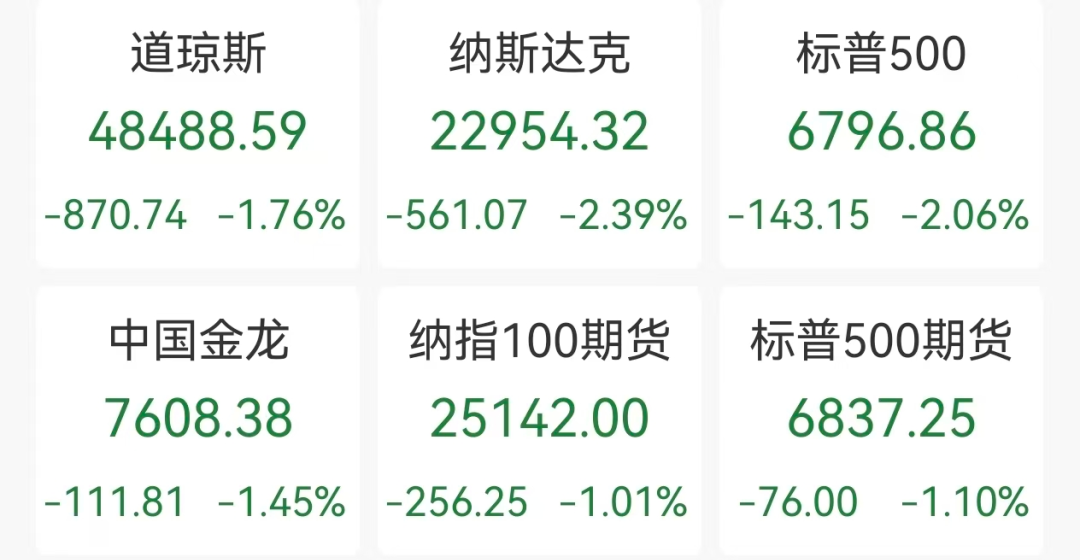
Market Overview - US stock indices experienced a significant decline, with the Dow Jones falling by 870 points (1.76%), the S&P 500 down by 143.15 points (2.06%), and the Nasdaq dropping by 561.07 points (2.39%) [1] - The Chicago Board Options Exchange Volatility Index (VIX), known as Wall Street's "fear index," surged above 20, reaching recent highs [1] Technology Sector - Major tech stocks saw substantial losses, with Nvidia and Tesla both dropping over 4%, while Apple and Amazon fell more than 3% [2][3] - Nvidia's stock price was reported at $178.07, down 4.38%, and Tesla at $419.25, down 4.17% [3] Streaming and Media - Netflix's post-market decline expanded to nearly 5% due to disappointing first-quarter earnings outlook and adjustments to its acquisition proposal for Warner Bros. assets to an all-cash offer totaling $82.7 billion [4] Semiconductor Industry - The semiconductor sector faced widespread declines, with Broadcom and Skyworks Solutions dropping over 5%, while TSMC fell more than 4% [4] Banking Sector - Bank stocks also fell across the board, with Citigroup down over 4% and JPMorgan and Morgan Stanley both declining more than 3% [4] Chinese Stocks - Chinese stocks mostly declined, with JinkoSolar down 12.5% and CenturyLink down over 10% [4][5] Bond Market - US Treasury yields rose to a four-month high, while the dollar index fell by 0.41%, marking its worst two-day performance in about a month [6] Precious Metals - Gold and silver prices reached new highs, with spot gold exceeding $4,763 per ounce and silver surpassing $94 per ounce [8][9] Cryptocurrency Market - The cryptocurrency market experienced a significant downturn, with Bitcoin dropping below $90,000 and Ethereum falling below $3,000, affecting approximately 163,000 traders [10][11]


Global Tensions Rock Markets: Tariffs Threat Send Stocks Tumbling, Safe Havens Soar on January 20, 2026
Stock Market News· 2026-01-20 22:07
Market Overview - U.S. equity markets faced a significant downturn on January 20, 2026, primarily due to escalating geopolitical tensions and President Trump's renewed tariff threats against several European nations [1][2] - The S&P 500 fell by 2.1%, marking its largest drop since October and turning negative for the year 2026 [2] - The Dow Jones Industrial Average decreased by 870 points (1.8%), while the Nasdaq Composite dropped by 2.4% [2] Geopolitical Impact - President Trump threatened to impose 10% tariffs on goods from Denmark, Norway, Sweden, France, Germany, the UK, the Netherlands, and Finland starting February 1, with a potential increase to 25% by June 1 if the U.S. is not allowed to purchase Greenland [2] - European markets also experienced declines, with France's CAC 40, Germany's DAX, and Italy's FTSE MIB all recording losses [2] Safe-Haven Assets - In response to market volatility, gold futures surged to a record high above $4,760 per ounce, while silver futures also reached an all-time high, surpassing $95 per ounce [3] - The yield on the 10-year Treasury note increased by seven basis points to approximately 4.29% [3] - The U.S. dollar index fell nearly 0.8% to 98.61, while West Texas Intermediate crude futures rose by 1.8% to about $60.55 per barrel [3] Technology Sector Performance - Technology stocks, particularly the "Magnificent Seven," faced significant declines, with Nvidia down 3.6%, Amazon down 3.7%, and Tesla off more than 3% [4] - Other major tech companies like Apple, Alphabet, Microsoft, and Meta Platforms saw declines ranging from 1.2% to 4.5% [4] Corporate Earnings - Microsoft remains a strong favorite among analysts, with 97% rating it as a "buy" and a median price target of $631 per share, indicating a potential 37% return over the next 12 months [5] - The company is heavily investing in AI data centers, planning to increase its total AI capacity by over 80% this year and nearly double its data center footprint over the next two years [5] - Companies like 3M and Fastenal reported quarterly results, with shares declining by approximately 7% and 2.5%, respectively, after announcements [6] Upcoming Earnings Reports - Netflix is scheduled to release its quarterly earnings report, with investors closely watching its all-cash deal to acquire Warner Bros. Discovery [7] - Other companies expected to report include Interactive Brokers Group, Progress Software, and United Airlines Holdings [7] Economic Indicators - The Consumer Price Index (CPI) for December showed inflation steady at 2.7% year-over-year, with the core rate at 2.6% year-over-year, both above the Federal Reserve's 2% target [9] - November's retail sales report indicated a broad-based gain of 0.6%, suggesting resilient consumer demand [9] Upcoming Economic Events - The week ahead includes crucial economic data and corporate earnings reports, with 31 S&P 500 companies set to release their fourth-quarter results [8] - Key economic data points to watch include GDP, Jobless Claims, Personal Income and Outlays, and the PMI Composite Flash [13]


英伟达收跌将近4.4%,特斯拉跌约4.2%,苹果和亚马逊至少跌3.4%



Mei Ri Jing Ji Xin Wen· 2026-01-20 21:42
Core Viewpoint - The Magnificent 7 index of major U.S. tech stocks experienced a decline of 3.08%, closing at 198.30 points [1] Group 1: Stock Performance - Nvidia saw a drop of 4.38% [1] - Tesla decreased by 4.17% [1] - Apple fell by 3.46% [1] - Amazon declined by 3.40% [1] - Meta Platforms dropped by 2.60% [1] - Alphabet (Google A) decreased by 2.42% [1] - Microsoft experienced a decline of 1.16% [1]
Billionaire Chamath Palihapitiya Says This Is the Best Artificial Intelligence (AI) Investment for 2026 (Hint: It's Not Even a Stock)
Yahoo Finance· 2026-01-20 21:20
Core Insights - Chamath Palihapitiya, a prominent venture capitalist and pioneer of the SPAC movement, is focusing on the commodities market for investment opportunities in 2026 [1][4] - Palihapitiya's background includes significant roles at AOL and Facebook, and he currently manages a venture capital firm called Social Capital [2][3] - His bold prediction for 2026 emphasizes investing in precious metals, particularly copper, as a key asset [10] Industry Trends - The current trend among sell-side analysts is to invest in hyperscalers like Microsoft, Alphabet, Amazon, and Meta Platforms, which are integrating AI into their ecosystems [6][7] - Chip designers such as Nvidia, AMD, Broadcom, and Micron Technology are seen as strong investment choices due to the AI infrastructure boom [7][8] - Palihapitiya suggests that the real opportunity lies in the raw materials necessary for building AI infrastructure, specifically highlighting copper as a hidden winner [9][10]


Amazon shoppers are switching to cheaper brands as Trump's tariffs raise prices, CEO Andy Jassy says
MarketWatch· 2026-01-20 21:20
Core Insights - Companies that bulk-ordered products last year to avoid tariffs are now facing inventory shortages, leading to rising prices as warned by Amazon's CEO [1] Group 1: Inventory and Pricing - Companies that stocked up on products in anticipation of tariffs are depleting their inventory [1] - The depletion of inventory is contributing to an increase in prices for consumers [1]

Amazon (AMZN) Seen as One of the Strongest AI Bull Cases Heading Into 2026, Bernstein Says
Yahoo Finance· 2026-01-20 20:36
Amazon.com, Inc. (NASDAQ:AMZN) is one of the AI Stocks Making Waves on Wall Street. On January 15, Bernstein SocGen Group analyst Nikhil Devnani reiterated an “Outperform” rating on the stock with a $300.00 price target. The analyst sees 2026 as the strongest bull case story ever since the pandemic, citing a palatable entry point for AMZN. In particular, the two performance indicators seen for Amazon are AWS revenue growth and retail margins, with both appearing to accelerate this year. Analysts at Berns ...
Amazon CEO Andy Jassy says tariffs are starting to drive up product prices
TechCrunch· 2026-01-20 19:50
Core Insights - Amazon CEO Andy Jassy indicates that consumers are starting to experience higher prices as sellers pass on costs from tariffs imposed by President Donald Trump [1][2] - Jassy noted a shift from the previous year when prices had not increased following the announcement of tariffs, suggesting that the impact of tariffs is becoming more pronounced [2] - Despite efforts to maintain low prices, Jassy acknowledged that price increases may be unavoidable due to the low operating margins in retail, particularly when costs rise significantly [3] Pricing Dynamics - Some sellers are choosing to pass on higher costs to consumers, while others are absorbing costs to maintain demand, indicating a mixed approach among sellers [2] - Consumers are showing resilience by shifting towards cheaper items and bargain hunting, while some are delaying premium purchases [3] Inventory Management - Amazon and its third-party sellers had previously stocked up on inventory to keep prices low, but this supply has largely been depleted since last fall, leading to potential price increases [1]

Amazon CEO Says Tariffs Bleeding Into Product Prices
PYMNTS.com· 2026-01-20 19:20
Core Insights - Amazon's CEO, Andy Jassy, indicated that White House tariffs are beginning to affect the prices of certain goods, marking a shift from previous statements where price increases were not observed [3][4]. Group 1: Impact of Tariffs on Pricing - Jassy noted that some sellers are passing on the higher costs from tariffs to consumers, while others are absorbing the costs to maintain demand, indicating a varied response among sellers [3]. - The inventory that Amazon and its third-party sellers had purchased in advance to mitigate tariff impacts has largely been depleted, leading to the current price adjustments [2]. - Jassy emphasized that while Amazon aims to keep prices low, there are instances where price increases are unavoidable due to the tariffs [4]. Group 2: Consumer Behavior and Economic Context - Despite the tariff impacts, consumers are reportedly resilient and continue to spend, although some are opting for less expensive alternatives or delaying larger discretionary purchases [4]. - A significant portion of American households, particularly those living paycheck to paycheck, are feeling the financial strain from modest cost increases, which can quickly affect their budgets [5]. - New data indicates that concerns about tariffs are widespread among consumers, reflecting ongoing financial pressures from inflation and uneven wage growth [6].