Broadcom(AVGO)

Search documents
深夜!全线崩跌,发生了什么?
券商中国· 2025-11-13 23:24
Market Overview - The US stock market experienced a significant sell-off, with the Dow Jones dropping nearly 800 points, the Nasdaq falling over 2%, and major tech stocks declining sharply, including Tesla which plummeted over 6% [1][3] - Concerns over high valuations in the tech sector have led to a wave of selling, particularly in AI-related stocks, as investors shift from an overweight position in tech to a more defensive stance [3][4] Economic Data Impact - The prolonged government shutdown has created a "data vacuum," severely impacting market expectations for Federal Reserve rate cuts, with the probability of a 25 basis point cut in December dropping to 50.7% from 70% [4][6] - The Labor Department's failure to release the October CPI report has left policymakers in a state of uncertainty regarding inflation and employment data, which are crucial for future monetary policy decisions [4][5] Federal Reserve's Stance - Federal Reserve officials are increasingly cautious about further rate cuts, emphasizing the need to maintain a restrictive policy to combat persistent inflation [6][8] - The current inflation rate remains above the Fed's target, and there are concerns that further easing could undermine the Fed's credibility in achieving its 2% inflation goal [7][8] Future Outlook - Analysts warn that the lack of economic data complicates the assessment of the economic outlook, with potential market volatility expected as data resumes publication [5][6] - Political risks remain, with indications that funding disputes may resurface in early 2024, potentially leading to another government shutdown [8]



美股三大股指收盘普跌 特斯拉跌超6%
Xin Lang Cai Jing· 2025-11-13 22:17
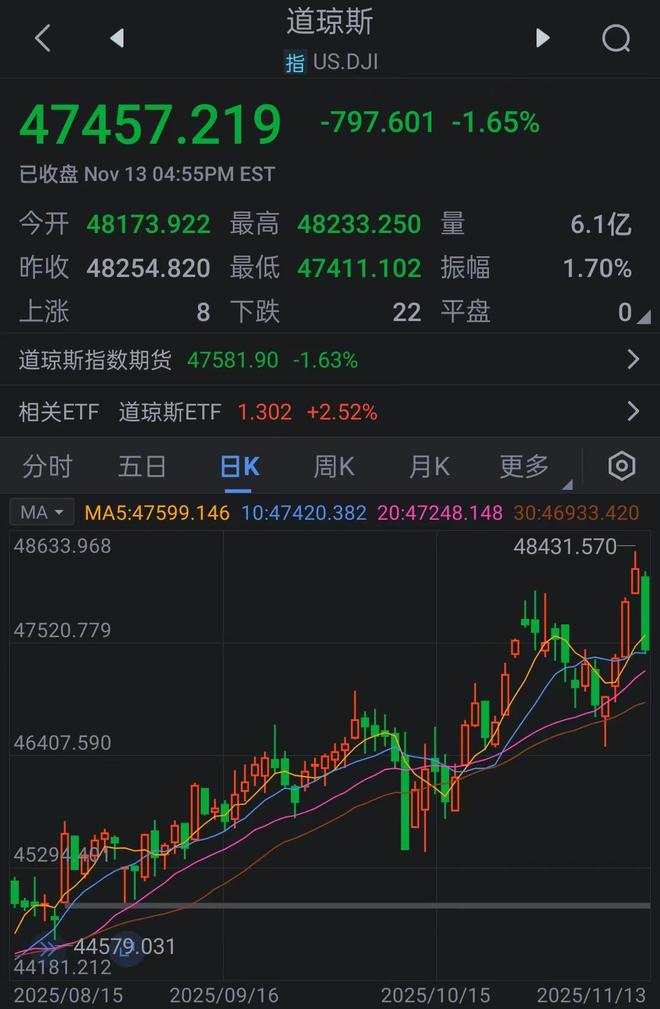
Group 1 - The three major U.S. stock indices closed lower, with the Dow Jones down 1.65%, the Nasdaq down 2.29%, and the S&P 500 down 1.65% [1] - Notable declines were observed in major tech stocks: Nvidia fell over 3%, Microsoft dropped over 1%, Google decreased over 2%, Amazon fell over 2%, Broadcom declined over 4%, Tesla dropped over 6%, and Oracle fell over 4% [1] Group 2 - The Dow Jones index closed at 47,457.219, down 797.601 points, with a trading volume of 610 million [2] - The index opened at 48,173.922, reached a high of 48,233.250, and had a low of 47,411.102, resulting in a trading range of 1.70% [2] - The Dow Jones futures were reported at 47,581.90, down 1.63% [2]




The Shutdown Is Over. Winter Is Usually Good For Stocks. Here's Why Investors Are Selling.
Yahoo Finance· 2025-11-13 21:23
Core Insights - The stock market faced a decline despite the end of the longest government shutdown in U.S. history, which was expected to positively impact equities [2][3] - President Trump signed legislation to reopen the federal government, alleviating economic pressure on over 1 million federal workers and allowing federal agencies to resume releasing important economic data [2] - The tech-heavy Nasdaq index led the decline, falling more than 2%, possibly indicating a "buy the rumor, sell the news" scenario [3] Market Trends - Historically, the end of government shutdowns has been beneficial for stock performance, with the S&P 500 showing gains in the one- and three-month periods following budget resolutions [5] - November has been the best month for the S&P 500 on average since 2000, and December often sees a "Santa Claus rally," yet current investor sentiment appears cautious due to concerns over an AI bubble and uncertain economic data [6] Sector-Specific Concerns - Tech stocks have been particularly affected by fears of an AI bubble, with significant declines in shares of companies like Nvidia and Palantir, despite the latter's strong earnings report [8][9] - The majority of the S&P 500's worst-performing stocks included high-profile AI beneficiaries, indicating a broader concern about the sustainability of the AI boom fueled by heavy investments in data centers [9]


Why Nasdaq 100 sinks nearly 2% as the US government reopens: why US stock market is down today - Nasdaq and Small Cap 2000 see the largest drops
The Economic Times· 2025-11-13 17:36
Market Overview - The stock market experienced significant declines, with the Nasdaq 100 dropping nearly 2% and the Small Cap 2000 seeing the largest percentage losses [1][10] - Major indices showed notable declines, with the Nasdaq Composite falling 1.75% to 22,997.79, the S&P 500 down 1.09% to 6,776.03, and the Dow Jones slipping 0.79% to 47,873.64 [17] Sector Performance - High-valuation tech stocks faced heavy selling, with Nvidia down about 4%, Tesla sinking more than 6%, and Alphabet and Broadcom both falling around 5% [2][11] - Disney plunged 9% after reporting weak revenue, contrasting with Cisco's gain of over 4% due to strong AI-related demand and positive guidance [14][19] - Small-cap stocks fell sharply as recession fears resurfaced, indicating a rotation into lower-valuation sectors such as healthcare and industrials [7][16] Economic Context - The reopening of the US government after a 43-day shutdown introduced uncertainty, as key inflation and jobs reports remain missing, complicating market expectations for the Federal Reserve's December meeting [3][12] - Rate-cut expectations shifted dramatically, with the odds of a December cut dropping from 95% a month ago to nearly 50-50, influenced by rising Treasury yields [5][13] - Analysts warned that the shutdown could reduce GDP by approximately $11 billion by 2026, adding to the economic uncertainty [5][12] Trading Trends - Investors are expected to face choppy trading conditions as missing economic data and shifting rate expectations create volatility [7][16] - The Nasdaq 100 remains the weakest index, continuing to pull major indices lower amid a broader market sell-off [8][19]

US stock market crash: Why Nasdaq falls big today — stock market is down as tech stocks tumble again
The Economic Times· 2025-11-13 17:04
Market Overview - The US stock market experienced a significant downturn, with the Nasdaq falling 1.7%, the S&P 500 dropping 1.1%, and the Dow slipping 382 points (0.8%) after reaching new highs earlier in the week [1][12][18] - Tech and AI stocks were particularly hard hit, with major declines in Nvidia, Broadcom, and Alphabet [1][6][7] Sector Performance - Traders shifted focus to value sectors, with healthcare, industrials, and financials showing relative strength, while small-cap stocks also rose [2][12] - The market breadth expanded beyond tech, but overall risk appetite diminished [2][12] Company-Specific Developments - Nvidia's shares fell approximately 4.18% to $185.71, driven by concerns over high valuations in the AI semiconductor market and tightened US export restrictions to China, which constitutes nearly 20% of its revenue [7][8] - Broadcom's stock declined by about 5.65% to $335.16, reflecting similar valuation concerns and competitive pressures in the semiconductor sector [9] - Alphabet's shares dropped around 2.28% to $280.89, amid fears of cooling demand for high-growth tech services and digital advertising [10] Economic Context - The end of the government shutdown added uncertainty to the market, with key inflation and jobs data remaining offline, leading to cautious investor sentiment [4][13] - U.S. Treasury yields increased, with the 10-year note yield rising to about 4.10%, contributing to downward pressure on high-growth tech stocks [15][16] Earnings Reports - Disney's stock fell 9% after reporting mixed fiscal Q4 results, with revenue of $22.46 billion missing expectations, although earnings per share beat estimates at $1.11 [2][14] - Firefly Aerospace's shares surged over 20% following a narrower loss and revenue beat, while Dillard's gained over 8% after reporting revenue of $1.49 billion and a 3% rise in comparable sales [3][14]
U.S. Stocks Move Sharply Lower, Dow Pulls Back Off Record Closing High
RTTNews· 2025-11-13 16:19
Market Overview - Major stock indices have experienced significant declines, with the Nasdaq down 417.09 points or 1.8 percent, the S&P 500 down 77.00 points or 1.1 percent, and the Dow down 351.82 points or 0.7 percent [2] - The Dow's pullback is attributed to a sharp decline in Disney's shares, which fell by 9.7 percent following the company's fiscal fourth quarter earnings report that exceeded analyst estimates but showed weaker-than-expected revenues [2] Sector Performance - Tech stocks are under pressure, with notable declines in Nvidia, Broadcom, and Alphabet, reflecting ongoing valuation concerns [3] - The NYSE Arca Computer Hardware Index dropped by 5.1 percent, while the Philadelphia Semiconductor Index fell by 3.5 percent, indicating substantial weakness in the semiconductor sector [4][5] - Networking stocks also declined, with the NYSE Arca Networking Index down by 3.0 percent despite positive earnings from Cisco Systems [5] - Other sectors such as brokerage, airline, and gold stocks have shown notable declines, while energy and pharmaceutical stocks have bucked the overall downtrend [5] Economic Context - The uncertainty in the market is compounded by the potential delay in the release of key U.S. economic reports due to the recent government shutdown, leaving traders and the Federal Reserve without critical data [4] - The yield on the benchmark ten-year treasury note has increased by 2.1 basis points to 4.100 percent, indicating a shift in the bond market following a previous rise [6] International Markets - In contrast to the U.S. market, stocks in the Asia-Pacific region mostly moved higher, with Japan's Nikkei 225 Index rising by 0.4 percent and China's Shanghai Composite Index advancing by 0.7 percent [5] - Major European markets, however, have declined, with the German DAX Index down by 1.2 percent, the U.K.'s FTSE 100 Index down by 1.0 percent, and the French CAC 40 Index down by 0.1 percent [6]



Stock Market Today: U.S. Stocks Have Worst Performance in Over Month As Traders Trim Rate Cut Bets, Gov't Reopens
Yahoo Finance· 2025-11-13 16:05
Market Overview - The U.S. markets experienced significant declines, with 75.6% of equities falling, marking one of the most bearish days in recent memory [2] - The Russell 2000 index fell by 2.8%, while the tech-heavy Nasdaq Composite dropped 2.29%, experiencing its worst day since October 10 [1][3] - The S&P 500 and Dow also faced declines of 1.66% and 1.65% respectively, ending a two-day rally [1] Technology Sector - Major technology stocks such as Tesla (-7.8%), Broadcom (-5.5%), and Nvidia (-4.8%) contributed to the overall market downturn [3][12] - The technology and industrial sectors are showing significant weakness, with many stocks in the capital markets also declining due to falling cryptocurrency values [4] Economic Indicators - Investors are uncertain about a potential rate cut at the Federal Reserve's upcoming meeting, with odds currently at 49.4% [5] - The reopening of the government is expected to bring delayed economic data, which could influence the Fed's decisions moving forward [6][23] Company Earnings - Virgin Galactic reported an EPS of -$1.09 and expects its first commercial spaceflight by Q4 2026, with most customers anticipated to fly in 2027 [1] - Disney's stock fell 9% after reporting adjusted earnings of $1.11 on $22.46 billion in revenue, missing revenue expectations of $22.75 billion [19][20] - Notable gainers included Cellebrite DI (+23%) and Ondas Holdings (+22.2%), both reporting strong earnings [7] Layoffs and Corporate Actions - Verizon is set to conduct its largest-ever layoff, cutting 15,000 jobs, which is about 15% of its workforce [18] - Bitdeer Technologies saw a significant drop of 18.9% after announcing a $148.4 million direct offering and a $400 million convertible bond sale, leading to concerns over dilution [9]
Nvidia Bought by Major Investor Betting on 'Broader' AI Growth
Benzinga· 2025-11-13 15:32
Group 1 - Nvidia Corp is gaining favor over Broadcom Inc as investors shift chip exposure, betting on Nvidia's broader graphics processing unit growth versus Broadcom's hyperscaler-heavy focus [1] - Nvidia became the first company to top the $4.5 trillion market cap in October [1] - Broadcom's stock has cooled after massive gains, while Nvidia is emerging as the preferred chip pick for its wider customer base and stronger long-term growth potential [1] Group 2 - Karen Firestone, executive chairman at Aureus Asset Management, is actively managing her portfolio by buying Nvidia shares while trimming her position in Broadcom [2] - Firestone's firm first bought Broadcom in June 2024, and the stock has since risen 160%, becoming a prominent position with significant long-term gains [3] - Aureus is increasing overall exposure to chips by adding Nvidia, noting that Nvidia's GPU business has broader growth potential than Broadcom's, which mainly serves hyperscalers [4] Group 3 - Firestone emphasized that Nvidia's broader customer base and stronger long-term opportunities make it the better buy now, while maintaining exposure to both companies for balance [4] - As of the latest check, Broadcom's stock traded 2.66% lower to $345.76, while Nvidia is down 2.49% [4]

Nancy Pelosi Is Retiring up 595%, but She’s Still Holding on to These 3 Stocks
Yahoo Finance· 2025-11-13 14:12
Core Insights - Nancy Pelosi announced her retirement, ending her term in January 2027, while holding significant stock positions in Nvidia, Alphabet, and Broadcom [1][3]. Company Holdings - **Nvidia (NVDA)**: Represents 20% of Pelosi's portfolio. The latest trade involved purchasing 50 call options with a strike price of $80, expiring on January 16, 2026. Since the trade, NVDA stock has increased by 47.09%, potentially yielding $569,000 if exercised today [4][5]. - **Alphabet (GOOGL)**: Comprises 15% of her portfolio. The latest transaction involved buying 50 call options, each representing 100 shares, with a significant gain of over 46% since the purchase. If exercised today, this would amount to $683,550 [6][7]. - **Broadcom (AVGO)**: Also accounts for 15% of her holdings, with recent trades showing gains exceeding 42% [7]. Investment Performance - Pelosi's investment strategy has yielded an impressive 858.58% return since mid-2014, significantly outperforming the S&P 500, which returned 263.2%, resulting in a 595% outperformance [3].
Megacap Tech Still Offers Plenty of Opportunity
Etftrends· 2025-11-13 13:19
Core Viewpoint - The Nasdaq-100 Index has increased approximately 22% year-to-date, driven by strong performances from major technology stocks, particularly the Magnificent Seven [1] Group 1: Market Performance - The Invesco Top QQQ ETF (QBIG) has outperformed with a year-to-date increase of 25.51% [3] - Concerns about stretched valuations in megacap tech stocks are present among investors, but these should not deter investment in ETFs like QBIG [2] Group 2: Economic Outlook - The economic outlook has improved since July, with Bloomberg consensus estimates for 2026 growth returning to 1.8%, close to trend levels [4] - Fiscal stimulus and a strong investment and capital spending outlook are expected to support growth into the next year [4] Group 3: Valuation Comparisons - The S&P 500 Information Technology Index trades at 42x earnings, significantly lower than the 67x seen during the tech bubble 25 years ago, suggesting current valuations are more justified [4] - Today's technology stocks are fundamentally stronger than those during the 1999-2000 period, with a return on equity for the tech sector slightly above 30%, compared to less than 20% historically [5][6] Group 4: Investment Considerations - QBIG is positioned as a better risk-adjusted investment in the tech sector due to its quality and profitability attributes, which are lacking in smaller, more speculative tech companies [7] - Recent performance trends indicate that leadership has shifted towards early-growth stocks and less profitable companies, rather than the Magnificent Seven or other mega-cap names [8]