
CKH HOLDINGS(CKHUY)

Search documents
兴证国际:首予香港中华煤气(00003)“增持”评级 有望受益于全国性的气量增长和价差修复
智通财经网· 2025-09-16 09:07
Core Viewpoint - Hong Kong and China Gas Company Limited has maintained a fixed dividend policy since 2009, with a consistent dividend payout of HKD 0.35 per share, leading to a significant increase in dividend payout ratio and total dividend amount over the years [1] Group 1: Dividend Policy and Financial Performance - The company has increased its dividend payout ratio from 44% in 2009 to 114% in 2024, with total dividends rising from HKD 2.3 billion to HKD 6.5 billion, reflecting a compound annual growth rate (CAGR) of 7.2% [1] - Forecasted net profit attributable to shareholders for 2025-2027 is expected to be HKD 58.48 billion, HKD 60.44 billion, and HKD 64.56 billion, representing year-on-year growth of 2.4%, 3.4%, and 6.8% respectively [1] Group 2: Hong Kong Gas Operations - The company is the sole gas supplier in Hong Kong, serving 2.04 million users with a penetration rate of 74% [2] - Despite a decline in gas consumption from 28,556 TJ to 27,159 TJ (a decrease of 4.9%) from 2013 to 2024, the company's EBITDA from Hong Kong operations has grown from HKD 4.2 billion to HKD 5.8 billion, with a CAGR of 3.0% [2] - The company benefits from a price adjustment mechanism that allows for biannual rate increases, which helps maintain stable revenue despite declining consumption [2] Group 3: Mainland China Operations - The company has expanded its mainland operations since 1994, covering 23 provincial regions, primarily in first and second-tier cities along the eastern coast and Chengdu-Chongqing area [3] - From 2019 to 2024, the gas sales volume has grown at a CAGR of 7.3%, aligning with the national consumption growth rate of 7.0% [3] - The company anticipates an increase in gas price differentials in mainland China, with projections of HKD 0.54, HKD 0.55, and HKD 0.58 per cubic meter for 2025-2027 [3] Group 4: Business Diversification and Green Energy - The company is restructuring its extended business segments, which include smart kitchens, insurance, and home safety, with significant market shares in Hong Kong but lower penetration in mainland China [4] - The company is also focusing on green energy initiatives, including green methanol, sustainable aviation fuel, and hydrogen, with production capacity expected to be released gradually from 2025 to 2028 [4] Group 5: Capital Expenditure and Cash Flow Management - Operating cash flow has slightly decreased from HKD 10.5 billion to HKD 9.0 billion between 2021 and 2024, while capital expenditure has reduced from HKD 10.2 billion in 2023 to HKD 6.0 billion in 2024 [5] - The company is optimizing non-core business operations and plans to introduce strategic investors to enhance its extended business segments [5] - Free cash flow is expected to gradually cover the annual fixed dividend of HKD 6.5 billion due to improved cash flow management and asset disposal strategies [5]

股权激励系列之一 | 股权激励与赴港上市2.0:董事长和高管应当关注的六大法律问题
3 6 Ke· 2025-09-15 02:27
Core Viewpoint - Equity incentives are crucial for attracting and retaining talent, as well as driving company growth, especially for companies preparing to list in Hong Kong. Companies must be aware of potential pitfalls and adopt a rigorous and professional approach to design and implement equity incentive plans [1][3]. Group 1: Trends in Equity Incentives for Chinese Companies - The prevalence of equity incentive plans among Chinese companies listed in A-shares, Hong Kong, and U.S. markets is on the rise, with 109 companies in Hong Kong announcing such plans in 2024, of which 82% are red-chip companies and 18% are H-shares [4]. - The focus of companies has shifted towards operational efficiency and cash flow accumulation, leading to a more cautious and refined approach to implementing incentive plans [4]. Group 2: Common Issues in Equity Incentives - Six main issues are identified, including mismatched incentive tools, foreign exchange registration requirements, shareholding structure design, high tax burdens, disclosure requirements, and cross-border incentive disputes [3]. - Companies often lack clarity on the granting mechanisms, exercise processes, and tax obligations related to equity incentives, which can lead to significant risks and costs [7]. Group 3: Mismatched Incentive Tools - Companies using the red-chip model often confuse equity incentives with stock options, overlooking other tools such as restricted stock and virtual stock, which can have different legal, financial, and tax implications [8]. - The choice of incentive tools can significantly impact the company's success and the tax burden faced by employees, potentially leading to costs in the hundreds of millions [8][9]. Group 4: Foreign Exchange Registration Issues - Companies must comply with the foreign exchange registration requirements for domestic residents holding shares in offshore companies, which can be cumbersome and costly if not managed properly [15][16]. - There are misconceptions about the necessity of registration for employees holding a small percentage of shares, which can lead to legal violations [16]. Group 5: Tax and Financial Implications - The tax burden from equity incentives can be substantial, with personal income tax rates reaching up to 45% upon exercising stock options, which can deter employee motivation [18][19]. - Companies must consider the financial impact of equity incentives on their financial statements, as share-based payments can significantly affect reported expenses and cash flow [21]. Group 6: Solutions and Best Practices - The use of equity incentive trusts (ESOP Trusts) can help mitigate tax burdens and streamline management processes for equity incentives [22][23]. - Companies should ensure that all legal documents related to equity incentives are meticulously prepared to avoid potential litigation and disputes in the future [27][30]. Group 7: Disclosure and Regulatory Compliance - Companies must disclose their equity incentive structures and related financial data to the Hong Kong Stock Exchange during the listing process, as failure to provide satisfactory information can delay the listing [25][26]. - The complexity of equity incentive plans necessitates thorough communication with legal, tax, and financial teams to ensure compliance with regulatory requirements [26].


服务贸易成全球经济增长和结构升级新引擎,中国如何抢占高地?
Di Yi Cai Jing· 2025-09-14 06:55
Core Insights - China's service trade has shown steady growth, with service exports reaching 1.7 trillion yuan in the first half of the year, a 15% increase year-on-year, and accounting for 11.5% of total exports, up 0.7 percentage points from the previous year [1][4]. Group 1: Service Trade Growth - The total service trade import and export volume reached 3.9 trillion yuan in the first half of the year, reflecting an 8% year-on-year growth [1]. - Traditional service sectors such as transportation and travel have driven the growth, with transportation service exports at 418.5 billion yuan (up 23.9%) and travel service exports at 174.87 billion yuan (up 68.7%) [4]. - Knowledge-intensive service exports reached 865.04 billion yuan, growing by 7.8%, indicating a significant increase in international competitiveness [4]. Group 2: Global Value Chain (GVC) Dynamics - The role of service trade in the global value chain has become increasingly prominent, with high-value segments like R&D, finance, and logistics being essential components [2]. - The interaction between goods and service trade is reciprocal, with services supporting cross-border goods movement and vice versa [5]. Group 3: Future Opportunities and Policy Support - The global service trade is expected to grow, with the WTO projecting a 4% increase in global service exports by 2025 [6]. - China's service trade is anticipated to benefit from a supportive policy environment, with measures to enhance service export capabilities and digital trade initiatives [7][9]. - The focus on digital trade and high-level openness is expected to facilitate China's transition from a manufacturing hub to a service and innovation center [7][8].

股市先涨为敬!李在明回顾执政百天,称韩国将进入“增长和飞跃时间”
Di Yi Cai Jing· 2025-09-11 07:47
Group 1: Political Landscape - The approval rating for President Lee Jae-myung has risen to 56%, marking a 2.4 percentage point increase over the past week, reflecting a positive trend in public perception of his governance [1][2] - Lee Jae-myung's administration is characterized by a focus on restoring and stabilizing the government after the previous administration's turmoil, with a notable emphasis on direct communication with the public [2][5] Group 2: Economic Measures - The new government prioritizes economic recovery and has introduced basic income policies, distributing consumer vouchers ranging from 150,000 to 550,000 KRW (approximately 770 to 2800 RMB) to stimulate spending [4][5] - Recent economic indicators show a rebound, with the KOSPI index surpassing 3300 points, and small business sales increasing by 6.44% year-on-year during a recent four-week period [4][5] - The Bank of Korea has revised its GDP growth forecast for the year from 0.8% to 0.9%, with a reported 0.7% quarter-on-quarter growth in Q2, the highest since Q1 2024 [5][6] Group 3: Foreign Relations Challenges - President Lee faces complex diplomatic challenges, particularly in managing relations with the U.S., highlighted by recent tensions over the detention of Korean workers in the U.S. [7][8] - The U.S. has imposed tariffs and is requiring increased investment from South Korea, complicating the economic landscape for Korean companies operating in the U.S. [7][8] - Lee's initial foreign visits included Japan, aiming to foster better relations, but potential shifts in Japan's political landscape could complicate future diplomatic efforts [8][9]

热搜爆了!董事长和明星女友 双双被拘!视频曝光
Zhong Guo Ji Jin Bao· 2025-09-09 07:29
Core Points - A company chairman was detained for insider trading after revealing confidential information to his celebrity girlfriend, leading to significant public interest and media coverage [1][3]. - The chairman's actions resulted in a financial loss of 5 million yuan due to a failed restructuring attempt [3]. - The celebrity, identified as Chu Yinan, had previously faced penalties from the China Securities Regulatory Commission (CSRC) and was fined 400,000 yuan for her involvement in insider trading [5][7]. Company and Industry Summary - The case highlights the risks associated with insider trading within the corporate environment, particularly involving high-profile individuals [3][5]. - The relationship between Chu Yinan and the chairman, Zheng Mouwen, was characterized by frequent communication, which raised red flags regarding potential insider trading activities [7]. - The investigation revealed that Chu Yinan used funds provided by Zheng Mouwen for her trading activities, further complicating the legal implications of the case [5][7].
高盛:美股多头继续押AI 空头担心增长和集中度
智通财经网· 2025-09-08 08:57
调查还显示,投资者对中国市场的兴趣正在回升。当被问及本月美股(S&P 500)和中国股市(MSCI China)谁将表现更佳时,投资者的看法几乎各占一半,显示出对中国市场的关注度已与美股旗鼓相 当。数据显示,高达62%的受访者计划维持或增加其在中国股市的头寸。这反映了市场在夏季经历强劲 反弹后吸引力的提升,但报告同时指出,近期市场的一些动态令部分投资者的热情有所降温,引发了对 潜在回调风险的关注。此外,美元的走势也再次成为焦点。继上月短暂反弹后,做空美元的共识似乎重 新占据上风。不过,对于驱动美元在年内剩余时间走势的关键因素——无论是利率差、美联储政策还是 全球储备多元化——投资者之间尚未形成明确的共识。 黄金为王:做多意愿达到记录最高点 引人注目的是,在众多资产类别中,黄金成为了最无争议的选择。据调查报告,看好金价走势的投资者 与看空者的比例达到了接近8比1。这是黄金首次在高盛调查中成为最受欢迎的多头交易,其热度是"史 无前例的",甚至超越发达市场股票。报告分析,无论是预期美联储即将开启降息周期的多头,还是担 忧美联储独立性、寻求避险的空头,都将黄金视为理想配置。此外,来自各国央行和潜在私人投资者的 需求, ...
高盛市场调研:进入9月,美股多头继续押AI,空头担心增长和集中度,所有人都看多黄金
Sou Hu Cai Jing· 2025-09-08 00:26
Group 1: Market Sentiment - Global institutional investors exhibit a divided market sentiment, with a strong consensus emerging on the bullish stance towards gold [1][3] - A survey of 804 institutional investors indicates a split between bullish and bearish camps, with concerns about economic slowdown and market concentration risks [2] Group 2: AI and Technology Stocks - The bullish camp remains optimistic about U.S. stocks, particularly the "Magnificent 7" tech giants, believing the AI narrative is far from over [2] - Over half of the respondents plan to maintain or increase their long positions in the "Magnificent 7," although new capital inflows are showing slight declines [2] Group 3: Gold Investment - Gold has become the most uncontroversial investment choice, with a ratio of nearly 8 to 1 favoring bullish sentiment over bearish [3] - The demand for gold is driven by expectations of an impending Federal Reserve rate cut and concerns over the Fed's independence, making it an ideal asset for both bulls and bears [3] Group 4: Interest in Chinese Market - Investor interest in the Chinese market is on the rise, with 62% planning to maintain or increase their positions in Chinese stocks [4] - The survey shows nearly equal expectations for the performance of U.S. stocks (S&P 500) and Chinese stocks (MSCI China), reflecting heightened attention towards China [4] Group 5: Dollar Sentiment - The consensus for shorting the dollar has re-emerged, following a brief rebound last month, although there is no clear agreement on the key factors influencing the dollar's performance [4]
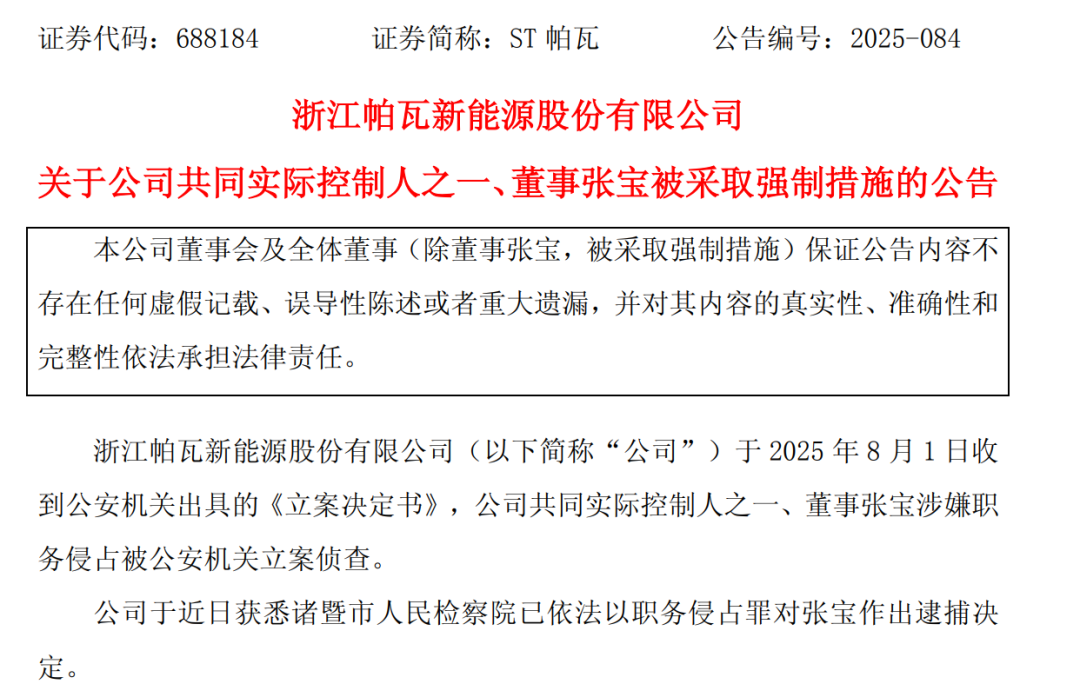
涉嫌侵占公司1.9亿元资金,张宝被批捕!他是大学博导,从教书到经商,成为上市公司董事长和实控人
Mei Ri Jing Ji Xin Wen· 2025-09-07 11:21
Core Viewpoint - ST Pava is currently facing significant challenges due to the investigation of its co-actual controller and director, Zhang Bao, for alleged embezzlement, which has raised concerns about the company's governance and financial practices [1][10]. Company Overview - ST Pava specializes in the research, production, and sales of new energy battery materials, focusing on lithium-ion and sodium-ion battery cathode materials, while also exploring solid-state battery technologies [4]. - Zhang Bao, aged 54, has held various academic and managerial positions, including serving as the general manager and chairman of ST Pava since 2019, before resigning in May 2025 due to health reasons [4][6]. Recent Developments - On August 1, 2025, ST Pava received a notice from law enforcement regarding the investigation of Zhang Bao for embezzlement, and he has since been arrested [1]. - As of June 24, 2025, Zhang Bao was the second-largest shareholder of ST Pava, holding 16.56 million shares, which accounted for 10.41% of the company [5]. - The company reported that other board members and senior management are continuing their duties normally, and the company's control has not changed [1]. Financial Issues - Zhang Bao has been involved in financial discrepancies, including the misappropriation of company funds totaling 191 million yuan, with 30 million yuan already returned to the company [10]. - The company has faced multiple warnings from regulatory bodies regarding inaccurate financial disclosures, including inflated revenue and improper management of company assets [10][11]. Market Performance - As of the last report, ST Pava's stock closed at 10.83 yuan, reflecting a 4.64% increase, with a market capitalization of 1.722 billion yuan [11][13].

高盛:美股多头继续押AI 空头担心增长和集中度 共识看多黄金
智通财经网· 2025-09-07 04:04
Group 1: Market Sentiment - The market sentiment among global institutional investors is showing a clear split, with bullish investors focusing on AI-driven tech stocks while bearish investors are increasingly wary of economic slowdown and market concentration risks [1][2] - A strong consensus has emerged that regardless of bullish or bearish views, there is a collective inclination to go long on gold, marking it as a common choice among investors [1] Group 2: Bullish and Bearish Perspectives - The survey of 804 institutional investors indicates that while overall risk sentiment has improved, two distinct camps have formed: the bullish camp remains optimistic about U.S. stocks, particularly the "Magnificent 7," while the bearish camp is concerned about the extent of the U.S. economic slowdown and concentration risks posed by large tech stocks [2] - Over half of the respondents plan to maintain or increase their long positions in the "Magnificent 7," although there is a slight decline in new capital inflows into this trade [2] Group 3: Gold Investment - Gold has emerged as the most uncontroversial asset choice, with a ratio of nearly 8 to 1 favoring bullish investors over bearish ones, marking a record high in the Goldman Sachs survey [3] - Both bullish investors anticipating a Federal Reserve rate cut and bearish investors seeking safe-haven assets view gold as an ideal allocation, supported by demand from central banks and potential private investors [3] Group 4: Focus on China and Dollar Sentiment - Investor interest in the Chinese market is on the rise, with 62% of respondents planning to maintain or increase their positions in Chinese stocks, reflecting a strong rebound in the market [4] - There is a renewed focus on the U.S. dollar, with a consensus emerging to short the dollar again, although there is no clear agreement among investors on the key factors driving the dollar's performance for the remainder of the year [4]
高盛市场调研:进入9月,美股多头继续押AI、空头担心增长和集中度、所有人都看多黄金
Hua Er Jie Jian Wen· 2025-09-07 02:44
Group 1 - The market sentiment among global institutional investors is showing a clear split, with bullish investors chasing AI-driven tech stocks while bearish investors are increasingly wary of economic slowdown and market concentration risks [1][2] - A strong consensus has emerged that regardless of bullish or bearish views, going long on gold has become a common choice among all investors, with a ratio of nearly 8 to 1 favoring bullish positions on gold [3] Group 2 - The survey of 804 institutional investors indicates that while overall risk sentiment has improved, two distinct camps have formed: the bullish camp remains optimistic about U.S. stocks, particularly the "Magnificent 7," while the bearish camp is concerned about the potential for a more severe economic slowdown and concentration risks in large tech stocks [2] - Interest in the Chinese market is on the rise, with 62% of respondents planning to maintain or increase their positions in Chinese stocks, reflecting a rebound in market attractiveness after a strong summer [4] - The consensus on the U.S. dollar has shifted again, with a renewed inclination to short the dollar, although there is no clear agreement among investors on the key factors driving the dollar's performance for the remainder of the year [4]
