Deutsche Bank AG(DB)

Search documents
德银、渣打据悉将研究扩大在美加密业务
news flash· 2025-04-21 10:20
Group 1 - Deutsche Bank and Standard Chartered are reportedly considering expanding their cryptocurrency operations in the United States [1] - No further details about the plans have been disclosed [1] - Deutsche Bank declined to comment on the report, while Standard Chartered did not respond to requests for comment [1]

香港交易所信息显示,德意志银行在理想汽车-W的持股比例于04月14日从17.03%降至16.70%。
news flash· 2025-04-17 09:08
Group 1 - Deutsche Bank's stake in Li Auto-W decreased from 17.03% to 16.70% on April 14 [1]
德意志银:关税暂缓之后:美中的四大市场主题
2025-04-16 03:02
Summary of Key Points from the Conference Call Industry and Company Involved - The conference call primarily discusses the **US-China trade relationship** and its implications for global markets, focusing on the economic interdependence between the two nations. Core Themes and Arguments 1. **Reducing Economic Dependency** - The US is aiming to reduce its economic reliance on China, prioritizing national security. Historical parallels are drawn to the early 20th century trade dynamics between the UK and Germany, highlighting the risks of high interdependence during geopolitical tensions. The current tariff levels on Chinese goods exceed 100%, indicating a significant trade decoupling is underway [3][4][10]. 2. **Refocusing Tariffs on US-China Trade** - The US has eased tariffs on most countries while increasing them on China, clarifying the focus of the trade conflict. China represents 32% of global production but only 12% of consumption, while the US accounts for 29% of consumption and 15% of production. This imbalance necessitates a shift where the US aims to increase production and China needs to boost consumption [4][17]. 3. **Global Economic Choices** - Countries worldwide will need to choose between aligning with US or Chinese demand. Energy importers may favor the US, while commodity exporters might lean towards China. The size of economies will play a crucial role in their leverage in trade negotiations [5][17]. 4. **Long-term USD/CNY Exchange Rate Dynamics** - The USD/CNY exchange rate is expected to be influenced more by persistent shocks to real interest rates rather than just tariff levels. High tariffs could lead to inflation in the US and deflation in China, potentially resulting in a stronger CNY in the long run, which would help correct trade imbalances [8][12][14]. Additional Important Insights - **Trade Dependence Statistics** - The bilateral trade between the US and China remains significant, with historical comparisons indicating that such high levels of trade can lead to drastic changes during conflicts, as seen in past global wars [10][17]. - **Impact of Tariffs on Inflation and Consumption** - The imposition of tariffs is likely to create inflationary pressures in the US while exerting deflationary effects in China, which could shift real interest rates favorably for the CNY [8][14]. - **Supply Chain Strain** - Ongoing tensions and tariff adjustments are expected to keep supply chains under pressure, affecting corporate operations globally [5]. This summary encapsulates the critical themes and insights from the conference call, providing a comprehensive overview of the current state and future implications of the US-China trade relationship.
德意志银行研究:年底金价有望突破3350 美元/ 盎司
Cai Jing Wang· 2025-04-14 07:52
Core Viewpoint - Deutsche Bank's precious metals analyst Michael Hsueh maintains a strong long-term bullish outlook for gold, raising the price forecast for the end of 2025 to $3,350 per ounce [1] Traditional Drivers Still Impactful - Since mid-February, the primary drivers for gold price increases have been traditional financial factors, including a decline in market risk appetite due to redefined U.S. tariffs, fluctuations in the U.S. dollar, falling U.S. Treasury yields, and a weak stock market [2] - The sensitivity of gold prices to traditional macro indicators remains significant, indicating potential short-term volatility due to changes in investment flows or central bank gold reserve adjustments [2] Central Bank Gold Accumulation Reshaping Pricing Logic - Central banks' continuous accumulation of gold has become a crucial support factor for gold prices, with global central bank gold purchases rising from 10% to 24% of total market demand since 2022, doubling the average purchase volume from 2011-2021 [3] - The main motivations for central banks to buy gold include long-term value preservation or inflation hedging (88%), performance during crises (82%), and portfolio diversification (76%) [3] - A survey indicates that 66% of central banks expect to increase gold's share in reserve assets, up from 46% in 2022, while 49% anticipate a decline in U.S. dollar reserves over the next five years [3] ETF Investors Joining Chinese Insurance Capital in Gold Trading - Private investment demand is showing signs of recovery, with global gold ETFs experiencing positive growth for the first time in two and a half years in February 2025 [4] - China's gold ETF purchases reached 1.47 million ounces in 2024, more than four times the volume in 2023, marking the highest annual increase since 2015 [4] - The potential allocation scale from participating institutions is estimated at $25 billion, equivalent to approximately 7% of global annual gold production, which could combine with central bank purchases to account for 30% of total gold market demand [4][5] Strong Adaptability of Asian Gold Import Demand to High Prices - Despite a decline in gold jewelry consumption to 38%, Asian non-monetary gold import demand is gradually adapting to rising prices, with long-term recovery potential [6] - Deutsche Bank predicts that even if gold prices exceed $3,000 per ounce, demand for jewelry, gold bars, and coins in the Asia-Pacific region will remain resilient [6] Structural Bull Market Foundation Solid - The trend of central banks increasing gold reserves is expected to continue amid rising geopolitical risks and challenges to the dollar's reserve status [7] - The return of ETF funds and the active participation of Chinese insurance capital are likely to strengthen gold investment demand, further solidifying the upward price foundation for gold [7]
香港交易所信息显示,德意志银行在理想汽车-W的持股比例于04月07日从17.13%降至16.97%。
news flash· 2025-04-10 09:22
Group 1 - Deutsche Bank's stake in Li Auto-W decreased from 17.13% to 16.97% on April 7 [1]
Is Palomar Holdings (PLMR) Stock Outpacing Its Finance Peers This Year?
ZACKS· 2025-04-08 14:40
Investors interested in Finance stocks should always be looking to find the best-performing companies in the group. Has Palomar (PLMR) been one of those stocks this year? A quick glance at the company's year-to-date performance in comparison to the rest of the Finance sector should help us answer this question.Palomar is a member of the Finance sector. This group includes 859 individual stocks and currently holds a Zacks Sector Rank of #4. The Zacks Sector Rank gauges the strength of our 16 individual secto ...


Stocks, the economy, and the entire world order are at risk if Trump doubles down on tariffs, Deutsche Bank says
Business Insider· 2025-04-07 11:39
Core Viewpoint - Deutsche Bank warns that President Trump's tariff plans could jeopardize the stock market, the economy, and the global order, with tariffs of at least 10% on goods from nearly all foreign nations causing significant market turmoil [1][2]. Group 1: Economic Impact - Trump's tariffs have led to the fourth-worst two-day decline in stocks since World War II, indicating severe market reactions [2]. - Deutsche Bank's researchers describe the tariff rollout as the largest shock to the global trading system since the 1970s and the biggest tax increase for US consumers since the Vietnam War [3]. - The existing trade regime has contributed to rising US wealth, benefiting companies and shareholders through improved supply chains and access to cheaper labor, but ending it could increase costs and reduce profit margins [4]. Group 2: Market Predictions - Deutsche Bank forecasts less than 1% growth for the US economy this year, with unemployment nearing 5% and core inflation rising to around 4% [5]. - UBS economists predict a reduction in real US GDP growth from 1.6% to 0.4% this year, alongside a forecast of 2.2% price growth and core inflation at 4.6% by year-end [7]. Group 3: Future Implications - The potential failure of international trade deals could have significant implications for US relationships in defense, geopolitics, and the multilateral rules-based world order [6].


刚刚!全线暴跌!
券商中国· 2025-04-04 11:33
欧洲股市、美股期货、石油、铜、白银,全线跳水! 今日,针对美国的"对等关税",中国发出反制措施,对原产于美国的所有进口商品,在现行适用关税税率基础上加征34%关税。此外,中国商务部、海关总 署六箭齐发,宣布将16家美国实体列入出口管制管控名单、对中重稀土相关物项实施出口管制、暂停6家美国企业产品输华资质、将11家美国企业列入不可靠 实体清单、对进口医用CT球管发起产业竞争力调查、在世贸组织起诉美"对等关税"等。 在贸易战升级的背景下,欧洲股市跌势不止。4月4日,欧洲股市全线暴跌,盘中跌幅持续扩大,截至19点,意大利富时MIB指数跌超7%,西班牙IBEX指数 跌近6%,德国DAX指数跌近5%,法国CAC 40指数跌超4%,英国富时100指数跌3.8%。 欧洲的银行股跌幅较大,斯托克欧洲600银行指数大跌超10%。德意志银行股价盘中大跌超11%,预计将出现2024年7月以来最糟糕的一天。德国商业银行跌 超7%,有望创下2023年3月以来最糟糕的一天。美股期货也大幅下挫,纳斯达克100指数期货、标普500指数期货均跌超3%,道指期货跌近3%。 其他品种方面,欧元对美元汇率在前一天上涨1.8%后下跌0.5%至1.09 ...



Deutsche Bank Stock: A Technical Breakout in the Making
Schaeffers Investment Research· 2025-03-26 16:08
Group 1 - Deutsche Bank AG has been gradually recovering from the financial crisis that occurred over 15 years ago, with shares forming a long-term rounding pattern indicating a significant accumulation process [2] - A breakout above the $15 level in 2024, followed by retests, suggests that 2025 may present promising opportunities for Deutsche Bank [2] - The 50-week moving average has crossed over a rising 200-week trendline, indicating positive momentum [3] Group 2 - Short interest peaked in 2020 and has been decreasing since, indicating potential buying power, as it would take five days for shorts to fully cover their positions [3] - Despite a 12-month average price target of $20.57, there remains pessimism among analysts, with three "hold" or worse ratings, suggesting that Deutsche Bank stock is positioned for potential bullish movements [5]

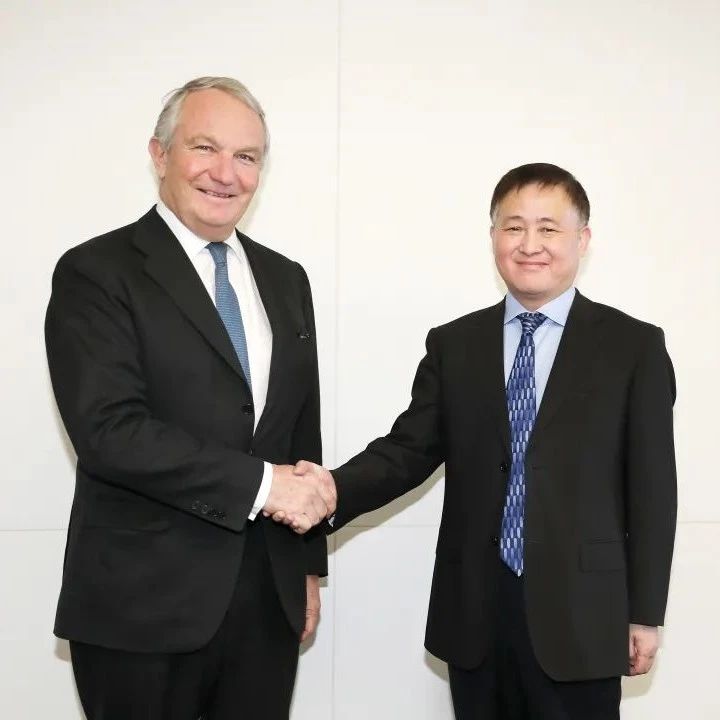
潘功胜会见德意志银行集团主席
证券时报· 2025-03-22 09:33
Group 1 - The meeting between the Governor of the People's Bank of China, Pan Gongsheng, and Deutsche Bank Group Chairman, Christian Sewing, focused on global economic and financial conditions, China's macroeconomic policies, and the country's financial openness [1] Group 2 - The article mentions significant developments in various sectors, including major announcements from Tencent and Tesla, as well as financial misconduct involving company 300630, which has initiated delisting procedures [2]