Disney(DIS)

Search documents
特朗普关税战,逼死美国电影?
3 6 Ke· 2025-05-07 11:50
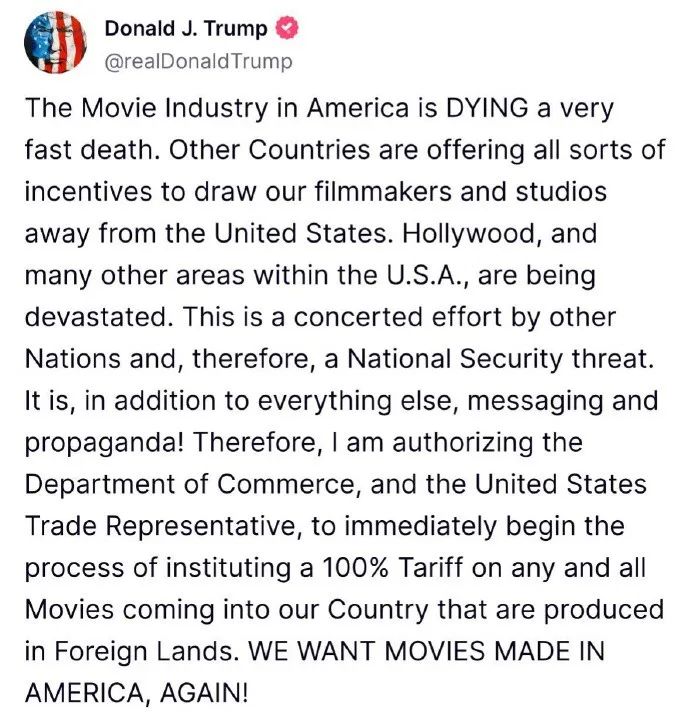
Core Viewpoint - The announcement by Trump to impose a 100% tariff on films produced abroad and entering the U.S. is aimed at protecting the domestic film industry, citing national security concerns and the need to combat excessive foreign influence in media [2][3]. Group 1: Impact on Hollywood - Following the tariff announcement, stock prices of major Hollywood studios dropped significantly, with Paramount down 2.2%, Disney 2.4%, Netflix 3.3%, and Warner Bros. 4.2% [3]. - The U.S. film industry has been gradually moving production overseas due to high labor costs, particularly in California, where Hollywood is located [5][8]. - The 2023 strike in Hollywood highlighted the industry's reliance on labor, with discussions around job losses due to the rise of artificial intelligence [5][24]. Group 2: Global Film Production Trends - As of October 2024, 120 countries and regions have implemented film production incentive policies to attract projects, benefiting from increased investment and job creation [11]. - Countries like Spain and Iceland have reported high returns on investment for film incentives, with Spain achieving a return index of 9 from 2019 to 2022 [12]. - Since 2022, U.S. film production has decreased by 26%, while global film production has surged, with a 34% year-on-year growth in the first quarter of 2025 [13]. Group 3: Economic Implications - The cost savings from relocating film projects can range from 20% to 40%, prompting many major productions to move overseas [22][23]. - Upcoming Hollywood films, such as "Mission: Impossible 8" and "Avatar 3," are being produced in countries like the UK and New Zealand, respectively [23]. - The shift in production has resulted in a significant decline in job opportunities for U.S. film industry workers, with a 25% reduction in employment over the past three years [24]. Group 4: Political Context - Trump's policies appear to be more about political maneuvering against Hollywood, which has historically opposed him, rather than genuine concern for the industry [25][28]. - The imposition of tariffs may provoke retaliatory measures from other countries, potentially harming the U.S. film industry's global standing [31][35]. - The announcement of the tariff was quickly followed by a statement from the White House indicating that the policy was not finalized, reflecting the uncertainty surrounding Trump's trade strategies [37].



迪士尼(DIS.N)2025财年Q2营收为236.2亿美元,Q2 EPS为1.81美元。
news flash· 2025-05-07 10:59
Core Insights - Disney's Q2 revenue for fiscal year 2025 reached $23.62 billion, indicating a strong performance in the quarter [1] - The earnings per share (EPS) for Q2 was reported at $1.81, reflecting the company's profitability during this period [1] Financial Performance - The total revenue of $23.62 billion represents a significant figure for the company, showcasing its ability to generate substantial income [1] - The EPS of $1.81 highlights the company's effective cost management and operational efficiency, contributing to its overall financial health [1]
迪士尼(DIS.N):二季度娱乐部门运营收入为12.6亿美元。
news flash· 2025-05-07 10:59
Group 1 - The core point of the article is that Disney's entertainment segment reported an operating income of $1.26 billion for the second quarter [1] Group 2 - The reported operating income reflects the performance of Disney's entertainment division during the specified period [1]
迪士尼(DIS.N):第三季度迪士尼+订阅业务季率预计将温和增长。
news flash· 2025-05-07 10:59
Group 1 - The core viewpoint indicates that Disney's subscription business for Disney+ is expected to see moderate growth in the third quarter [1] Group 2 - The anticipated growth in Disney+ subscriptions suggests a positive trend in user engagement and retention [1]
Disney Reports Better-Than-Expected Quarterly Numbers Driven By Sports And Experiences
Deadline· 2025-05-07 10:54
Core Insights - Disney's fiscal second quarter results exceeded expectations, driven by strong performance in its Sports and Experiences divisions, with revenue reaching $23.6 billion, a 7% increase year-over-year [1][2] - Earnings per share rose to $1.45 from $1.21 in the previous year, indicating solid financial health [1] Revenue Performance - The Sports division saw a significant boost from the expanded College Football Playoff and an additional NFL game, leading to a 29% increase in domestic ad revenue [2] - Revenue from Domestic Parks and Experiences increased by 13%, while Consumer Products revenue climbed by 14% [3] Streaming Growth - Direct-to-consumer operating profit in streaming rose by $289 million to $336 million, marking a positive trend after a challenging five-year rollout of Disney+ [3] - Disney+ subscribers reached 126 million, an increase of 1.4 million from the previous quarter, while the Disney+-Hulu bundle grew by 2.5 million to 180.7 million [4] Future Outlook - CEO Bob Iger expressed optimism about the company's growth trajectory, highlighting upcoming theatrical releases, the launch of ESPN's new direct-to-consumer offering, and numerous expansion projects in the Experiences segment [4]

Disney(DIS) - 2025 Q2 - Quarterly Results
2025-05-07 10:52
FOR IMMEDIATE RELEASE Exhibit 99.1 May 7, 2025 Total segment operating income and diluted EPS excluding certain items (also referred to as adjusted EPS) are non-GAAP financial measures. The most comparable GAAP measures are income before income taxes and diluted EPS, respectively. See the discussion on pages 17 through 21 for how we define and calculate these measures and a quantitative reconciliation thereof to the most directly comparable GAAP measures. (1) "Our outstanding performance this quarter—with a ...
OpenAI计划30亿美元收购Windsurf;分众传媒拟收购新潮传媒100%股权
Sou Hu Cai Jing· 2025-05-07 05:40
Mergers and Acquisitions - OpenAI plans to acquire Windsurf for approximately $3 billion, marking its largest acquisition to date aimed at enhancing its technological capabilities in the AI sector [2] - Intel is selling 51% of its stake in Altera to Silver Lake for an estimated valuation of $8.75 billion, as part of its strategy to improve its balance sheet [3] - Harman International is acquiring Masimo's audio business for $350 million, with the deal expected to close by the end of the year [4] - Infosys has reached a final agreement to acquire The Missing Link, an Australian cybersecurity firm, to strengthen its cybersecurity capabilities [5] - DoorDash is set to acquire UK-based food delivery company Deliveroo for approximately $3.9 billion, expanding its international footprint [6] - Uber plans to acquire 85% of Turkish food delivery platform Trendyol GO for about $700 million, pending regulatory approval [7] - Lyft is acquiring European ride-hailing app FreeNow for approximately €175 million ($197 million), with the deal expected to close in the second half of 2025 [8] - Hugging Face is entering the robotics field by acquiring Pollen Robotics, although the financial terms of the deal were not disclosed [9] - WPP is acquiring data collaboration platform InfoSum to enhance its AI-driven data services [10] - CleverTap is acquiring rehool.ai to strengthen its customer retention services [11] - Focus Media plans to acquire New潮传媒 for an estimated valuation of 8.3 billion yuan [13] - China Mobile intends to acquire approximately 15.46% of Hong Kong Broadband for about HKD 1.2 billion [14] - IBM has completed the acquisition of Hakkoda to expand its data transformation services [15] - FuboTV is under investigation by the U.S. Department of Justice regarding its acquisition by Disney, focusing on potential market concentration issues [19] - Universal Music's acquisition of Downtown Music is facing an EU investigation due to potential competitive impacts [20] - Onsemi has withdrawn its acquisition offer for Allegro Microsystems, citing reluctance from Allegro's board [21]



特朗普加征“100%电影关税”:“大刀”重创好莱坞?
3 6 Ke· 2025-05-07 00:16
Core Viewpoint - The announcement of a 100% tariff on foreign-made films by the U.S. government is seen as a misguided attempt to protect the American film industry, which is already facing significant challenges and may lead to adverse effects on Hollywood and the broader entertainment sector [2][3][5]. Group 1: Impact on the Film Industry - The U.S. film industry is experiencing a rapid decline, with foreign countries offering incentives to attract American filmmakers, leading to a significant loss of talent and production [2][3]. - Major media stocks fell sharply following the announcement, with Netflix down 4.55%, Lions Gate Entertainment down 8.5%, and Warner Bros. Discovery down 2.6% [2]. - The proposed tariffs could substantially increase production costs for Hollywood studios and trigger a global upheaval in the entertainment industry [2][3]. Group 2: Economic and Legal Concerns - Industry associations have urged Congress to carefully evaluate the economic and legal implications of the tariff policy, arguing that it will not revive Hollywood but rather have the opposite effect [2][3]. - The U.S. film industry had a trade surplus of $15.3 billion in 2023, with exports amounting to $22.6 billion, indicating that the film sector is not in the same position as the manufacturing sector that faces trade deficits [3]. Group 3: Structural Challenges - Hollywood is facing a structural crisis exacerbated by the pandemic, strikes, and now tariffs, with predictions of further declines in production and revenue [9][12]. - The film industry is experiencing a shift towards shorter content formats, with streaming becoming the primary viewing channel for 73% of American adults, indicating a decline in traditional cinema attendance [13]. - The overall production budget for U.S. film and television projects is projected to decrease by 26% compared to 2022, highlighting a trend of reduced investment in the industry [12]. Group 4: Potential Consequences - The tariff could lead to increased production costs, reduced output, and a decline in profitability, further diminishing audience interest in cinema [6]. - There is a risk of international retaliation, which could severely impact the revenue generated from overseas markets, where U.S. films typically earn about 70% of their total box office [6][9]. - The film industry's reliance on international markets makes it vulnerable to policy changes, with potential job losses and a decrease in cultural influence as a result of the tariff [6][9].
美股前瞻 | 三大股指期货齐跌,高盛:科技股回调即买入AI股良机
智通财经网· 2025-05-06 12:01
Market Overview - US stock index futures are all down, with Dow futures down 0.77%, S&P 500 futures down 0.93%, and Nasdaq futures down 1.21% [1] - European indices also show declines, with Germany's DAX down 0.89%, UK's FTSE 100 down 0.22%, France's CAC40 down 0.52%, and the Euro Stoxx 50 down 0.70% [2] - WTI crude oil increased by 2.15% to $58.36 per barrel, while Brent crude rose by 2.06% to $61.47 per barrel [2] Company News - Goldman Sachs indicates that recent earnings reports from major tech companies in the AI sector have boosted investor confidence, suggesting that recent pullbacks present a buying opportunity [3] - DoorDash reported Q1 revenue growth of 20.7% to $3.03 billion, with adjusted EBITDA of $590 million, exceeding market expectations [4] - Philips lowered its annual profit forecast due to the impact of US tariffs, estimating a net effect of €250 million to €300 million (approximately $283 million to $340 million) [5] - Palantir's Q1 revenue surged 39% to $884 million, leading to an upward revision of its 2025 revenue forecast to approximately $3.9 billion, a 36% year-over-year increase [5] - Ford's Q1 revenue fell 5% to $40.7 billion but exceeded analyst expectations, while the company withdrew its full-year profit guidance [6] - Apple is expected to launch AI features in China with support from Alibaba and Baidu, integrating local compliance mechanisms [7] - WeRide expanded its strategic partnership with Uber to deploy autonomous Robotaxi services in 15 cities over the next five years [8] - The US Department of Justice is pushing for the forced divestiture of Google's online advertising business, citing illegal monopoly practices [9]





迪士尼第二季度业绩前瞻:增长机遇还是增长陷阱?
美股研究社· 2025-05-06 11:59
Core Viewpoint - Disney is a global entertainment giant with diverse revenue streams including box office sales, subscription fees, and theme park sales, divided into three segments: entertainment, sports, and experiences [1] Group 1: Revenue Sources and Business Segments - Disney's stock is controversial, with optimists citing the long-term potential from franchises like Marvel and Pixar, while others worry about market share erosion during the shift from cable to streaming [1] - The company is focusing on launching ESPN's direct-to-consumer service, which is expected to present ESPN independently and potentially increase average revenue per user (ARPU) [2] - Disney+ has reached 125 million users, but recent reports indicate a slight decline, contrasting with Netflix's growth to over 300 million users [3] Group 2: Financial Performance and Projections - Revenue data for the past three fiscal years shows growth across all segments: Entertainment ($39.569 billion in 2022 to $41.186 billion in 2024), Sports ($17.270 billion to $17.619 billion), and Experiences ($28.085 billion to $34.151 billion) [4] - The operating profit margins are 9.53% for entertainment, 13.66% for sports, and 27.15% for experiences, indicating that experiences are the most profitable segment [4] - Disney expects its experiences segment to grow by 6% to 8% annually, with projected revenue for Q2 2025 at $23.17 billion, slightly above current expectations [5] Group 3: Valuation and Market Position - A discounted cash flow (DCF) analysis estimates Disney's enterprise value at $185.1 billion, suggesting the stock is slightly overvalued at $211.83 billion [6] - The equity value is calculated at $172 billion, leading to a fair value of $95 per share, indicating a slight undervaluation [7] - Analysts rate the stock as "hold," reflecting concerns over growth prospects and the potential for further compression of the price-to-earnings ratio if earnings growth cannot be restored [7]