GM(GM)

Search documents
美国汽车业:关税反扑- 底特律能否保住盈利(2025 年第二季度预览)U.S. Autos_ The tariff strikes back - can Detroit protect its earnings_ (Q2_25 Preview)
2025-07-25 07:15
Summary of U.S. Autos & Auto Parts Conference Call Industry Overview - The focus is on the U.S. automotive industry, particularly the impact of tariffs on earnings and production for major Original Equipment Manufacturers (OEMs) such as Ford, GM, and Stellantis [2][17][19]. Key Points and Arguments 1. **Tariff Impact on Earnings**: The upcoming Q2 results will prominently display the costs associated with tariffs, with estimates suggesting an EBIT impact ranging from €1.8 billion to $5 billion for OEMs [3][19]. 2. **Demand Pull-Forward**: There has been a temporary boost in sales due to tariff-induced demand pull-forward in April and May, but this is not expected to be sustainable [4][25]. 3. **Production Cuts**: OEMs are expected to cut production in H2 2025, which may lead to disappointing sales and earnings as the market softens [2][6][19]. 4. **Consumer Environment**: A weakening consumer environment, driven by tariff-induced inflation and a shift towards lower-paying jobs, is likely to reduce discretionary spending on automobiles [6][19]. 5. **Electric Vehicle (EV) Market**: The demand for Battery Electric Vehicles (BEVs) has improved, but policy headwinds and the removal of tax credits may create challenges for OEMs, particularly the Detroit Three [5][19]. 6. **OEM Strategies**: Ford, GM, and Stellantis are increasing U.S. content and working with suppliers to comply with USMCA, but these strategies have not yet effectively mitigated costs [19][24]. 7. **Stellantis Positioning**: Stellantis is seen as better positioned among the Detroit Three due to its international operations, which reduce its tariff exposure [11][18]. 8. **Rivian and Polestar Challenges**: Rivian's tariff impact is delayed due to inventory management, while Polestar faces challenges from geopolitical tensions affecting its global production strategy [12][24]. Important but Overlooked Content 1. **Market Share Stability**: Despite the challenges, market share for GM and Stellantis has remained stable at approximately 17% and 7%, respectively, with Ford increasing its share to 14% [25]. 2. **Pricing Trends**: There has been no significant change in pricing or discounts across the sector, indicating that OEMs have absorbed tariff costs without passing them onto consumers [19][25]. 3. **Long-term Outlook**: The long-term growth plans for companies like Polestar may need to be reassessed due to the impact of U.S. tariffs and trade tensions [24]. Financial Metrics - **Ford**: Estimated gross EBIT impact of $2.5 billion for the remainder of 2025, with a total annual estimate of $3.75 billion [19]. - **GM**: Estimated EBIT drag from tariffs is between $4 billion and $5 billion, with a structural cost shift closer to $7 billion to $8 billion [19]. - **Stellantis**: Expected to manage a net tariff impact in the U.S. of approximately €1 billion to €1.5 billion [18]. This summary encapsulates the critical insights from the conference call regarding the U.S. automotive industry's current state and future outlook, particularly in light of tariff impacts and changing consumer dynamics.


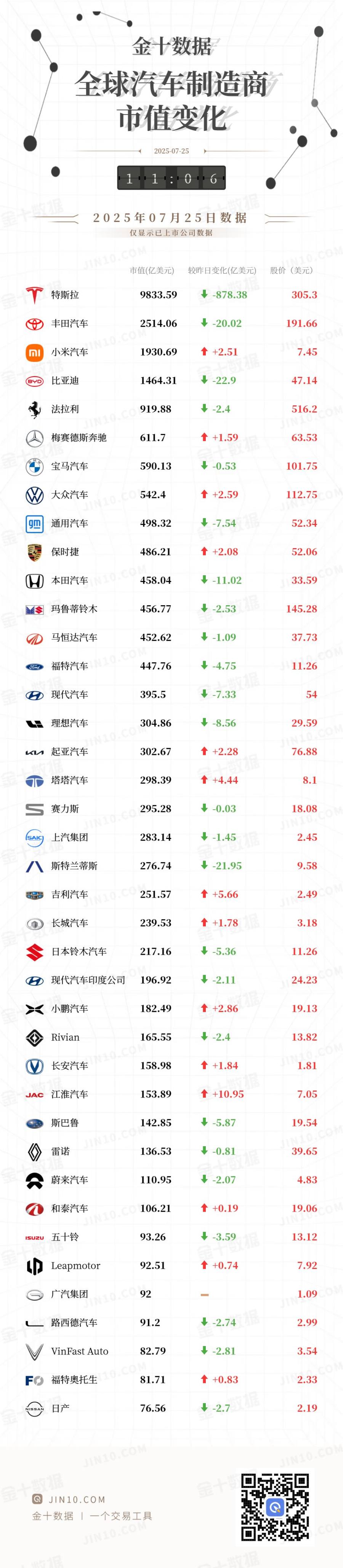
金十图示:2025年07月25日(周五)全球汽车制造商市值变化
news flash· 2025-07-25 03:09
Group 1 - The market capitalization of global automotive manufacturers has shown significant fluctuations as of July 25, 2025, with Volkswagen leading at $542.4 billion, reflecting a 2.59% increase [1][3] - General Motors experienced a decline in market value, dropping to $498.32 billion, a decrease of 7.54% [3] - Porsche's market capitalization rose to $486.21 billion, marking a 2.08% increase [3] Group 2 - Honda's market value decreased by 11.02%, bringing it down to $458.04 billion [3] - Mahindra & Mahindra's market capitalization fell slightly by 1.09% to $452.62 billion [3] - Ford's market value also declined by 4.75%, reaching $447.76 billion [3] Group 3 - The market capitalization of Hyundai is reported at $395.5 billion, with a decrease of 7.33% [3] - Li Auto's market value decreased by 8.56%, now at $304.86 billion [3] - Kia Motors saw a slight increase of 2.28%, with a market capitalization of $302.67 billion [3] Group 4 - Tata Motors experienced a notable increase of 4.44%, raising its market value to $298.39 billion [3] - SAIC Motor's market capitalization is at $283.14 billion, reflecting a decrease of 1.45% [3] - Stellantis faced a significant drop of 21.95%, with its market value at $276.74 billion [3] Group 5 - Geely's market capitalization increased by 5.66%, reaching $251.57 billion [3] - Great Wall Motors' market value rose by 1.78% to $239.53 billion [3] - Suzuki's market capitalization decreased by 5.36%, now at $217.16 billion [3] Group 6 - Xpeng Motors' market value increased by 2.8%, reaching $182.49 billion [4] - Rivian's market capitalization decreased by 2.4%, now at $165.55 billion [4] - Changan Automobile's market value increased by 1.84%, bringing it to $158.98 billion [4] Group 7 - JAC Motors saw a significant increase of 10.95%, with a market capitalization of $153.89 billion [4] - Subaru's market value decreased by 5.87%, now at $142.85 billion [4] - Renault's market capitalization slightly decreased by 0.81%, reaching $136.53 billion [4]






美媒:业内人士称日美贸易协议“让底特律三巨头处于不利地位”,对加墨征税恐让处境更糟
Huan Qiu Shi Bao· 2025-07-24 22:50
Group 1 - The recent US-Japan trade agreement is viewed as a significant victory by President Trump, but it raises concerns for American automakers who fear competitive disadvantages [1][2] - The agreement reduces the "reciprocal tariff" rate from 25% to 15%, with a 12.5% tariff on Japanese cars, leading to a total of 15% when combined with the previous 2.5% tariff [1] - American automakers, represented by a trade organization, argue that the agreement gives Japanese cars an advantage over those produced by the "Big Three" automakers in the US [1][2] Group 2 - The US automotive policy committee chairman states that American companies and workers are at a disadvantage due to high tariffs on steel, aluminum, and vehicle parts [2] - General Motors reported an $1.1 billion loss in the second quarter due to the tariffs, with expectations of worsening impacts in the third quarter [2] - The White House claims the agreement will create hundreds of thousands of jobs in the US and lead to a $550 billion investment from Japan [2] Group 3 - Concerns exist regarding the actual penetration of American cars in the Japanese market, which is known for being one of the most closed automotive markets globally [3] - Only 6% of cars sold in Japan are imported from other countries, and the market favors smaller vehicles over the larger American trucks and SUVs [3] - The US Treasury Secretary warned that higher tariffs would be reinstated if Japan does not comply with the trade agreement [3]
金十图示:2025年07月24日(周四)美股热门股票行情一览(美股盘中)


news flash· 2025-07-24 16:39
Market Overview - The market capitalization of major US stocks shows varied performance, with Oracle at 762.30 billion, Mastercard at 321.36 billion, and Visa at 770.15 billion, reflecting increases of +0.66%, +0.86%, and +0.68% respectively [3] - Exxon Mobil's market cap is 679.53 billion, with a slight decrease of -0.98%, while Johnson & Johnson and Netflix show minor changes of -0.08% and -0.05% respectively [3] - Companies like Wells Fargo and Cisco have market caps of 270.15 billion and 279.59 billion, with respective increases of +0.98% and -0.58% [3] Notable Stock Movements - T-Mobile US Inc experienced a significant increase of +6.20%, reaching a market cap of 272.19 billion [3] - General Electric and Coca-Cola saw market caps of 285.05 billion and 298.76 billion, with increases of +0.37% and +0.91% respectively [3] - Companies like Disney and Goldman Sachs have market caps of 229.06 billion and 221.80 billion, with slight changes of +0.01% and -0.60% [3] Sector Performance - The technology sector shows mixed results, with Intel at 991.05 billion, down -3.28%, while AMD increased by +2.46% to 254.92 billion [5] - The consumer goods sector is represented by companies like Procter & Gamble and Coca-Cola, with market caps of 371.68 billion and 298.76 billion, showing slight increases [3][4] - The energy sector, represented by Exxon Mobil and Chevron, shows varied performance, with Exxon down -0.98% and Chevron up +0.66% [3] Summary of Key Companies - Oracle's market cap stands at 762.30 billion, reflecting a positive trend [3] - Mastercard and Visa show strong performance with market caps of 321.36 billion and 770.15 billion, both increasing [3] - Companies like Pfizer and Comcast have market caps of 1579.81 billion and 1332.00 billion, with Pfizer showing minimal change and Comcast down -3.16% [4][5]

给电动车二次生命,宝马、本田、福特联手搞事情
汽车商业评论· 2025-07-24 16:31
Core Viewpoint - The article discusses the growing importance of Vehicle-to-Grid (V2G) technology in enhancing the efficiency of electric vehicles (EVs) and promoting sustainable energy development, highlighting ChargeScape's collaboration with PSEG Long Island as a significant step in this direction [2][4][5]. Group 1: ChargeScape and V2G Technology - ChargeScape, a startup formed by BMW, Honda, Ford, and Nissan, is at the forefront of integrating EVs into the energy grid through V2G technology [2][4]. - The collaboration with PSEG Long Island marks the first time EVs are included in the utility's demand response program, aiming to intelligently manage the charging behavior of over 6,000 EV owners during peak electricity demand [4][7]. - The AI-driven platform by ChargeScape will optimize charging times and intensity, alleviating grid pressure while providing economic incentives to participants [5][7]. Group 2: Benefits and Challenges of V2G - V2G technology can dynamically adjust EV charging to prevent grid overload, thus enhancing grid stability and efficiency [5][8]. - Concerns about battery degradation due to V2G usage are being addressed, with studies indicating that controlled charging can actually prolong battery life [8]. - The potential for reusing retired EV batteries in energy management is highlighted, as these batteries can support the grid during peak demand periods [10][12]. Group 3: Global Implementation and Regulatory Environment - Utrecht has launched the first large-scale V2G car-sharing service in Europe, demonstrating the need for collaboration among automakers, charging infrastructure providers, energy companies, and local governments for successful V2G implementation [15][16]. - Renault has initiated V2G practices in France, emphasizing the need for unified regulations in Europe to unlock the full potential of V2G technology [17]. - In China, while the rapid adoption of EVs is noted, the implementation of V2G technology faces challenges due to differences in market conditions and regulatory environments compared to the US and Europe [18][19].


General Motors is “the poster child of tariff impacts.”
Yahoo Finance· 2025-07-24 16:30
Tariff Impact on Automakers - The automotive industry, particularly General Motors, is highly exposed to global trade, especially nearshoring from Mexican and Canadian factories [1] - The market is assessing the duration of tariff impacts, potentially lasting a few quarters, which aligns with General Motors' expectations [2] Market Sentiment and Investment Strategy - Market sentiment, rather than immediate earnings or economic fundamentals, has driven recent market rallies, highlighting the difficulty of timing the market [3] - Long-term investors are focused on the future, considering scenarios as far out as 2026 [3] Investor Concerns and Adaptations - Investors are encouraged by the market rally but remain curious about tariffs and policy changes [4] - Investors are seeking to adjust their financial plans to accommodate these evolving factors [4]
美国对日关税15%,美国车企集体破防:本土汽车再次被抛弃
Guan Cha Zhe Wang· 2025-07-24 15:34
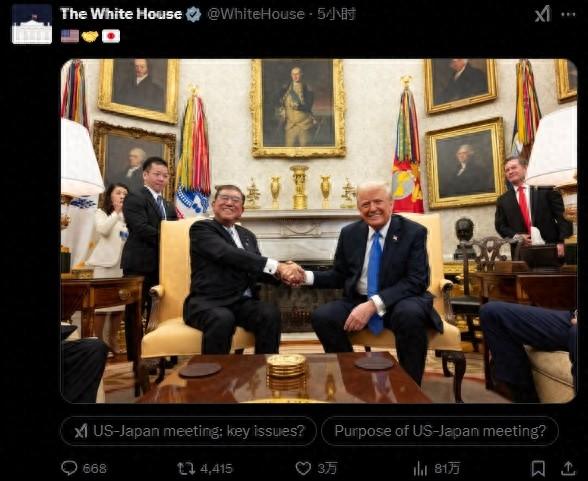
Core Points - The U.S. and Japan have reached a trade agreement where the U.S. will reduce tariffs on Japanese cars and parts to 15%, while Japan will invest $550 billion in the U.S. and open its markets for cars and rice [1][2] - U.S. automakers express concerns that the reduced tariffs will disadvantage American companies, as they will face higher tariffs on vehicles produced with a significant amount of U.S. parts compared to Japanese imports [2][6] - The agreement may set a precedent for other countries, raising fears among U.S. automakers about potential similar negotiations with the EU and South Korea [6][8] U.S. Automakers' Concerns - U.S. automakers, represented by the American Automotive Policy Council, argue that the deal is detrimental to American industry and workers, as it imposes higher tariffs on domestically produced vehicles with U.S. parts [2][6] - General Motors reported a $1 billion profit drop in Q2 due to tariffs and warned of further losses in the next quarter, while Stellantis expects a $2.7 billion loss in the first half of 2025 [6] - The complexity of the North American automotive supply chain means that U.S. manufacturers are heavily reliant on parts from Mexico and Canada, making them vulnerable to tariff impacts [6] Market Reactions - Following the announcement of the U.S.-Japan trade agreement, stock prices for Toyota and Honda surged, along with shares of Korean and European automakers [7] - The German automotive industry is particularly concerned, as they have seen a significant drop in exports to the U.S. and are advocating for concessions in trade negotiations [7] - South Korean automakers Hyundai and Kia are expected to report significant losses due to tariffs in their upcoming financial results [7][8] Future Trade Negotiations - The U.S. government is reportedly exploring similar agreements with the EU and South Korea, but there are concerns about the implications for U.S. automakers if these countries secure lower tariffs [6][8] - A White House official downplayed the likelihood of similar tariff reductions for other countries, emphasizing that Japan's investment proposal was unique [8]

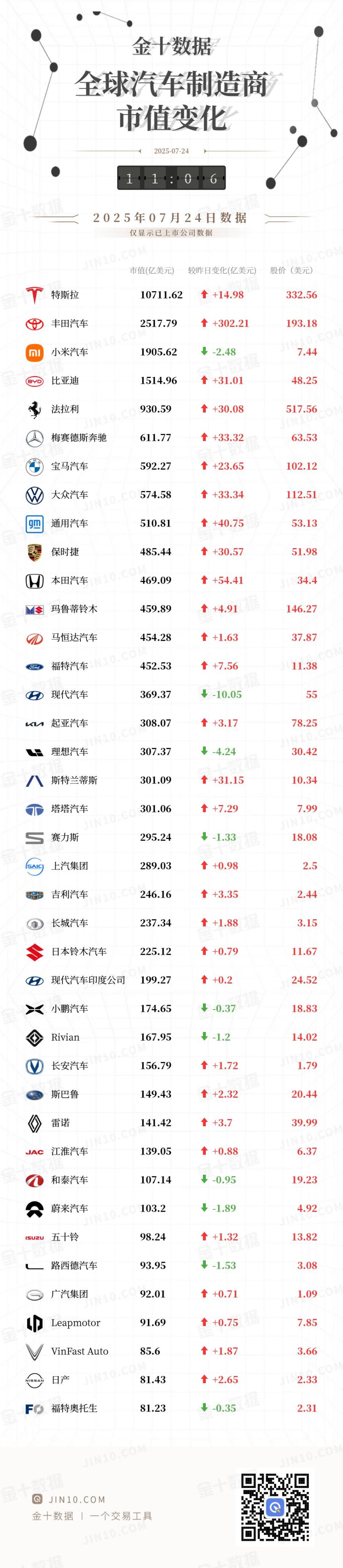
金十图示:2025年07月24日(周四)全球汽车制造商市值变化
news flash· 2025-07-24 03:10
Core Insights - The article presents the market capitalization changes of global automotive manufacturers as of July 24, 2025, highlighting significant fluctuations in their valuations [1]. Market Capitalization Summary - Volkswagen has a market capitalization of $574.58 billion, with an increase of $33.34 billion [3]. - General Motors (GM) stands at $510.81 billion, up by $40.75 billion [3]. - Porsche's market value is $485.44 billion, reflecting an increase of $30.57 billion [3]. - Honda's market capitalization is $469.09 billion, with a notable rise of $54.41 billion [3]. - Maruti Suzuki's valuation is $459.89 billion, increasing by $4.91 billion [3]. - Mahindra & Mahindra's market cap is $454.28 billion, up by $1.63 billion [3]. - Ford's market capitalization is $452.53 billion, with an increase of $7.56 billion [3]. - Hyundai's market value is $369.37 billion, showing a decrease of $10.05 billion [3]. - Li Auto's valuation is $307.37 billion, down by $4.24 billion [3]. - Stellantis has a market capitalization of $301.09 billion, increasing by $31.15 billion [3]. - Tata Motors' market cap is $301.06 billion, up by $7.29 billion [3]. - SAIC Motor's valuation is $289.03 billion, with a slight increase of $0.98 billion [3]. - Geely's market capitalization is $246.16 billion, up by $3.35 billion [3]. - Great Wall Motors stands at $237.34 billion, increasing by $1.88 billion [3]. - Suzuki's market value is $225.12 billion, with a rise of $0.79 billion [3]. - Xpeng Motors has a market capitalization of $174.65 billion [4]. - Rivian's valuation is $167.95 billion, down by $1.20 billion [4]. - Changan Automobile's market cap is $156.79 billion, increasing by $1.72 billion [4]. - Subaru's market value is $149.43 billion, up by $2.32 billion [4]. - Renault's market capitalization is $141.42 billion, with an increase of $3.70 billion [4]. - JAC Motors stands at $139.05 billion, up by $0.88 billion [4]. - NIO's market cap is $103.20 billion, down by $1.89 billion [4].



Tariffs Cloud General Motors' Outlook As Annual Profits Remain At Risk
Benzinga· 2025-07-23 19:45
Core Viewpoint - General Motors is facing challenges from rising tariffs and significant capital expenditures but maintains a strong free cash flow projection of $7.5 billion to $10 billion for 2025 [1][8] Financial Performance - In the second quarter, General Motors reported adjusted earnings per share of $2.53, exceeding the analyst consensus estimate of $2.40 [4] - Quarterly sales reached $47.12 billion, surpassing the expected $45.57 billion [4] - The company's adjusted EBIT margins fell to 6.4%, impacted by a $1.1 billion tariff headwind [1][4] Future Outlook - The company anticipates a challenging second half of the year, particularly in North America, with expected declines in wholesale volumes and increased tariff burdens [2][5] - General Motors expects a mid-single-digit sequential drop in North American wholesale volumes, translating to an approximate 8% year-over-year decline in the second half of 2025 [5] - The third quarter is projected to carry a heavier gross tariff burden than the second quarter, although mitigating actions are expected to soften the impact [6] Strategic Measures - Bank of America Securities analyst Federico Merendi has reiterated a Buy rating on General Motors, adjusting the price forecast from $65 to $62 [3] - The company has maintained its full-year guidance, with expectations of stronger free cash flow in the second half potentially allowing for share buybacks [6][8] - Despite higher capital expenditures, the relative impact is considered manageable as peers in the industry face similar challenges [7] Market Reaction - GM shares have increased by 8.79%, trading at $53.19 [8]