Alphabet(GOOG)

Search documents
谷歌,计划发行百年债券
财联社· 2026-02-10 02:11
Core Viewpoint - Alphabet, the parent company of Google, plans to issue a rare 100-year bond, marking the first such issuance by a tech company since the late 1990s, as part of a larger debt issuance strategy to support its significant capital expenditures in artificial intelligence [2][3]. Group 1: Bond Issuance Details - The 100-year bond will be denominated in British pounds, alongside four other bonds of different maturities also in pounds, with pricing expected as early as Tuesday [2]. - This issuance is notable as it is the first time Alphabet will issue bonds in pounds, driven by strong demand from UK pension funds and insurance companies for long-term financing [3]. - Historically, the 100-year bond market has been dominated by governments and institutions like universities, with only a few corporate issuances, including those by Electricité de France and the University of Oxford in 2021 [4]. Group 2: Market Context and Implications - The issuance of such long-term bonds is rare for corporations due to risks associated with potential acquisitions, outdated business models, and technological obsolescence [6]. - The last tech company to issue a 100-year bond was Motorola in 1997, which subsequently faced significant market challenges, highlighting the risks associated with long-term corporate debt [6]. - The current bond issuance aligns with a broader trend of significant capital expenditures in the tech sector, particularly related to artificial intelligence, with Alphabet planning to spend $185 billion this year, doubling its previous year's expenditure [8]. Group 3: Broader Debt Market Trends - Alphabet's bond issuance is part of a larger wave of corporate debt issuance, with expectations that total U.S. corporate bond issuance will reach $2.46 trillion this year, an 11.8% increase from 2025 [9]. - The demand for bonds related to artificial intelligence is expected to drive significant growth in the bond market, with estimates suggesting that the issuance could reach $2.3 trillion this year [9].



未知机构:近年来大多数大型科技公司开始通过分红和回购-20260210
未知机构· 2026-02-10 02:10
近年来,大多数大型科技公司开始通过分红和回购股票的方式将现金返还给股东。 例如,谷歌和 Meta Platforms 都这么做,但今年可能会很难做到这一点,因为旨在扩充用于人工智能的计算能力的 资本支出几乎完全耗尽了其运营产生的现金流。 :两者已经开始缩减股票回购。 然而,取消分红可能会比较棘手,因为两家公司都是在 2024 年才开始发放 近年来,大多数大型科技公司开始通过分红和回购股票的方式将现金返还给股东。 例如,谷歌和 Meta Platforms 都这么做,但今年可能会很难做到这一点,因为旨在扩充用于人工智能的计算能力的 资本支出几乎完全耗尽了其运营产生的现金流。 :两者已经开始缩减股票回购。 然而,取消分红可能会比较棘手,因为两家公司都是在 2024 年才开始发放股息,这使得它们的股票对投资者更具 吸引力。 亚马逊在 11 月发行了 150 亿美元债券,增强了其现金状况,截至 12 月 31 日其持有现金为 1230 亿美元,这 给了它相当大的缓冲。 :不会遇到同样的问题,因为它自 2022 年以来就没有回购股票,也从未支付过股息。 不过,据 TheInformation报道源头信息联 系 微 信W ...




7000亿美元豪赌!AI基建正拖垮巨头们的现金流
投中网· 2026-02-10 02:09
Core Insights - The article discusses the financial reports of major tech companies, highlighting a shift from AI enthusiasm to concerns over capital expenditures and cash flow issues [4][5] - Despite impressive revenue figures, stock prices for Amazon, Microsoft, and Google fell significantly after their earnings reports, indicating market skepticism [4] Capital Expenditure Analysis - Amazon's projected capital expenditure for 2026 is $200 billion, exceeding analyst expectations of $144.7 billion and up 60% from its 2025 estimate of $125 billion [8] - Microsoft reported a quarterly capital expenditure of $37.5 billion, a year-on-year increase of approximately 66% [9] - Alphabet's capital expenditure for Q4 2025 is estimated at $27.9 billion, with plans for 2026 expenditures between $175 billion and $185 billion, roughly double that of 2025 [9] - Overall, the five major tech companies are expected to have a combined capital expenditure of $600 billion to $700 billion in 2026 [11] Free Cash Flow Concerns - Amazon's operating cash flow over the past 12 months was $139.5 billion, a 20% increase, but its free cash flow plummeted 71% to $11.2 billion [12] - Microsoft reported an operating cash flow of approximately $35.76 billion for the quarter, with free cash flow significantly below market expectations [13] - The trend indicates that while operating cash flows are strong, massive capital expenditures are severely compressing free cash flows across these companies [14] Depreciation and Future Earnings Impact - Tech companies are extending the depreciation periods of their assets to improve short-term profits, which may lead to increased depreciation costs impacting future earnings [15][16] - Microsoft and Alphabet have extended the useful life of their servers and network equipment, which could result in concentrated depreciation costs affecting profitability in the next 3-5 years [15][16] Market Sentiment and AI Investment Risks - The article describes the current AI arms race as a gamble, with significant upfront investments made by tech companies without immediate profitability [18] - Analysts express concerns that OpenAI's funding model may lead to financial strain, as it relies heavily on external capital for its operations [20][21] - The complexity of cloud service contracts and the reliance on future growth projections create potential risks for tech companies and their clients [21][24] Customer Impact and Business Strategy - Microsoft has adjusted its pricing strategies, reducing long-term discounts and increasing bundling of AI services, which may affect customer choices and costs [26] - Companies must consider the total lifecycle costs of AI applications, including cloud resources and integration expenses, as they navigate the evolving landscape [26][27]

谷歌母公司Alphabet拟发行200亿美元债券
Cai Jing Wang· 2026-02-10 02:03
Core Viewpoint - Alphabet, the parent company of Google, plans to issue $20 billion in bonds, significantly exceeding previous expectations, to support its annual capital expenditure plan of $185 billion, with a focus on investments in AI infrastructure such as data centers [1] Group 1 - The bond issuance of $20 billion is aimed at financing Alphabet's substantial capital expenditure [1] - The annual capital expenditure plan is projected to reach $185 billion, indicating a strong commitment to growth and infrastructure development [1] - Investments in AI infrastructure, particularly data centers, are highlighted as a key focus area for the company [1] Group 2 - The financing move reflects a broader trend among technology giants to raise capital amid the competitive landscape of AI development [1]
忽略“春节AI大战”吧,AI的入口之争胜负早已明了
3 6 Ke· 2026-02-10 01:34
Core Viewpoint - The article discusses the competition in the AI market, particularly focusing on the contrasting strategies of Alibaba and Google, highlighting Alibaba's unique approach with its Qianwen App and its implications for the AI landscape [1][4]. Group 1: AI Market Competition - The AI market is increasingly viewed as a contest of marketing expenditures, particularly illustrated by the recent "red envelope war" during the Spring Festival, where companies compete for user engagement through financial incentives [1]. - Alibaba's Qianwen App launched a significant promotional campaign, achieving over 10 million orders within 9 hours, indicating a successful marketing strategy that diverges from traditional competition [1][13]. - The article posits that the success of Alibaba's Qianwen App is a result of long-term strategic investments made years prior, rather than just a short-term marketing victory [1][9]. Group 2: Strategic Comparisons - Google has adopted a full-stack self-research strategy, investing heavily in various aspects of AI, including hardware and software, while Microsoft has taken a dual approach, relying on partnerships and third-party resources [2][3]. - As of Q4 2025, Microsoft's market value has decreased by over 30%, contrasting with Google's market value, which has approached $4 trillion, highlighting the effectiveness of Google's strategy [2]. - Alibaba is positioned as the closest competitor to Google in the full-stack AI space, with significant investments planned for AI infrastructure and capabilities [4][5]. Group 3: Future Projections - Alibaba plans to invest 380 billion yuan in AI capital expenditures over the next three years, with an additional 100 billion yuan recently announced, indicating a strong commitment to AI development [5]. - The company aims to redefine the AI landscape by creating a new operating system based on large models, which will facilitate the development of numerous applications through natural language [4]. - The competitive landscape is expected to shift from performance and customer acquisition to a broader ecosystem competition, encompassing computing power, cloud services, and user engagement [9][14].

Alphabet发200亿美元美债获超千亿认购 拟推100年期英镑债 2026年资本开支最高达1850亿美元
Sou Hu Cai Jing· 2026-02-10 01:19
Group 1 - Alphabet's parent company, Google, completed a bond issuance on February 9, raising $20 billion, exceeding the initial plan of $15 billion, indicating strong market demand and investor confidence in its AI business strategy [1] - The bond issuance attracted over $100 billion in subscription orders, highlighting the market's enthusiasm for Alphabet's AI initiatives [1] - In addition to the dollar bonds, Alphabet is preparing for bond issuances in Swiss francs and British pounds, including a rare 100-year bond, marking the first such issuance in the global tech sector since Motorola in 1997 [1] Group 2 - Alphabet's capital expenditure guidance for 2026 indicates a maximum investment of $185 billion, surpassing the total capital expenditures of the past three years, primarily directed towards AI-related infrastructure such as data centers [1] - The Q4 2025 financial report revealed that Alphabet's revenue grew by 18% year-on-year to $113.8 billion, with net profit increasing by 30% to $34.455 billion, driven by a 48% year-on-year surge in Google Cloud revenue to $17.7 billion, largely due to demand for AI-related products [1] - The recent trend among global tech giants includes a surge in AI infrastructure financing, exemplified by Oracle's completion of a $25 billion bond issuance, setting a new record for corporate bond subscription levels at $129 billion [1]
半导体早参 | 机构表示一季度内存价格较2025年第四季度飙升高达90%,英伟达力挺科技巨头超6000亿美元资本开支
Mei Ri Jing Ji Xin Wen· 2026-02-10 01:17
Market Performance - The Shanghai Composite Index rose by 1.41% to close at 4123.09 points, while the Shenzhen Component Index increased by 2.17% to 14208.44 points, and the ChiNext Index surged by 2.98% to 3332.77 points [1] - The semiconductor ETFs, including the Kweichow Moutai Semiconductor ETF (588170), rose by 2.25%, and the Huaxia Semiconductor Equipment ETF (562590) increased by 2.24% [1] - In the overnight U.S. market, the Dow Jones Industrial Average rose by 0.04%, the Nasdaq Composite increased by 0.90%, and the S&P 500 rose by 0.47% [1] Industry Insights - According to Counterpoint's February memory price tracking report, memory prices are expected to rise by 80%-90% quarter-on-quarter in Q1 2026, driven primarily by a significant increase in general server DRAM prices [2] - The price of 64GB RDIMM contracts has surged from $450 in Q4 to over $900 in Q1, with expectations to exceed $1000 in Q2 [2] - NVIDIA's CEO Jensen Huang stated that the growing capital expenditure in AI infrastructure by tech giants like Microsoft, Amazon, Meta, Oracle, and Alphabet, which plan to invest over $600 billion in 2026, is reasonable and sustainable [2] - Huang emphasized that this represents the largest infrastructure build-up in human history, driven by an extreme demand for computing power [2] Corporate Actions - Alphabet Inc. plans to issue $20 billion in dollar-denominated bonds, exceeding the initial expectation of $15 billion, due to a surge in demand for AI-related bonds, attracting over $100 billion in subscriptions [3] - The longest maturity bonds, due in 2066, were priced at a yield 0.95 percentage points above U.S. Treasury rates, down from an earlier spread of 1.2 percentage points [3] - The capital expenditure of the four major U.S. cloud service providers is expected to exceed $670 billion in 2026, representing a year-on-year growth of over 60% [3] Related ETFs - The Kweichow Moutai Semiconductor ETF (588170) and its linked funds focus on semiconductor materials and equipment, capturing companies in the semiconductor sector that are benefiting from the AI revolution and domestic substitution trends [3][4] - The Huaxia Semiconductor Equipment ETF (562590) also emphasizes semiconductor equipment and materials, with a significant focus on the upstream semiconductor industry [4]

科技巨头豪赌AI,一年烧掉一国国防预算
21世纪经济报道· 2026-02-10 01:12
Core Viewpoint - The article highlights the dual reactions of investors to the quarterly earnings reports of major tech companies, particularly regarding the explosive growth in AI-related cloud services and the significant capital expenditures (CAPEX) these companies are committing to for future growth [1][2]. Group 1: Cloud Business Performance - All three companies, Microsoft, Google, and Amazon, reported cloud business growth that exceeded market expectations, with Google Cloud achieving a revenue of $17.664 billion, a 48% year-over-year increase [4][6]. - Microsoft’s Azure and other cloud services saw a revenue increase of 39%, with the intelligent cloud segment surpassing $50 billion in quarterly revenue for the first time [6]. - Amazon AWS reported a 24% year-over-year growth, reaching $35.6 billion, marking its fastest growth since late 2022 [7]. Group 2: Capital Expenditures - Microsoft reported a record quarterly capital expenditure of $37.5 billion, a 66% increase year-over-year [2][10]. - Google plans to spend between $175 billion and $185 billion on capital expenditures in 2026, nearly doubling its 2025 budget [2][10]. - Amazon announced a capital expenditure of up to $200 billion for 2026, representing a more than 50% increase from its already high 2025 spending [2][10]. Group 3: Future Orders and Revenue Visibility - Google Cloud's unfulfilled orders reached $240 billion, more than doubling year-over-year, while AWS's backlog surged 40% to $244 billion, and Microsoft's remaining performance obligations soared to $625 billion, a 110% increase [8][12]. - These future orders provide a strong foundation for anticipated revenue, but they also require substantial capital investment to fulfill [9][12]. Group 4: Investor Concerns and Market Dynamics - Investors are increasingly worried about the pace of returns on these massive investments, with concerns that spending may outstrip revenue growth [12][13]. - The article notes a shift in investor focus from revenue growth to the sustainability of capital returns, as high capital expenditures could pressure profit margins and free cash flow [12][13]. - The ongoing "arms race" in AI and cloud infrastructure is seen as a necessary gamble for these companies to maintain market leadership despite short-term stock price volatility [11][13].

全球大公司要闻 | 特斯拉FSD落地稳步推进;Alphabet发债获千亿认购
Wind万得· 2026-02-10 00:55
Group 1 - Tesla's Elon Musk announced that SpaceX is shifting focus to building a "self-sustaining city" on the Moon, with plans to initiate a Mars colonization project within the next 5-7 years [2] - Alphabet raised $20 billion through a bond issuance, exceeding the initial target of $15 billion, with over $100 billion in subscription orders [2] - TSMC plans to increase its investment in the Kumamoto plant in Japan to $17 billion for mass production of 3nm technology, marking a significant step in the semiconductor supply chain and geopolitical landscape [2] Group 2 - OpenAI's CEO Sam Altman reported strong growth, with ChatGPT's monthly growth rate surpassing 10%, and the launch of the new Codex model GPT-5.3-Codex [2][3] - Alibaba revealed its new model Qwen3.5, which features a novel mixed attention mechanism and is likely to be a vision-language model [3] Group 3 - Pop Mart aims to sell over 400 million products globally by 2025, with the THE MONSTERS product line expected to exceed 100 million units [5] - Zhongke Shuguang plans to raise up to 800 million RMB through convertible bonds for AI-related projects, including advanced computing systems and next-generation AI training machines [5] - 16 companies, including Meituan and JD, are receiving guidance from government departments to improve labor management and protect workers' rights [6] Group 4 - Nvidia's CEO Jensen Huang stated that AI infrastructure capital expenditures could exceed $600 billion by 2026 due to strong demand for computing power [8] - Apple's CEO Tim Cook emphasized that AI will be a core pillar for the future, acknowledging user feedback issues with Apple Intelligence [8] - Amazon's Q4 results showed increased capital expenditures impacting short-term profits, but AWS continues to grow strongly [9]



谁杀死了硅谷程序员?
3 6 Ke· 2026-02-10 00:45
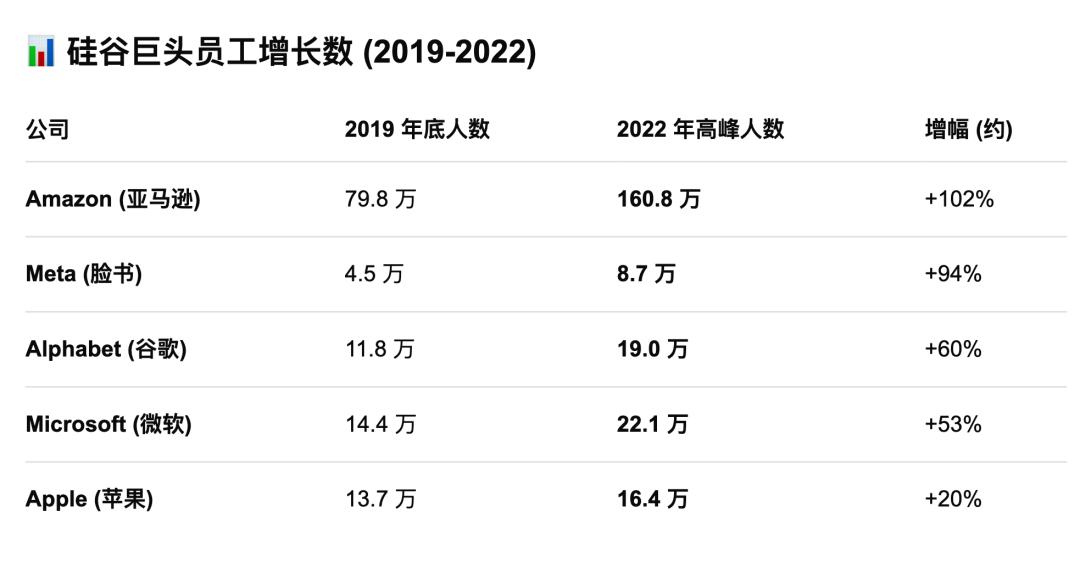
Core Insights - The current wave of layoffs in Silicon Valley, termed "The Great Tech Reset," is primarily due to internal inefficiencies and bureaucratic expansion rather than a direct result of AI advancements [1][20]. Group 1: Layoff Statistics and Trends - From 2023 to 2025, over 500,000 layoffs are expected in the U.S. tech industry, with major companies like Amazon and Oracle leading the charge [1]. - Layoffs are projected to be 264,000 in 2023, 153,000 in 2024, and 124,000 in 2025, indicating a continuing trend of workforce reduction [4]. - Major tech companies saw significant employee growth from 2019 to 2022, with Amazon's workforce increasing by 102% and Meta's by 94% [2]. Group 2: Causes of Workforce Expansion - The COVID-19 pandemic created a false sense of permanent growth in online services, leading to aggressive hiring practices among tech giants [3]. - A talent race emerged, where companies hired not just for operational needs but to prevent competitors from acquiring skilled programmers [3]. - Low interest rates and abundant cash flow during this period facilitated extensive hiring [3]. Group 3: Impact of AI on Employment - AI is indeed changing the software and programming landscape, leading to reduced demand for entry-level engineers [5][6]. - Companies are increasingly using AI to optimize operations, which has resulted in significant workforce reductions [5][20]. - The perception that AI is solely responsible for layoffs is contested, with some arguing that the layoffs were necessary due to pre-existing inefficiencies [8][12]. Group 4: Organizational Inefficiencies - The rapid expansion of tech companies led to bureaucratic inefficiencies, with many employees not contributing effectively to productivity [16][19]. - The phenomenon of "middle management black holes" emerged, where excessive layers of management hindered operational efficiency [16]. - Companies like Meta and Amazon have seen significant increases in per-employee profit after restructuring and reducing their workforce [19][20]. Group 5: Future Outlook - The current restructuring signifies a shift away from growth driven by headcount to a focus on efficiency and productivity [20]. - The tech industry is expected to return to a model defined by code, product, and physical efficiency, moving away from the previous era of growth through excessive hiring [20].