Alphabet(GOOG)

Search documents
腾讯研究院AI速递 20260312
腾讯研究院· 2026-03-11 16:10
Group 1 - Google has released its first native multimodal embedding model, Gemini Embedding 2, which integrates text, images, audio, video, and PDFs into a unified vector space for cross-modal retrieval, eliminating information loss and engineering complexity associated with traditional multi-model approaches [1] - The model employs Russian nesting doll representation learning technology (MRL), reducing vector dimensions from 3072 to 768 with only a 0.18 point loss, balancing performance and cost [1] - Compared to competitors like OpenAI, Cohere, and Jina, Gemini Embedding 2 is currently the only commercial-grade embedding model covering five modalities, achieving state-of-the-art (SOTA) in multimodal capabilities [1] Group 2 - Meta has acquired the AI social platform Moltbook, which was launched only 40 days prior, and its founders will join Meta's Super Intelligence Lab (MSL) [2] - Moltbook gained attention for its "encrypted language" hoax posts, revealing critical flaws in identity verification and security on the platform [2] - Meta is interested in Moltbook's underlying capabilities for AI agents to be permanently online and autonomously discover and connect, planning to integrate it into its AI ecosystem after addressing security issues [2] Group 3 - Nvidia has signed a $60 billion computing power agreement with Thinking Machines Lab to deploy a next-generation Vera Rubin computing cluster with a scale of 1GW, including cash investment from Nvidia [3] - The company, founded by former OpenAI CTO Mira Murati, has a current valuation of $50 billion and recently appointed the founder of PyTorch as its new CTO after a previous departure [3] - By securing scarce computing power capacity, the company is building a second moat beyond talent competition to support cutting-edge model training and enterprise-level AI customization [3] Group 4 - Tencent has responded to security and cost concerns regarding OpenClaw, emphasizing that installation is free but model calls incur token fees, and has launched a series of security products and the SkillHub plugin ecosystem [4] - Tencent's lobster services are divided into two categories: deployment solutions around the open-source OpenClaw and the self-developed desktop AI agent WorkBuddy, which shares the Agent architecture with CodeBuddy [4] - Nearly 40,000 Tencent employees are already using OpenClaw internally, indicating a shift towards a new development model involving agents [4] Group 5 - Tencent Cloud has launched the SkillHub skill marketplace, which has over 13,000 lobster skills, supporting Chinese search and domestic node acceleration, and is compatible with various agent frameworks and environments [5] - More than 50 high-quality skills covering frequent scenarios such as office collaboration, development tools, and content creation have been selected, completing security scans and quality filtering [5] - Over 10 products, including Tencent Docs, QQ Browser, and Tencent Maps, have undergone skill transformation, allowing for one-click integration with OpenClaw [5] Group 6 - ZhiMi has launched its chip brand "Xinjichuan Yue," which includes a mobile chip (Chixiao 01) with a self-developed NPU architecture, a 2nm process autonomous driving chip with 2000 TOPS computing power, and the mass-produced Tianqiong series of general-purpose robot chips [7] - The company has announced plans for a space computing center, intending to deploy 2 million computing satellites to form a super constellation, with the first space computing box set to be verified in orbit soon [7] - A personal super AI computer with 1.5 PFLOPS has been introduced, utilizing a unified memory architecture capable of locally loading large models with billions of parameters and supporting multi-device networking [7] Group 7 - On the 10th anniversary of AlphaGo's victory over Lee Sedol, Demis Hassabis reflects on how the "37th move" initiated the modern AI era, showcasing AI's ability to surpass human experts and autonomously discover new strategies [8] - The reinforcement learning and search methods from AlphaGo have been extended to various scientific fields, including AlphaFold for protein structure prediction and AlphaProof for mathematical reasoning [8] - DeepMind believes that combining Gemini's world model, AlphaGo's search planning, and specialized AI tools is key to achieving artificial general intelligence (AGI) [8] Group 8 - The new version of LeRobot v0.5.0 integrates full-body control for the Unitree G1 humanoid robot and introduces six new strategy models, supporting LoRA fine-tuning [9] - Dataset processing has been significantly optimized, with streaming video encoding achieving zero-wait recording and image training speed improved by ten times, along with the launch of EnvHub for direct loading of simulation environments [9] - The codebase has been upgraded to Python 3.12+ and Transformers v5, with a new third-party strategy plugin system, and the paper has been accepted by ICLR 2026 [9] Group 9 - The author of "The Biography of Hassabis" reveals the contradictory personality of Demis Hassabis, who dislikes control yet is extremely competitive, and his clear aversion to the pursuit of power [10] - Hassabis attempted for three years to make DeepMind independent from Google but failed, and the book contains details that contradict Hassabis's own statements following the dismissal of co-founder Suleyman [10] - The author believes that AI safety faces the "Oppenheimer dilemma," where scientists can build technology but cannot control its use, ultimately requiring cooperation between the US and China to achieve safety [10] Group 10 - Jensen Huang outlines a five-layer industrial system for AI, consisting of energy, chips, infrastructure, models, and applications, where each successful application drives demand down to power generation [11] - He asserts that AI has crossed a critical threshold, with significant improvements in model inference and deployment capabilities, and open-source models like DeepSeek-R1 accelerating the growth of full-stack demand [11] - While thousands of billions have been invested globally, trillions in infrastructure remain to be built, marking it as the largest infrastructure project in human history [11]





GSLC : Still Lagging SPY In 2026 After Underperforming In 2025 (NYSEARCA:GSLC)
Seeking Alpha· 2026-03-11 14:17
Core Viewpoint - Goldman Sachs ActiveBeta U.S. Large Cap Equity ETF (GSLC) has underperformed compared to its peers and benchmarks, leading to a recommendation of "Hold" for investors [3][17]. Fund Overview - GSLC was launched on September 17, 2015, with an NAV of approximately $14.7 billion, focusing on large-cap American-listed stocks [3][4]. - The fund employs a rules-based approach to select stocks based on four factors: Value, Momentum, Quality, and Low Volatility [4][9]. Performance Analysis - GSLC has lagged behind the SPY ETF in 2025 and early 2026, primarily due to underweighting key stocks like Alphabet (GOOG) and Eli Lilly (LLY) [7][17]. - The fund's performance has been hindered by a lack of aggressive momentum chasing, resulting in a struggle to differentiate itself from traditional passive ETFs [7][8]. Peer Comparison - GSLC has a total of 445 holdings, which is less than SPY and IVV, but it aims for a more defensive and strategic tilt through its smart beta approach [9][11]. - The fund's average daily share volume is over 360,000 shares, translating to more than $40 million, indicating sufficient liquidity for large investors [5][10]. Financial Metrics - GSLC has an expense ratio of 0.09%, comparable to SPY, but has not delivered the same level of performance, making it a challenging sell [7][17]. - The fund's Sharpe ratio is 1.24, indicating a decent risk-adjusted return, although it is slightly below the benchmark's Sharpe ratio of 1.33 [15][16]. Conclusion - While GSLC offers a viable option for U.S. large-cap exposure, its recent underperformance and missed opportunities in stock selection have led to a cautious outlook [17].



2017,制造奥本海默
远川研究所· 2026-03-11 13:30
Core Insights - The article discusses the revolutionary impact of the Transformer architecture introduced in the paper "Attention Is All You Need" by Google researchers in June 2017, which has become the foundation for various AI applications, including large models and AI agents [2][3][4]. Group 1: Historical Context and Initial Reactions - The initial reception of the Transformer architecture was underwhelming, with both Google and the tech community underestimating its potential, focusing instead on projects like AlphaGo [3][4]. - The paper's authors, from Google Brain and Google Research, were primarily focused on improving translation efficiency, not realizing the broader implications of their work [11][4]. - The success of AlphaGo in 2016 overshadowed the significance of the Transformer, leading to a lack of attention from Google's management [4][3]. Group 2: Development and Adoption of Transformer - The introduction of the Transformer aimed to improve computational efficiency by eliminating the need for RNNs, utilizing self-attention mechanisms to allow words in a text to relate to each other dynamically [13][12]. - The release of the Transformer paper sparked a wave of innovation in natural language processing (NLP), leading to models like BERT, which set new benchmarks in the field [14][15]. - OpenAI was one of the few organizations that recognized the transformative potential of the Transformer, leading to the development of the GPT series of models [5][16]. Group 3: The Rise of OpenAI and GPT Models - OpenAI's GPT-1 model, released in 2018, showcased a generative approach to language modeling, differing from Google's discriminative approach with BERT [16][19]. - The release of GPT-3 in 2020 marked a significant milestone, with 175 billion parameters, demonstrating the effectiveness of scaling laws in AI model performance [21][20]. - OpenAI's strategic decisions, including partnerships with Microsoft, positioned it as a leader in the AI space, leading to a competitive arms race among tech giants [27][26]. Group 4: Ethical Considerations and Future Directions - Concerns about the ethical implications of AI models, particularly regarding bias and safety, have emerged, prompting OpenAI to develop InstructGPT to align AI outputs with human values [28][29]. - The article highlights the ongoing tension between technological advancement and ethical considerations in AI development, suggesting that the industry must navigate these challenges carefully [34][27].



Google officially snaps up Wiz as it closes mammoth $32 billion deal
Business Insider· 2026-03-11 13:08
Core Viewpoint - Google has completed its $32 billion acquisition of cybersecurity firm Wiz, enhancing its cloud security capabilities amid the growing importance of AI in cloud services [1][2]. Group 1: Acquisition Details - The acquisition of Wiz marks Google's largest-ever acquisition, aimed at bolstering its cloud business as more organizations migrate to cloud environments [2][3]. - Wiz provides a platform that helps customers protect data across various cloud services, which is increasingly critical as businesses adopt AI technologies [1][2]. Group 2: Market Context - The deal is seen as a response to the rising sophistication of cyber threats, with attackers leveraging AI to enhance their operations [2][3]. - Google has indicated that Wiz will continue to operate as a multicloud offering, maintaining availability through competitors like Amazon and Microsoft [3]. Group 3: Company Vision - The CEO of Wiz, Assaf Rappaport, emphasized the company's mission to protect organizational assets, indicating that the acquisition is just the beginning of their journey [4].

Google completes $32B acquisition of Wiz
TechCrunch· 2026-03-11 12:56
Core Insights - Google has acquired Israeli cybersecurity firm Wiz for $32 billion in cash, marking its largest acquisition to date [1] - Wiz will be integrated into Google Cloud while retaining its brand and commitment to securing customers across all cloud environments [1] Group 1: Acquisition Details - The acquisition is aimed at enhancing cloud security and enabling organizations to build securely across any cloud or AI platform [2] - Google initially offered $23 billion for Wiz in 2024, but the offer was declined as Wiz's CEO believed the business had greater growth potential [2] - Talks between the companies resumed in early 2025, leading to a finalized agreement in March [3]

X @BSCN

BSCN· 2026-03-11 10:36
🇺🇸🇮🇷NEWS: IRAN MAY TARGET MAJOR U.S. COMPANIES, INCLUDING GOOGLE AND MICROSOFTIran has officially designated the infrastructure of major American technology companies as legitimate targets, naming @Microsoft, Palantir, @Google, Oracle, Nvidia, and IBM directly.The declaration escalates the conflict beyond military assets into the heart of global digital and cloud infrastructure.A cyberattack or physical strike on any of these companies' data centers could trigger catastrophic disruption to global financial, ...
伊朗媒体列出新的“合法目标”:谷歌、微软、英伟达…
Xin Lang Cai Jing· 2026-03-11 10:31
Core Viewpoint - The article highlights that the Iranian Tasnim News Agency has identified U.S. companies with ties to Israel as new targets, indicating an escalation in regional conflict that now includes infrastructure warfare [1] Group 1: Companies Listed - The companies mentioned include Google, Microsoft, Palantir, IBM, Nvidia, and Oracle, all of which have operations in Israel and the Gulf region [1] - These companies' technologies have been utilized for military purposes, making their offices and cloud-based facilities potential targets in the ongoing conflict [1] Group 2: Context of the Conflict - The report indicates that as U.S. tech companies rapidly expand their data center networks in the Middle East, the significant investments in regional AI infrastructure are now being recognized as targets in the battlefield [1]


Google acquires Intersect Power for $4.75bn
Yahoo Finance· 2026-03-11 09:44
Core Insights - Google has acquired Intersect Power for $4.75 billion, which includes the assumption of debt, with a total enterprise value of $12 billion for the combined transactions [1][6] Group 1: Acquisition Details - The acquisition involves the purchase of Intersect's digital power business and the spin-out of its grid-tied clean energy assets into a new company named IPX Power [1] - The deal was announced in December 2025, following a partnership formed in December 2024 between Google, Intersect Power, and TPG to connect data center energy demand with clean generation and storage resources [4] Group 2: IPX Power Operations - IPX Power has launched as an independent power producer with a portfolio of 4.4 GW of solar photovoltaic capacity and 8.8 GWh of battery storage in California and Texas [3] - The company is developing additional projects through a multi-gigawatt pipeline across both states, serving various customers including utilities and corporate buyers [3] Group 3: Leadership and Support - David Brochu has been appointed as CEO of IPX Power, with a leadership team that includes Nick Pape as CFO, Todd Johansen as CCO, and John Martinez as COO [4] - TPG Rise Climate holds majority ownership in IPX Power, which is supported by Greenbelt Capital Partners and Climate Adaptive Infrastructure [2][6]

Netflix's AI Drive Followed by This TV Group. It Just Struck a Deal With Google.
Barrons· 2026-03-11 09:28
Core Insights - Media companies are increasingly investing in artificial intelligence to enhance content recommendation systems and reduce operational costs [1] Group 1 - The focus on artificial intelligence is aimed at improving user engagement through better content personalization [1] - Companies are leveraging AI technologies to streamline processes and achieve cost efficiencies [1] - The shift towards AI is seen as a strategic move to stay competitive in a rapidly evolving media landscape [1]

ChatGPT和Claude争了个寂寞!用户重叠仅11%,中国应用霸榜移动端
量子位· 2026-03-11 09:00
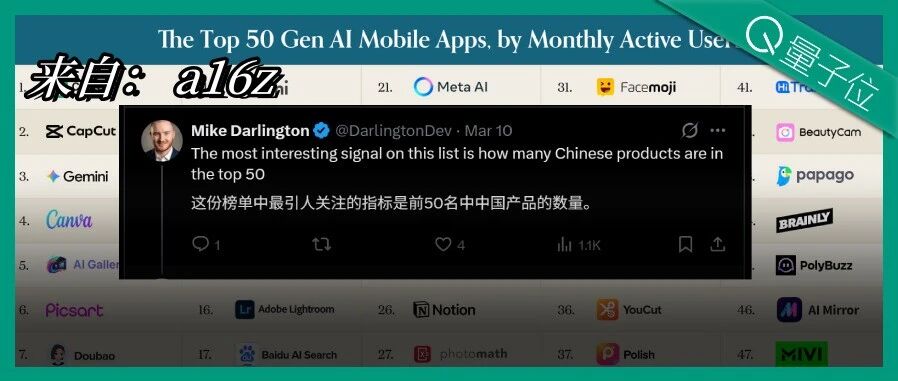
Core Insights - The article discusses the recent ranking of the "Top 100 Most Loved Consumer AI Applications" released by venture capital firm a16z, highlighting the significant presence of Chinese teams in the mobile AI application space [1][14]. - It notes the interesting phenomenon where the production and consumption of AI applications are becoming increasingly separated, with a notable number of users for Chinese-developed tools coming from overseas [6][3]. - The article also emphasizes the competitive landscape between major AI applications, particularly ChatGPT and Claude, revealing that they are targeting different user bases with minimal overlap [10][54]. Summary by Sections Overview of the Ranking - a16z has been compiling the "Top 100 Consumer AI Applications" list since the rise of ChatGPT three years ago, initially focusing on native AI applications but now including non-native ones like Canva and Notion in the latest version [15][17]. - The ranking is divided into two categories: the top 50 web-based AI products and the top 50 mobile AI applications, with data collected until January 2026 [23][24]. Market Dynamics - The article highlights that nearly half of the top mobile AI applications are developed by Chinese teams, with significant user engagement from international markets [3][27]. - It identifies three major AI markets globally, with the surprising inclusion of Russia as a significant player alongside the US and China [60][65]. User Engagement and Growth - ChatGPT remains the leading consumer AI application, with its monthly active users significantly outpacing competitors like Gemini and Claude [28][29]. - The article notes a rapid increase in ChatGPT's user base, reaching 900 million weekly active users, which represents over 10% of the global population [30][31]. Competitive Landscape - The competition is intensifying, with challengers like Gemini and Claude experiencing rapid growth in paid user numbers, driven by innovative features [34][35]. - The article discusses the strategic divergence between ChatGPT and Claude, with ChatGPT focusing on a broader consumer base while Claude targets professional users [53][54]. Trends in AI Applications - The article observes a shift in the types of AI applications gaining popularity, with video and music AI products rising while image-based applications are declining [82][75]. - It notes that the integration of AI capabilities into existing platforms is becoming more common, as seen with products like Nano Banana being incorporated into Gemini [79][106]. Future Predictions - The report predicts that AI assistants may evolve into operating system-like environments, leading to a competitive landscape resembling that of mobile operating systems rather than traditional search engines [58][59]. - It concludes with a note on the challenges of accurately measuring the popularity of AI products due to the evolving nature of user engagement and application forms [113][116].