
Alphabet(GOOG)

Search documents
科技巨头争夺印度市场,硅谷富豪加码加州政治影响力
Sou Hu Cai Jing· 2026-02-25 10:18
Group 1 - India is positioning itself to become the world's third-largest AI power, following the US and China, as emphasized by Prime Minister Narendra Modi at the AI Impact Summit [3][4] - Modi advocates for preventing AI monopolies and promoting shared and open-source technology to benefit the world, focusing on applications that can enhance the prospects of India's 1.45 billion people [3][4] - Major tech companies are making significant investments in India, with Google announcing $15 billion for data centers and undersea cables, Microsoft committing $17.5 billion, and Amazon planning to invest $35 billion [3][4] Group 2 - India's large online population, with approximately 1.4 billion people holding digital identities and over 700 million having digital health accounts, presents substantial opportunities for AI companies [4][5] - The US government is strengthening tech ties with India through agreements like the Silicon Valley Accord, distancing India from China amid geopolitical tensions [5][6] - Silicon Valley billionaires are increasingly influencing California politics, contributing millions to various political campaigns and seeking new allies as Governor Gavin Newsom approaches term limits [7][8]





你想不到的AI芯片大战
半导体芯闻· 2026-02-25 10:11
Core Insights - The relationship between Google and Nvidia is complex, characterized by both collaboration and competition, particularly in the AI chip market [1] - Google has been a major customer of Nvidia's AI chips, with CEO Sundar Pichai mentioning Nvidia products in 10 out of 12 quarterly earnings calls over the past three years [1] - Google's recent launch of the Gemini 3 large language model, trained entirely on its own TPU chips, signifies its ambition to compete directly with Nvidia in the AI chip space [1] Group 1 - Google's Gemini 3 model has achieved impressive results in AI benchmarks, positioning the company at the forefront of the AI field [1] - Following the Gemini 3 release, Google is reportedly selling its TPU chips to other companies, including Meta Platforms, which could make Google a direct competitor to Nvidia [2] - Nvidia has signed a significant agreement with Meta to deploy its CPU chips in traditional server devices, marking a major expansion of its CPU's use [2] Group 2 - Google is increasing financial support for data center partners, including a potential $100 million investment in a cloud startup named Fluidstack, mirroring Nvidia's investment strategy [2] - Securing chip production capacity is a significant challenge for Google, as Nvidia currently dominates the necessary production lines and components [3] - Nvidia has prioritized the procurement of specialized memory required for AI systems, further complicating Google's ambitions in the AI chip sector [3]

Russia fines Google for distributing VPN services, TASS reports
Reuters· 2026-02-25 09:37
Group 1 - A Russian court has fined Alphabet's Google 22 million roubles ($288,000) for distributing VPN services on the Google Play app store [1] - The VPN services allow Russian users to access foreign tech platforms and content that are banned or restricted in Russia [1]

研报 | 预估2026年全球八大CSP合计资本支出将破7,100亿美元,谷歌TPU引领ASIC布局
TrendForce集邦· 2026-02-25 09:01
Core Insights - The global cloud service providers (CSPs) are significantly increasing their capital expenditures on AI servers and related infrastructure, with a projected total exceeding $71 billion in 2026, reflecting a year-on-year growth rate of approximately 61% [2][5][6]. Group 1: Major CSPs and Their Investments - The eight major CSPs include Google, AWS, Meta, Microsoft, Oracle, Tencent, Alibaba, and Baidu [6]. - Google is expected to have a capital expenditure exceeding $1.783 billion in 2026, with a year-on-year increase of 95%. Google has a significant lead in ASIC development, with its TPU shipments projected to account for nearly 78% of its AI server output [6][7]. - Amazon is increasing its procurement of NVIDIA GPU systems, with its GPU models expected to represent nearly 60% of its AI server offerings in 2026. The new generation of its self-developed ASIC, Trainium 3, is anticipated to launch in the second quarter of 2026 [7]. - Meta's capital expenditure is projected to exceed $1.245 billion in 2026, with a year-on-year growth of 77%. Its AI servers will primarily utilize NVIDIA and AMD solutions, with GPU models expected to account for over 80% [8]. Group 2: ASIC Development and Market Dynamics - Microsoft is focusing on long-term demand for large model training and inference, primarily acquiring NVIDIA solutions for its AI servers. The company has released its self-developed chip, Maia 200, aimed at high-efficiency AI inference applications [8]. - Oracle is expanding its GPU solutions in response to AI data center projects, while ByteDance is expected to allocate over half of its capital expenditure to AI chip procurement, with NVIDIA's H200 being a key solution [9]. - Tencent is sourcing NVIDIA GPUs to support cloud and generative AI demands while collaborating with local firms to develop its own ASIC solutions [9]. - Both Alibaba and Baidu are actively developing their own ASIC AI chips, with Alibaba providing AI infrastructure through its subsidiaries and Baidu planning to introduce its Kunlun solutions for large-scale AI training and inference applications [9].





高瓴、李录、巴菲特最新持仓披露!
Sou Hu Cai Jing· 2026-02-25 08:57
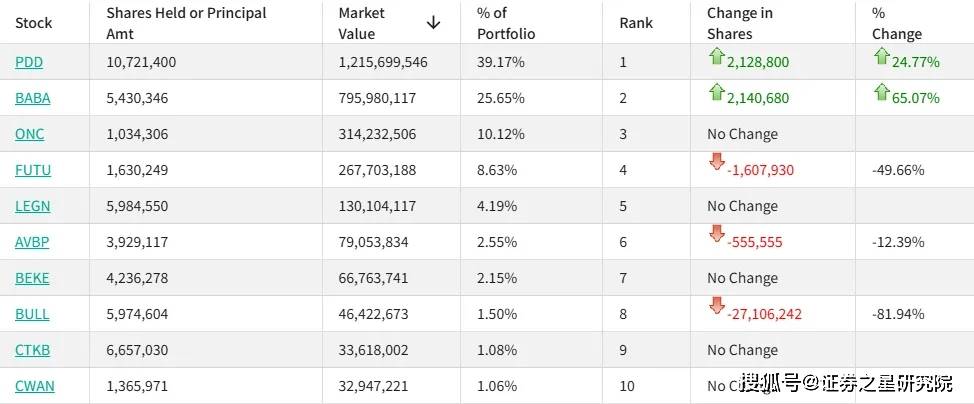
Group 1: Hillhouse Capital (HHLR) - Hillhouse Capital's HHLR fund reported a total market value of $3.104 billion at the end of Q4 2025, a decrease of 24% from the previous quarter, indicating a strategy of "focusing on core and shrinking edges" [2][4] - The top ten holdings include seven Chinese concept stocks, which account for nearly 90% of the total portfolio, primarily in internet e-commerce, biomedicine, and fintech sectors [2][4] - Significant increases in holdings were observed for Pinduoduo and Alibaba, with Pinduoduo's market value rising to $1.216 billion (up 24.77%) and Alibaba's to $795 million (up 65.07%) [3][4][5] - HHLR has reduced positions in competitive or non-core areas, clearing out stocks like Baidu and NetEase, while also entering positions in tech stocks like TSMC and Google [5] Group 2: Himalaya Capital - Himalaya Capital, managed by Li Lu, reported a Q4 2025 market value of $3.57 billion, up 10% from $3.23 billion in the previous quarter, maintaining a concentrated investment style [7][9] - The top four holdings (Google, Bank of America, Pinduoduo, and Berkshire Hathaway B) account for over 87% of the portfolio, with Google being the largest holding at $1.565 billion (43.86%) [9][10] - The fund exited its position in SOC and initiated a new position in Crocs, reflecting a focus on brands with strong market presence and cash flow [10] Group 3: Berkshire Hathaway - Berkshire Hathaway's Q4 2025 report, the last under CEO Warren Buffett, showed a portfolio dominated by familiar names, including Apple, American Express, and Coca-Cola [11][12] - Berkshire reduced its Apple holdings by over 10.29 million shares, marking the third consecutive quarter of reduction, while still maintaining Apple as its largest holding [13][14] - The company also significantly reduced its stake in Bank of America and Amazon, while increasing positions in Chevron and new investments in The New York Times, indicating a cautious approach to high-value assets [15][16] - Berkshire's cash reserves reached $381.7 billion, surpassing stock holdings for the fifth time in history, suggesting a strategic wait for better investment opportunities [16][18]




高盛警告:AI热潮背后的经济真相与万亿风险!
Sou Hu Cai Jing· 2026-02-25 07:54
Group 1 - Goldman Sachs predicts that AI will have a "negligible" impact on the US economy by 2025, contributing essentially zero to GDP growth, which was 2.2% last year [3][4] - The report indicates that significant capital is flowing towards Asian manufacturing, particularly in semiconductor production, rather than benefiting the US economy directly [3][8] - Major tech companies' capital expenditures are estimated to be around 75% directed towards Asian manufacturing regions, complicating the measurement of AI's net contribution to the US economy [4][11] Group 2 - The S&P 500 index has reached record valuations, with the five major constituents (NVIDIA, Microsoft, Apple, Google, and Amazon) having a price-to-earnings ratio of 28, which is above historical averages but below the 50 times seen during the 2000 dot-com bubble [4][8] - If AI capital expenditures drop back to 2022 levels, AI hardware and service suppliers could face a loss of up to 30% in expected annual sales growth for the S&P 500, equating to a potential $1 trillion impact [4][11] - Analysts expect a significant slowdown in capital expenditures by the end of 2025 or 2026, although tech giants are currently raising their spending guidance [7][11] Group 3 - Some experts argue that the economic contributions of AI are overestimated, with estimates suggesting that chatbots and large language models contributed only about 0.2% to last year's GDP growth [10][11] - Public opinion is divided, with some questioning the short-term practicality of AI-generated content due to time consumption and error rates, while others view the current investment as a defensive strategy in a competitive landscape [10][11] - Long-term concerns include the potential for AI to displace a significant number of jobs, which could challenge government revenue and necessitate tax adjustments [10][11]

半导体行业:行业整体景气上行,存储、设备、晶圆代工需求火
Dongguan Securities· 2026-02-25 07:29
Group 1: Overall Industry Outlook - The semiconductor industry is experiencing an upward trend in performance, driven by strong demand in storage, equipment, and foundry sectors [1] - The report maintains an overweight recommendation for the semiconductor sector due to the overall industry recovery and growth potential [1] Group 2: Performance of Overseas Listed Companies - North American cloud service providers, including Microsoft, Amazon, Google, and Meta, reported significant year-on-year growth in cloud revenues, driven by AI demand, with capital expenditures expected to increase substantially in 2026 [14][15][16][17] - TSMC, the global leader in foundry services, reported a 25.5% year-on-year increase in Q4 2025 revenue, reaching $33.73 billion, with net profit growing over 40% [21] - Micron Technology's Q1 FY26 revenue reached approximately $13.64 billion, benefiting from rising storage prices driven by AI demand [31] - Texas Instruments and Analog Devices showed signs of recovery in the analog chip sector, with Texas Instruments reporting a 10% year-on-year revenue increase in Q4 2025 [39][41] Group 3: Performance of Domestic Listed Companies - SMIC reported a Q4 2025 revenue of 17.81 billion yuan, a year-on-year increase of 11.9%, with net profit growing by 23.2% [57] - The semiconductor packaging and testing sector is recovering, with several companies reporting improved profitability and growth driven by AI demand [60] - The analog chip sector is also showing signs of recovery, with many companies reporting improved performance compared to 2024 [62] Group 4: Investment Recommendations - The report suggests focusing on high-growth segments driven by AI, such as computing chips, storage, advanced packaging, and semiconductor equipment [7]


左手算力、右手电力!谷歌的焦虑藏不住了
Ge Long Hui· 2026-02-25 07:28
Core Viewpoint - Google is aggressively expanding its data center operations in Minnesota and Texas to meet unprecedented computing power demands, while also committing to clean energy initiatives [1][2][3]. Group 1: Minnesota Data Center - Google announced a partnership with Xcel Energy to build its first data center in Minnesota, which will include 1,900 megawatts of clean energy supply, comprising 1,400 megawatts of wind power, 200 megawatts of solar energy, and 300 megawatts of long-duration battery storage [5][6]. - The local city council has supported the data center project, which has received preliminary development approvals and financial incentives, including a $36 million tax break [7]. - The project is expected to generate over $130 million in tax revenue for the local government, although it faces opposition from local residents and environmental groups, with ongoing legal and regulatory reviews [8]. Group 2: Texas Data Center - In Texas, Google is also constructing a new data center that focuses on water resource safety and energy affordability, utilizing advanced air-cooling technology to minimize water consumption [10]. - This expansion is part of a broader $40 billion investment in Texas, aimed at addressing the rapidly growing demand for computing power [11]. Group 3: Computing Power and AI Development - Google's computing power is projected to increase from 15 gigawatts at the end of 2025 to 35 gigawatts by 2028, with cloud computing capacity expected to more than double [12]. - The company is leveraging its expanding infrastructure to enhance its AI capabilities, as evidenced by the recent release of the Gemini 3.1 Pro model, which has shown significant performance improvements [15]. - Analysts have upgraded Alphabet's stock rating based on its competitive advantages in customer data, distribution channels, and computing power, positioning it as a leading player in the AI era [16]. Group 4: Industry Challenges - The rapid expansion of data centers is facing challenges such as electricity and water shortages, community resistance, and outdated power grids, which are becoming significant obstacles for project implementation [17]. - The increasing energy demands of AI data centers have prompted discussions about self-sufficient power solutions among major tech companies, including proposals for space-based data centers to alleviate terrestrial constraints [17].
速递 | 谷歌急眼了!OpenClaw用户集体被封
未可知人工智能研究院· 2026-02-25 06:29
Core Viewpoint - The essence of technology is to serve people, not to become a tool for monopoly and restriction. The recent actions by Google against OpenClaw highlight the tension between platform control and user autonomy in the AI landscape [1]. Group 1: Google's Actions Against OpenClaw - Google has banned OpenClaw, an open-source AI framework, leading to account restrictions for users who integrated it with Google's Gemini, indicating a zero-tolerance policy for using third-party tools [6][11]. - The reaction from Google is not merely about limiting usage but reflects a deeper concern over the potential for users to exploit subscription services for automated, continuous production, which could disrupt Google's pricing and operational models [11][12]. - The core issue is Google's desire to reclaim control over the entry points to its services, as the use of OpenClaw threatens to shift user engagement away from Google's official channels [13]. Group 2: Implications for Domestic Users - In contrast to Google's restrictive measures, domestic players like Baidu and NetEase are lowering barriers to entry by promoting simplified deployments of similar frameworks, which could democratize access to AI tools [15]. - The emergence of domestic alternatives suggests a shift towards creating a more accessible AI ecosystem, potentially leading to a broader range of applications and services [16]. - The focus for domestic developers should be on creating compliant, reusable AI solutions that can integrate seamlessly into existing business processes, rather than merely replicating existing models [19]. Group 3: Market Dynamics and Future Opportunities - The current phase in the AI sector is characterized by a restructuring of order, where major platforms are using account bans to establish market norms, indicating a shift from technical competition to regulatory frameworks [22]. - The most valuable skills in the future will not be those of individuals who can ask questions but rather those who can effectively manage and utilize AI systems within organizational contexts [20]. - The opportunity lies in developing AI solutions that are not only functional but also compliant and adaptable, enabling businesses to leverage AI as a deliverable workforce [19].

DeepMind 运作模式曝光,暗示根本没输 OpenAI:员工20% 时间重启创新,保守巨头直接变 “实验狂”
3 6 Ke· 2026-02-25 06:15
Core Insights - Google DeepMind is positioning itself as a modern version of Bell Labs, focusing on ambitious research agendas while allowing researchers the freedom to explore various paths [1][5][10] - The integration of Google Brain and DeepMind has led to the establishment of a central AI engine around the Gemini project, which is expected to mature by 2026 [2][9] - Google is reviving its lab culture, currently advancing approximately 30 projects, and leveraging a well-known innovation mechanism where employees can dedicate 20% of their time to exploratory projects [2][17] Group 1: Operational Model - Google DeepMind operates on two core methodologies: providing direction without dictating answers and fostering interdisciplinary collaboration among experts from various fields [1][6] - The leadership of Demis Hassabis is pivotal, as he balances top-down direction with bottom-up innovation, allowing for a unique approach to research and development [6][7] - The company emphasizes a long-term perspective, as evidenced by its significant breakthroughs in quantum error correction and the development of a flood prediction system covering 150 countries [3][29] Group 2: Gemini Project - Gemini serves as the foundational infrastructure for the company, with major iterations occurring every 5 to 6 months, immediately integrating into core products like Search and Workspace [4][9] - The project is designed to support a wide range of applications, from generative AI to scientific research, demonstrating a commitment to both immediate and long-term goals [2][9] Group 3: Innovation and Experimentation - The revival of Google's lab culture has led to the development of AI-native products, such as Notebook LM and Flow, which are designed to enhance user interaction and creativity [10][11][14] - The company continues to encourage innovation through its 20% time policy, allowing employees to pursue projects outside their primary responsibilities, contributing to a vibrant culture of creativity [17][19] - Notable projects like Learn Your Way and Co-Scientist exemplify the company's commitment to leveraging AI for educational and research advancements [18][19] Group 4: AI in Education - Google DeepMind is actively researching the impact of AI on education, with findings indicating that a significant majority of students and teachers are utilizing AI tools [22][23] - The company aims to create personalized learning experiences and assist teachers in enhancing their productivity, thereby transforming traditional educational methods [24][25] Group 5: Scientific Advancements - Google DeepMind is making strides in quantum computing, materials science, and meteorological predictions, with significant breakthroughs in each area [29][30][33] - The company has developed a flood prediction model that has the potential to save lives by providing timely warnings, showcasing the practical applications of its research [34] - Project Suncatcher aims to utilize space for AI training, reflecting the company's forward-thinking approach to harnessing solar energy for computational needs [35][36]