
Alphabet(GOOGL)

Search documents
刚刚,全线大涨!芯片,突传重磅利好!黄金、白银飙涨
券商中国· 2026-02-03 00:37
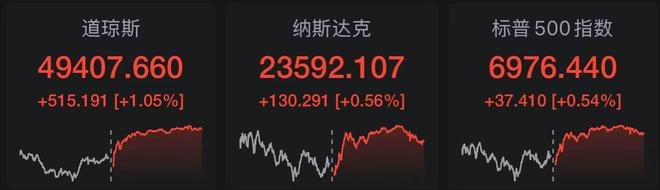
Core Viewpoint - The article highlights a significant rebound in the U.S. stock market, particularly in the semiconductor sector, driven by optimistic forecasts for DRAM prices by Goldman Sachs, which predicts a substantial increase in prices for 2026 [1][3][4]. Semiconductor Sector - The U.S. stock market saw a strong performance with major indices rising, particularly the Dow Jones, which increased by over 1%, and the S&P 500 approaching historical highs [1][3]. - Semiconductor stocks experienced a collective surge, with the Philadelphia Semiconductor Index rising by 1.7%. Notable performers included SanDisk, which surged over 15%, and Western Digital, which rose nearly 8% [3][4]. - Analysts suggest that capital moving out of precious metals and cryptocurrencies is seeking new investment opportunities, with the storage chip sector poised to attract this influx of funds due to strong fundamentals [3][4]. DRAM Price Forecast - Goldman Sachs has significantly raised its price forecasts for DRAM, predicting a 90%-95% quarter-over-quarter increase in Q1 2026, following a 45%-50% increase in Q4 2025. This outlook exceeds previous market expectations [4]. - In the PC DRAM segment, TrendForce has adjusted its price forecast for Q1 2026 to a 105%-110% increase, surpassing Goldman Sachs' earlier estimate of 80%-90%, indicating potential for further price increases [4]. Economic Indicators - The ISM reported a surprising rise in the U.S. manufacturing PMI for January, jumping from 47.9 to 52.6, indicating expansion and the fastest growth rate since 2022, driven by robust new orders and production [6]. - The new orders index reached 57.1, a significant increase from the previous 47.7, while the production index also showed strong growth, suggesting a rebound in factory activity after a prolonged period of contraction [6]. - Employment index recorded 48.1, indicating a slowdown in job losses within the manufacturing sector, although it remains below the expansion threshold [6].






“热钱”寻找新叙事点,昨夜存储巨头暴涨!
证券时报· 2026-02-03 00:16
Core Viewpoint - The article highlights the significant movements in the U.S. stock market, particularly focusing on the performance of major companies and the implications of recent economic data. Group 1: Stock Market Performance - On February 2, U.S. stock indices closed higher, with the Dow Jones up 1.05%, S&P 500 up 0.54%, and Nasdaq up 0.56% [1][3] - Major tech companies are set to report earnings this week, including Google, Amazon, and others across various sectors [1] Group 2: Technology Sector Insights - Micron Technology rose over 5%, while other tech stocks like Texas Instruments, Dell Technologies, and Apple saw gains exceeding 4% [5] - Apple is expected to launch a new MacBook Pro with an M6 chip, which will not utilize TSMC's latest 2nm N2P process, potentially saving costs and ensuring supply [5] - Nvidia's stock fell 2.89% amid stalled negotiations with OpenAI regarding a $100 billion investment, highlighting risks associated with reliance on a single client [6] Group 3: Semiconductor and Memory Market - SanDisk shares surged 15.44% following reports of a 35% increase in average NAND flash prices by Q4 2025, attracting investment from funds moving away from precious metals and cryptocurrencies [6] Group 4: Economic Indicators - The U.S. manufacturing PMI unexpectedly rose from 47.9 to 52.6 in January, marking the highest level since February 2022 and indicating a shift towards expansion [9][11] - The U.S. government shutdown has delayed the release of the January non-farm payroll report, affecting data collection and publication by the Bureau of Labor Statistics [10]


Waymo完成160亿美元融资,计划今年拓展无人驾驶出租车至全球多地
Sou Hu Cai Jing· 2026-02-02 23:45
Core Insights - Waymo, a subsidiary of Alphabet, has completed a $16 billion financing round, aiming to expand its autonomous taxi fleet to over ten new cities globally, including London and Tokyo [1][3] Financing and Valuation - The financing round was led by Dragoneer Investment Group, DST Global, and Sequoia Capital, resulting in a company valuation of $126 billion [3] - Major investors included Andreessen Horowitz, Mubadala Capital, and several others, with Alphabet maintaining its status as the controlling shareholder [3] Business Expansion - Waymo plans to use the funds to drive business expansion, having significantly accelerated its development over the past year [3] - The company has received approval to operate autonomous ride-hailing services to and from San Francisco International Airport, covering all of Northern California and several major U.S. urban areas [3][4] Operational Scale - Waymo currently provides 400,000 rides per week across six major U.S. urban areas, with a projected annual ride total of 15 million by 2025, tripling its previous figures [5] - The cumulative ride total has surpassed 20 million, indicating a strong operational scale [5] Safety and Regulatory Challenges - Despite rapid expansion, Waymo's autonomous taxis have faced operational errors, leading to increased regulatory scrutiny and public criticism [5] - Investigations have been launched by the National Highway Traffic Safety Administration and the National Transportation Safety Board regarding incidents involving the autonomous vehicles, including a recent case where a child was injured near a school [5]

Waymo完成160亿美元融资估值达1260亿美元,宣称自动驾驶安全性已优于人类驾驶
Xin Lang Cai Jing· 2026-02-02 23:02
Alphabet旗下自动驾驶汽车子公司Waymo于当地时间周一宣布完成了一轮 160 亿美元的融资,这使得该 公司在"融资后"的估值达到 1260 亿美元。 这轮融资是Alphabet为支持 Waymo 进一步拓展至更多市场所采取的最新举措。 这轮融资是Alphabet为支持 Waymo 进一步拓展至更多市场所采取的最新举措。 此次的估值比 Waymo 在 2024 年 10 月上一轮融资时所达到的估值高出一倍多。上一轮融资是该公司的 C 轮融资,金额为 56 亿美元,估值为 450 亿美元。 Waymo联合首席执行官Tekedra Mawakana和Dmitri Dolgov在一篇博客文章中写道:"这一里程碑建立在 安全性的基础上,而如今,Waymo的安全性在统计数据上已经优于人类驾驶。我们不再是在验证一个 概念,而是在将商业现实规模化。" 此次的估值比 Waymo 在 2024 年 10 月上一轮融资时所达到的估值高出一倍多。上一轮融资是该公司的 C 轮融资,金额为 56 亿美元,估值为 450 亿美元。 Waymo联合首席执行官Tekedra Mawakana和Dmitri Dolgov在一篇博客文章中 ...
The AI Conversation Shifts: Davos, Siri, & Claude, Oh My!
Etftrends· 2026-02-02 22:06
Group 1 - The AI conversation has shifted from feasibility to the implications of Artificial General Intelligence (AGI), focusing on speed, displacement, and economic adjustments [1] - Elon Musk predicts AI could surpass human intelligence by the end of 2023 or early 2024, while JPMorgan's Jamie Dimon warns of potential rapid job displacement [1] - Anthropic's Claude Code is advancing AI capabilities, with over 90% of its new models being autonomously written by AI agents, indicating a significant technological inflection point [1] Group 2 - Google's Tensor Processing Unit (TPU) buildout is expected to produce three million TPUs in 2026, scaling to seven million by 2028, driven by demand from companies like Anthropic [1] - The ROBO Global Artificial Intelligence Index (THNQ) has evolved to focus 75% on enabling infrastructure, reflecting where value is accruing in the AI landscape [2] - THNQ's exposure to semiconductor fabrication, semi equipment, optical interconnects, edge computing, and cloud providers positions it to benefit from multiple vectors of AI monetization [2]

Earnings live: Palantir stock surges after Q4 beat, NXP and Disney stocks fall
Yahoo Finance· 2026-02-02 21:39
Group 1 - The fourth quarter earnings season is ongoing, with major companies like Alphabet, Amazon, AMD, Qualcomm, and Palantir reporting results [1] - As of January 30, 33% of S&P 500 companies have reported their fourth quarter results, with an estimated 11.9% increase in earnings per share, marking the 10th consecutive quarter of annual earnings growth for the index [2][4] - Analysts initially expected an 8.3% increase in earnings per share, which was revised upwards due to strong performance from tech companies, reflecting a shift from the previous quarter's 13.6% growth rate [4] Group 2 - Big Tech companies are setting the tone for the earnings season, with ongoing capital expenditures and themes such as artificial intelligence and economic policies influencing market dynamics [5] - Upcoming earnings reports will include updates from companies like Disney, Chipotle, PepsiCo, Uber, and Snap, indicating continued investor interest in diverse sectors [5]


美股三大指数收涨 道指涨超1%
Xin Lang Cai Jing· 2026-02-02 21:21
Core Viewpoint - The U.S. stock market experienced gains on Monday, with the Dow Jones Industrial Average rising by 1.05%, the Nasdaq increasing by 0.56%, and the S&P 500 up by 0.54% [1] Group 1: Major Index Performance - The Dow Jones Industrial Average rose by 1.05% [1] - The Nasdaq increased by 0.56% [1] - The S&P 500 was up by 0.54% [1] Group 2: Performance of Large Tech Stocks - Micron Technology saw an increase of over 5% [1] - Intel, Apple, and AMD each rose by over 4% [1] - Google and Amazon increased by over 1% [1] Group 3: Decline in Other Tech Stocks - Nvidia and Oracle both fell by over 2% [1] - Meta, Microsoft, and Tesla each declined by over 1% [1] - Netflix and Broadcom experienced slight declines [1]


Here's How Much Alphabet Stock Is Expected to Move After Earnings on Wednesday
Investopedia· 2026-02-02 21:11
Core Insights - Alphabet is expected to report record-high revenue for the fourth quarter, with projections of $111.37 billion, reflecting a 15% year-over-year increase, and adjusted earnings per share anticipated to grow over 20% to $3.09 [1][1][1] Stock Performance Expectations - Traders anticipate a significant movement in Alphabet's stock post-earnings report, with options pricing indicating a potential rise or fall of more than 5% from Monday's close of just under $345, suggesting a range between approximately $328 and $362 [1][1][1] - The stock has already increased about 25% since the last quarterly report in late October, when it surpassed the $100 billion revenue mark for the first time [1][1][1] Analyst Sentiment - Analysts remain largely bullish on Alphabet, with 12 out of 15 analysts rating it as a "buy" and the average price target set at $350, indicating expectations for continued record highs [1][1][1] - HSBC analysts are particularly focused on commentary regarding Google Cloud's capacity to meet AI demand, growth in overall searches, and updates on collaborations with Apple [1][1][1]

Jim Cramer on Alphabet: “It May Be Even Making More Money From AI Than Meta”
Yahoo Finance· 2026-02-02 20:18
Group 1 - Jim Cramer expressed a bullish outlook on Alphabet Inc., suggesting it may be a significant player in AI search and could potentially generate more revenue from AI than Meta [1] - Alphabet is recognized for its diverse tech-related offerings, including search, advertising, cloud computing, AI tools, and digital content platforms like YouTube and Google Play [2] - Cramer highlighted that Alphabet appears to be the "only winner in AI" at the moment, especially in contrast to competitors like Microsoft and Meta, which face challenges related to energy sourcing for their data centers [2] Group 2 - There is a perspective that while GOOGL has investment potential, other AI stocks may offer greater upside and lower downside risk [3]

Will Alphabet’s Q4 Earnings Send GOOGL Stock Higher?
Yahoo Finance· 2026-02-02 19:18
Alphabet (GOOG) (GOOGL) will release its fourth-quarter financial results on Wed., Feb. 4. Heading into the earnings, Alphabet stock has surged 81.35% over the past six months, reaching a fresh high of $344.83 today. Alphabet stock has got a significant boost from its growing artificial intelligence (AI) capabilities and AI-driven momentum across its businesses. November's launch of Gemini 3 has strengthened Google’s position in the AI space. Further, investors’ optimism has also been supported by Alphabe ...