IBM(IBM)

Search documents
IBM Up 10 Days in a Row: What's Driving the Winning Streak?
MarketBeat· 2025-06-13 17:11
Core Viewpoint - IBM has experienced a significant stock rally, with shares more than doubling since the start of 2024, driven by advancements in AI and quantum computing [2][3]. Group 1: Quantum Computing Developments - IBM plans to build the world's first large-scale "fault-tolerant" quantum supercomputer, named IBM Quantum Starling, by 2029, which is expected to have 20,000 times the operational power of current systems [4]. - The Starling system will be capable of processing 100 million quantum operations, with a subsequent processor, Bluejay, projected to enable over one billion operations by 2033 [5]. - A detailed roadmap includes milestones such as the Quantum Loom testing in 2025 and various upgrades leading to the Starling launch [12]. Group 2: AI Innovations - IBM's focus on agentic AI aims to assist large enterprises in managing workflows and proprietary data, exemplified by the Granite AI model on the Watsonx platform [6]. - The AI segment has shown strong performance, with software sales reaching over $6.3 billion in Q1 2025, marking a 9% year-over-year increase [7][8]. - The recurring revenue from products like Red Hat supports this growth, indicating a robust business model [8]. Group 3: Financial Performance - IBM reported strong earnings on April 23, with an EPS of $1.60 surpassing the expected $1.42, and revenue of $14.54 billion exceeding the forecast of $14.41 billion [9]. - The company generated a record $2 billion in free cash flow and improved its EBITDA margin by 240 basis points due to AI workflow automation [10]. - Full-year guidance projects a 5% revenue growth and $13.5 billion in free cash flow generation [10]. Group 4: Analyst Ratings and Stock Forecast - The stock has received multiple analyst upgrades, with price targets ranging from $285 to $300, indicating potential upside from current levels [13]. - The average 12-month stock price forecast is $250.31, suggesting a moderate buy rating among analysts [10][13].



独家对话IBM陈旭东:DeepSeek很热,但影响尚未全面到来! 丨 科创100人
Xin Lang Ke Ji· 2025-06-13 10:24
Core Insights - The impact of generative AI on enterprises is still limited, with significant changes in specific fields like image generation, translation, and coding, but not in overall business processes and efficiency [3][4] - Many enterprises need to enhance their digitalization before fully leveraging AI technologies, as a solid information technology foundation is crucial for AI applications [4][5] - Companies often misunderstand AI's capabilities, believing it to be omnipotent and easy to implement, which leads to miscalculations in return on investment (ROI) [5][6] Digitalization and AI Investment - Enterprises must develop knowledge bases and intelligent Q&A systems as foundational AI investments, which are essential for future growth [7] - AI investment should be viewed in three areas: hardware, software platforms, and personnel training, all of which are necessary for successful AI implementation [6][8] - The current AI investment landscape is characterized by a focus on future potential rather than immediate financial returns, with many companies still in the early stages of development [8][9] Market Dynamics and Strategy - The AI market consists of three main types of companies: those with large models and cloud services, those offering customized development, and those like IBM that provide integrated platforms [9][10] - IBM's hybrid cloud and AI strategy, established seven years ago, positions the company well in the market, leveraging a wide range of software tools for client needs [10] - The focus of IBM's services is shifting towards private and overseas enterprises, building on its long-standing relationships and trust within the Chinese market [10]


解决最大瓶颈,IBM要在2029年打造“最强量子计算机”?
Huan Qiu Shi Bao· 2025-06-11 22:33
Core Insights - IBM scientists claim to have solved the major bottleneck in quantum computing and plan to launch the world's first large-scale quantum computer by 2029, which will be 20,000 times more powerful than any existing quantum computer [1][2]. Quantum Error Correction - The primary technical barrier to the widespread adoption of quantum computers is "quantum error correction," as quantum bits (qubits) are highly sensitive to environmental interactions, leading to errors due to a phenomenon known as "decoherence" [1]. - IBM's new quantum computer, named "Starling," will utilize 200 logical qubits composed of approximately 10,000 physical qubits, while a subsequent model, "Blue Jay," is planned for 2033 with 2,000 logical qubits [2]. - IBM has developed a novel quantum error correction method that allows quantum hardware to surpass previous limitations, using more efficient LDPC error correction codes to reduce the number of physical qubits required for reliable logical qubits [2]. Future of Quantum Computing - Currently, quantum computers can only utilize a few hundred qubits, limiting their application to custom problems that test their potential against traditional binary computers [3]. - IBM envisions future quantum computers capable of using hundreds of millions of qubits to ensure widespread adoption, necessitating the development of new algorithms and programs to fully leverage their high performance [3].
Quantum Rivalry Rises With IBM's Push: Is D-Wave Still a Buy?
ZACKS· 2025-06-11 20:01
Core Insights - D-Wave Quantum's shares have surged by 1359.5% over the past year, driven by increasing demand for quantum technology, an AI infrastructure boom, and strong quarterly results [1][7]. - IBM's recent announcement of the IBM Quantum Starling, a large-scale fault-tolerant quantum computer, poses a competitive threat to D-Wave Quantum, as it aims to perform 20,000 times more operations than current machines [2][3]. Long-term Tailwinds for D-Wave Quantum - D-Wave achieved quantum computational supremacy in Q1 2025, solving a materials science problem in minutes that would take a classical supercomputer nearly a million years, using its 1,200-qubit Advantage2 prototype [5][7]. - D-Wave specializes in annealing quantum computing, which is optimized for combinatorial and optimization problems, allowing for immediate deployment compared to competitors focused on gate-based models [6][13]. - The company exited Q1 2025 with a cash balance of $304.3 million, bolstered by $146.2 million from its third At-The-Market offering, positioning it as a capital-efficient player in the quantum space [7][8]. Technical Indicators - D-Wave Quantum's stock is trading above both the 50-day and 200-day moving averages, indicating a bullish trend and positive market sentiment [9]. Earnings Estimates - The Zacks Consensus Estimate indicates a 30% improvement in D-Wave's Q2 2025 earnings and a 72% improvement for the full year compared to the previous year [11][12]. Competitive Landscape - D-Wave is the only quantum computing company to demonstrate real-world quantum supremacy, distinguishing itself from competitors like IonQ and Rigetti Computing, which are still developing less mature gate-based systems [13][15]. - Despite IBM's entry into the quantum computing market, D-Wave is expected to continue capitalizing on its production-ready annealing solutions and has a long runway for growth [15].



ChatGPT picks top 2 quantum computing stocks to buy in June
Finbold· 2025-06-11 19:38
Industry Overview - Quantum computing is experiencing renewed momentum with significant investments and advancements in the field [1] - Recent breakthroughs include Google's Willow chip, which can perform calculations in minutes that would take supercomputers years [1] Company: IBM - IBM is identified as a leading player in quantum computing, with its stock gaining 27% year to date and currently valued at $280 [2] - The 'Starling' initiative aims to develop a large-scale, fault-tolerant quantum computer by 2029, and the company has introduced the Condor chip featuring over 1,000 qubits [3] - IBM's strong financial position supports its R&D efforts, positioning the company for quantum leadership while maintaining value in its core business segments [4] Company: IonQ - IonQ is highlighted as a high-risk, high-reward investment, focusing exclusively on quantum computing and utilizing trapped-ion technology [5] - The company recently acquired Oxford Ionics for $1.1 billion, indicating its ambition to scale quantum systems, with its stock rising over 20% in the past month, though down nearly 8% year to date, trading at $39 [7] - IonQ reported Q1 2025 revenue of $7.57 million, slightly above estimates, and narrowed its net loss to $32.3 million from $39.6 million the previous year [9]


ChatGPT picks 2 quantum computing stocks to buy in June
Finbold· 2025-06-11 19:38
Industry Overview - Quantum computing is experiencing renewed momentum with significant investments and advancements in the field [1] - Recent breakthroughs include Google's Willow chip, which can perform calculations in minutes that would take supercomputers years [1] Company: IBM - IBM is identified as a leading player in quantum computing, with its stock gaining 27% year to date, currently valued at $280 [2] - The 'Starling' initiative aims to develop a large-scale, fault-tolerant quantum computer by 2029, and the company has introduced the Condor chip with over 1,000 qubits and a modular architecture called System Two [3] - IBM's strong financial position supports its R&D efforts, positioning the company for quantum leadership while maintaining value in its core business segments [4] Company: IonQ - IonQ is highlighted as a high-risk, high-reward investment, focusing exclusively on quantum computing and utilizing trapped-ion technology, which is considered more stable than superconducting alternatives [5] - The company recently acquired Oxford Ionics for $1.1 billion, indicating its ambition to scale quantum systems, leading to a 20% increase in stock price over the past month, though it remains down nearly 8% year to date, trading at $39 [7] - In Q1 2025, IonQ reported revenue of $7.57 million, slightly above estimates, and narrowed its net loss to $32.3 million from $39.6 million the previous year, aided by a non-cash gain of $38.5 million [9]

ETFs to Buy as IBM Launches Fault-Tolerant Quantum PC
ZACKS· 2025-06-11 12:01
Group 1: Core Announcement - IBM has announced the development of Starling, the world's first large-scale fault-tolerant quantum computer, set for release in 2029, which will operate 20,000 times more operations than current quantum machines [1][2] Group 2: Importance of Fault Tolerance - Starling's fault tolerance enables practical applications in various industries, including drug discovery, semiconductor design, supply chain optimization, and financial risk modeling [2] Group 3: Market Performance - Following the announcement, IBM's stock reached an all-time high of $273.27 on June 9, with a 60% increase over the past year, significantly outperforming the S&P 500's 12% gain during the same period [3] Group 4: Technical Innovation - IBM's new quantum error correction code, qLDPC, is more efficient and scalable than Google's surface code, requiring fewer qubits and less physical space [4][5] Group 5: Industry Outlook - The quantum computing industry is projected to expand to $8.6 billion by 2028, indicating a significant shift towards fully integrated, large-scale quantum systems [6] Group 6: Quantum Computing ETFs - Quantum Computing ETFs include a mix of Big Tech leaders, quantum startups, and semiconductor firms, such as Defiance Quantum ETF (QTUM), Global X Future Analytics Tech ETF (AIQ), and ARK Innovation ETF (ARKK) [8]
IBM,要造最强量子计算机
半导体行业观察· 2025-06-11 01:39
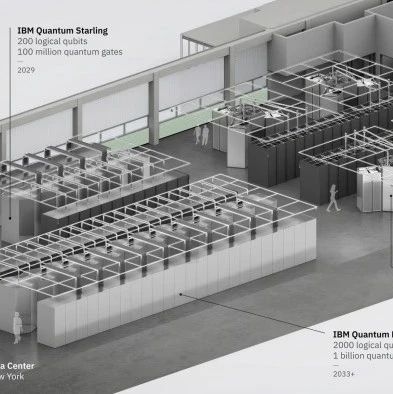
Core Viewpoint - IBM plans to build the world's first large-scale fault-tolerant quantum computer, named IBM Quantum Starling, by the end of this century, which will have a computing power 20,000 times greater than current quantum computers [2]. Group 1: Quantum Computing Developments - Quantum computers store information as quantum bits (qubits), which can exist in both "0" and "1" states simultaneously, allowing for more powerful computations compared to classical computers [3]. - A major challenge in quantum computing is the susceptibility of qubits to errors caused by "noise," which are small environmental interferences that can disrupt their quantum state [3]. Group 2: IBM's Roadmap and Collaborations - IBM's confidence in achieving a fault-tolerant quantum computer by 2029 is based on advancements in error reduction methods, specifically the "quantum low-density parity-check" (qLDPC) code, and real-time error correction techniques using classical computing [4]. - IBM is collaborating with the quantum startup SEEQC as part of a U.S. Defense Advanced Research Projects Agency (DARPA) quantum benchmarking program to assess the scalability of quantum operations [4]. Group 3: Market Implications and Industry Reactions - IBM aims to stimulate developer interest in creating quantum algorithms, which are crucial for realizing returns on investment in quantum computing [5]. - Analysts express skepticism about how IBM's breakthroughs will translate into tangible commercial value, noting that the transformative potential of fault-tolerant quantum computers remains speculative [5]. - The comprehensive nature of IBM's plans for building a fault-tolerant quantum computer is noteworthy and should alert businesses and the tech community to the rapid advancements in quantum computing [6].
OpenAI发布“史上最强”模型o3-pro,o3降价80%;Meta同意以148亿美元收购Scale AI 49%股份丨全球科技早参
Mei Ri Jing Ji Xin Wen· 2025-06-10 23:52
Group 1: OpenAI Developments - OpenAI has launched its new reasoning model o3-pro, claiming it to be the most powerful AI model to date, capable of accessing tools for web searches, document analysis, visual reasoning, and personalized responses [2] - The o3-pro model outperformed Google's Gemini 2.5 Pro in the AIME 2024 math benchmark and surpassed Anthropic's Claude 4 Opus in the GPQA Diamond doctoral-level science test, showcasing its leading performance in reasoning models [2] - OpenAI announced an 80% price reduction for its previous reasoning model o3, which may influence investor expectations regarding the company's growth potential [2] Group 2: Meta's Acquisition - Meta has agreed to acquire a 49% stake in AI startup Scale AI for $14.8 billion, emphasizing the importance of high-quality training data for AI development [3] - Scale AI, founded in 2016, specializes in providing large-scale labeled data essential for developing advanced AI tools like OpenAI's ChatGPT [3] - As part of the deal, Scale AI's CEO Alexandr Wang will take on a senior role at Meta, leading a new lab focused on "superintelligence" [3] Group 3: Microsoft's Copilot - Microsoft is reportedly on the verge of securing a major client for its AI product Copilot, which has over 1 million Microsoft 365 licenses [4] - If the client activates Copilot for 1 million employees at a monthly rate of $30 per user, it could generate approximately $360 million in annual revenue for Microsoft [4] - This potential acquisition highlights the market appeal of Microsoft's AI products and boosts investor confidence in the company's AI business prospects [4] Group 4: Starbucks AI Initiative - Starbucks plans to pilot an AI assistant named "Green Dot Assist" in 35 stores this month, developed on Microsoft's Azure OpenAI platform [5] - The AI assistant aims to streamline operations by providing baristas with guidance via tablets, covering drink preparation and equipment troubleshooting [5] - Starbucks intends to reduce order service time to under four minutes, addressing sales challenges in the U.S. market [5] Group 5: IBM's Quantum Computing Plans - IBM announced plans to launch a large-scale fault-tolerant quantum computer by 2029, detailing a roadmap to achieve this goal [6] - The quantum computer, named "Starling," will be built in Poughkeepsie, New York, and is expected to have around 200 logical qubits, offering computational power 20,000 times greater than current quantum computers [6] - This initiative reflects IBM's technological ambitions and aims to enhance its image in cutting-edge technology fields [7]



IBM announces new quantum processor, plan for Starling supercomputer by 2029
CNBC· 2025-06-10 15:47
Core Insights - IBM announced a roadmap for developing a large-scale, fault-tolerant quantum computer named Quantum Starling [1] - The new IBM Quantum Nighthawk processor is expected to be released later this year [1] Quantum Computing Requirements - A fault-tolerant quantum computer is essential for unlocking the full potential of quantum computing, requiring the ability to run larger circuits with hundreds of millions of gates and hundreds of qubits [2] - Fault tolerance is defined as the system's capability to correct errors and prevent them from propagating throughout the system [2] Competitive Landscape - The quantum computing race has intensified, with Google announcing its quantum chip "Willow" in December, followed by Microsoft's Majorana 1 chip in February, and Amazon's "Ocelot" chip shortly thereafter [3]