IBM(IBM)

Search documents
超117万人被裁!
商业洞察· 2025-12-18 09:23
Core Viewpoint - The article discusses the alarming rise in layoffs in the U.S. job market, with over 1.17 million employees laid off by November 2025, a 54% increase from the previous year, drawing parallels to the 2008-2009 financial crisis [4][5]. Group 1: Causes of Layoffs - The primary cause of layoffs is attributed to the efficiency revolution led by the DOGE department, resulting in 293,753 federal employees and contractors losing their jobs, with an additional 20,976 in the private and non-profit sectors, an eightfold increase compared to 2024 [15]. - The macroeconomic environment, characterized by high costs and tariffs, is also a significant factor, as many companies face debt repayment pressures from loans taken during the low-interest period of 2020-2021 [18][19]. - Companies, particularly those owned by private equity, are cutting jobs at a rate 1.5 times higher than publicly traded firms due to high leverage costs and cash flow constraints [21][22]. Group 2: Impact on Various Industries - The retail sector is the hardest hit, with a significant drop in consumer confidence and companies like Target and Starbucks announcing substantial layoffs due to decreased sales [27][28]. - The service industry has seen a 64% increase in layoffs, with UPS cutting 14,000 management positions to improve efficiency [30][31]. - The food industry has also been affected, with 34,165 job losses throughout the year, particularly in beef processing due to rising costs [32][33]. Group 3: Technology and Management Changes - The technology sector has contributed significantly to layoffs, with 35% of the total layoffs coming from this industry, primarily affecting middle management roles [46][47]. - A new corporate mantra has emerged: "Every employee generates revenue," leading to layoffs becoming a normalized management tool rather than a crisis response [51]. - Companies like Amazon and IBM have reported increased profits while simultaneously announcing significant layoffs, indicating a trend where cost-cutting measures are prioritized over workforce stability [53][54]. Group 4: Future Implications - The trend of layoffs is expected to continue, with predictions that the technology sector will see a peak in cost-cutting benefits by 2026, potentially reducing operational costs significantly [58]. - However, the loss of middle management, which often holds critical technical knowledge, could extend product development cycles and hinder innovation [62][71]. - The article warns that excessive cost-cutting may erode the foundation of innovation within the technology sector, leading to long-term negative consequences [72].







IBM and Pearson Team Up on AI-Powered Learning
Yahoo Finance· 2025-12-17 18:43
International Business Machines Corporation (NYSE:IBM) is included among the 12 Best Dogs of the Dow to Invest in. IBM and Pearson Team Up on AI-Powered Learning IBM and Pearson announced on December 11 that they are teaming up on a global partnership focused on AI-powered learning. The goal is to build more personalized learning tools for businesses, public-sector groups, and schools. These products are designed to help individuals acquire the right skills more quickly and transition smoothly between ro ...
Wolters Kluwer CCH® Tagetik achieves IBM Cloud for Financial Services® Validated designation
Businesswire· 2025-12-17 18:31
Group 1 - Wolters Kluwer's CCH Tagetik Intelligent Platform has received the IBM Cloud for Financial Services Validated designation [1] - The IBM Cloud for Financial Services framework aims to help institutions mitigate risk and accelerate innovation [1] - The designation ensures that solutions comply with stringent regulatory and security standards [1]

12 Best Dogs of the Dow to Invest in
Insider Monkey· 2025-12-17 16:40
In this article, we will take a look at some of the best dogs of the Dow stocks.Research published in the International Journal of Trade, Economics and Finance points to the work of Michael O’Higgins and John Downes, authors of Beating the Dow, who laid out a simple but influential investment idea. They showed that an equally weighted basket made up of the 10 highest dividend-paying stocks in the Dow Jones Industrial Average often delivers better returns than the DJIA itself.This approach became widely know ...

Jefferies Sees $198 Billion Revenue Potential By 2040 For Quantum Computing - Alphabet (NASDAQ:GOOG), Alphabet (NASDAQ:GOOGL)
Benzinga· 2025-12-17 13:31
Industry Overview - The quantum computing industry is currently generating $1 billion in revenue, with projections indicating potential growth to $198 billion by 2040 according to Jefferies [1][2] - Mizuho Securities also predicts significant growth in the quantum computing sector, estimating the market could reach $205 billion by 2035, likening it to the early GPU era [4] Company Ratings - Jefferies has initiated coverage on three companies in the quantum industry: D-Wave Quantum (NYSE:QBTS) and IonQ (NYSE:IONQ) both rated as Buy, and Rigetti Computing (NASDAQ:RGTI) rated as Hold [3] - The industry is supported by investments from governments and major tech companies, including Alphabet Inc. and IBM [3] Financial Performance - D-Wave Quantum reported Q3 results showing 100% revenue growth to $3.8 million, with a GAAP gross profit increase of 156% to $2.7 million and a gross margin of 71.4% [6] - IonQ reported Q4 revenue of $39.9 million, exceeding analyst estimates by 47.8%, and raised its full-year 2025 revenue guidance to $106–110 million, surpassing previous estimates [6] Stock Performance - Year-to-date, D-Wave Quantum's stock surged by 165.56%, while IonQ's stock increased by 15.24% [7]





IBM (IBM) Sees a More Significant Dip Than Broader Market: Some Facts to Know
ZACKS· 2025-12-16 23:46
Company Performance - IBM closed at $303.18, reflecting a -1.78% change from the previous day, underperforming the S&P 500's daily loss of 0.24% [1] - Over the past month, IBM shares gained 3.87%, outperforming the Computer and Technology sector's gain of 0.89% and the S&P 500's gain of 1.31% [1] Earnings Expectations - The upcoming earnings report is expected to show an EPS of $4.33, a 10.46% increase compared to the same quarter last year, with projected revenue of $19.21 billion, reflecting a 9.45% rise [2] - For the annual period, earnings are anticipated at $11.39 per share and revenue at $67.02 billion, indicating increases of +10.26% and +6.8% respectively from the previous year [3] Analyst Estimates - Recent changes in analyst estimates for IBM suggest a positive outlook on business operations and profit generation [3] - The Zacks Consensus EPS estimate has increased by 0.04% over the last 30 days, with IBM currently holding a Zacks Rank of 3 (Hold) [5] Valuation Metrics - IBM has a Forward P/E ratio of 27.11, which is a premium compared to the industry average Forward P/E of 24.95 [6] - The PEG ratio for IBM stands at 3.07, while the average PEG ratio for the Computer - Integrated Systems industry is 1.1 [6] Industry Context - The Computer - Integrated Systems industry is part of the Computer and Technology sector, currently holding a Zacks Industry Rank of 15, placing it in the top 7% of over 250 industries [7] - Research indicates that the top 50% rated industries outperform the bottom half by a factor of 2 to 1 [7]
美国超117万人被裁,原因何在?
虎嗅APP· 2025-12-16 13:38
Core Viewpoint - The article discusses the alarming rise in layoffs in the U.S., with over 1.17 million employees laid off as of November, marking a 54% increase from the previous year, reminiscent of the 2008-2009 financial crisis [5][6]. Group 1: Causes of Layoffs - The primary cause of layoffs is attributed to the efficiency revolution led by the DOGE department, resulting in 293,753 federal employees and contractors losing their jobs, with an additional 20,976 in the private and non-profit sectors, an eightfold increase compared to 2024 [15]. - The macroeconomic environment, characterized by high costs and tariffs, is also a significant factor, as many companies face debt repayment pressures from loans taken during the low-interest period of 2020-2021 [18][19]. - Retail, service, and food industries are the hardest hit, with retail experiencing a 20% drop in consumer confidence and significant job cuts from companies like Target and Starbucks due to rising prices and reduced consumer spending [27][30][32]. Group 2: Impact on Different Sectors - The retail sector has seen massive layoffs, with companies like Target cutting 1,800 jobs and Starbucks 900 due to decreased consumer spending [30]. - The service industry has also been affected, with 69,089 layoffs, a 64% increase, as companies like UPS cut 14,000 management positions to improve efficiency [30]. - The food industry faced 34,165 layoffs, with rising costs leading to job cuts in beef processing companies [32]. Group 3: Technology and Management Changes - The technology sector has contributed significantly to layoffs, with 35% of the total layoffs coming from this industry, particularly affecting middle management roles [47][48]. - Companies are increasingly using layoffs as a management tool to improve profitability, with a new focus on revenue per employee as a key performance indicator [50]. - The trend of cutting middle management has led to immediate operational cost savings, with companies like Amazon and Verizon reporting significant efficiency improvements after layoffs [57]. Group 4: Future Outlook - The technology sector is expected to continue this trend, with predictions of a peak in cost-cutting benefits by 2026, potentially reducing operational costs and increasing profit margins [60]. - However, the loss of middle management, which often holds critical technical knowledge, may extend product development cycles and hinder innovation [65][74]. - The article warns that excessive cost-cutting could erode the foundation of innovation in the tech industry, leading to a talent shortage and reduced research and development investment [75][73].

Can’t get a job? Blame AI? Train in ‘power skills,’ IBM exec says: ‘You can’t hire a college student now to just come in and create a spreadsheet’
Yahoo Finance· 2025-12-16 13:05
If 2023 was the year of shock and 2024 was the year of experimentation, 2025 marks the moment the corporate world finally accepted that artificial intelligence is not just a novelty—it is the new infrastructure of work. According to Justina Nixon-Saintil, IBM’s Vice President of Corporate Social Responsibility and Chief Impact Officer, the conversation has fundamentally shifted from fascination to urgent integration. In a recent interview with Fortune at IBM’s gleaming new flagship office at the southeas ...
3 Dividend-Paying Artificial Intelligence Stocks to Buy in 2026
The Motley Fool· 2025-12-16 12:25
Core Viewpoint - Investing in dividend-paying AI companies provides a way to gain passive income while participating in the rapidly expanding AI market [1] Group 1: Company Overview - Three notable AI stocks with attractive dividend yields are IBM, Cisco, and Nokia, offering diversification within the AI ecosystem [2] - IBM has a dividend yield of 2.2% and has shifted its focus to AI and cloud computing, resulting in significant sales growth [4][5] - Cisco's dividend yield is 2.1%, and the company is positioned to meet the demands of AI-driven networking with new products [10][12] - Nokia offers the highest dividend yield at 2.5% and is focusing on AI-supported 6G technology through a partnership with Nvidia [15][16] Group 2: Financial Performance - IBM's revenue rose 9% year-over-year to $16.3 billion in Q3, with its software division growing 10% to $7.2 billion [5] - Cisco reported a 5% year-over-year revenue growth to $56.7 billion for the fiscal year 2025, with an 8% increase in Q1 [12] - Nokia experienced a 4% year-over-year revenue growth to 13.8 billion euros in the first three quarters of 2025, following a decline in 2024 [18] Group 3: Future Prospects - IBM aims to achieve quantum advantage by the end of 2026, which could enhance its AI capabilities significantly [9] - Cisco expects revenue to continue rising in fiscal 2026, forecasting between $60.2 billion and $61 billion [12] - Nokia's partnership with Nvidia is expected to accelerate the development of AI-RAN technology, with testing set to begin in 2026 [16]



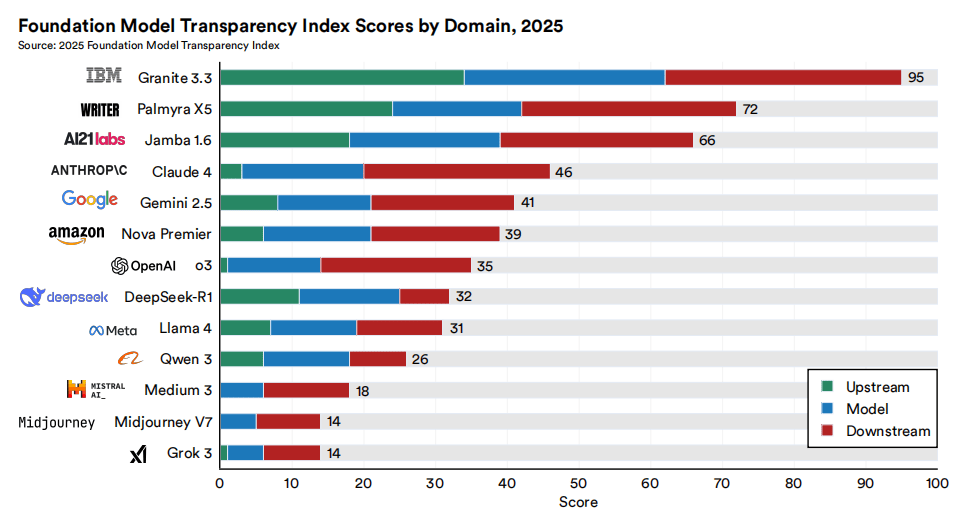
斯坦福报告:AI透明度集体倒退!IBM夺冠,马斯克xAI垫底
Sou Hu Cai Jing· 2025-12-16 10:28
(来源:The 2025 Foundation Model Transparency Index) 从报告的整体结果来看,尽管 2024 年报告显示模型透明度有短暂的改善,但 2025 年的报告指出,透明度指数正呈现倒退:各基础模型的平 均得分从 2024 年的 58 分下降到 2025 年的 40 分,几乎与 2023 年报告首次发布时的水平相当(备注:100 分为满分)。 最近,美国斯坦福大学等团队发布了一份名为《2025 年基础模型透明度指数》(FMTI,The 2025 Foundation Model Transparency Index)的报 告。其中,IBM 以透明度得分最高夺冠,xAI 和 Midjourney 则垫底。 该报告揭示了一种令人担忧的趋势:随着技术的发展,尽管基础模型在性能等各方面持续进步,但其在数据使用、模型训练和下游影响等方 面的透明度却出现了集体倒退。 这是该报告自 2023 年以来发布的第三个年度版本,就像通过量化透明度为各大基础模型开发者做一次"体检"。 本次评估共包括 13 家基础模型公司,其中既有阿里巴巴、DeepSeek 和马斯克的 xAI 等首次纳入报告的企业, ...