Infineon(IFNNY)

Search documents
英飞凌和意法半导体在模拟设备报告发布后,股价触及盘中高点。


Xin Lang Cai Jing· 2026-02-18 12:16
英飞凌和意法半导体在模拟设备报告发布后,股价触及盘中高点。 来源:滚动播报 ...
Infineon CEO flags growth prospects for humanoid robot chips
Reuters· 2026-02-18 06:53
Core Viewpoint - Infineon Technologies is strategically positioned to capitalize on the anticipated growth in the market for microchips utilized in humanoid robots [1] Company Summary - The CEO of Infineon Technologies expressed confidence in the company's readiness to benefit from future market trends in semiconductor technology [1]

GaN大厂,新动态
半导体行业观察· 2026-02-16 01:58
导语 瑞萨电子拓展氮化镓业务,与美国EPC公司签署许可协议 瑞萨电子正在加强其氮化镓(GaN)功率器件业务。该公司已与美国氮化镓专业制造商EPC签署了 一项全面的许可协议。这将使瑞萨电子获得EPC的低压氮化镓技术,该公司表示,这将"拓展其在 人工智能功率架构等大批量市场的机遇"。 EPC于2026年2月10日(美国时间)宣布,已与瑞萨电子签署了一项全面的氮化镓(GaN)功率器 件许可协议。该协议将使瑞萨能够获得EPC的低压GaN技术和供应链生态系统,从而拓展其在人工 智能电源架构等大批量市场的机遇。 在一年的时间里,该公司将建立起自己参与合作研发的产品的生产能力。 EPC成立于2007年,是一家专注于氮化镓(GaN)的美国制造商,致力于开发其增强型氮化镓 (eGaN)技术。根据Yole Group的研究,EPC是氮化镓功率器件市场第四大厂商,预计到2024年 市场份额将达到13.5% 。根据这项协议,瑞萨电子将能够利用EPC的低压eGaN技术及其成熟的供 应链生态系统。未来一年,两家公司计划建立各自的生产能力,以生产此次合作的成果。 瑞萨电子表示,这项协议将为瑞萨电子带来EPC在低压GaN技术方面的专业知识, ...

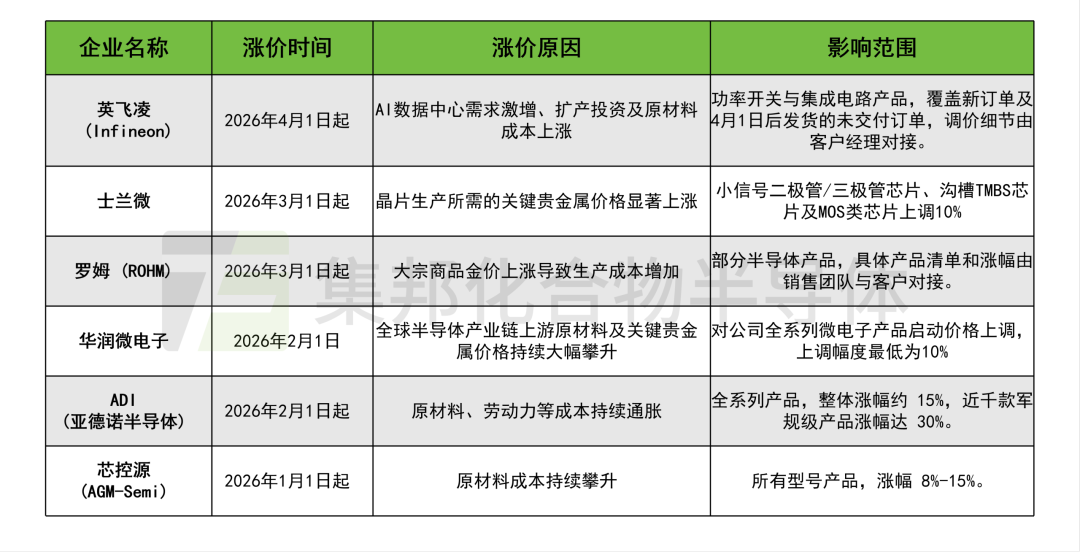
华润微、士兰微、英飞凌等多家半导体厂商涨价!
Xin Lang Cai Jing· 2026-02-14 05:12
Core Viewpoint - The recent price increase announcements from multiple power semiconductor companies, including Silan Micro, Infineon, and China Resources Microelectronics, have drawn significant industry attention, indicating a broader trend of rising costs and demand in the semiconductor sector [1][14]. Price Increase Details - Infineon will raise prices for power switches and integrated circuit products starting April 1, 2026, due to surging demand from AI data centers, expansion investments, and rising raw material costs [2][19]. - Silan Micro will implement a 10% price increase on small signal diodes, transistors, trench TMBS chips, and MOS chips effective March 1, 2026, driven by significant increases in key precious metal prices [2][17]. - ROHM will also increase prices for certain semiconductor products starting March 1, 2026, due to rising commodity prices [2]. - China Resources Microelectronics will raise prices for its entire range of microelectronic products by at least 10% starting February 1, 2026, citing significant increases in upstream raw material prices [2][20]. - Analog Devices (ADI) will increase prices by approximately 15% across its entire product range, with some military-grade products seeing increases of up to 30% starting February 1, 2026 [2]. - AGM-Semi will raise prices by 8%-15% for all models starting January 1, 2026, due to rising raw material costs [2]. Reasons for Price Increases - The primary driver for the price increases is the sustained pressure on production costs, influenced by rising commodity prices, particularly precious metals, and increased costs in wafer manufacturing and packaging [10][23]. - The tightening of wafer foundry capacity, as leading foundries shift focus away from mature processes, has further exacerbated cost pressures [10][23]. - Demand for power semiconductors is structurally increasing due to rapid growth in sectors such as AI data centers, electric vehicles, energy storage, and industrial control [10][24]. Market Dynamics - The value of power components in AI servers has increased significantly, with the price per server component rising from $6-7 to $30-50, a nearly fivefold increase, which has driven demand for power switches and power management chips [11][24]. - The ongoing development in automotive electronics and energy storage is further amplifying the demand gap for power semiconductors, supporting price increases [10][25]. Impact on Third-Generation Semiconductors - The price increases from major power semiconductor manufacturers may facilitate a shift towards third-generation semiconductors, as the price gap between traditional silicon-based devices and SiC/GaN devices narrows [12][25]. - As traditional power device prices rise, downstream companies may reconsider their cost structures, potentially favoring SiC devices for their efficiency and reduced thermal management needs [12][26]. - In the AI server power market, rising traditional silicon power prices may drive manufacturers to adopt more efficient GaN solutions to lower operational costs [12][26]. Conclusion - The price increase trend among power semiconductor companies is a reflection of supply-demand imbalances, rising costs, and technological advancements, marking a significant phase of structural adjustment in the global power semiconductor industry [13][27]. - This trend not only accelerates the domestic substitution process for silicon-based power semiconductors but also acts as a catalyst for the cost-effective application of third-generation semiconductors, promoting a transition towards high-efficiency, energy-saving, and miniaturized high-end fields [13][27].


近50家芯片大厂最新业绩:谁在赚钱,谁还在复苏?
芯世相· 2026-02-14 04:07
Core Viewpoint - The semiconductor industry is expected to recover in 2025, with significant revenue growth driven by rising storage prices and increasing demand from data centers, leading to improved performance for major chip manufacturers [3][4]. Group 1: Semiconductor Sales and Growth - Global semiconductor sales are projected to reach $791.7 billion in 2025, a 25.6% increase from $630.5 billion in 2024, with further growth expected towards $1 trillion in 2026 [3]. - The recovery is attributed to strong demand from emerging technologies such as AI, IoT, 6G, and autonomous driving [3]. Group 2: Chip Design and IDM - Texas Instruments (TI) is expected to achieve approximately $17.68 billion in revenue for 2025, reflecting a 13% year-over-year growth, with significant contributions from industrial and automotive sectors [6]. - STMicroelectronics (ST) anticipates a revenue decline of 11% to around $11.8 billion, with Q4 showing slight improvement driven by personal electronics [8]. - NXP's revenue is projected at $12.27 billion, down 3%, with automotive and industrial sectors remaining stable [10]. - Renesas reported a revenue drop of 2% to 1.3212 trillion yen, marking its first loss in six years due to significant impairment losses [12]. - Microchip Technology expects growth in both year-over-year and quarter-over-quarter sales, with a projected revenue of $1.186 billion for Q3 2026 [12]. - Qorvo's revenue exceeded expectations at $993 million, with an 8.4% year-over-year increase [12]. - Infineon's revenue is projected at €14.662 billion, down 2%, but with strong demand in AI driving growth [14]. Group 3: Memory Chips - Samsung's revenue is expected to reach 333.6059 trillion won (approximately $233.8 billion), a 10.9% increase, with the semiconductor division achieving 130.1 trillion won in revenue [29]. - SK Hynix anticipates a record revenue of 97.15 trillion won (approximately $681.6 billion), a 47% increase year-over-year [31]. - Micron's revenue is projected to rise from $25.11 billion to $37.38 billion, with HBM chip capacity sold out for 2026 [33]. - GigaDevice expects a revenue increase of approximately 25% to 9.203 billion yuan [35]. Group 4: Wafer Foundry - TSMC's revenue is projected to reach approximately 3.8 trillion new Taiwan dollars (around $122.42 billion), a 31.6% increase, with advanced processes contributing significantly [47]. - UMC expects a slight revenue increase of 2.3% to 237.55 billion new Taiwan dollars, with a focus on mature process technologies [49]. - SMIC anticipates a record revenue of $9.3268 billion, a 16.2% increase, with improved profitability driven by increased wafer sales [51]. Group 5: Testing and Packaging - ASE Group's revenue is expected to reach 645.388 billion new Taiwan dollars, an 8.4% increase, with advanced packaging services contributing significantly [57]. - Amkor's revenue is projected at $6.71 billion, a 6% increase, with strong performance in advanced packaging and computing business [59]. Group 6: Equipment - ASML's total net sales are expected to reach €32.667 billion, a 15.6% increase, with a record order backlog reflecting strong demand for AI-related technologies [61]. - Lam Research anticipates a record year with significant growth driven by advanced process technologies [63]. Group 7: Distribution - WPG Holdings expects a revenue of 999.12 billion new Taiwan dollars, a 13.4% increase, driven by AI and high-performance computing demand [66]. - WPG's revenue is projected to exceed 1 trillion new Taiwan dollars, marking a significant milestone [68].



MEMS,重新洗牌
半导体行业观察· 2026-02-14 01:37
Core Insights - The MEMS industry is undergoing an unprecedented wave of consolidation, marking a shift from chaotic growth to a structured reorganization, indicating a significant reshaping of the industry landscape [5][8][13]. Group 1: Recent Mergers and Acquisitions - STMicroelectronics acquired NXP's MEMS sensor business, focusing on automotive and industrial applications, to enhance its market position and expand into high-value segments [5][6]. - Infineon plans to acquire ams OSRAM's non-optical sensor product line for €570 million, aiming to strengthen its sensor portfolio and target emerging markets like humanoid robotics [6][10]. - SiTime's $1.5 billion acquisition of Renesas Electronics' timing business highlights the importance of timing technology in MEMS, with expected revenue generation of approximately $300 million within a year post-acquisition [7][10]. - Qorvo divested its MEMS sensor assets for $21.5 million to focus on its core RF and connectivity technologies, optimizing its asset structure [7][8]. Group 2: Market Dynamics and Growth Areas - The MEMS market is experiencing a bifurcation, with consumer electronics facing saturation and intense competition, while automotive, industrial, medical, and humanoid robotics sectors are witnessing explosive growth [11][12]. - Automotive applications are projected to become the fastest-growing segment, driven by electrification and advanced driver-assistance systems, with the number of MEMS devices per vehicle expected to exceed 70 [12][13]. - The industrial MEMS market is anticipated to surpass $10 billion by 2026, fueled by predictive maintenance and automation trends [12][13]. - The global MEMS market is forecasted to grow from over $15.4 billion in 2024 to over $33 billion by 2036, indicating strong demand in high-value applications [12][13]. Group 3: Industry Trends and Future Outlook - The ongoing consolidation is expected to continue, with more small to medium-sized MEMS companies likely to be acquired or divested, leading to increased industry concentration [27][28]. - Domestic MEMS companies in China are positioned to transition from "replacement" to "breakthrough," focusing on niche markets and enhancing their competitive edge [28][29]. - The competition in the MEMS industry is fundamentally about "technology + scale," with successful companies needing to balance both aspects to thrive [25][30]. - The integration of advanced technologies such as AI and new materials is driving the evolution of MEMS from standalone sensors to intelligent systems, creating new value propositions [14][15].


英飞凌:预计氮化镓市场2025年至2030年复合增长率达到44%
Jin Rong Jie· 2026-02-10 09:40
Core Insights - Infineon released its "2026 GaN Technology Outlook," projecting a compound annual growth rate (CAGR) of 44% for the gallium nitride (GaN) market from 2025 to 2030 [1] - Revenue from GaN technology is expected to reach $920 million in 2026, representing a 58% year-over-year increase [1] - GaN power devices are rapidly entering emerging fields such as AI data centers, robotics, electric vehicles, renewable energy, digital health, and quantum computing, driving higher performance and energy-efficient system designs [1] - By 2026, GaN technology is anticipated to further penetrate the power electronics industry [1]
从英飞凌业绩看AI对功率的挤占情况
2026-02-10 03:24
Summary of Conference Call on Infineon Technologies Company Overview - Infineon Technologies is a key player in the power semiconductor market, particularly in the server MOSFET and power chip sectors, holding approximately 50% market share in the server MOSFET segment and around 18% in the overall power chip market [2][3]. Core Insights and Arguments - **AI Impact on Business Growth**: The demand for power chips has significantly increased due to AI, especially following the release of the silicon carbide technology and the 800V NV white paper. The MOSFET segment has benefited from this high demand, with good delivery times and utilization rates [1][3]. - **Financial Performance**: In the first quarter, Infineon reported revenues of €3.6 billion, a year-on-year increase of 7%, with a real growth of 14% after accounting for currency effects. The automotive segment grew by 4%, power segment by 16%, industrial segment by 19%, while the IoT segment declined by 7% [5]. - **Future Revenue Projections**: Infineon anticipates AI-related revenues to reach €1.5 billion by 2026, with potential upward revisions. The target for 2027 is set at €2.5 billion, primarily constrained by capacity expansion needs [10]. - **Market Trends**: The power chip market is expected to improve in supply-demand dynamics and continue price increases in the coming quarters, driven by overseas recovery and AI-related demand. Key factors include overseas product utilization rates and market conditions [6]. Additional Important Insights - **Product Demand in AI**: Each GPU requires approximately 30 DR MOS components, which has led to a significant increase in MOSFET demand. The market for low-voltage MOSFETs is experiencing a shift towards supply-demand imbalance, with high-end products in short supply [4][12]. - **Domestic Market Dynamics**: The domestic low-voltage MOSFET market is led by companies like Yangjie Technology and others, with high utilization rates but not yet reaching extended delivery times. An improved supply-demand environment is expected within a year [13]. - **Stock Performance Concerns**: Infineon's stock has shown relative weakness due to cautious guidance on overall gross margins for 2026, concerns over price declines, increased capital expenditures, and cash flow issues [8][9]. - **Strategic Measures**: Infineon and other international manufacturers are actively addressing the challenges posed by AI, including plans to expand production capacity for high-end MOSFETs and reallocating resources from standard components to high-growth areas [14][15]. This summary encapsulates the key points from the conference call regarding Infineon Technologies, highlighting the impact of AI on its business, financial performance, market trends, and strategic responses to industry challenges.
英飞凌加入AI时代发债狂潮!汽车业务低迷未解 押注数据中心“突围”
智通财经网· 2026-02-09 10:58
Core Viewpoint - The competition for AI computing power is intensifying, leading to a significant increase in bond issuance among tech companies, with Infineon being the latest to join this trend [1] Group 1: Infineon's Bond Issuance - Infineon is issuing euro-denominated benchmark bonds with maturities of 5, 8, and 11 years, with the shortest bond's issuance spread approximately 90 basis points above mid-term swap rates, and the 2037 bond's spread around 130 basis points [1] - The proceeds from this bond issuance will be used to acquire AMS Osram's automotive, industrial, and medical sensor businesses, as Infineon seeks to diversify its operations amid long-term weak demand for automotive and industrial chips [1] - Infineon plans to increase its investment in technology and capacity for large-scale AI data centers, aiming for revenue growth as global demand for AI computing solutions accelerates [1] Group 2: AI Demand and Automotive Business - The strong demand from AI data centers is helping Infineon cope with the long-term weakness in its automotive chip business, which has been its largest segment, accounting for about half of total sales [2] - Infineon's automotive business has been struggling since late 2022, with significant revenue declines driven by long-term weak demand and inventory adjustments by automotive chip customers [2] - The CEO of Infineon noted that the active demand from AI data centers is providing a strong tailwind amid relatively weak conditions in other markets [2] Group 3: Broader Industry Trends - Other major tech companies are also entering the bond market to fund their AI investments, with IBM leading the way by completing a €3.5 billion bond issuance, and Oracle raising $25 billion to support its AI initiatives [2] - Amazon plans to invest $200 billion in data centers this year, while Google anticipates capital expenditures of $185 billion by 2026, both exceeding Wall Street analysts' expectations [3] - Meta and Microsoft are also expected to continue significant investments in AI, with Meta having completed a $30 billion bond issuance last year [3]
Amazon deepens ties with STMicro to secure semiconductors for data centres
Business· 2026-02-09 09:18
Group 1: Amazon and STMicroelectronics Partnership - Amazon's cloud service AWS is strengthening its relationship with STMicroelectronics to secure semiconductor technologies for data centers [1] - Under the agreement, AWS received warrants to acquire up to 24.8 million ordinary shares of STMicro, with an initial exercise price of $28.38 [2] - This marks at least the second investment by AWS in a chip company [2] Group 2: Market Impact and Semiconductor Demand - STMicro's shares increased by 6.5% to $26.51 following the announcement [3] - The global expansion of data centers for AI technologies is creating new business opportunities for semiconductor companies, with significant demand for advanced AI chips [4] - STMicro, a supplier for major companies like Tesla and Apple, recently forecasted first-quarter revenue that exceeded analysts' expectations, indicating a recovery in consumer electronics demand [5] Group 3: Industry Trends and Future Projections - The demand for mature analog chips is also rising for applications in AI data centers, including power management and cooling [4] - Infineon Technologies projected a tenfold increase in AI-related revenue to €2.5 billion ($3 billion) by its 2027 fiscal year [4] - STMicro's CEO noted that the automotive market remains unstable, despite signs of recovery in other sectors [5]