
INNOVENT BIO(IVBIY)

Search documents
中金:维持信达生物(01801)跑赢行业评级 目标价118.3港元
智通财经网· 2026-02-09 02:40
Core Viewpoint - The company has raised its revenue forecast for 2025 by 5.0% to 12.6 billion yuan, and its net profit forecast for 2026 has been increased by 274% to 6.68 billion yuan due to collaboration with Takeda, with a new net profit forecast for 2027 set at 4.14 billion yuan [1] Group 1 - The company forecasts a product revenue of approximately 11.9 billion yuan for 2025, representing a year-on-year growth of about 45%, with Q4 product revenue expected to be around 3.3 billion yuan, showing over 60% growth [2] - The company's product revenue has surpassed 10 billion yuan for the first time, driven by innovative products, with the oncology product portfolio expanding to 13 products by 2025 [3] - The company has seven products entering the national medical insurance directory for 2025, which will be implemented in 2026, indicating strong commercial momentum [4] Group 2 - The company is focusing on the continuous realization of innovative molecules like IBI363 and its internationalization process, with significant collaboration with Takeda worth 10 billion USD announced in October 2025 [5] - The company expects substantial profit growth in 2026 due to the anticipated progress in global development of IBI363 and other clinical trials [5]
88.5亿美元,信达生物与礼来达成重磅合作!港股通创新药ETF(159570)大涨近2%!加速出海叠加商业化兑现双重催化!
Xin Lang Cai Jing· 2026-02-09 02:24
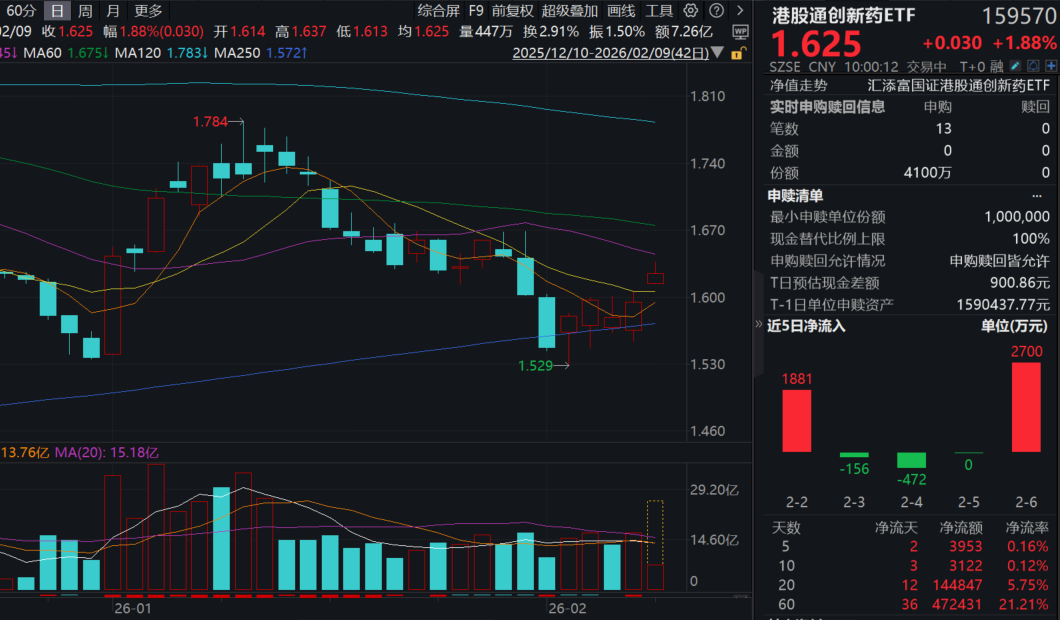
Core Viewpoint - The Hong Kong stock market for innovative drugs is experiencing significant growth, with the Hong Kong Stock Connect Innovative Drug ETF (159570) rising nearly 2% and achieving a trading volume exceeding 750 million yuan, indicating renewed investor interest [1][3]. Group 1: Company Developments - Innovent Biologics announced a strategic partnership with Eli Lilly to advance global R&D in oncology and immunology, receiving an upfront payment of $350 million and potential milestone payments totaling up to $8.5 billion [3]. - The stock performance of key companies within the ETF is positive, with Innovent Biologics up over 4%, BeiGene and China National Pharmaceutical Group up over 3%, and CSPC Pharmaceutical Group and Hansoh Pharmaceutical up over 1% [3][4]. Group 2: Industry Trends - The Chinese innovative drug sector is transitioning from "scale accumulation" to "value release," with a projected increase in License-out transactions from $2.562 billion in 2017 to $140.274 billion by 2025, indicating a significant leap in global recognition [5]. - By 2025, over 70% of companies in the innovative drug sector are expected to achieve revenue growth, with companies like BeiGene reporting revenues exceeding 36 billion yuan, showcasing strong commercialization capabilities [6]. - The innovative drug sector is entering a phase of profitability, with companies like Innovent Biologics and Rongchang Biologics achieving breakeven, while others like Elysium and Rongchang Biologics maintain robust growth [9][11]. Group 3: Investment Opportunities - The innovative drug sector is expected to see a surge in clinical data releases in 2026, with major academic conferences likely to provide further validation for domestic innovative drugs [8]. - Investment strategies should focus on core areas such as small nucleic acids, bispecific antibodies, and ADCs, while also capitalizing on performance forecast windows to identify high-potential stocks [8][12].

超88亿美元!信达生物七度携手礼来,布局肿瘤免疫新药研发
2 1 Shi Ji Jing Ji Bao Dao· 2026-02-09 02:04
Core Viewpoint - The strategic collaboration between Innovent Biologics and Eli Lilly aims to advance global research and development of innovative drugs in oncology and immunology, with Innovent leading the projects in China while Eli Lilly retains exclusive rights outside Greater China [1]. Group 1: Partnership Details - Innovent Biologics will receive an upfront payment of $350 million and is eligible for up to $8.5 billion in milestone payments related to research, regulatory, and commercialization achievements [1]. - The collaboration marks the seventh partnership between Innovent and Eli Lilly, highlighting a long-standing relationship that has evolved from capital investment to product commercialization [2]. - Innovent has previously collaborated with Eli Lilly on multiple projects, including agreements that set records for cooperation amounts between multinational and local pharmaceutical companies [2][3]. Group 2: Financial Performance - In 2020, Innovent achieved total revenue of 3.844 billion yuan, a year-on-year increase of 266.9%, with product revenue reaching 2.368 billion yuan, a 133.0% increase [3]. - The company anticipates total product revenue of approximately 11.9 billion yuan in 2025, marking a 45% year-on-year growth and the first time surpassing 10 billion yuan in product revenue [7]. - Innovent aims to achieve a product revenue scale of 20 billion yuan by 2027 and plans to advance five core pipelines into global Phase III clinical trials by 2030 [7]. Group 3: Globalization Strategy - Innovent's collaboration model has become a crucial component of its product pipeline, with 18 approved products, many developed through partnerships [6]. - The company is focusing on reducing reliance on external collaborations while enhancing its core R&D capabilities [10]. - Innovent's internationalization journey reflects the broader trend of Chinese innovative pharmaceutical companies transitioning to global markets, emphasizing the need for quality and originality in innovation [10].
港股信达生物(01801.HK)高开逾4%
Mei Ri Jing Ji Xin Wen· 2026-02-09 01:44
每经AI快讯,信达生物(01801.HK)高开逾4%,截至发稿,涨4.65%,报83.2港元,成交额1364.48万港 元。 ...
信达生物高开逾4% 与礼来制药达成战略合作 潜在交易额高达88.5亿美元
Zhi Tong Cai Jing· 2026-02-09 01:40
Core Viewpoint - The strategic collaboration between Innovent Biologics and Eli Lilly aims to advance the global research and development of innovative drugs in oncology and immunology, marking a significant milestone in their long-term partnership [1] Group 1: Financial Aspects - Innovent Biologics received an upfront payment of $350 million as part of the agreement [1] - The company is eligible for up to approximately $8.5 billion in milestone payments related to research, regulatory, and commercialization achievements [1] - Innovent Biologics retains the rights to all products in Greater China while Eli Lilly secures exclusive global development and commercialization rights outside this region [1] Group 2: Strategic Collaboration - This agreement represents the seventh collaboration between Innovent Biologics and Eli Lilly, further deepening their productive partnership [1] - The collaboration leverages Innovent's established antibody technology platform and efficient clinical capabilities to lead projects from drug discovery to clinical concept verification in China [1] - Eli Lilly will benefit from the global exclusive development and commercialization rights for the relevant projects outside Greater China [1]
港股异动 | 信达生物(01801)高开逾4% 与礼来制药达成战略合作 潜在交易额高达88.5亿美元
智通财经网· 2026-02-09 01:32
Core Viewpoint - Cinda Biologics has entered into a strategic partnership with Eli Lilly to advance global research and development of innovative drugs in oncology and immunology, which is expected to enhance their long-term collaboration and drive growth in the biopharmaceutical sector [1] Group 1: Financial Terms of the Agreement - Cinda Biologics will receive an upfront payment of $350 million from Eli Lilly [1] - The agreement includes potential milestone payments totaling up to approximately $8.5 billion, contingent upon achieving specific development, regulatory, and commercialization milestones [1] - Cinda Biologics is entitled to a tiered sales share from net sales outside Greater China for each product [1] Group 2: Collaborative Efforts and Responsibilities - This partnership marks the seventh collaboration between Cinda Biologics and Eli Lilly, further deepening their productive relationship [1] - Cinda Biologics will leverage its established antibody technology platform and efficient clinical capabilities to lead the projects from drug discovery to clinical concept verification (completion of Phase II trials) [1] - Eli Lilly will obtain exclusive global development and commercialization rights for the relevant projects outside Greater China, while Cinda Biologics retains all rights within Greater China [1]
信达生物与礼来就创新药研发达成战略合作,最高可获85亿美元里程碑付款
Xin Lang Cai Jing· 2026-02-08 23:16
Core Viewpoint - Cinda Biologics has entered into a strategic collaboration with Eli Lilly to advance the global development of innovative drugs in the oncology and immunology fields [1] Group 1: Collaboration Details - Cinda Biologics will lead the projects from drug discovery to clinical concept validation in China, specifically through the completion of Phase II clinical trials [1] - Eli Lilly will obtain exclusive development and commercialization rights for the related projects outside of Greater China, while Cinda Biologics retains all rights within Greater China [1] Group 2: Financial Terms - Cinda Biologics will receive an upfront payment of $350 million [1] - Upon achieving specific subsequent milestones, Cinda Biologics is eligible for up to approximately $8.5 billion in milestone payments related to research, regulatory, and commercialization [1] - Cinda Biologics will also have the right to receive a tiered sales share based on net sales outside of Greater China for each product [1]

Eli Lilly expands partnership with Innovent to develop oncology, immunology drugs (LLY:NYSE)
Seeking Alpha· 2026-02-08 15:33
Core Insights - Innovent Biologics has signed a deal with Eli Lilly to jointly develop experimental medicines targeting cancer and immune-related diseases, marking the continuation of a partnership that has lasted over a decade [4] Company Developments - The new agreement represents the seventh collaboration between Innovent Biologics and Eli Lilly, indicating a strong and ongoing relationship in the biopharmaceutical sector [4]

信达生物与礼来制药达成全球战略合作 推进肿瘤及免疫领域的新药开发
Mei Ri Jing Ji Xin Wen· 2026-02-08 10:46
Core Viewpoint - The announcement highlights a strategic collaboration between Innovent Biologics and Eli Lilly to advance global research and development of innovative drugs in oncology and immunology, marking their seventh partnership and reinforcing a long-term productive relationship [1] Group 1: Strategic Collaboration - Innovent Biologics, along with its subsidiaries, has entered into a strategic partnership with Eli Lilly to enhance the global R&D of innovative drugs in the oncology and immunology sectors [1] - This agreement represents the seventh collaboration between the two companies, indicating a deepening of their long-term and effective partnership [1] - The unique collaboration framework is expected to create a new model for cooperation, accelerating the global development process of the company's innovative R&D pipeline [1]
信达生物与礼来制药达成全球战略合作推进肿瘤及免疫领域的新药开发
Zhi Tong Cai Jing· 2026-02-08 10:25
Core Insights - Company has entered into a strategic collaboration with Eli Lilly to advance global R&D of innovative drugs in oncology and immunology, marking the seventh partnership between the two entities [1] - The collaboration aims to leverage complementary strengths to accelerate the global development of innovative drugs, with the company leading projects from drug discovery to clinical concept validation in China [1] - Eli Lilly will obtain exclusive global development and commercialization rights outside Greater China, while the company retains all rights within Greater China [1] Financial Terms - The agreement includes an upfront payment of $350 million, with potential milestone payments totaling up to approximately $8.5 billion based on specific future milestones [2] - The company is entitled to a tiered sales share from net sales of each product outside Greater China [2] Collaboration Model - This partnership breaks traditional licensing models, creating a seamless end-to-end innovation ecosystem that integrates the company's flexible drug discovery and early development capabilities with Eli Lilly's extensive global presence [2] - The collaboration underscores the company's core R&D capabilities and aims to expedite the translation of scientific discoveries into globally impactful medical solutions [2]