
KUAISHOU(KSHTY)

Search documents
美银:重申快手-W“买入”评级 目标价94港元
Zhi Tong Cai Jing· 2026-02-26 08:08
该行预计快手2025年第四季业绩将符合预期,并维持先前的预测。预期收入同比增10%至389亿元人民 币(下同),调整后净利同比增15%至54亿元。预计广告/电商收入将同比增13%及17%。预期快手可灵 (Kling)业务第四季营收为3.7亿元,高于先前预测的3.3亿元。 美银发布研报称,重申快手-W(01024)"买入"评级,予目标价94港元,认为市场对竞争的担忧可能有些 过头。 ...

美银:重申快手-W(01024)“买入”评级 目标价94港元
智通财经网· 2026-02-26 08:07
智通财经APP获悉,美银发布研报称,重申快手-W(01024)"买入"评级,予目标价94港元,认为市场对 竞争的担忧可能有些过头。 该行预计快手2025年第四季业绩将符合预期,并维持先前的预测。预期收入同比增10%至389亿元人民 币(下同),调整后净利同比增15%至54亿元。预计广告/电商收入将同比增13%及17%。预期快手可灵 (Kling)业务第四季营收为3.7亿元,高于先前预测的3.3亿元。 ...
【窩輪透視】快手RSI 39接近超賣,支撐位企穩可期
Ge Long Hui· 2026-02-26 05:12
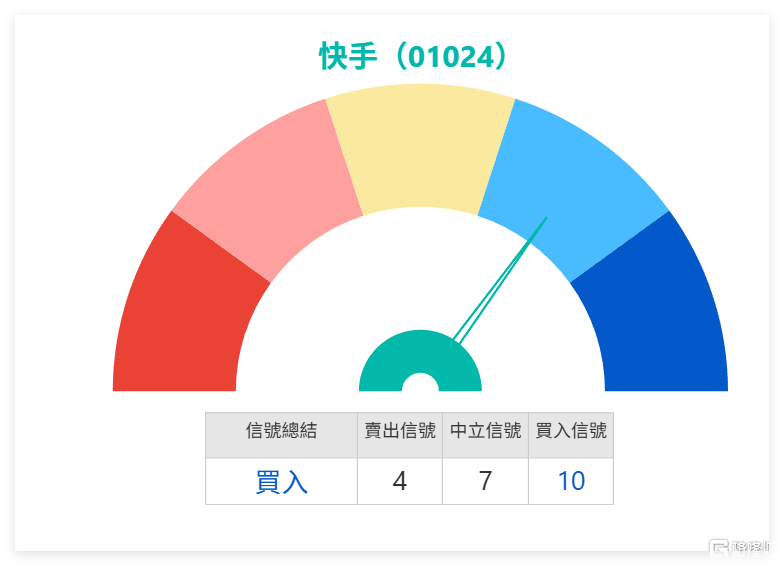
Core Viewpoint - Kuaishou's stock shows signs of potential technical rebound despite recent adjustments, with overall technical indicators leaning towards a positive outlook [1][3]. Group 1: Kuaishou's Technical Analysis - On February 25, Kuaishou's closing price was HKD 66.35, down 0.45% with a trading volume of HKD 1.711 billion, indicating moderate activity without significant fluctuations [1]. - The closing price was below the 10-day moving average (MA10) of HKD 68.51 and the 30-day moving average (MA30) of HKD 74.87, suggesting short to medium-term pressure, but remained above the 60-day moving average (MA60) of HKD 71.30, indicating long-term support [1]. - The Relative Strength Index (RSI) was at 39, approaching oversold territory, suggesting a potential for short-term technical rebound [1]. - Support levels are identified at HKD 58.4 and HKD 63.9, with the stock trading above the first support level, while resistance levels are at HKD 71.6 and HKD 79.2, with HKD 71.6 being a critical short-term resistance [1]. - Overall technical signals indicate a "buy" recommendation with a strength rating of 10, supported by multiple moving averages and indicators suggesting a potential bottoming out [1]. Group 2: Performance of Peer Technology Stocks - On February 25, peer technology stocks exhibited mixed performance, with Tencent, Meituan, Alibaba, and JD.com showing slight increases, while Kuaishou, Xiaomi, Bilibili, NetEase, and Baidu experienced minor declines, all within 1% [3]. - Most stocks closed below their MA10 and MA30, indicating a short to medium-term correction phase, while many approached or were slightly below their MA60, showing long-term support [3]. - The RSI for most stocks ranged between 30-47, indicating relative low levels and potential for oversold rebounds [3]. - Meituan and Xiaomi had the highest technical signal strength at 12, while Bilibili had a lower strength of 7, reflecting a generally positive sentiment towards the technology and internet sector [3]. Group 3: Review of Kuaishou-Related Products - A review of Kuaishou-related structured products from February 23 showed that bearish products performed well following Kuaishou's recent adjustments, with HSBC's bear certificate rising by 24% and JPMorgan's by 21% over two days [4]. - The selected Kuaishou products include a call option from Bank of China with a strike price of HKD 77.05 and a leverage of 5.9, suitable for investors anticipating a short-term rebound [7]. - A put option from Macquarie with a strike price of HKD 57.688 and a leverage of 6.7 is recommended for those expecting a decline in Kuaishou's short-term performance [7].

百度、网易、快手、小米,再度下跌
Di Yi Cai Jing Zi Xun· 2026-02-25 08:39
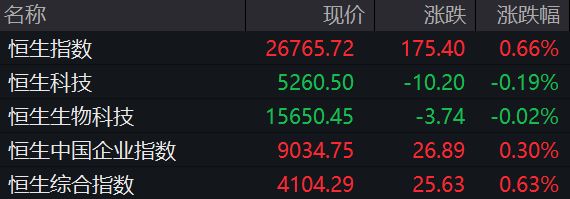
Market Performance - The Hang Seng Index closed up by 0.66% at 26,765.72, gaining 175.40 points [2] - The Hang Seng Tech Index decreased by 0.19%, closing at 5,260.50, down by 10.20 points [2] Sector Performance - The Hang Seng Biotech Index fell by 0.02% to 15,650.45, with a decline of 3.74 points [2] - The Hang Seng China Enterprises Index rose by 0.30%, closing at 9,034.75, up by 26.89 points [2] - The Hang Seng Composite Index increased by 0.63%, closing at 4,104.29, gaining 25.63 points [2] Notable Stock Movements - SenseTime (商汤-W) dropped by 5.36% to 2.470, down by 0.140 [3] - Tongcheng Travel (同程旅行) fell by 4.97% to 21.020, down by 1.100 [3] - Leapmotor (零跑汽车) decreased by 3.71% to 43.060, down by 1.660 [3] - Horizon Robotics (地平线机器人-W) declined by 3.41% to 8.510, down by 0.300 [3] - NIO (蔚来-SW) fell by 2.64% to 40.640, down by 1.100 [3] - Alibaba Health (阿里健康) decreased by 2.53% to 5.790, down by 0.150 [3] GEO Concept Stocks - MINIMAX-WP experienced a significant drop of 14.38%, closing at 753.500 [4] - Zhiyuan (智谱) fell by 10.75% to 560.500 [4] - XunCe (迅策) decreased by 3.72% to 86.650 [4]
反差强烈!美股AI惨遭抛售,中国AI疯涨超四倍,市值碾压京东快手
Sou Hu Cai Jing· 2026-02-25 07:54
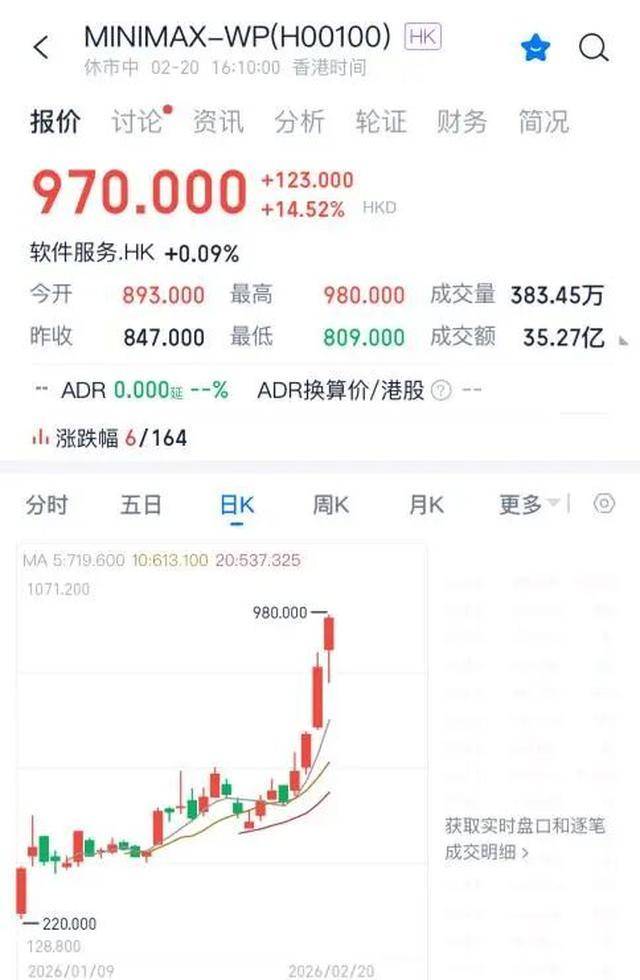
Group 1 - The US AI sector has faced significant institutional sell-offs since 2026, with the "Magnificent Seven" tech giants dragging down the S&P 500 index, while OpenAI's financial sustainability is questioned by Wall Street [1][6] - In contrast, Chinese AI companies like Zhiyu Technology and MiniMax have seen substantial stock price increases, with Zhiyu rising 42.72% to HKD 725 and MiniMax increasing 14.52% to HKD 970, both reaching new highs since their listings [1][4] - Both companies have achieved market capitalizations exceeding HKD 300 billion, comparable to established mid-to-large tech firms, surpassing the valuations of companies like JD.com and Kuaishou [1] Group 2 - Investors are drawn to Zhiyu and MiniMax due to their perceived scarcity and growth potential, with Zhiyu focusing on B2B solutions and MiniMax leveraging multi-modal technology for C-end products, with over 70% of its revenue coming from overseas [2] - The limited float of shares for both companies (1.7 million for MiniMax and 1.17 million for Zhiyu) suggests a potential for price volatility as lock-up periods expire [2] - The contrasting narratives of the US and Chinese AI markets highlight a significant difference in operational costs, with China's lower electricity costs providing a competitive edge [8] Group 3 - OpenAI, despite having around 1 billion users and generating nearly USD 10 billion in subscription revenue in 2025, faces substantial losses, with projected losses nearing USD 40 billion for 2026 [7] - The success of Zhiyu and MiniMax's IPOs marks a pivotal moment for the Chinese AI industry, shifting focus from mere technological aspirations to financial sustainability and profitability [18] - The commercial viability of both companies remains under scrutiny, with Zhiyu's revenue growth expected to slow and MiniMax's revenue projections indicating a potential increase to USD 209 million by 2026 [19][20] Group 4 - MiniMax's business model focuses on a combination of C-end cash flow and B-end growth, with a significant portion of its revenue derived from overseas markets [11] - The rapid pace of AI IPOs mirrors the internet bubble of 2000, with companies like MiniMax and Zhiyu being exceptions in terms of their short time to market [12][14] - The competitive landscape for AI models is intensifying, with both companies needing to navigate challenges such as user retention and potential copyright litigation [10][11]
快手3月上新季发布商达政策 全域资源助推商家焕新好生意
Cai Jing Wang· 2026-02-25 04:50
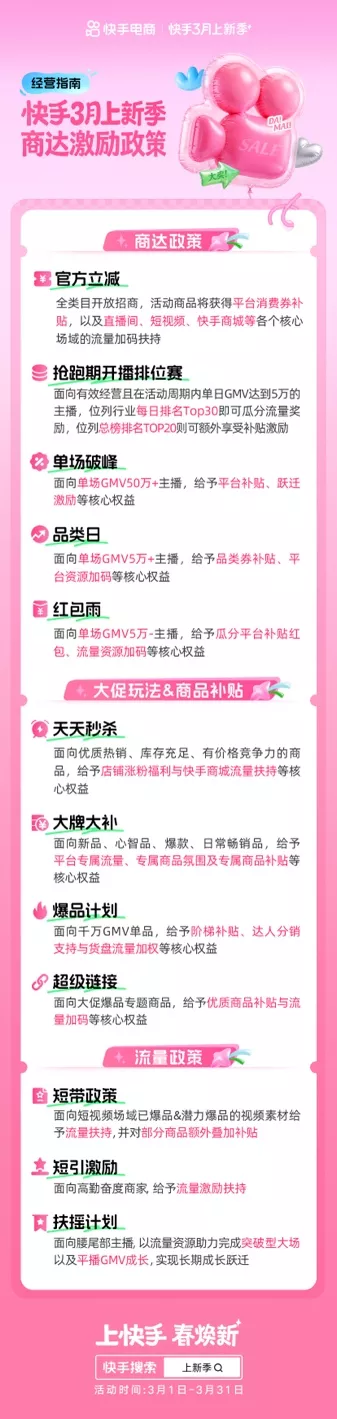
Core Insights - The article discusses the launch of Kuaishou's March New Product Season, which aims to stimulate consumer demand through various promotional policies and incentives for merchants [1][4]. Group 1: Merchant Policies - The merchant policy is open to all categories, providing platform consumption coupon subsidies and increased traffic support across key areas such as live streaming and short videos [4]. - A ranking competition is available for effective operators achieving a daily GMV of 50,000, with top performers eligible for traffic rewards and additional subsidies [4]. - Special incentives are provided for high-performing live streams, including subsidies and resource boosts for those achieving GMV of 500,000 or more in a single session [4]. Group 2: Promotional Strategies and Subsidies - Daily flash sales are targeted at high-demand, competitively priced products, offering benefits such as increased store followers and traffic support [4]. - Special support is available for new products and bestsellers, including exclusive traffic and product subsidies [4]. - The "Super Link" initiative focuses on promotional products, providing quality product subsidies and traffic boosts [4]. Group 3: Traffic Policies - Short video policies offer traffic support for existing and potential best-selling products, with additional subsidies for select items [5]. - High-engagement merchants receive traffic incentives to enhance their visibility [5]. - The "Fuyou Plan" aims to assist mid-tier and lower-tier streamers in achieving significant growth in GMV through resource allocation [5]. Group 4: Overall Strategy - Kuaishou's March New Product Season has commenced, focusing on comprehensive merchant support through subsidies, traffic incentives, and promotional strategies to capitalize on renewed consumer demand [5].
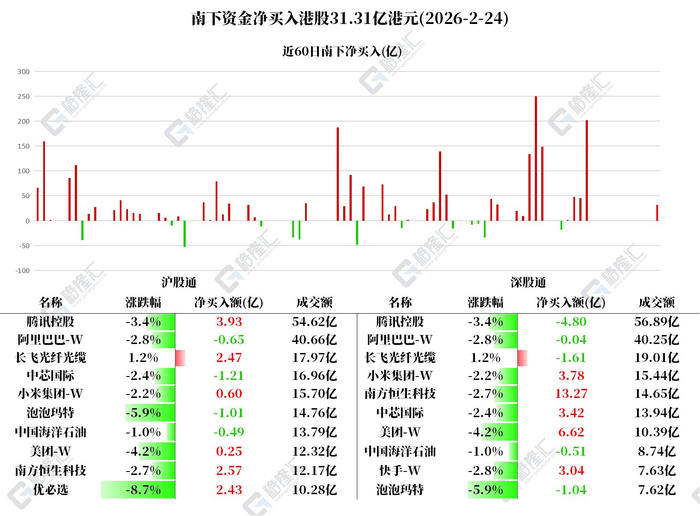
图解丨南下资金净买入美团、小米和快手
Ge Long Hui A P P· 2026-02-24 10:24
Group 1 - Southbound funds net bought Hong Kong stocks worth HKD 3.131 billion today [1] - The largest net purchases were in Southern Hang Seng Technology (HKD 1.585 billion), Meituan-W (HKD 0.687 billion), Xiaomi Group-W (HKD 0.437 billion), Kuaishou-W (HKD 0.304 billion), UBTECH (HKD 0.242 billion), and SMIC (HKD 0.22 billion) [1] - Southbound funds have net bought Meituan for five consecutive days, totaling HKD 2.62343 billion, and Xiaomi for three consecutive days, totaling HKD 2.66892 billion [1] Group 2 - Tencent Holdings experienced a decline of 3.4% with a net buy of HKD 0.393 billion [3] - Alibaba-W also saw a drop of 2.8% with a net sell of HKD 0.065 billion [3] - Longi Green Energy had a slight increase of 1.2% with a net buy of HKD 0.247 billion [3] - Bubble Mart faced a significant decline of 5.9% with a net sell of HKD 1.01 billion [3] - Meituan-W declined by 4.2% with a net buy of HKD 0.25 billion [3]


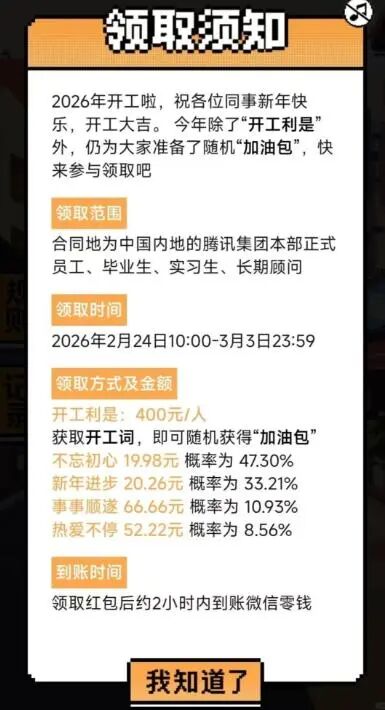
互联网大厂花式发开工红包:腾讯除每人400元外,还准备了随机“加油包”;百度为首次发放,最高可得2026元;还有京东、快手、淘天……
Mei Ri Jing Ji Xin Wen· 2026-02-24 06:13
Group 1 - Companies are distributing "opening red envelopes" to employees after the New Year holiday, with Tencent giving 400 yuan per person and additional random "boost packages" [1] - Kuaishou is providing opening red envelopes of 366 yuan for full-time employees and 200 yuan for interns [3] - Baidu's founder, Li Yanhong, sent customized blessings and opening red envelopes through the work software "Ruliu," with amounts ranging from 365 yuan to 2026 yuan for employees, while interns receive 188 yuan [5] - Xiaomi's CEO Lei Jun announced that he and the company's executives are distributing opening red envelopes to employees [7] - JD.com is reported to have given out lollipop red envelopes [9] - Taotian Group is providing scratch cards and plush toys as opening gifts for employees [11]



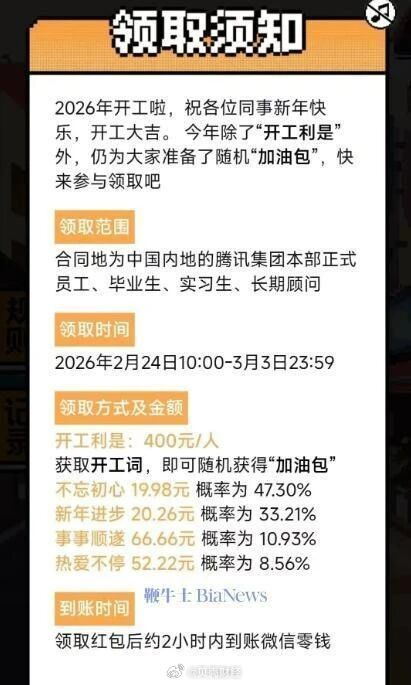
腾讯小米快手百度开工日发红包,百度最高2026元
Bei Ke Cai Jing· 2026-02-24 05:12
【#互联网大厂花式发开工红包# [拜托]#是谁开工第一天被狠狠宠到# [doge]】 据透露,百度这次发放开工红包的金额,在365元、588元、666元、888元、2026元不等,员工最高可以 获得2026元的超大额开工红包,实习生则可获得188元的开工红包。百度此次开工红包金额跟在职年限 无关,而是系统随机分配。 根据截图,红包中写到:新年快乐!新的一年,让我们坚守简单可依赖的价值观,以梦为马,执AI之 钥,破效率之茧,成创新之势,一起用科技让复杂的世界更简单!值得注意的是,此前,百度并没有在 春节假期结束后发放开工红包的习惯。 (东方财经) 2026年开工啦,祝各位同事新年快 乐, 开工大吉。 今年除了"开工利是" 外,仍为大家准备了随机"加油包",快 来参与领取吧 2月24日,新年假期后的开工日,多家公司给员工发开工红包。腾讯除"开工利是"每人400元外,还准备 了随机"加油包"。 雷军和小米高管团队一起,给小米员工发开工红包,并祝福大家新一年红红火火,万事大吉。 快手给全员发开工红包,据了解正式员工366元,实习生200元。 百度创始人李彦宏的数字人,通过工作软件"如流"的服务号,向全体员工发送定制祝 ...

瑞银:看好中国AI成本优势 偏好阿里(09988)、百度(09888)、腾讯(00700)及快手
智通财经网· 2026-02-24 04:18
Group 1 - UBS report indicates that by 2026, AI agents are expected to achieve large-scale applications, shifting from dialogue to action scenarios [1] - There is a divergence in application scenarios between the US and China, with the US focusing more on enterprise applications while China invests heavily in consumer services [1] - Leading AI labs globally, such as Anthropic and OpenAI, will prioritize enterprise development and monetization by 2026 [1] Group 2 - Chinese AI models, including MiniMax, Kimi, and GLM, have significantly increased their share in emerging agent products like OpenClaw [1] - UBS is optimistic about the long-term market share growth of Chinese AI models in the global enterprise API market due to their improving intelligence and cost-effectiveness [1] - Major Chinese internet companies launched red envelope activities during the Spring Festival to drive AI product traffic, with Tencent's Yuanbao (1 billion RMB), Alibaba's Tongyi Qianwen (3 billion RMB), and Baidu's Wenxin Yiyan (500 million RMB) [1] Group 3 - A wave of model releases occurred during the Spring Festival, narrowing the capability gap with leading global AI labs [2] - UBS believes that the ongoing disruptive narrative around AI has boosted investment sentiment among model providers, but investors remain cautious about vertical platforms and application companies [2] - UBS has initiated a positive investment rating for MiniMax and is optimistic about Alibaba and Baidu's full-stack AI capabilities, as well as Tencent and Kuaishou's potential in AI applications [2]
