
Lilly(LLY)

Search documents
Foghorn Therapeutics (NasdaqGM:FHTX) FY Conference Transcript
2025-11-10 17:00
Summary of Foghorn Therapeutics FY Conference Call Company Overview - **Company**: Foghorn Therapeutics (NasdaqGM:FHTX) - **Focus**: Targeting the chromatin regulatory system and the BAF complex, primarily in oncology [2][3] Industry Insights - **Oncology Relevance**: Approximately 50% of cancers have dependencies or mutations related to chromatin regulation, highlighting the importance of this area in cancer biology [2] - **Targeting Challenges**: The similarity between proteins in the BAF complex (e.g., SMARCA2 and SMARCA4) complicates selective targeting due to their 90%-95% similarity [3][4] Key Programs and Developments SMARCA2 Program - **Scientific Rationale**: SMARCA2 is targeted due to its synthetic-lethal relationship with SMARCA4, where loss of SMARCA4 increases dependency on SMARCA2 in cancer cells [6][7] - **Clinical Data**: Patients with SMARCA4 mutations show significantly worse prognosis in non-small cell lung cancer, with response rates dropping from approximately 40% to 20% [7] - **Market Opportunity**: In the U.S., about 22,000 non-small cell lung cancer patients have SMARCA4 mutations, with an estimated 11,000-17,000 potentially having loss of function [8] Clinical Trials - **Current Status**: The SMARCA2 inhibitor FHD-909 is in phase one trials, with ongoing dose escalation and no maximum tolerated dose reached yet [16][17] - **Study Design**: The trial includes various cancer histologies with a focus on non-small cell lung cancer patients with SMARCA4 mutations [15] - **Expected Outcomes**: Anticipation of a go/no-go decision for dose expansion in the first half of 2026 [16] CBP and EP300 Programs - **Mechanism**: CBP and EP300 are sister proteins involved in histone acetylation, with challenges in dual inhibition leading to myelosuppressive effects [21][22] - **Commercial Opportunity**: Targeting CBP could address approximately 20,000-25,000 patients with specific mutations, while EP300 shows potential in hematological malignancies [23][24] ARID1B Program - **Target Validation**: ARID1B is a highly mutated target in cancer, with Foghorn being the only company to develop selective binders for this target [27][28] - **Development Status**: The program is in hit-to-lead stage, with in vivo proof of concept expected in 2026 [29] Additional Insights - **Combination Studies**: The company recognizes the importance of combination therapies in oncology and plans to explore both monotherapy and combination regimens in future studies [18][19] - **Clinical Risks**: Acknowledgment of the risks associated with being first to market, particularly in the context of the SMARCA2 program [9][10] Conclusion Foghorn Therapeutics is positioned in a promising niche within oncology, focusing on challenging targets related to chromatin regulation. The company is advancing several innovative programs, particularly in SMARCA2, CBP, and EP300, with significant market opportunities and ongoing clinical trials that could lead to impactful treatments for cancer patients.


美股异动 | 礼来(LLY.US)涨超5.4% 股价触及历史新高
智通财经网· 2025-11-10 15:40
智通财经APP获悉,周一,礼来(LLY.US)股价触及历史新高981.99美元。截至发稿,该股涨超5.4%,报 974.415美元。消息面上,高盛称,协议通过大幅降低药品月费,成功解锁了此前不确定的数千万医保 和医疗补助患者市场,预示着销量的巨大增长潜力,维持2030年950亿美元市场规模预测。礼来凭借更 高市场份额和口服药提前上市占据优势,诺和诺德则面临多重增长压力,2027年IRA谈判可能使其价格 劣势扩大至18%。 ...
美股异动丨礼来涨约6%创新高 高盛评GLP-1减肥药大降价 礼来占优、诺和诺德承压
Ge Long Hui· 2025-11-10 15:14
Core Viewpoint - Eli Lilly's stock rose by 5.9% to $979.16, surpassing its previous intraday record of $972.53 set on August 22, 2024, driven by Goldman Sachs' report on a significant reduction in drug monthly fees, unlocking a previously uncertain market of millions of Medicare and Medicaid patients, indicating substantial sales growth potential, while maintaining a market size forecast of $95 billion by 2030 [1] Group 1 - Eli Lilly's market share and early launch of oral medications provide a competitive advantage [1] - Novo Nordisk faces multiple growth pressures, with potential price disadvantages expanding to 18% by 2027 due to IRA negotiations [1] - Goldman Sachs' analysis suggests a significant increase in sales potential for Eli Lilly due to the new pricing strategy [1]

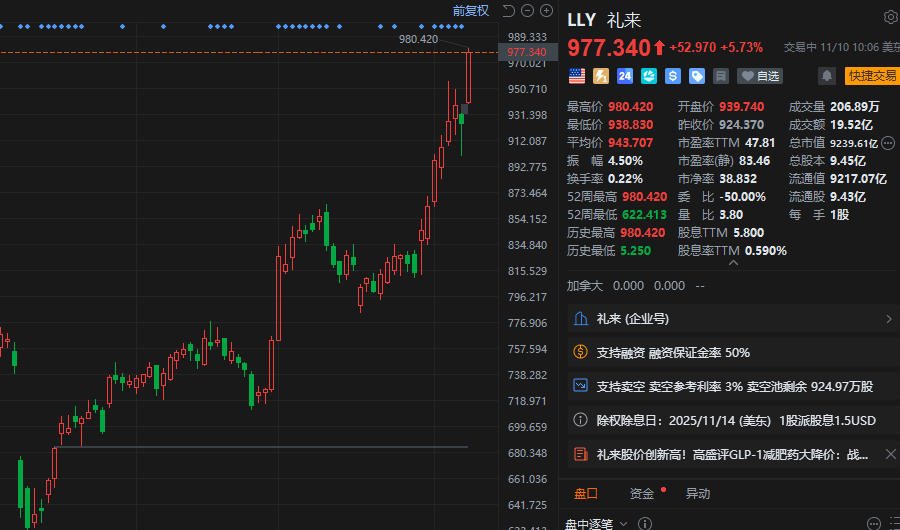
礼来股价触及历史新高,最新上涨5.56%
Mei Ri Jing Ji Xin Wen· 2025-11-10 15:08
(文章来源:每日经济新闻) 每经AI快讯,11月10日,礼来股价触及历史新高,最新上涨5.56%。 ...
医药生物行业周报(11月第1周):流感活动上升-20251110
Century Securities· 2025-11-10 14:45
Investment Rating - The report does not explicitly state an investment rating for the industry [1] Core Insights - The pharmaceutical and biotechnology sector experienced a decline of 2.4% from November 3 to November 7, 2025, underperforming compared to the Wind All A index (0.63%) and the CSI 300 index (0.82%) [2][7] - The rise in flu activity was noted, with the percentage of flu-like illness (ILI) cases reported at 4.7% in the week of October 27 to November 2, 2025, indicating an increase compared to previous weeks and years [2][10] - The final overall survival (OS) results from the HARMONi-A study of Ivosidenib combined with chemotherapy for EGFR-mutant non-small cell lung cancer showed a significant improvement in OS, with a median OS of 16.8 months versus 14.1 months for the control group [2][10] Weekly Market Review - The pharmaceutical and biotechnology sector's performance was down 2.4%, with notable declines in medical research outsourcing (-4.93%), chemical preparations (-4.42%), and other biological products (-4.33%) [7][8] - The leading gainers included Hezhi China (61.1%), Wanze Shares (30.3%), and Fuxiang Pharmaceutical (23.3%), while Changshan Pharmaceutical (-20%), Yifang Bio-U (-17.8%), and Guangshengtang (-15.3%) were the biggest losers [10] Industry News and Key Company Announcements - On November 7, 2025, the final OS analysis of the HARMONi-A study was presented, showing significant results for Ivosidenib in combination with chemotherapy [10][12] - According to data from the Chinese Center for Disease Control, flu-like illness percentages in southern provinces increased to 4.6%, while northern provinces reported 5.1%, both higher than the previous week [10][12] - BeiGene reported a total revenue of $1.412 billion for Q3 2025, a 41% year-on-year increase, driven by a 51% growth in global sales of its product [12][14] - Metsera announced a merger agreement with Pfizer, with an estimated total transaction value of approximately $9 billion [12][14]


Eli Lilly signs deal for MeiraGTx's gene therapy for severe eye disease
Reuters· 2025-11-10 14:10
Core Insights - MeiraGTx Holdings has entered into a partnership with Eli Lilly, which could exceed $475 million in total value, providing Eli Lilly with rights to an experimental gene therapy targeting a rare inherited disorder [1] Company Summary - The deal with Eli Lilly represents a significant financial opportunity for MeiraGTx Holdings, highlighting the potential of its gene therapy in the pharmaceutical market [1] - The partnership underscores the growing interest in gene therapies for rare diseases, indicating a trend towards innovative treatment solutions within the industry [1]

与礼来(LLY.US)达成基因疗法合作 MeiraGTx(MGTX.US)盘前大涨
智通财经网· 2025-11-10 13:57
Core Viewpoint - MeiraGTx Holdings has entered into a strategic collaboration with Eli Lilly to develop and commercialize gene therapies for eye diseases, leading to a significant pre-market stock price increase of 13.22% [1] Group 1: Collaboration Details - The agreement grants Eli Lilly global exclusive rights to MeiraGTx's AAV-AIPL1 gene therapy project, targeting Leber Congenital Amaurosis Type 4 (LCA4), a severe hereditary retinal disease caused by a defect in the AIPL1 gene [1] - Eli Lilly will also gain rights to additional gene therapy technologies from MeiraGTx as part of the collaboration [1] Group 2: Financial Terms - MeiraGTx will receive a $75 million upfront payment and could earn over $400 million upon achieving certain milestones [1] - The company will also be eligible for tiered royalties from potential sales of the licensed products [1]

Does Trump's MFN Policy Put Pharma ETFs in the Crosshairs?
ZACKS· 2025-11-10 13:50
Core Insights - Eli Lilly and Novo Nordisk have agreed to reduce prices for obesity drugs under the Trump administration's Most-Favored-Nation drug pricing policy, aiming to align U.S. drug prices with the lowest prices in other advanced countries [1][3][4] - The price cuts will significantly impact the pharmaceutical industry, particularly affecting major companies and their associated ETFs [2][6] Price Reduction Details - The agreement includes a reduction of GLP-1 drug prices to approximately $350 per month from over $1,000, with Medicare prices dropping to $245 and beneficiaries paying a $50 co-pay [4][5] - Insulin prices will also be capped at $35 per month, and the deal mandates MFN pricing for all new products [5] Financial Impact - The implementation of MFN pricing is expected to compress revenue and earnings for major pharmaceutical firms, particularly those with high-cost, single-source brand-name drugs [6][9] - Companies like Pfizer, Eli Lilly, and AbbVie are likely to see profit margins decline as they adjust domestic prices to lower international benchmarks [7][8] Stock Market Reaction - Following the announcement, shares of Novo Nordisk and Eli Lilly fell by 1.8% and 1.4%, respectively, indicating immediate market reactions to the news [9] Long-Term Strategies - In the long term, large-cap pharmaceutical companies may adapt by increasing prices in other markets and shifting research investments towards biologics, which have longer exclusivity periods [10][11] - Companies may also alter launch strategies in countries with lower prices to protect U.S. pricing [11] ETF Exposure - The MFN policy poses indirect risks for pharmaceutical ETFs that hold significant positions in affected companies, potentially leading to declines in Net Asset Value (NAV) and share prices [12][13] - ETFs such as iShares US Pharmaceuticals ETF, VanEck Pharmaceutical ETF, and Invesco Pharmaceuticals ETF have substantial exposure to companies like Eli Lilly, Pfizer, and AbbVie, making them vulnerable to the new pricing mandate [14][15][16]

GLP-1之后,巨头卷向下一代减重药
第一财经· 2025-11-10 13:32
Core Insights - Pfizer won a dramatic bidding war against Novo Nordisk for the weight loss drug manufacturer Metsera, acquiring it for $10 billion, which includes a competitive amylin drug pipeline [3][4] - Amylin drugs mimic the action of the pancreatic hormone amylin, differing from currently marketed GLP-1 drugs, but both types suppress appetite and reduce food intake [3][4] - Analysts believe that the future combination of GLP-1 and amylin therapies could enhance weight loss efficiency and quality [4][5] Industry Developments - Major pharmaceutical companies, including Novo Nordisk, Eli Lilly, AbbVie, and Roche, are developing amylin-targeting weight loss drugs [4][6] - Eli Lilly's amylin therapy, eloralintide, showed positive results in a mid-stage study, indicating potential for further development [4][5] - Novo Nordisk presented data at the 2025 EASD annual meeting showing that its amylin drug cagrilintide led to an average weight loss of approximately 12.5 kg in obese or overweight patients [5][6] Competitive Landscape - Roche has partnered with Zealand Pharma to develop long-acting amylin drugs, indicating a collaborative approach in the industry [6] - Experts suggest that while direct comparisons between GLP-1 and amylin therapies are not yet possible, they may offer different benefits for various patient populations [6] - In China, several biopharmaceutical companies are also developing next-generation amylin-targeting weight loss therapies, with notable advancements from companies like Genscript and Xianju Pharmaceutical [6]


2025年《财富》榜单上的23家大健康企业
财富FORTUNE· 2025-11-10 13:21
Core Viewpoint - The pursuit of "health and longevity" is becoming a central goal in modern society, moving beyond mere longevity to maintaining quality of life over an extended lifespan. This shift is supported by a collaborative ecosystem of scientists, pharmaceutical and medical device companies, healthcare providers, and health service payers, driving the "big health" industry forward [1][2][7]. Group 1: Overview of the Big Health Industry - Well Equity Partners focuses on the health and longevity sector, backed by Walgreens Boots Alliance, a long-standing member of the Fortune Global 500 list [2]. - The collaboration between Fortune magazine and Well Equity Partners has identified 23 noteworthy companies in the big health sector, showcasing both established giants and emerging startups [2][3]. - The selected companies share a common trait: their business strategies and core operations align with the goals of promoting health and longevity [3][7]. Group 2: Key Companies in the Big Health Sector - Notable companies include UnitedHealth Group, Elevance Health, Johnson & Johnson, Roche, HCA Healthcare, Bayer, Eli Lilly, Novo Nordisk, China National Pharmaceutical Group, and others, all of which are recognized in the Fortune Global 500 [5][6]. - Emerging companies such as Shanghai Ladder Medical Technology and Quantum Life Limited are also highlighted for their innovative contributions to the health and longevity landscape [6][7]. Group 3: Innovations in Disease Management - The focus on transforming severe diseases into manageable chronic conditions is crucial for achieving health and longevity. Companies are innovating in drug development and medical devices to address high-prevalence diseases like metabolic and neurodegenerative disorders [14][24]. - Novo Nordisk and Eli Lilly are leading in the diabetes treatment space with their GLP-1 drugs, which have opened new avenues for managing metabolic diseases [16][17]. - Bayer is pioneering cell and gene therapies for neurodegenerative diseases, particularly Parkinson's disease, showcasing advancements in treatment methodologies [19][20]. Group 4: Preventive Health and Early Diagnosis - The emphasis on early detection and diagnosis is vital for intercepting health issues before they escalate. Companies are developing portable and efficient diagnostic tools to enhance accessibility and accuracy in healthcare [26][27]. - Innovations in functional foods and lifestyle management are gaining traction, aligning with the "Food as Medicine" philosophy to prevent diseases through dietary interventions [31][32]. Group 5: Health Services and Insurance Models - Companies like UnitedHealth Group and Elevance Health are creating integrated ecosystems that encompass health insurance, medical services, and health information technology, optimizing patient care and cost efficiency [39][40]. - In China, Taikang Insurance Group is building a comprehensive health ecosystem that connects insurance, asset management, and healthcare services, addressing the needs of various demographics [40]. Group 6: Future Directions and Ecosystem Development - The evolution of the health and longevity sector is marked by a shift towards a more integrated approach, where scientific research, innovative products, and supportive payment mechanisms converge to enhance public health outcomes [44][46]. - The ongoing development of technologies and services aims to make health and longevity accessible to a broader population, moving from niche offerings to mainstream solutions [43][46].





