
Lilly(LLY)

Search documents
诺和诺德口服版Wegovy获批 以自费渠道主攻减重市场
Xin Lang Cai Jing· 2025-12-23 08:50
Core Viewpoint - Novo Nordisk's oral version of Wegovy has received FDA approval and is set to launch for self-paying users in the U.S. in early January 2026, marking a significant competitive advantage over Eli Lilly [1][5] Core Transaction and Launch Strategy - In November, Novo Nordisk agreed to a pricing strategy of $149 per month for Medicare, Medicaid, and uninsured self-paying users if the oral weight loss drug was approved [2][6] - The company plans to distribute the drug through various channels, including CVS, Walmart, and online platforms like GoodRx, allowing patients to start treatment without waiting for insurance coverage [2][7] - This marks a shift in Novo Nordisk's traditional approach, focusing on self-paying users to stimulate sales growth amid increasing competition, which has led to a significant drop in the company's market value [2][7] Market Competition and Product Advantages - Novo Nordisk faces intense competition from Eli Lilly's Zepbound and potential low-cost generic versions of semaglutide, with Eli Lilly's oral weight loss drug expected to be approved by March 2026 [3][8] - The oral version of Wegovy aims to attract patients who are reluctant to undergo GLP-1 injection therapy, providing more prescription options for doctors and better aligning with patient needs [3][8] - Clinical trials indicate that users of the oral Wegovy lost an average of 13.6% of their body weight over 15 months, closely matching the injection version's effectiveness of approximately 15% [3][8] Self-Paying Market Potential and Industry Perspectives - The CEO of telehealth company Ro noted that the oral medication is a more acceptable "entry option" for patients who fear needles or experience "injection fatigue" [4][9] - Novo Nordisk does not expect the oral version to cannibalize the injection version's business, with analysts predicting that oral GLP-1 drugs could capture 20% of the global weight loss drug market by 2030 [4][9] - However, some fund managers express skepticism about the current valuations of certain listed companies, indicating that the long-term market performance of oral weight loss drugs will depend on user demand and pricing strategies [4][9]


全球股市涨势暂歇,金银再创新高,日元强反弹,原油连涨后企稳,加密货币承压
Hua Er Jie Jian Wen· 2025-12-23 08:24
在股市经历又一年的强劲表现后,市场当前关注的焦点在于:投资者能否将这股乐观情绪延续至2026年。基金经理们正持续增加股票仓位,同时 将现金持有量维持在历史低位。尽管科技股估值已处高位,但对股市进一步上涨的预期仍主导着市场情绪。与此同时,美联储的政策路径备受关 注,市场普遍预期其在明年将进行两次降息。 | = US 30 | 48,320.8 | 48,374.3 | 48,299.8 | -41.9 | -0.09% | | --- | --- | --- | --- | --- | --- | | 트 US 500 | 6,869.2 | 6,881.0 | 6,867.5 | -9.3 | -0.14% | | 트 US Tech 100 | 25,423.9 | 25,496.1 | 25,411.8 | -37.8 | -0.15% | 诺和诺德欧股涨7%,主要受到该公司减肥药获得美国食品药品监督管理局批准的利好推动。据华尔街见闻,12月22日周一,美国食品药品监督管 理局(FDA)批准了丹麦制药巨头诺和诺德的首款GLP-1类口服减肥药。 此次批准也让诺和诺德在与主要竞争对手礼来的激烈竞赛中暂时领先。 ...


盘后股价大涨近10%!美国批准首款“口服版减肥神药”,诺和诺德拔得头筹!礼来预计3月获批!
美股IPO· 2025-12-23 04:15
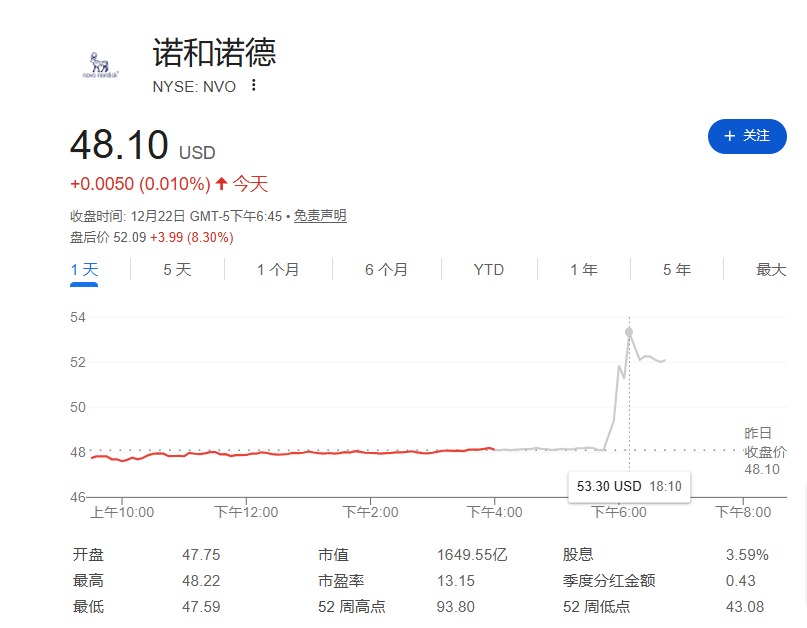
美国FDA批准了诺和诺德的首款口服GLP-1减肥药,使其在与礼来的激烈竞争中抢得先机,公司股价盘后一度应声大涨10%。这款Wegovy的口服版本 将于明年1月初在美国上市,起始现金价为每月149美元。临床数据显示其可帮助患者减重高达16.6%,并能降低心血管风险。礼来的同类口服药预计在3 月获批。 抢在礼来之前,诺和诺德在美国的减肥药市场竞争中扳回一局。 12月22日周一,美国食品药品监督管理局(FDA)批准了丹麦制药巨头诺和诺德的首款GLP-1类口服减肥药。这款新药是其明星注射产品Wegovy的口 服版本,为数百万寻求更便捷治疗方案的肥胖症患者带来了新选择。 根据诺和诺德的声明,这款口服新药将于明年1月初在美国上市。公司披露了初步的定价策略, 起始剂量的现金支付价格为每月149美元。公司同时表 示,对于拥有保险的患者,在涵盖所有剂量的情况下,每月费用可能低至25美元。 更高剂量的定价以及更详细的保险覆盖和患者节省计划将在临近上 市时公布。 诺和诺德首席执行官Mike Doustdar在声明中表示:"Wegovy口服药为患者提供了一个全新、便捷的治疗选择,可以帮助他们开始或继续他们的减重旅 程。"他强调,目前 ...
减肥药上市潮将临,谁能“击败”司美格鲁肽?
Xin Lang Cai Jing· 2025-12-23 02:33
Group 1: Market Overview - Obesity is a significant public health challenge in China, with approximately 180 million patients, the highest globally. Without intervention, the prevalence of overweight and obesity among adults is projected to reach 65.3% by 2030 [1] - The GLP-1 weight loss drug market is primarily dominated by Eli Lilly and Novo Nordisk, with a projected global market size of approximately $52.83 billion in 2024, reflecting a 46% year-on-year growth [4] - The demand for GLP-1 weight loss drugs has surged, with social media referring to them as "miracle drugs" due to their effectiveness in controlling blood sugar, delaying gastric emptying, and suppressing appetite [1] Group 2: Key Players and Products - Novo Nordisk's semaglutide holds the largest market share at 55%, with products Ozempic, Wegovy, and Rybelsus contributing a combined sales forecast of $29.296 billion in 2024 [5] - Eli Lilly's tirzepatide follows closely with a 31% market share, generating nearly $16.5 billion in revenue, approximately 36% of Eli Lilly's total revenue for 2024 [6] - Notable products expected to be among the top-selling drugs globally by 2026 include Mounjaro, Zepbound, and Wegovy, with projected sales of $25.8 billion, $19.7 billion, and $15.4 billion respectively [7][8] Group 3: Competitive Landscape - Both Eli Lilly and Novo Nordisk are intensifying their competition, with Novo Nordisk announcing clinical trial results for a higher dose of semaglutide that could elevate weight loss efficacy above 20% [9] - Eli Lilly is also advancing its oral GLP-1 drug Orforglipron, which is expected to be approved soon, showing a weight loss of approximately 12.4% over 48 weeks [10] - Other pharmaceutical companies, such as AstraZeneca and Roche, are entering the weight loss market, with AstraZeneca focusing on new mechanisms and Roche collaborating on long-acting insulin analogs [11][12] Group 4: Domestic Market Developments - Domestic companies are rapidly developing GLP-1 weight loss drugs, with ten companies currently applying for semaglutide injections, indicating a competitive landscape in China [14] - The expiration of semaglutide's core patent in March 2026 is seen as a significant opportunity for domestic firms to launch generic versions, potentially leading to a surge in market entries [16] - Innovative products like the dual receptor agonist developed by Innovent Biologics and the long-acting GLP-1 drugs from domestic companies are expected to reshape the market dynamics [17][18] Group 5: Future Trends - The global weight loss drug market is anticipated to shift towards lower prices and higher accessibility, with both Eli Lilly and Novo Nordisk announcing price reductions for their GLP-1 drugs [20] - The World Health Organization has recommended GLP-1 drugs as a long-term treatment for obesity, emphasizing the need for increased production and reduced costs to ensure accessibility [19] - The Chinese weight loss drug market is projected to grow from 260 million yuan in 2016 to 8.7 billion yuan by 2025, reaching 14.9 billion yuan by 2030, indicating a robust growth trajectory [25]
美国批准首款“口服版减肥神药”,诺和诺德拔得头筹股价大涨,礼来预计3月获批
Hua Er Jie Jian Wen· 2025-12-23 00:36
抢在礼来之前,诺和诺德在美国的减肥药市场竞争中扳回一局。 12月22日周一,美国食品药品监督管理局(FDA)批准了丹麦制药巨头诺和诺德的首款GLP-1类口服减肥药。这款 新药是其明星注射产品Wegovy的口服版本,为数百万寻求更便捷治疗方案的肥胖症患者带来了新选择。 这一消息立即在资本市场引发积极反响。诺和诺德股价在美股盘后交易中一度上涨约10%,目前稍回落至8%。对 于诺和诺德而言,此次获批是一场关键胜利,此前由于市场对其竞争地位的担忧,其股价在年内一度承压。 此次批准也让诺和诺德在与主要竞争对手礼来的激烈竞赛中暂时领先。据彭博报道,礼来公司自己的口服减肥药 预计将在明年3月获批。这意味着诺和诺德拥有了几个月的宝贵窗口期,以巩固其在口服药市场的首发优势,而口 服剂型正成为两家巨头继注射剂之后的下一个核心战场。 口服新药抢先上市,定价策略初显 根据诺和诺德的声明,这款口服新药将于明年1月初在美国上市。公司披露了初步的定价策略,起始剂量的现金支 付价格为每月149美元。公司同时表示,对于拥有保险的患者,在涵盖所有剂量的情况下,每月费用可能低至25美 元。更高剂量的定价以及更详细的保险覆盖和患者节省计划将在临近上 ...
FDA approves first GLP-1 pill for obesity from Novo Nordisk
CNBC· 2025-12-22 23:09
Group 1 - The U.S. FDA has approved the first-ever GLP-1 pill for obesity from Novo Nordisk, which could increase treatment access for more patients [1] - This approval positions Novo Nordisk ahead of its main competitor, Eli Lilly, in the obesity treatment market, which is projected to be worth around $100 billion by the 2030s [2] - Analysts believe that oral pills could capture a 24% market share, equating to approximately $22 billion, in the global weight loss drug market by 2030 [3] Group 2 - Novo Nordisk's executive vice president emphasized that having an oral option will motivate different patient segments to seek treatment, enhancing access and ease of use compared to injections [4]

Bet on These Top-Ranked Healthcare ETFs Before 2025 Ends
ZACKS· 2025-12-22 19:46
Key Takeaways U.S. healthcare challenged the S&P 500 in 2025, with biotech leading as the industry index rose 23.2%. GLP-1 drug breakthroughs, AI-driven efficiency and strong earnings beats fueled the sector's rally. ETF exposure offers diversified access as M&A activity and demographic tailwinds support 2026 growth. As we approach the final weeks of 2025, the U.S. healthcare sector has transitioned from a defensive stalwart to a primary market leader. Evidently, while the S&P 500 has delivered a solid ret ...


Jim Cramer Discusses Major Catalyst For Eli Lilly (LLY)
Yahoo Finance· 2025-12-22 17:29
We recently published 8 Stocks on Jim Cramer’s Radar. Eli Lilly and Company (NYSE:LLY) is one of the stocks on Jim Cramer's radars. Eli Lilly and Company (NYSE:LLY) is another top Cramer healthcare stock. Over the course of the year, the CNBC TV host has praised the firm’s lead in the weight loss drug industry and its manufacturing capacity. Cramer has also asserted that Eli Lilly and Company (NYSE:LLY) has a robust drug pipeline that can help the firm in non-weight-loss drug markets. However, more recen ...
BofA Maintains Buy on Eli Lilly (LLY), Expects 2027 Earnings to Fully Realize Value of Obesity Drug Launches
Yahoo Finance· 2025-12-22 13:42
Eli Lilly and Company (NYSE:LLY) is one of the best growth stocks to buy in 2026. On December 15, Bank of America analyst Jason Gerberry lowered the firm’s price target on Eli Lilly to $1,268 from $1,286 with a Buy rating on the shares. BofA remains bullish on Eli Lilly’s stock due to the company’s successful obesity product launches and the steady expansion of its pipeline into new therapeutic areas. 2027 projected earnings are expected to better capture the company’s long-term growth potential. In othe ...
Eli Lilly and Company (LLY) Announces Updated Meaningful Data on Breast Cancer Treatment
Yahoo Finance· 2025-12-22 13:39
Eli Lilly and Company (NYSE:LLY) is one of the best forever stocks to buy according to hedge funds. On December 15, Goldman Sachs lifted its price target on Eli Lilly and Company (NYSE:LLY) to $1,145 from $951 while reiterating a Buy rating on the stock. Eli Lilly and Company (LLY) Announces Updated Meaningful Data on Breast Cancer Treatment Pixabay/Public Domain On December 12, Eli Lilly and Company provided updated data for its oral estrogen receptor antagonist Inluriyo (imlunestrant) currently in Pha ...