LENOVO GROUP(LNVGY)

Search documents
联想集团发布多款“超级智能体”
news flash· 2025-05-07 02:27
Core Viewpoint - Lenovo Group has introduced a groundbreaking "Super Intelligent Agent" technology, marking a significant evolution of artificial intelligence from a tool-based assistant to a comprehensive intelligent partner and "AI twin" [1] Group 1: Technology Features - The "Super Intelligent Agent" technology is defined as a cognitive operating system for individuals and enterprises, featuring three core functionalities: perception and interaction, cognition and decision-making, and autonomy and evolution [1] Group 2: Industry Impact - The launch signifies a key breakthrough in Lenovo's hybrid artificial intelligence implementation, indicating a shift in the AI landscape towards more integrated and intelligent systems [1]
联想集团20250423
2025-04-24 01:55
Summary of Lenovo Group Conference Call Company Overview - **Company**: Lenovo Group - **Industry**: Technology, specifically PC and AI server manufacturing Key Points and Arguments Global Capacity and Supply Chain Management - Lenovo has established global production capacity in regions such as Mexico, Vietnam, and the United States to meet North American and global market demands while mitigating geopolitical risks [1][2] - The company is upgrading and expanding its U.S. factories to meet the production needs for PCs and AI servers [1][2] Impact of U.S. Tariff Policies - The impact of U.S. tariff policies on Lenovo's revenue is limited, with exposure not exceeding 20%, and PC products accounting for about 10% of that [1][4] - Lenovo ranks third in North American PC shipments, which reduces the impact of tariffs compared to competitors like Dell and HP [4] - The company has a resilient supply chain with over 30 production bases across 11 countries, allowing for flexible responses to tariff issues [2][6] H20 Ban and Chip Supply - The potential ban on H20 is expected to have a relatively minor impact on Lenovo, as over 70% of its ISC business revenue comes from overseas markets [1][8] - Lenovo has diversified its chip suppliers, with over 50% of chips sourced from AMD, reducing reliance on any single supplier [5][8] Financial Goals and Revenue Projections - For the new fiscal year, Lenovo aims for double-digit revenue growth across all business groups, with mobile and IC businesses targeting over 20% growth [3][11] - The company projects revenue between $70 billion and $75 billion, with profits expected between $1.5 billion and $1.6 billion [3][16] AI PC Market Potential - The discontinuation of Windows 10 updates is anticipated to drive a replacement demand for 300 to 400 million PCs starting in the second half of 2025, lasting for at least three years [3][15] - Lenovo expects AI PCs to account for over 80% of global PC sales within three years, presenting a significant growth opportunity [1][9] Strategic Focus on Hybrid AI - Lenovo's strategy for the new fiscal year includes a focus on hybrid AI, integrating personal, enterprise, and public intelligence to meet diverse user needs [9][10] - The company plans to launch new AI PC products and enhance cross-device data integration for improved user experience [10] Market Performance - In the first quarter, Lenovo's PC shipments grew by 10.8%, with a market share of 24.1%, outperforming the industry growth rate of 4.9% [14] Future Outlook and Challenges - Lenovo acknowledges potential short-term impacts from tariffs but does not foresee significant changes in overall revenue and demand [15][16] - The company is committed to maintaining profit margins despite cost pressures from tariffs [16] Upcoming Events - Lenovo's Innovation Technology Conference is scheduled for May 7, featuring product launches and discussions on AI infrastructure [21][22] Additional Important Information - Lenovo's IS business aims for sustainable profitability after recent losses, with no upper limit on future profit targets [12][19] - The company is actively collaborating with leading GPU manufacturers to mitigate risks associated with U.S. chip bans [8][9]
“全球资源 本地交付”:联想集团如何霸榜全球供应链TOP10
Zhong Guo Chan Ye Jing Ji Xin Xi Wang· 2025-04-18 08:29
Core Viewpoint - Lenovo Group demonstrates strong supply chain resilience and adaptability to globalization challenges through its "global resources + local delivery" operational model, as emphasized by CEO Yang Yuanqing, who stated that "there is no turning back on globalization" [1][4]. Group 1: Unique Advantages of Global Resources and Local Delivery - Lenovo's operational model provides significant resilience in a complex international trade environment, allowing the company to effectively manage trade frictions and geopolitical risks [2]. - The company has established approximately 30 manufacturing bases across 11 countries, including China, Mexico, and the United States, over the past 20 years [2]. - The Hungary factory, which began full production in June 2022, plays a crucial role in Lenovo's global strategy, producing over 90% of data center products sold in the EMEA region and supporting personalized workstation production with a capacity of over 1,000 servers and 4,000 workstations per day [2]. Group 2: Supply Chain Resilience and Globalization Strategy - Lenovo is recognized for its exceptional global supply chain operations, ranking 10th in Gartner's list of the top 25 global supply chains [3]. - The company is expanding its global footprint through a partnership with Alat in Saudi Arabia, establishing a local manufacturing presence and enhancing supply chain resilience while capitalizing on growth opportunities in the Middle East and Africa [3]. - Lenovo is building an innovative ecosystem to support its hybrid AI strategy, focusing on collaboration across various core capabilities, including venture capital, research and development, supply chain, and manufacturing [3]. Group 3: Response to Geopolitical Challenges - Lenovo's diversified global supply chain and manufacturing layout serve as key differentiators in addressing macroeconomic challenges, with the company committed to optimizing its globalization strategy [4]. - The company aims to enhance supply chain resilience and responsiveness while leading the wave of AI democratization, as stated by Yang Yuanqing during the 2025/26 fiscal year kickoff meeting [4].
PC Market Starts 2025 With Solid Growth, Tariff Turbulence Looms
ZACKS· 2025-04-09 15:21
Core Insights - The global PC market experienced a 4.9% year-over-year increase in first-quarter shipments, totaling 63.2 million units, marking six consecutive quarters of growth [1] - However, the growth is largely attributed to pre-tariff stockpiling by vendors and buyers, raising concerns about future demand due to new U.S. tariffs [2][3] Market Dynamics - The first-quarter performance was artificially inflated due to strategic decisions by supply chain players to accelerate shipments ahead of tariff impacts [3] - Despite the pre-tariff boost, underlying demand for commercial PCs remains strong, driven by the upcoming end of Windows 10 support and interest in AI-enabled devices [4][5] Vendor Performance - Lenovo maintained its market leadership with 15.2 million shipments and a 24.1% market share, an increase from 22.8% year-over-year [6] - HP and Dell followed with 12.8 million and 9.6 million shipments, respectively, while Apple saw a significant 14.1% year-over-year growth, reaching 5.5 million units [6][7] Future Outlook - The introduction of new U.S. tariffs has created uncertainty, with potential strategies for vendors including relocating manufacturing and adjusting inventories [8] - Cost increases from tariffs are expected to impact consumers and enterprise buyers, potentially delaying purchases and affecting demand levels [9] - Overall, while the PC market showed strong early traction in 2025, the outlook remains unstable due to inflation and macroeconomic risks [10]



联想集团20250402
2025-04-02 14:06
Lenovo Group Conference Call Summary Industry Overview - The personal computer (PC) market is undergoing significant changes, similar to the transition from regular phones to smartphones decades ago. By 2028, over 80% of PCs are expected to be AI-enabled, marking the entry into the AI era. This shift indicates that AI will be capable of autonomous actions and decision-making without human intervention. The industry is moving from application-based to intent-understanding models. Lenovo collaborates with current and new chip suppliers, including Intel, AMD, and Qualcomm, to provide more options and AI opportunities [3][4]. Key Insights and Arguments - Lenovo anticipates a 5%-10% growth in the PC market by 2025, surpassing the industry average, driven by the end of Windows 10 updates, particularly in the commercial sector where security concerns will accelerate device upgrades [4]. - AI PCs are priced approximately 10% higher than traditional PCs, enhancing profitability. While prices may decrease as AI PCs enter the mainstream market from 2025 to 2026, Lenovo expects to maintain a 5%-10% price increase, ensuring profitability remains strong [4][6]. - Lenovo achieved its highest market share in five years during Q3, maintaining a leading global position, with increasing Windows system activations attributed to product innovation and strong market competitiveness [8]. - Lenovo defines five key characteristics of AI PCs, including edge and cloud models, personal intelligent agents, multi-layer databases with privacy protection, NPU integration, and application ecosystem connectivity. Lenovo's penetration rate in China's PC shipments is about 15%, with a market share of approximately 35% [4][9]. - At CES and MWC, Lenovo launched over 150 AI-enabled devices, showcasing its technological strength and commitment to future innovations [12]. - Lenovo's four strategic priorities include maintaining growth above market levels, achieving industry-leading profitability, retaining global leadership, and expanding into emerging markets while increasing the share of high-end devices [14]. Market Opportunities - Approximately 250 million Windows 10 laptops require updates due to Microsoft's cessation of updates in October 2025. Additionally, around 400 million devices over four years old are also due for replacement, particularly those purchased during the pandemic [5]. Financial Performance - Lenovo's Q3 financial report indicated a significant increase in market share, with a strong competitive position and continuous innovation leading to increased Windows activations [8]. AI PC Market Dynamics - The market for AI PCs is expected to see a penetration rate of 20%-30% by 2025, increasing to 50% by 2026, and potentially reaching 70%-80% in the following years. The average price premium for AI PCs is around 10%, which contributes to increased sales and improved gross margins [17][24]. Future Outlook - Lenovo aims to lead in personal and enterprise intelligence sectors, targeting double-digit revenue growth across all business groups. The mobile and ISG (Infrastructure Solutions Group) segments aim for over 20% revenue growth, with significant orders from major clients like Alibaba and ByteDance [18][25]. Strategic Developments - Lenovo's AI server revenue constitutes about 30% of its ISG business, with substantial orders from Alibaba and other major clients. The company aims to enhance profitability while maintaining a strong position in traditional infrastructure [25][26]. Conclusion - Lenovo is well-positioned to capitalize on the evolving PC market, particularly with the rise of AI PCs. The company's strategic focus on innovation, market leadership, and expansion into emerging markets will likely drive future growth and profitability.
联想集团ISG总裁:即将更新2/3的存储产品路线图
Ge Long Hui· 2025-03-31 03:08
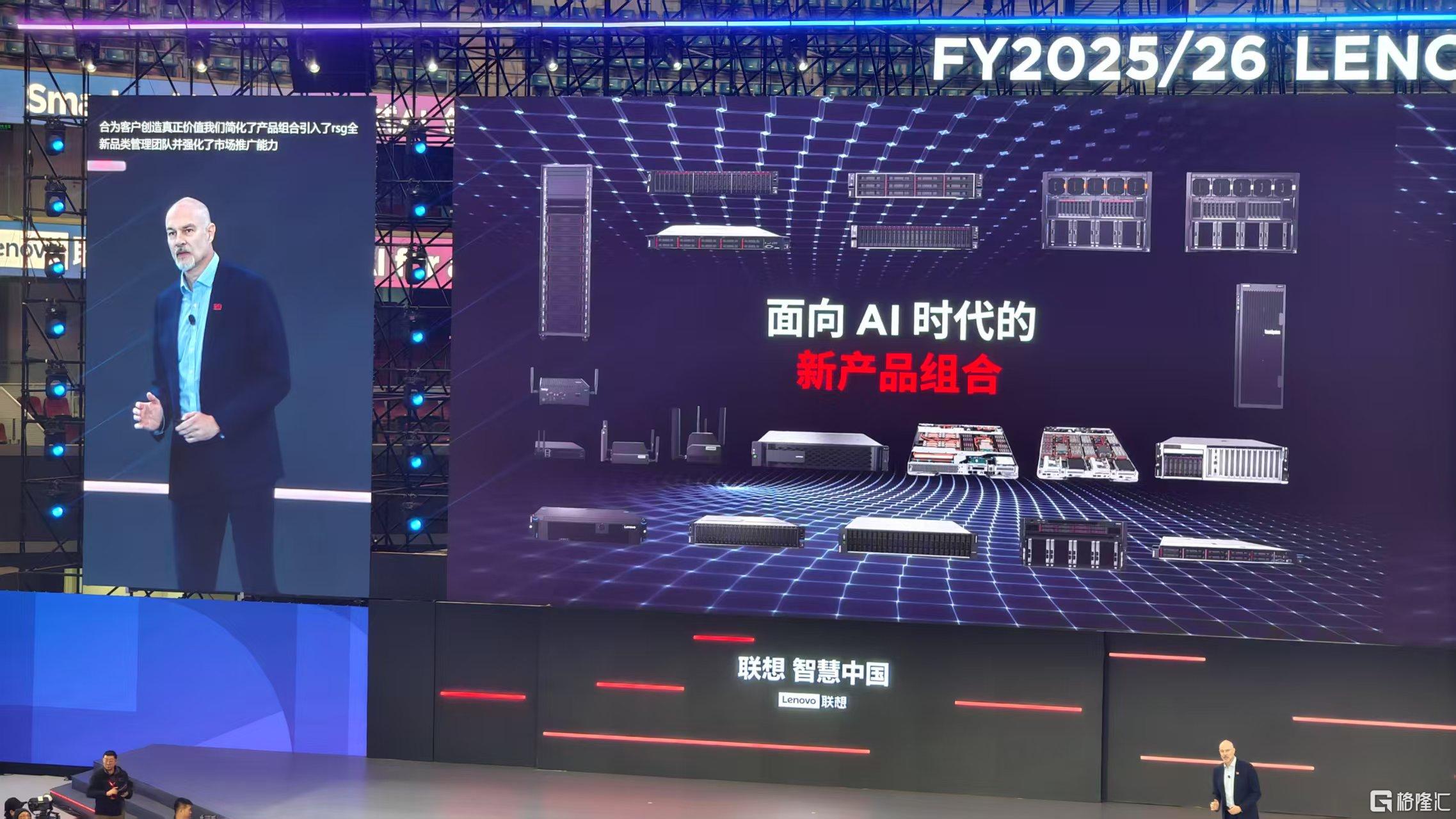
3月31日,联想集团2025/26财年誓师大会在北京召开,半年前刚刚加入联想集团的执行副总裁兼ISG基础设施方案集团总裁Ashley Gorakhpurwalla亮相,他表 示,对联想的混合式人工智能战略和方法论深感钦佩,通过独特的将AI带入数据领域,它使各类企业都能够全面释放AI的能力,达到规模化——同时平衡 云端与本地部署方案的优势。 Ashley的职业生涯始于电气工程师,设计神经网络AI系统。在过去的30年里,他始终专注于将技术带给客户,推动创新并赢得成功。 机构预测数据显示,2025 年 AI 相关支出将增长三倍。企业必须在推进人工智能落地应用与实现可衡量的业务价值之间找到平衡——这是行业的关键转折 点。"也正是这一点让我对联想ISG(基础设施方案业务)的潜力充满期待!" Ashley称。 凭借联想的全栈基础设施,ISG(基础设施方案业务)是联想混合式AI优势集的基石。 那么,联想如何在行业中取得成功?Ashley做了进一步的诠释。 首先,联想必须为客户和合作伙伴创造卓越价值。联想从零开始构筑了一项卓越的云服务(CSP)业务,利用联想独特的ODM+模式,实现了规模化创新和高 效交付。联想与具有效率领先 ...
联想集团20250314
2025-03-16 14:53
Lenovo Group Conference Call Summary Company Overview - Lenovo Group is the world's largest PC brand, holding a market share of 25.5%. The company is structured into three main business segments: IDG (Intelligent Devices Group), ISG (Infrastructure Solutions Group), and SSG (Solutions and Services Group). IDG is the primary revenue source, accounting for approximately 73% of total revenue [2][3][7]. Financial Performance - During the pandemic, demand for PCs and tablets surged, but subsequently declined, leading to an overall revenue drop of over 8% year-on-year for 2024, with net profit down 37% [2][8]. - In the first three quarters of fiscal year 2025, revenue increased by over 20%, driven by AI PC products, although gross margin decreased to 15.96% due to rapid expansion in the mobile business [2][9]. AI PC Development - AI PC is identified as a core driver for Lenovo's future growth, providing intelligent and personalized user experiences through local deployment of AI models. The global AI PC penetration rate is expected to be around 10% in 2024, potentially reaching 70% by 2028, with an annual growth rate of 44% [2][10][15]. - AI PCs revolutionize human-computer interaction by enabling voice commands for functionality, significantly enhancing user experience [2][12]. Business Segment Insights IDG (Intelligent Devices Group) - IDG includes PCs, smartphones, tablets, and smart home devices. The PC segment has underperformed since 2022, but smartphone sales have improved. The end of free upgrades for Windows 10 is expected to drive replacement demand for PCs [2][17]. - In Q4 2024, IDG contributed approximately 73% to total revenue [7]. ISG (Infrastructure Solutions Group) - ISG provides automated spending support services to cloud vendors, benefiting from significant capital expenditures from domestic and international cloud companies. It is expected to achieve profitability in Q4 2024 and show strong performance in 2025 [4][25]. - The hardware business within ISG is projected to grow rapidly due to increasing demand for inference-side computing power [24]. SSG (Solutions and Services Group) - SSG focuses on after-sales services and has developed over 40 proprietary IP solutions. Although its revenue contribution is relatively small, it plays a crucial role in accelerating enterprise digital transformation [4][26][27]. Market Trends and Future Outlook - The pandemic's impact on the PC and tablet market has led to a significant demand drop post-2022, affecting overall revenue [8]. - Lenovo's strong position in the global PC market, with over 20% market share, remains stable, and the company is expected to lead in the AI PC era [18]. - The company anticipates profits of $1.5 billion in 2025, with optimistic projections reaching $2.5 billion by 2027 [28]. Additional Insights - Lenovo's global manufacturing capabilities, with over 30 factories, enhance its competitive edge in the PC industry [5]. - The integration of AI into devices is expected to change user interaction and habits, with potential new devices like smart glasses emerging as significant platforms [11][16]. This summary encapsulates the key points from Lenovo Group's conference call, highlighting the company's structure, financial performance, business segment insights, market trends, and future outlook.
联想集团20250305
2025-03-05 05:45
Summary of Lenovo Group's Conference Call Industry and Company Overview - The conference call focuses on the **AI PC** sector and the **Lenovo Group** as a key player in this industry [3][4][12]. Core Insights and Arguments - **AI PC Development**: The company anticipates a significant shift in AI PC trends by 2025 due to model optimization and the rapid development of open-source models, which enhance product functionality and reduce costs [3][4]. - **Personal Productivity**: AI applications have reached a usable level, with increasing demand for vectorized knowledge bases. This trend is expected to accelerate the adoption of AI PCs in 2025 [3][4]. - **Competitive Landscape**: Lenovo, HP, and Dell have distinct strategies in the IPC layout. Lenovo focuses on domestic computing infrastructure and open-source models, HP emphasizes high-performance computing and enterprise solutions, while Dell integrates technology and service [6][11]. - **Value Addition in IPC**: The added value in IPC lies in system services and software ecosystems. The company aims to monetize through AI assistants, data analysis tools, and partnerships with third-party developers [7][12]. - **Future Brand Development**: PC brands will shift from hardware-centric models to comprehensive solution providers, enhancing software ecosystems and user experiences [8][9]. - **Local AI Functionality**: Local AI operations are crucial for security and cost-effectiveness, especially in sensitive industries. Local deployment reduces data handling complexities and costs compared to cloud solutions [10][11]. - **Lenovo's Competitive Advantages**: Lenovo's strengths include rapid AI assistant integration, extensive service offerings, economies of scale, and diversified revenue streams through advertising and subscription services [11][12]. Additional Important Points - **Impact on Valuation Methods**: The rise of AI PCs will alter traditional PC brand valuation methods, shifting focus from hardware sales to system service layers and embedded AI solutions [12]. - **2025 Outlook for Lenovo**: The company is optimistic about 2025, expecting benefits from infrastructure investments and the AI PC trend, which will enhance its performance and valuation [13][14].
Prediction: Trump's Tariffs Would Cause These Stocks to Be Big Losers in 2025
The Motley Fool· 2025-02-26 09:49
Core Viewpoint - The reintroduction of tariffs by the Trump administration is expected to negatively impact several companies, particularly General Motors, Lenovo Group, and Magna International, leading to significant stock declines in 2025 due to trade tensions and protectionist policies [2][14]. Group 1: General Motors - General Motors (GM) has seen a double-digit percentage decline in its stock year to date, despite better-than-expected fourth-quarter results [3]. - GM exports more light vehicles made in Mexico to the U.S. than any other automaker, with 12% of its assets located in Mexico, making it vulnerable to tariffs [4]. - The company has major facilities in Canada and China, and its CEO has indicated that GM is preparing to mitigate the impacts of tariffs, but the stock is still predicted to be a major loser [5]. Group 2: Lenovo Group - Lenovo Group, the world's largest PC maker, has experienced a stock increase of over 30% this year, but its future prospects are uncertain due to its status as a Chinese company [6]. - Approximately 34% of Lenovo's total revenue comes from North America, primarily the U.S., and the company has manufacturing locations in China and Mexico, which will be adversely affected by tariffs [7][8]. - Although Lenovo's CEO believes tariffs may not significantly harm the business, the potential for steeper tariffs on Chinese imports could worsen the situation [9][10]. Group 3: Magna International - Magna International has seen its shares fall roughly 8% year to date and around 30% over the past year, with expectations of continued decline due to tariffs [12]. - The company has identified "increasing trade protectionism" as a risk factor, indicating that tariffs could escalate into a global trade-tariff war, impacting its business as a major supplier to U.S. automakers [13].