Pfizer(PFE)

Search documents
If You'd Invested $1,000 in Pfizer (PFE) Stock 3 Years Ago, Here's How Much You'd Have Today
The Motley Fool· 2025-08-12 01:16
Group 1 - The core performance of Pfizer has been disappointing, with a $1,000 investment made on August 8, 2022, worth only $585 by August 8, 2025, compared to a $1,615 value for the S&P 500 index over the same period [1] - Future performance is crucial for current and potential investors, and Pfizer's outlook appears promising due to ongoing investments and strategic planning [2] - Past exceptional performance was driven by the COVID-19 vaccine and treatments, but demand has decreased, and several key products are losing patent protection soon [3] Group 2 - Pfizer is actively investing in its pipeline, which includes over 100 active programs, particularly in oncology, to counteract the loss of patent protection on major products [3] - The company has been receiving additional drug approvals and implementing cost-cutting measures to enhance profitability [3] - Pfizer offers a significant dividend yield of 7%, providing returns to investors while they await the benefits of the company's investments [4]



Pfizer Just Beat Its Earning Estimates. Is This the Beginning of a Turnaround for the Pharmaceutical Stock?
The Motley Fool· 2025-08-12 00:15
Core Viewpoint - Pfizer has shown a strong performance in its recent earnings report, which may signal a potential turnaround for the company after a significant decline in stock value over the past three years [1] Financial Performance - Total revenue for Pfizer increased by 10% year over year to $14.7 billion, with adjusted earnings per share rising by 30% to $0.78 [5] - Revenue from the coronavirus vaccine Comirnaty reached $381 million, a 96% increase compared to the previous year, while Paxlovid generated $427 million, marking a 70% year-over-year growth [2] - New product Abrysvo, a vaccine for RSV, reported sales of $143 million, more than doubling its revenue from the same period last year [3] Product Performance - Key products contributing to revenue include the anticoagulant Eliquis, cancer drugs Xtandi and Padcev, and Vyndaqel, which addresses heart problems related to a rare disease [4] - Pfizer's oncology pipeline is expected to yield significant clinical and regulatory successes in the coming years, reducing reliance on existing products facing patent expirations [8] Cost Management - Pfizer is actively reducing expenses, projecting net cost savings of $4.5 billion by the end of the year and a total of $7.2 billion by the end of 2027 [5][9] Market Valuation - The stock is currently valued at a forward price-to-earnings ratio of approximately 8.3, significantly lower than the healthcare industry's average of 15.9, making it an attractive investment opportunity [11]
FDA May Not Renew Pfizer's Authorization For Covid Shots In Younger Children, Moderna Prepares To Boost Supply
Benzinga· 2025-08-11 17:55
Core Viewpoint - Pfizer's COVID-19 vaccine for children under five may lose FDA authorization, potentially leading to supply shortages, with Moderna stepping in to fill gaps [1][2][3] Group 1: FDA Authorization and Vaccine Availability - The FDA may not renew the emergency use authorization for Pfizer's pediatric COVID-19 vaccine for the 2025 respiratory season, which could remove the only vaccine available for children under five [2][3] - Pfizer anticipates full FDA approval for its COVID-19 vaccine for children aged 5 to 11 this fall, but options for the youngest age group would be limited without authorization [3] Group 2: Current Vaccine Landscape - Moderna's pediatric vaccine, approved in July, is only available for children with specific health conditions, while Novavax's pediatric shot is available for children 12 and older with similar conditions [4] - The CDC is in discussions with Moderna to increase vaccine supply for young children in anticipation of potential gaps [4] Group 3: Vaccination Rates and Public Health Concerns - Health experts express concern that narrowing vaccine access could further decrease already low vaccination rates, with only 5.6% of children aged six months to four years vaccinated and 15% of children aged 5 to 17 [5] - Despite low uptake, the vaccines are noted to be highly effective in preventing hospitalization and death [5] Group 4: Regulatory Changes and Controversies - The U.S. Health and Human Services Secretary announced that the COVID-19 vaccine will no longer be recommended for pregnant women and healthy children on the CDC's immunization schedule [6] - The FDA has implemented stricter clinical trial requirements for healthy adults and limited annual booster approvals to older and high-risk Americans [7] - A lawsuit has been filed against Robert F. Kennedy Jr. for changes to COVID-19 vaccine recommendations, which plaintiffs argue undermine science and public health [8]


Should Pfizer Stock Be in Your Portfolio After Solid Q2 Results?
ZACKS· 2025-08-11 14:16
Core Insights - Pfizer reported strong Q2 2025 results, with adjusted EPS of 78 cents, a 30% increase year-over-year, and revenues of $14.7 billion, up 10% [1][9] - The company reaffirmed its revenue outlook for 2025 while raising its adjusted EPS guidance, indicating strong fundamentals despite short-term fluctuations [2] - Pfizer's oncology segment is a key growth driver, with revenues rising 9% in H1 2025, bolstered by the Seagen acquisition and new product launches [3][9] Financial Performance - Revenues from key products such as Vyndaqel, Padcev, Lorbrena, Paxlovid, and Comirnaty vaccine contributed positively, while Ibrance saw a decline [1] - The company expects a revenue CAGR of approximately 6% from 2025 to 2030, supported by a diversified portfolio and new product launches [6] - Pfizer's non-COVID operational revenues improved, with new and acquired products generating $4.7 billion in H1 2025, a 15% operational increase year-over-year [5] Strategic Developments - Pfizer's acquisition of Seagen is expected to contribute over $10 billion in risk-adjusted revenues by 2030, enhancing its oncology pipeline [7] - The company is expanding its oncology biosimilars portfolio and advancing several candidates in late-stage development [3][4] - Pfizer is also working on label expansions for existing products across oncology and non-oncology categories [4] Market Challenges - Sales of COVID-related products have significantly declined, with projections of around $11 billion in 2024 compared to $56.7 billion in 2022, leading to uncertainty in future revenues [10] - The company anticipates a $1 billion unfavorable impact from the Medicare Part D redesign under the Inflation Reduction Act [12] - Pfizer faces potential revenue impacts from the loss of exclusivity for several key products between 2026 and 2030 [11] Valuation and Investment Outlook - Pfizer's stock is trading below industry averages, with a forward P/E ratio of 7.93 compared to the industry average of 13.71, making it attractive for value investors [19] - The Zacks Consensus Estimate for earnings has seen upward revisions for 2025 and 2026, indicating positive market sentiment [22] - The company plans to achieve $7.7 billion in cost savings by the end of 2027, which should support profit growth despite anticipated revenue challenges [26]

“指数权重跌至数十年来最低点”!美国医药股被市场“抛弃”了
Hua Er Jie Jian Wen· 2025-08-11 03:04
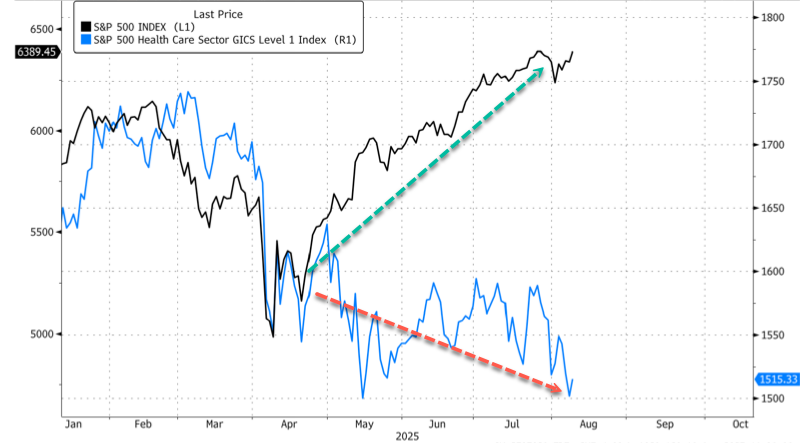
Core Viewpoint - Investor sentiment is highly pessimistic, and U.S. pharmaceutical stocks are facing the most severe challenges in decades [1][3]. Group 1: Market Performance - Major biopharmaceutical companies experienced significant sell-offs during the recent earnings season, leading to a weak overall performance of the sector [1][3]. - The healthcare sector's weight in the S&P 500 index has dropped to its lowest point in decades [1][9]. - Vertex Pharmaceuticals and Eli Lilly faced substantial declines, with Vertex dropping 20.6% on August 4 due to setbacks in its pain medication project, while Eli Lilly recorded its largest drop since the dot-com bubble [4][7]. Group 2: Stock Volatility - The average volatility of healthcare stocks during this earnings season reached ±6%, marking one of the highest volatility records in history [3][9]. - Other major healthcare stocks, including Novo Nordisk, McKesson Corp, and UnitedHealth Group, saw declines of 10% to 20% post-earnings [3][7]. Group 3: Policy Uncertainty - Policy uncertainties, particularly regarding the Trump administration's Most Favored Nation pricing proposal and potential tariffs on the pharmaceutical industry, are major challenges for pharmaceutical stocks [8][9]. - Analysts are closely monitoring the potential announcement of pharmaceutical tariffs, expected in mid-August, which could further impact the sector [8][9]. Group 4: Company-Specific Developments - Despite the overall weak performance, some companies like Johnson & Johnson and Gilead Sciences showed strong results, with Gilead's stock rising 6% last week and a year-to-date increase of 30% due to robust HIV business growth [7]. - The weight loss drug sector has been particularly hard hit, with Eli Lilly losing $100 billion in market value due to disappointing data on its oral weight loss medication [7].


北美医药生物-一图胜千言-A picture is worth a thousand words
2025-08-11 02:58
Summary of Key Points from the Conference Call Industry Overview - The conference call focuses on the **Biopharma** industry in **North America** with a comprehensive analysis of the **US drug market** as per **IQVIA Rx** data [1][6]. Core Insights - The **Total Prescription Year-over-Year (YoY) growth** for the week ending August 1, 2025, was reported at **+2.8%**, an increase from **+1.7%** the previous week and **+2.6%** over the past 12 weeks [1][6]. - For the week ended August 1, the **US total market weekly TRx YoY change** was **+2.8%**, compared to **+0.9%** a year ago. The **rolling 4-week TRx YoY** was **+2.9%** and the **rolling 12-week TRx YoY** was **+2.6%** [2]. Company-Specific Developments - **Bristol Myers Squibb (BMY)**: - The drug **Cobenfy** was approved for schizophrenia on September 26, 2024. The current scripts are approximately **2,010** for the week, up from **1,950** the previous week. To meet 2025 consensus expectations, Cobenfy's TRx needs to track at **~2-3x** the volumes from recent schizophrenia launches [3]. - The consensus estimate for Cobenfy has decreased from **$196 million** to **$171 million**, implying that approximately **129K TRx** are required to meet these estimates [3]. - **Vertex Pharmaceuticals (VRTX)**: - The drug **Journavx** was approved for acute pain on January 30, 2025, with current scripts at approximately **6,800**, up from **6,430** the previous week. It is noted that hospital scripts, which account for about **35%** of total scripts, are not captured by IQVIA [4]. - To achieve a sales target of **$78 million**, approximately **345K total scripts** are needed, assuming a **$225 net price per script** [4]. - **Gilead Sciences (GILD)**: - The launch comparison for **Yeztugo** (lenacapavir) shows current TRx at approximately **210**, down from **300** the previous week. The injectable formulation accounts for **50%** of total TRx [5]. Additional Insights - The **extended unit (EUTRx)** weekly YoY growth was reported at **+1.9%**, which is below the TRx YoY growth [2]. - The **sequential weekly TRx growth** was **-0.1%**, an improvement from **-1.2%** the week before [2]. - The **biopharma industry view** is categorized as **attractive**, while the major pharmaceuticals industry view is **in-line** [7]. Notable Trends - The **momentum of top outpatient drugs** indicates varying performance across different companies, with notable declines in some established drugs like **Humira** (AbbVie) showing a **-40%** YoY change, while newer drugs like **Mounjaro** (Eli Lilly) and **Zepbound** (Eli Lilly) show significant growth rates of **69%** and **257%** respectively [24]. Conclusion - The conference call highlights a positive trend in the US drug market with specific growth in total prescriptions. However, individual company performance varies significantly, with newer drugs showing strong growth potential while established drugs face declines. The insights provided can guide investment decisions in the biopharma sector.


疫苗行业周报:疫苗领域创新突破,国内外进展显著-20250810
Xiangcai Securities· 2025-08-10 13:51
Investment Rating - The industry investment rating is maintained at "Overweight" [3][10][29] Core Viewpoints - The vaccine industry is experiencing significant innovation breakthroughs both domestically and internationally, with multiple companies achieving clinical trial approvals for new vaccines [2][6][10] - The industry is currently facing performance pressure due to supply-demand imbalances, with high competition leading to price declines for some products [10][29] - Long-term prospects remain positive, driven by policy support, increasing demand due to aging populations, and ongoing technological advancements in vaccine development [11][31] Summary by Sections Recent Developments - Watson Bio's mRNA vaccine for respiratory syncytial virus (RSV) has received clinical trial approval, marking a significant step in domestic vaccine innovation [5][6] - The first phase trial of China's Tian Tan strain HIV vaccine has been successfully completed, indicating progress in HIV vaccine research [5][6] - Pfizer reported a 10% revenue growth in Q2 2025, exceeding market expectations, with significant contributions from its anticoagulant and COVID-19 products [5][6] Market Performance - The vaccine sector saw a slight decline of 0.44% last week, while the overall pharmaceutical sector dropped by 0.84% [7][8] - The vaccine industry has shown a cumulative increase of 0.96% since the beginning of 2025, indicating a recovery trend [7][8] Valuation Metrics - The vaccine sector's price-to-earnings (PE) ratio is 80.76X, with a recent decrease of 0.33X, while the price-to-book (PB) ratio stands at 1.96X [9][10] - The PE ratio is within the 48.20% percentile since 2013, indicating a relatively high valuation compared to historical data [9][10] Investment Recommendations - The report suggests focusing on companies with strong innovation capabilities and differentiated products, recommending companies like CanSino and Kanghua Bio [10][31] - The long-term outlook emphasizes the importance of innovation and international expansion as key drivers for growth in the vaccine industry [10][31]



Meet the 7.3% Yield Dividend Stock That Could Soar in 2026
The Motley Fool· 2025-08-10 10:05
Core Viewpoint - Pfizer's stock has recently rebounded due to strong Q2 earnings, indicating potential for future growth as the company navigates post-pandemic challenges [1][2] Financial Performance - Pfizer's dividend yield has reached 7.3%, attracting investors despite the company's struggles post-COVID-19 [4] - The company has maintained its dividend for 15 consecutive years, with the current dividend at $1.72 per share, which is well below the midpoint of management's 2025 adjusted EPS guidance of $3 per share [5][6] Growth Prospects - Pfizer has raised its 2025 adjusted earnings guidance from $2.80-$3.00 to $2.90-$3.10 per share, focusing on growth in oncology and specialty drugs, which are less likely to face pricing pressures [8] - Specialty drug sales have increased by 6% year over year, while oncology sales have risen by 9% through six months of 2025, contributing approximately $16.5 billion to sales [9][10] Market Sentiment - Analysts project Pfizer's earnings to grow at an annualized rate of 9% over the next three to five years, despite current market concerns regarding tariffs and political pressures [11] - The stock is currently trading at just 8 times the midpoint of its 2025 earnings guidance, suggesting a significant undervaluation given its growth potential [13] Investment Appeal - Pfizer presents a compelling investment opportunity for income-focused investors due to its high dividend yield, potential for high-single-digit growth, and a valuation that could increase with improved market sentiment [14][15]

Funds Only Portfolio: Potentially $6,000 Per Month Income
Seeking Alpha· 2025-08-09 12:01
Group 1 - The primary goal of the "High Income DIY Portfolios" Marketplace service is to achieve high income with low risk and capital preservation [1] - The service provides DIY investors with essential information and portfolio/asset allocation strategies aimed at creating stable, long-term passive income with sustainable yields [1] - The portfolios are specifically designed for income investors, including retirees or near-retirees, and include seven different portfolios: 3 buy-and-hold, 3 rotational portfolios, and a 3-bucket NPP model portfolio [1] Group 2 - The offerings include two high-income portfolios, two dividend growth investing (DGI) portfolios, and a conservative NPP strategy portfolio characterized by low drawdowns and high growth potential [1]


Arvinas Announces FDA Acceptance of the New Drug Application for Vepdegestrant for the Treatment of ESR1m, ER+/HER2- Advanced Breast Cancer
Globenewswire· 2025-08-08 20:05
Core Viewpoint - The FDA has accepted the New Drug Application (NDA) for vepdegestrant, a novel treatment for advanced or metastatic breast cancer, with a PDUFA action date set for June 5, 2026 [1][5]. Company Overview - Arvinas, Inc. is a clinical-stage biotechnology company focused on developing therapies for life-threatening diseases using its PROTAC protein degrader platform [8]. - The company is collaborating with Pfizer for the co-development and commercialization of vepdegestrant, sharing development costs and profits [4]. Product Details - Vepdegestrant is an investigational oral PROTAC estrogen receptor degrader aimed at treating ER+/HER2- advanced or metastatic breast cancer with ESR1 mutations [3][5]. - The drug has shown statistically significant improvement in median progression-free survival compared to fulvestrant in the Phase 3 VERITAC-2 clinical trial [1][2]. Clinical Trial Information - The VERITAC-2 trial enrolled 624 patients across 213 sites in 25 countries, with 270 patients having ESR1 mutations [6][7]. - The primary endpoint of the trial was progression-free survival, with overall survival as a key secondary endpoint [7]. Regulatory Status - Vepdegestrant has been granted Fast Track designation by the FDA, highlighting the unmet medical need in the target patient population [5].