Pfizer(PFE)

Search documents
Did Pfizer Just Say "Checkmate" to Novo Nordisk?
The Motley Fool· 2025-11-26 09:15
Core Insights - The weight loss drug market is projected to approach nearly $100 billion by the end of the decade, with drugs like Ozempic and Wegovy gaining significant popularity and driving revenue for Novo Nordisk [1][4] - Pfizer has made a strategic move to enter the weight loss drug market by acquiring Metsera, a biotech company developing weight loss candidates, for an initial enterprise value of $4.9 billion, later increasing its bid to $7 billion [8][9] - Despite Pfizer's acquisition, Novo Nordisk continues to experience double-digit growth in its obesity care sales, which rose by 37% in the first nine months of the year [10] Company Developments - Pfizer previously halted the development of its weight loss pill candidate, danuglipron, due to a clinical trial participant's liver issue, but remains committed to the weight loss market through acquisitions [5][6] - Novo Nordisk has launched its own bid for Metsera at $6.5 billion, indicating competitive dynamics in the weight loss drug sector [8][9] - Novo Nordisk has a robust pipeline of weight loss drug candidates and has submitted for regulatory approval of an oral weight loss candidate this year [12] Competitive Landscape - Eli Lilly is a significant competitor in the weight loss drug market, generating substantial revenue from its portfolio and potentially launching a weight loss pill shortly after Novo Nordisk [13][14] - Pfizer's acquisition of Metsera is not expected to pose an immediate threat to Novo Nordisk's revenue, as the candidates from Metsera are years away from commercialization [10][13] - The competitive landscape remains dynamic, with established players like Eli Lilly and new entrants like Pfizer vying for market share in the lucrative weight loss drug sector [2][14]



从“减肥神药”覆盖到抗癌药!“美国版集采”来势汹汹 将削减36%支出
Zhi Tong Cai Jing· 2025-11-26 08:37
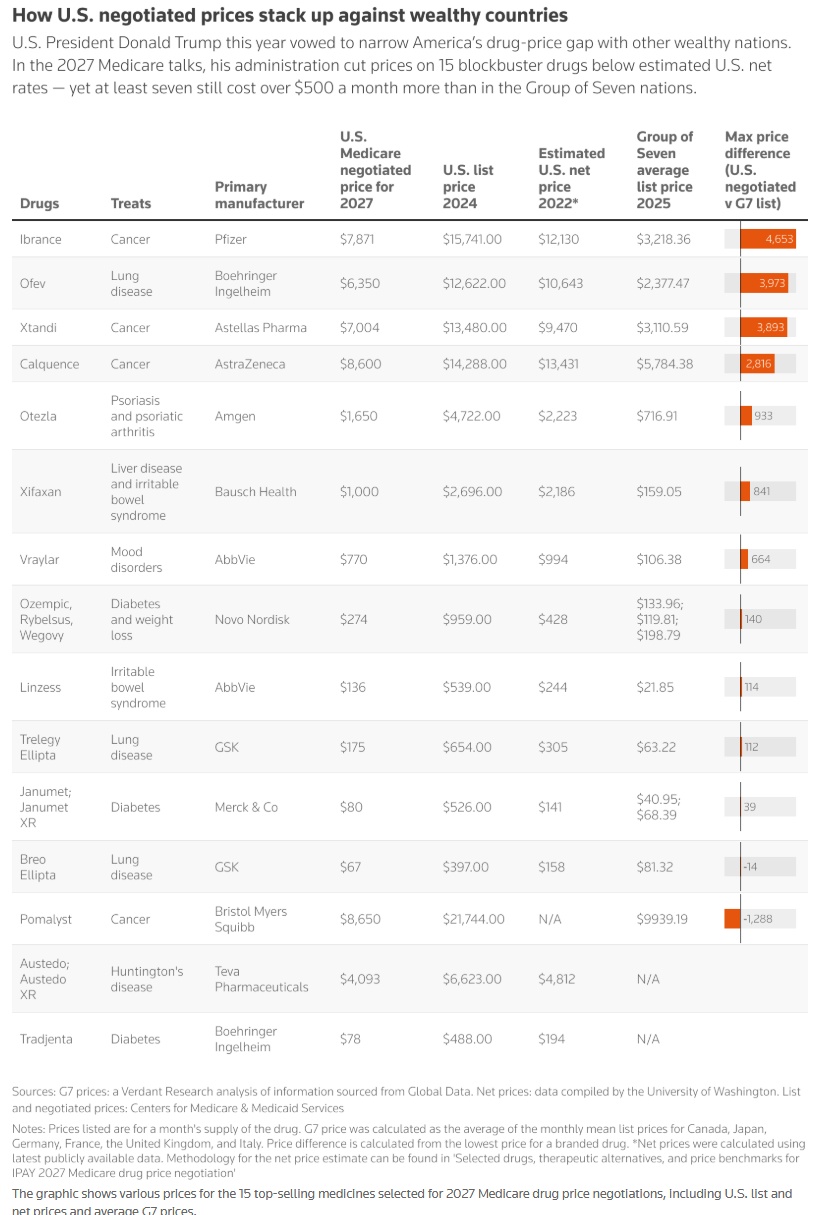
Core Insights - The recent Medicare negotiations are expected to save approximately 36% on the prices of 15 high-cost drugs, translating to around $8.5 billion in net reimbursement costs [1][3][10] - The new prices will take effect in 2027, with significant reductions for popular drugs like semaglutide, which will drop over 70% to about $274 per month [1][4] - The negotiations are part of the Inflation Reduction Act signed by President Biden in 2022, which allows Medicare to negotiate drug prices for the first time [2][11] Drug Price Reductions - The estimated net prices for drugs like Calquence, Ofev, and Ibrance have been reduced by over $4,000 each in the latest negotiations [2][4] - The new pricing for other drugs includes Trelegy Ellipta at $175 (down from $654) and Linzess at $136 (down from $539) [4][10] - The average negotiated prices for these drugs are still higher than those in the Group of Seven (G7) nations, with some drugs costing over $500 more than their G7 counterparts [7][11] Comparison with Previous Negotiations - The 36% savings in the current negotiations surpasses the 22% savings achieved in the previous year's negotiations for 10 different drugs [3][10] - The pricing strategy has become more efficient, with newer products potentially having greater flexibility in pricing [4][10] Industry Response - The pharmaceutical industry has expressed strong opposition to government price negotiations, arguing that such policies are detrimental [5][10] - Industry representatives claim that government pricing policies like the Inflation Reduction Act and the Most-Favored-Nation pricing are misguided [5][12] Future Implications - The Medicare negotiations are expected to influence other payers to seek similar pricing from drug manufacturers [10] - Future negotiations will include an additional 15 drugs, with discussions set to begin in February [12]


Valneva Announces Positive Final Phase 2 Results for Lyme Disease Vaccine Candidate
Globenewswire· 2025-11-26 06:00
Core Insights - Valneva SE announced positive final immunogenicity and safety data from the Phase 2 study of its Lyme disease vaccine candidate, VLA15, indicating strong immune response and favorable safety six months after a third booster dose, supporting the concept of yearly vaccinations before Lyme season [1][4][6] Company Overview - Valneva SE is a specialty vaccine company focused on developing, manufacturing, and commercializing prophylactic vaccines for infectious diseases, addressing unmet medical needs [9] - The company has advanced multiple vaccines from early R&D to approvals and currently markets three proprietary travel vaccines [10] - Valneva's commercial revenues support the advancement of its vaccine pipeline, including the only Lyme disease vaccine candidate in advanced clinical development, partnered with Pfizer [11] Vaccine Development - VLA15 is the most advanced Lyme disease vaccine candidate, with all vaccinations completed in the pivotal VALOR Phase 3 trial [2] - The vaccine targets the outer surface protein A (OspA) of Borrelia burgdorferi, the bacteria causing Lyme disease, and covers the six most prevalent OspA serotypes in North America and Europe [5] - The Phase 2 study, VLA15-221, included a pediatric population and demonstrated that antibody levels remained well above baseline across all serotypes and age groups six months after the third booster dose [6][7] Market Need - There are currently no approved human vaccines for Lyme disease, with approximately 476,000 cases diagnosed annually in the U.S. and 132,000 cases reported in Europe [2][8] - The geographic expansion of Lyme disease highlights the pressing medical need for vaccination, as early symptoms are often overlooked, leading to serious chronic complications if untreated [8]


Want Over $7,000 in Annual Dividends? Invest $25,000 in Each of These 4 Stocks.
Yahoo Finance· 2025-11-25 10:30
Core Insights - Conagra Brands, a 105-year-old company with over 20 national food brands, is projected to achieve more than $11.6 billion in sales this year while modernizing its portfolio for future growth [1] - The company's stock has declined 37% year-to-date, making it one of the worst performers in the S&P 500, which has resulted in an increased dividend yield of 8% [2] - Conagra has a trailing payout ratio of 78% and has increased its dividend for the past six years, indicating a commitment to returning value to shareholders [7] Conagra Brands - Conagra is focusing on modernizing its product offerings to drive future growth [1] - The company has experienced a significant stock decline, which has led to a high dividend yield, attracting value investors [2] - The dividend payments from Conagra are projected to grow, with historical growth rates averaging 6.3% annually over the past five years [3] - The current dividend yield of Conagra is significantly higher than the S&P 500 average of 1.2% [5] - Conagra's price-to-earnings (P/E) and price-to-sales (P/S) ratios are near 10-year lows, suggesting potential value [7] United Parcel Service (UPS) - UPS has also faced a challenging year, with a 28% decline in stock price, resulting in a dividend yield of almost 7% [8] - The company has maintained or increased its dividend annually since going public in 1999, reflecting its financial strength [9] - UPS's dividend payout ratio is currently at 91%, but it is expected to decrease as earnings per share (EPS) are projected to grow by 4% and 11% in 2026 and 2027, respectively [10] Pfizer - Pfizer's stock has seen a modest decline of 5% year-to-date, with a current dividend yield of 6.9%, the highest in the healthcare sector [11] - The company has a 98% dividend payout ratio, which is projected to decline to 75% by 2026, indicating potential for sustainable dividends [12] - Pfizer has a strong track record of dividend increases over the past 16 years, supported by its balance sheet strength [12] Verizon - Verizon offers a dividend yield of 6.7%, making it one of the top dividend payers in the S&P 500 [13] - The company has a commitment to returning value to shareholders, with a 21-year track record of annual dividend increases [14] - Verizon's current P/E ratio is less than 9 times earnings for the next 12 months, indicating potential undervaluation [15]




JNJ Stock vs. PFE Stock: Which Pharmaceutical Giant Is A Better Buy?
Forbes· 2025-11-25 10:20
Core Insights - Johnson & Johnson (JNJ) has significantly outperformed Pfizer (PFE) in 2023, with JNJ's stock rising nearly 45% compared to PFE's decline of 6%, while the S&P 500 increased by 13% [2] - The performance disparity is attributed to JNJ's strong strategic execution and growth drivers, contrasting with the challenges faced by Pfizer in a post-pandemic environment [2][4] Johnson & Johnson's Growth Drivers - JNJ's stock rise is supported by strong earnings and an optimistic outlook, with Q3 2025 earnings exceeding sales and profit projections, leading to an increase in full-year guidance [7] - Strategic acquisitions, such as Halda Therapeutics and Intra-Cellular Therapies, have bolstered JNJ's high-growth portfolio [7] - The planned separation of the orthopedics division (DePuy Synthes) allows JNJ to focus on higher-margin fields like cardiovascular and surgical technologies [7] - The Innovative Medicines division and the MedTech division have shown consistent operational growth, driven by successful product launches and acquisitions [7] Pfizer's Downturn - Pfizer's stock decline is primarily due to decreased demand for COVID-19 products, resulting in a significant revenue gap compared to pandemic sales [7] - Investor concerns regarding future growth are heightened by patent expirations, regulatory challenges, and the withdrawal of a weight-loss medication candidate [7] - JNJ's quarterly revenue growth was 6.8%, while PFE experienced a decline of 5.9%, with JNJ's Last 12 Months revenue growth at 5.1% compared to PFE's 3.9% [7] Financial Comparison - JNJ demonstrates superior revenue growth performance, improved margins, and a relatively lower valuation compared to PFE, indicating a more favorable investment opportunity in JNJ [4][6] - JNJ's profitability is stronger, with a Last 12 Months margin of 26.2% and a 3-year average margin of 26.4% [7]


创新药千亿BD交易背后的繁荣和挑战
投中网· 2025-11-25 07:41
Core Insights - The Chinese innovative drug industry has reached a new watershed in 2025, characterized by significant transactions and a shift towards quality over quantity in drug development [5][7][8]. Group 1: Industry Evolution - The year 2025 marks the tenth anniversary of the Chinese innovative drug industry, described as a year of "frenzy" due to major transactions such as 60.5 billion USD partnership between 3SBio and Pfizer, 12.5 billion USD collaboration between Hengrui Medicine and GSK, and 11.4 billion USD deal between Innovent Biologics and Takeda [6][8]. - License-out upfront payments reached 4.55 billion USD in the first three quarters of 2025, surpassing the total financing amount of 3.19 billion USD in the primary market, indicating that BD transactions have become a crucial cash flow pillar during a capital winter [6][22]. - The approval speed of new drugs has accelerated, with 43 new drugs approved in the first half of 2025, a 59% increase year-on-year, and 26 innovative drugs approved by October [14][20]. Group 2: Market Dynamics - The total amount of BD transactions in the Chinese pharmaceutical sector exceeded 100 billion USD, with 103 license-out transactions totaling 92.03 billion USD in the first three quarters, a 77% year-on-year increase [16][20]. - The oncology field remains the core battlefield, with 63 projects going overseas in the first three quarters, while the endocrine and metabolic fields have also seen significant growth [16][22]. - The U.S. is the primary acquirer in license-out transactions, accounting for 49% of the total, followed by Germany, South Korea, and Switzerland [22]. Group 3: Financial Performance - The innovative drug sector achieved a revenue of 48.83 billion CNY in the first three quarters of 2025, a 22.1% year-on-year increase, with a notable profit turnaround for leading companies [41][43]. - Leading companies like BeiGene and Innovent Biologics reported significant profits, with BeiGene achieving a net profit of 1.139 billion CNY in the first three quarters [41][43]. - The financial performance of small biotech firms contrasts sharply, with many facing severe funding challenges and some, like NuoHui Health, being forced to delist due to financial misconduct [40][43]. Group 4: Challenges and Opportunities - Despite the industry's growth, deep-seated challenges remain, including insufficient late-stage clinical development capabilities and the phenomenon of "selling early-stage pipelines at a discount" [25][36]. - The gap in clinical trial capabilities between domestic companies and multinational corporations (MNCs) is evident, with MNCs leveraging their resources to dominate core clinical resources in China [30][33]. - The proportion of license-out transactions for late-stage projects has only slightly increased, indicating a continued reliance on early-stage assets [26][36].



FDA Approves MRK's Keytruda & Keytruda SC Combo in Bladder Cancer
ZACKS· 2025-11-24 16:51
Core Insights - The FDA has approved both intravenous and subcutaneous formulations of Merck's Keytruda in combination with Pfizer's Padcev for treating muscle-invasive bladder cancer in patients ineligible for cisplatin-based chemotherapy [1][2][6] Regulatory Approvals - Keytruda and Keytruda Qlex have been approved as neoadjuvant and adjuvant treatments for adult patients with muscle-invasive bladder cancer who cannot receive cisplatin-based chemotherapy [2][8] - This marks the first approval of a PD-1 inhibitor plus ADC regimen for this specific patient population [2] Clinical Trial Data - The approvals were based on the phase III KEYNOTE-905 trial, which demonstrated a 60% reduction in the risk of event-free survival and a 50% improvement in overall survival compared to surgery alone [4][7][6] Financial Performance - Keytruda generated sales of $23.30 billion in the first nine months of 2025, reflecting an 8% year-over-year increase [9] - Padcev, part of Pfizer's oncology portfolio, generated $1.43 billion in sales during the same period, marking a 25% year-over-year increase [9] Market Context - Year to date, Merck's shares have decreased by 1.7%, while the industry has seen a rise of 16.1% [3]

Stock market outlook for 2025 and beyond, crypto prices crumble
Youtube· 2025-11-24 15:51
Market Overview - The market is experiencing volatility with major indices showing mixed movements, including the Dow up about 0.21%, Nasdaq up about 1%, and S&P 500 up about 0.61% [1] - Bitcoin has seen a significant decline, down approximately 24% over the last two months, with a recent drop of about 6% in the past week [1][3] - The total capitalization of the crypto market has fallen by about 24% since its October peak, equating to over $1 trillion in value lost [1] Consumer Spending and Retail - The National Retail Federation anticipates that consumers will spend over $1 trillion this holiday season, marking a strong consumer sentiment [2] - Recent retail earnings reports have shown mixed results, with companies like Gap and TJ Maxx performing well, while Home Depot's results were less favorable [2] - High-income consumers are driving spending, while low-income consumers remain under pressure [2] AI and Technology Sector - Goldman Sachs suggests that the narrative around AI capital expenditures (capex) is crucial for market stability, with expectations of continued growth in technology demand [2][3] - Nvidia's recent performance is seen as a key indicator for the tech sector, with any weakness potentially impacting broader market sentiment [2][3] Cryptocurrency Insights - Institutional investors are currently sidelined, with Bitcoin ETF outflows reaching $3.5 billion in November, the largest since February [4] - The correlation between Bitcoin and the NASDAQ suggests that stabilization in crypto prices may be necessary for broader market recovery [5][6] - Analysts express caution regarding a V-shaped recovery for Bitcoin, citing the need for more dovish Fed commentary and institutional participation [4][5] Company-Specific Developments - Moderna has faced significant stock price declines, down 43% this year, and is currently the most shorted stock in the S&P 500, with 20% of shares shorted [28][30] - Pfizer is diversifying its business into weight loss drugs and other areas, contrasting with Moderna's struggles to adapt post-COVID vaccine demand [29][30] - Analysts highlight the need for Moderna to diversify its product offerings beyond COVID vaccines to regain investor confidence [31][35]







Arvinas Announces Data Presentations from the Vepdegestrant (ARV-471) Clinical Development Program at the 2025 San Antonio Breast Cancer Symposium (SABCS)
Globenewswire· 2025-11-24 12:00
Core Viewpoint - Arvinas, Inc. announced that multiple abstracts on vepdegestrant (ARV-471), a novel investigational PROTAC estrogen receptor degrader, have been accepted for presentation at the San Antonio Breast Cancer Symposium (SABCS) scheduled for December 9-12, 2025, highlighting its potential as a treatment for advanced or metastatic breast cancer with ESR1 mutations [1][5][6] Presentation Details - The presentation titled "Subgroup analyses of VERITAC-2" will be led by Erika P. Hamilton, focusing on vepdegestrant versus fulvestrant in ER+/HER2- advanced breast cancer [2] - Another presentation will cover circulating tumor DNA biomarker analyses in a phase 1/2 study of vepdegestrant, presented by Seth A. Wander [2] - David Chandiwana will present on the real-world prevalence of ESR1 mutations among patients with ER+/HER2- metastatic breast cancer after first-line treatment [2] - Jo Chien will present on the I-SPY2 Endocrine Optimization Pilot trial evaluating vepdegestrant in combination with other therapies [2] About Vepdegestrant - Vepdegestrant is an orally bioavailable PROTAC estrogen receptor degrader that has shown statistically significant improvement in progression-free survival compared to fulvestrant in patients with ESR1-mutated advanced breast cancer [5] - The FDA is currently reviewing the New Drug Application (NDA) for vepdegestrant, with a Prescription Drug User Fee Act (PDUFA) action date set for June 5, 2026, and it has received Fast Track designation [5] Collaboration with Pfizer - Arvinas has a global collaboration with Pfizer for the co-development and co-commercialization of vepdegestrant, sharing worldwide development costs and profits [6] - In September 2025, both companies announced plans to select a third party for the commercialization and further development of vepdegestrant [6] Company Overview - Arvinas is a clinical-stage biotechnology company focused on developing protein degradation therapies through its PROTAC platform, targeting various diseases including advanced breast cancer [7] - The company is advancing multiple investigational drugs, including ARV-102 for neurodegenerative disorders and ARV-393 for non-Hodgkin lymphoma, alongside vepdegestrant [7]

Leadership: Top business execs share their strategies for success
Yahoo Finance· 2025-11-23 17:00
Macroeconomic Trends & Policy Implications - The future lies in understanding distribution tails, not averages, indicating a shift from unifying themes like globalization to a world of fragmentation [1][2] - Policy makers should recognize the multimodal world and focus on the impact of events at the distribution tails [1][2] - The US needs to maximize the potential of its workforce by equipping people with the necessary tools to compete globally [11] Impact of AI and Skills Development - The job market is shifting, requiring "whole brain" skills that combine creative thinking, ecosystem understanding, and emotional intelligence (EQ) [3][5] - AI can automate data processing, freeing up individuals to focus on human aspects like problem-solving and relationship building, leading to increased productivity [5][7] - Equipping students from K-12 through higher education with AI-centric skills is crucial for embracing the new work paradigm [13] Diversity, Equity, and Inclusion (DEI) - The business case for DEI remains strong, with diverse thought leading to lower risk and higher returns [9] - Companies should continue to hire the best people and enable them to be effective, embracing the resources available [9] - Actualizing every able-bodied American to participate in the economy is essential for creating GDP and expanding job access [18] Business Strategy & Leadership - Government shutdowns and geopolitical uncertainty can freeze economic growth and negatively impact business [24][26] - Leaders should know what they stand for and maintain their values, especially during crises [44] - Building resilience in volatile industries requires preparing for crises during times of prosperity [44] Airline Industry & Customer Experience - Delta is investing over $1 billion to provide free Wi-Fi at scale, enhancing the customer experience [31] - Delta is redesigning seats and increasing the premium category on international flights to 50% [33][34] - AI will influence the process of pricing tickets by making it more efficient and agile, but not on an individual basis [39][41]