TEL(TOELY)

Search documents
Wall Street Breakfast Podcast: Lawmakers Urge Broader China Chip Curbs
Seeking Alpha· 2025-10-08 10:58
Group 1: U.S. Semiconductor Equipment Market - U.S. lawmakers are advocating for expanded restrictions on chipmaking equipment sales to China following a bipartisan investigation revealing that Chinese semiconductor firms spent billions on advanced machinery in the past year [3][5] - A report from the U.S. House of Representatives Select Committee on China indicated that $38 billion in products and services were purchased from top semiconductor manufacturing equipment suppliers, marking a 66% increase from 2022 [5][6] - These purchases accounted for nearly 39% of the total combined sales of major chip equipment makers such as Applied Materials, Lam Research, and KLA, enhancing the production capacity and technological sophistication of Chinese semiconductor fabs [6][7] Group 2: Air Traffic Control Issues - Air traffic controller shortages have resulted in significant flight delays and cancellations across U.S. airports, with over 10,000 flights affected from Monday to early Wednesday [8][9] - The Federal Aviation Administration (FAA) has reported increased staffing shortages, leading to traffic slowdowns at some airports to ensure safe operations [8][9] - Transportation Secretary noted a concerning uptick in absenteeism among air traffic controllers, with some areas experiencing up to 50% reductions in staffing [9][10] Group 3: AI Industry Developments - Anthropic plans to open its first office in India in early 2026, marking its second Asia-Pacific location as it seeks to expand in a rapidly growing market [10][11] - India has become Anthropic's second-largest user base for its Claude chatbot, driven by tech investment and rising enterprise demand [11] - Both Anthropic and OpenAI are facing increasing competition from rivals like Google's Gemini and AI startup Perplexity, which are offering advanced features to Indian users [11][12]


Global Markets React to EU Security Threats, Yen Volatility, and Anglo American’s $50B Merger Defense
Stock Market News· 2025-10-08 07:38
Group 1: EU Defense Initiatives - European Commission President Ursula von der Leyen condemned recent drone incidents as a pattern of hybrid warfare, advocating for an EU-wide anti-drone system for detection, interception, and neutralization [2][9] - The proposed anti-drone system aims to create a coordinated shield using a network of radars and acoustic sensors across EU member states, responding to recent drone sightings linked to Russian activities [3][9] Group 2: Japanese Yen and Economic Factors - The Japanese Yen is under downward pressure, with market watchers focused on identifying the next support level amid ongoing political uncertainty in Japan and global economic influences [4][5] - Analysts are closely monitoring the Bank of Japan's policy decisions, as potential rate hikes or adjustments to asset purchases could significantly impact the yen's performance against major currencies [5] Group 3: Anglo American and Teck Resources Merger - Anglo American is defending its due diligence on a $50 billion merger with Teck Resources, which aims to create the world's fifth-largest copper producer, despite Teck's recent cuts to copper forecasts [6][7][9] - The merger, valued at C$69 billion, is strategically focused on securing copper supply amid rising demand, particularly for electrification and renewable energy [7] Group 4: UK Public Borrowing Adjustments - The UK public borrowing for the first five months of the financial year was revised down by £2 billion due to an error in VAT receipt data, affecting budget deficit and public sector net borrowing figures [8][10] - Despite the revision, the overall borrowing for the financial year to August 2025 remains at £83.8 billion, which is £16.2 billion higher than the same period last year [10] Group 5: UK Steel Industry Challenges - The UK steel industry faces a significant crisis as the EU proposes to double tariffs on UK steel imports to 50% and reduce duty-free quotas by 47%, posing an existential threat to the sector [11][12] - With 78% of British steel exports going to the EU, industry leaders are concerned about potential job losses and the devastating impact of these proposed tariffs [12] Group 6: US Legislative Actions on Chip Manufacturing - A bipartisan group of US legislators is pushing for expanded export controls on chip manufacturing equipment to China, following a report revealing significant purchases by Chinese companies [13][14] - These purchases, amounting to nearly $40 billion and representing a 66% increase from 2022, accounted for a substantial share of global sales from major semiconductor toolmakers [14]



美国想全面限制芯片设备
半导体行业观察· 2025-10-08 02:09
Core Viewpoint - The article discusses the loopholes in the efforts by the U.S. and its allies to restrict China's advanced chip manufacturing capabilities, allowing China to purchase nearly $40 billion worth of cutting-edge chip manufacturing equipment [2][3]. Group 1: Legislative Actions and Recommendations - A bipartisan investigation by U.S. lawmakers revealed that existing export controls are insufficient, as Chinese entities can effectively collaborate to circumvent these restrictions [2]. - Lawmakers are advocating for nationwide controls on China, proposing a presumption of denial policy for licenses related to advanced and traditional chip manufacturing tools [2]. - The report calls for an expansion of the restricted entity list and a ban on all allied manufacturers from selling products to more Chinese military entities [2]. Group 2: Sales and Market Impact - The report highlights that last year, Chinese companies purchased $38 billion worth of equipment from five leading semiconductor manufacturing equipment suppliers, marking a 66% increase from 2022 [3]. - This figure represents nearly 39% of the total sales of Applied Materials, Lam Research, KLA, ASML, and Tokyo Electron [3]. - The sales to China have made the country increasingly competitive in the semiconductor manufacturing sector, impacting global human rights and democratic values [4]. Group 3: Industry Response and Coordination - Tokyo Electron's U.S. president noted a decline in sales to China this year due to new regulations and welcomed increased coordination between the U.S. and Japanese governments [4]. - The report suggests that allies should enhance coordination and broaden the scope of restrictions, including limiting components that China can use to manufacture its own chip-making tools [4]. - A senior researcher from the Foundation for Defense of Democracies emphasized that China is attempting to rewrite the entire supply chain, indicating a shift in the competitive landscape [4].
Nikkei ends at three-week low on profit-taking as second half of fiscal year begins
The Economic Times· 2025-10-01 08:45
Market Overview - The Nikkei share average closed at 44,550.85, down 0.85%, marking its lowest close since September 11, and has lost for four consecutive sessions [1][5] - The broader Topix index fell 1.37% to 3,094.74 [1][5] - A significant sell-off occurred as investors took profits from the recent rally that had boosted the Nikkei [1][2] Company Performance - Tokyo Electron, a chip-making equipment manufacturer, experienced a notable surge of 27.6% in September, its largest monthly gain since February 2024, contributing significantly to the Nikkei's record high last month [3][5] - On the day of the report, Tokyo Electron's stock fell by 2.09%, while SoftBank Group, a technology start-up investor, declined by 2.38%, becoming the largest detractors from the Nikkei [4][5] - Advantest, a chip-testing equipment maker, saw a slight increase of 0.17%, following overnight gains in the U.S. chip index [5] Sector Performance - The Tokyo Stock Exchange's 33 industry sub-indexes saw declines, with the bank index dropping 3.07%, making it the worst-performing sector [5] - Major banks such as Mitsubishi UFJ Financial Group and Mizuho Financial Group fell by 3.17% and 3.83%, respectively [5] - The real estate firm index decreased by 2.83%, while drug manufacturers rose by 0.95%, with Otsuka Holdings and Chugai Pharmaceutical increasing by 5.22% and 3.86%, respectively [5] - Overall, 91% of the 1,600 stocks trading on the TSE's prime market fell, while only 7% rose [5]


2025年上半年全球前十半导体设备商营收同比增长24%
Zheng Quan Shi Bao Wang· 2025-09-21 07:03
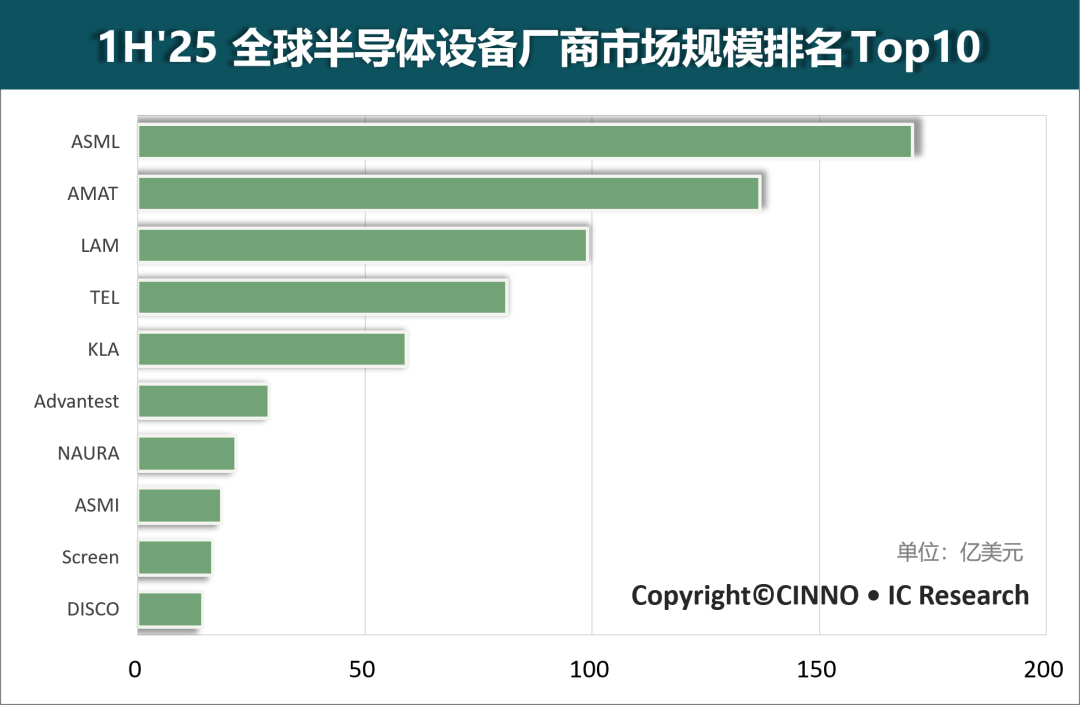
Core Insights - The global semiconductor equipment market is projected to exceed $64 billion in revenue for the top 10 manufacturers in the first half of 2025, reflecting a year-on-year growth of approximately 24% [1] - ASML remains the leading company in the semiconductor equipment sector, with an estimated revenue of $17 billion in the first half of 2025, followed by Applied Materials (AMAT) at $13.7 billion [1] - North Huachuang is the only Chinese semiconductor equipment manufacturer in the top 10, ranking seventh in the first half of 2025, up from eighth in 2024 [1] Company Performance - ASML, the world's largest lithography equipment manufacturer, reported a 38% year-on-year increase in semiconductor business revenue for the first half of 2025 [1] - Applied Materials (AMAT) experienced a 7% year-on-year growth in semiconductor business revenue in the first half of 2025 [2] - Lam Research (LAM) saw a 29% increase in semiconductor business revenue during the same period [2] - Tokyo Electron (TEL) reported a 10% year-on-year growth in semiconductor business revenue [2] - Advantest achieved a remarkable 124% increase in semiconductor business revenue [2] - North Huachuang's semiconductor business revenue grew by 31% in the first half of 2025 [2] - ASM International (ASMI) reported a 28% year-on-year growth in semiconductor business revenue [3] - Disco experienced a 13% increase in semiconductor business revenue [3] Industry Outlook - SEMI predicts that the total sales of semiconductor manufacturing equipment will reach a record $125.5 billion in 2025, representing a year-on-year growth of 7.4% [3] - The semiconductor equipment sales are expected to continue expanding in 2025 and reach new highs in 2026, driven by demand for AI-driven chip innovations [3] - China, Taiwan, and South Korea are projected to remain the top three regions for semiconductor equipment spending through 2026, with China leading the way [3]

CINNO:2025年上半年全球半导体设备商半导体业务Top10营收合计超640亿美元
智通财经网· 2025-09-16 13:06
Core Insights - The global semiconductor equipment market is projected to exceed $64 billion in revenue for the top 10 companies in the first half of 2025, representing a year-on-year growth of approximately 24% [1] - The top five companies in the semiconductor equipment sector remain unchanged from 2024, with ASML leading at approximately $17 billion in revenue for 1H25 [1][5] - North Huachuang is the only Chinese company in the top 10, ranking seventh with approximately $2.2 billion in revenue for 1H25, down from sixth in 2024 [1][11] Summary by Company - **ASML (Netherlands)**: The leading photolithography equipment manufacturer, with 1H25 semiconductor revenue growing by 38% [5] - **Applied Materials (AMAT, USA)**: The largest semiconductor equipment supplier, with a 7% year-on-year revenue increase in 1H25 [6] - **Lam Research (LAM, USA)**: Specializes in semiconductor manufacturing equipment, achieving a 29% revenue growth in 1H25 [7] - **Tokyo Electron (TEL, Japan)**: Japan's largest semiconductor equipment company, with a 10% revenue increase in 1H25 [8] - **KLA (USA)**: A leader in semiconductor process control and measurement equipment, with a 27% revenue growth in 1H25 [9] - **Advantest (Japan)**: Focuses on semiconductor testing equipment, with a remarkable 124% revenue growth in 1H25 [10] - **North Huachuang (NAURA, China)**: The leading semiconductor equipment manufacturer in mainland China, with a 31% revenue growth in 1H25 [12] - **ASM International (ASMI, Netherlands)**: Engaged in semiconductor deposition equipment, with a 28% revenue increase in 1H25 [13] - **Screen Holdings (Japan)**: Involved in semiconductor and PCB manufacturing equipment, with a 2% revenue growth in 1H25 [14] - **Disco (Japan)**: A leading manufacturer of wafer cutting equipment, achieving a 13% revenue growth in 1H25 [15]
爱德万测试市值20年来首超Tokyo Electron
日经中文网· 2025-09-11 03:09
Core Viewpoint - The valuation of semiconductor equipment manufacturers is changing due to advancements in manufacturing technology and the rise of generative AI, leading to increased investment in companies like Advantest, which has recently surpassed Tokyo Electron in market capitalization for the first time in 20 years [2][4]. Group 1: Market Dynamics - Advantest's market capitalization exceeded 10 trillion yen for the first time, reaching approximately 10.0556 trillion yen, surpassing Tokyo Electron's 9.975 trillion yen [4]. - The shift in focus from "front-end" to "back-end" processes in semiconductor manufacturing is influencing investor preferences, with Advantest benefiting from this trend [6]. - The demand for testing equipment is increasing as semiconductor manufacturing becomes more complex, making yield improvement crucial for manufacturers [7]. Group 2: Company Performance - Advantest's stock price has surged, increasing 2.7 times from the end of 2023, while Tokyo Electron has faced challenges, including a significant 18% downward revision of its net profit forecast for fiscal year 2025 [8]. - Advantest has captured a 58% market share in the testing equipment market, while Tokyo Electron's market share in other segments is only 20-30% [8]. - Concerns over Tokyo Electron's relationship with TSMC due to a former employee's alleged misconduct have added pressure to its stock price [8]. Group 3: Future Outlook - Analysts believe Advantest's stock price advantage will continue, with a projected price-to-earnings ratio (PER) of around 43, which is considered reasonable given the expected expansion of the AI market [9]. - Comparatively, global leaders like ASML and Applied Materials have significantly higher market capitalizations, indicating that Advantest must continue to enhance its performance to close the gap [9].

芯片设备公司,冰火两重天
半导体行业观察· 2025-08-19 01:24
Core Insights - The profitability of top chip equipment manufacturers is diverging, with some losing momentum due to declining sales in China, while others are capitalizing on the demand for AI chips [2][5] - Among ten manufacturers from Japan, the US, and Europe, five reported a year-on-year decline in net profit or lower growth compared to the previous year [2] - The combined net profit of these manufacturers has remained robust, growing approximately 40% for the fifth consecutive quarter, reaching $9.4 billion [2] Group 1: Company Performance - Lam Research's net profit surged by 69%, driven by strong sales of deposition and etching equipment for high-bandwidth memory and advanced logic chips [2] - KLA's net profit increased by 44%, benefiting from growth in inspection and measurement equipment for advanced packaging [2] - ASML Holding, ASM International, and Advantest also reported higher profit growth compared to the same period in 2024 [2] Group 2: Challenges Faced - Tokyo Electron, Screen Holdings, and Teradyne experienced declines in net profit after significant growth of over 50% to 90% in the previous year [5] - A major factor for the decline is the slowdown in sales to China, with nine companies reporting a combined sales drop of 5% to $9.3 billion, accounting for 30% of total sales, down from approximately 40% at the end of 2023 [5] - Tokyo Electron's sales from China accounted for 39%, a decrease of 11 percentage points from the previous year, and growth in its Taiwan business could not compensate for this loss [5] Group 3: Market Outlook - Despite the challenges, five US and European companies expect sales growth in the upcoming quarter, with four Japanese companies also projected to achieve revenue growth [6] - The industry faces uncertainty as Washington considers imposing new semiconductor tariffs and restricting AI semiconductor exports [6] - The total market capitalization of the top ten semiconductor equipment manufacturers is approximately $910 billion, down about 20% from the latest peak in July 2024 [7]

台积电2nm芯片技术流向东京电子公司,日企高层紧急赴台请罪。(看看新闻)
Xin Lang Cai Jing· 2025-08-09 19:26
Core Insights - TSMC's 2nm chip technology is being transferred to Tokyo Electron, indicating a significant collaboration between the two companies [1] - Executives from Tokyo Electron have urgently traveled to Taiwan to apologize, suggesting potential issues or miscommunications regarding the technology transfer [1] Group 1 - TSMC is advancing its chip technology by moving to 2nm, which is a critical step in semiconductor development [1] - The collaboration with Tokyo Electron highlights the importance of partnerships in the semiconductor industry [1] - The urgent visit by Tokyo Electron's executives indicates the high stakes involved in this technology transfer [1]

Tokyo Electron: Weak Short-Term Trends Mask Medium-Term Opportunities
Seeking Alpha· 2025-08-09 11:08
Group 1 - The focus is on identifying and analyzing companies that can play a significant role in today's geopolitics and leverage their intellectual property to become future leaders [1] - The investment strategy targets growth companies, particularly in the mid-cap segment, with a focus on sectors such as biotechnology, computer chips, cloud technology, energy, and commodities [1] - A systematic balance sheet analysis will be conducted, as many growing businesses often struggle with funding, while a stress test will be employed to evaluate the safety of each business model [1] Group 2 - Long-term capital appreciation is prioritized over short-term speculation, indicating a strategic investment approach [1] - The analyst has a background in communication and an MBA, enhancing the depth of analysis provided [1] - The analyst aims to provide extensive coverage on the relevant themes and welcomes feedback to improve the quality of insights shared [1]