TEL(TOELY)

Search documents
刚刚,日本股汇“双杀”!
Shang Hai Zheng Quan Bao· 2025-11-18 04:26
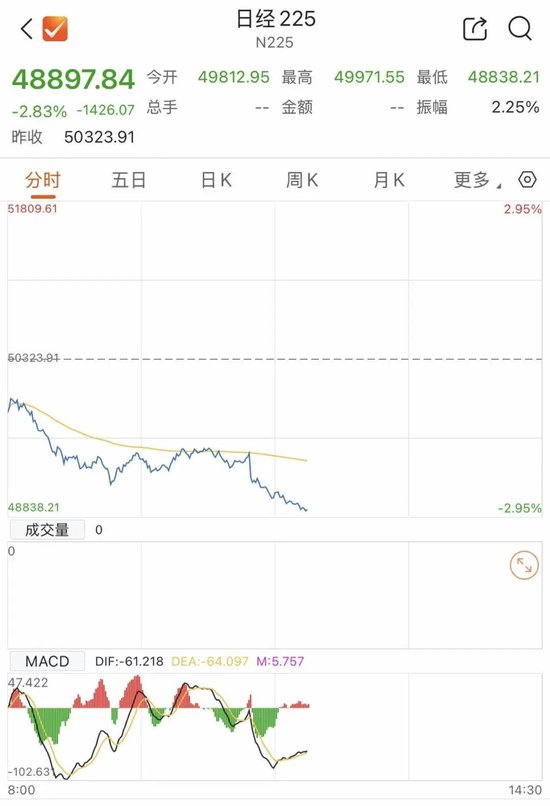
Group 1 - The Japanese stock market experienced a significant decline, with the Nikkei 225 index falling below 49,000 points, down over 1,400 points, representing a drop of 2.83% [1] - The Japanese yen continued its weakening trend, with the euro to yen exchange rate surpassing 180 for the first time since 1999, driven by concerns over Japan's deteriorating fiscal situation [3] - Political tensions arising from provocative statements by Japanese Prime Minister Suga Yoshihide regarding Taiwan have negatively impacted consumer sentiment, leading to declines in major companies such as SoftBank Group, Tokyo Electron, and Nintendo [5] Group 2 - Analysts express concerns that deteriorating Japan-China relations could further impact Japan's economy, which is already facing downward pressure, potentially leading to negative growth in the fourth quarter [7] - The South Korean stock market also saw a significant drop, with the KOSPI index declining over 3% [7]


东京电子股价下跌4.4%
Mei Ri Jing Ji Xin Wen· 2025-11-14 06:17
Core Viewpoint - Tokyo Electron's stock price has decreased by 4.4% as of November 14 [1] Group 1 - The decline in stock price indicates potential market concerns regarding Tokyo Electron's performance or external factors affecting the semiconductor industry [1]
Asian Shares Mixed As Tech Stocks Drag
RTTNews· 2025-11-12 08:40
Market Overview - Asian stocks ended mixed amid concerns about a potential AI-driven market bubble and signs of a weakening U.S. labor market [1] - Oil prices drifted lower after a recent gain, while China's Shanghai Composite index finished marginally lower as investors refocused on economic fundamentals [2] - Hong Kong's Hang Seng index surged 0.85% following the People's Bank of China's commitment to maintain an "appropriately loose" monetary policy [3] Company Performance - Sony Group shares increased by 3.7% after raising its profit outlook, while SoftBank Group and Tokyo Electron saw declines of 3.5% and 1.6% respectively [4] - In South Korea, the Kospi index rose 1.07%, driven by gains in auto and energy stocks, with Hyundai Motor and SK Innovation rising by 2.4% and 3.4% respectively [4] - Australian markets ended lower, with the S&P/ASX 200 dipping 0.22% as investors expressed concerns over high tech valuations, while Commonwealth Bank of Australia fell 3.1% due to margin pressure warnings [5] Economic Indicators - New Zealand's S&P/NZX 50 index rose 0.49% to a record high, reflecting positive market sentiment [6] - U.S. stocks ended mixed, with the Dow rising 1.2% to a record close amid expectations of an end to the government shutdown, while the tech-heavy Nasdaq Composite fell 0.3% [7] - A report indicated that private employers in the U.S. shed an average of 11,250 jobs per week in the four weeks ending October 25, signaling a deteriorating labor market [6]


Japan's Nikkei retreats as traders take profits after tech rally
The Economic Times· 2025-11-11 07:21
Market Overview - The Nikkei share average closed down 0.14% at 50,842.93 after reaching a one-week high of 51,513.16 earlier in the day, which was a rise of 1.18% [1][6] - The broader Topix index gained 0.13% to finish at 3,321.58 [2][6] AI Sector Performance - Artificial intelligence-related shares were the primary drivers of the Nikkei's early gains, following a rally in Wall Street tech stocks amid optimism for an end to the U.S. government shutdown [2][6] - SoftBank Group, an AI-focused startup investor, initially surged by 5.55% before closing with a gain of 1.98% after announcing a 4-for-1 stock split and net profit that exceeded analyst expectations [5][6] Investor Sentiment - The afternoon trading session saw a decline in momentum, with the Nikkei index dropping as much as 0.65% at one point, as some traders opted to lock in profits [4][6] - Maki Sawada, a strategist at Nomura Securities, noted that there was "no single, big driving force" for stock gains, indicating a cautious sentiment among investors [4][6] Component Performance - On the day, 117 of the 225 components of the Nikkei index declined, while 105 rose and three remained flat [5][6] - Sony Group experienced a significant increase of 5.51% after reporting strong earnings during the midday trading recess [6] - Chip-making machinery manufacturer Tokyo Electron and chip-testing equipment maker Lasertec ended the day flat after shedding early gains, while Advantest saw a decline of 4.08% [6]

Asian shares sink after losses for Big Tech pull US stocks lower
BusinessLine· 2025-11-05 06:09
Market Overview - Tokyo's Nikkei 225 index fell over 4% amid a broader decline in Asian markets following a retreat on Wall Street, primarily driven by selling in Big Tech shares [1] - The Nikkei index was down 2.8% by mid-afternoon, closing at 50,090.33 [1] Company Performance - SoftBank Group's shares dropped 9.8% due to concerns over its investments in artificial intelligence [2] - Tokyo Electron and Advantest Corp. saw declines of 4.1% and 7.2% respectively, reflecting negative sentiment in the tech sector [2] - Palantir Technologies fell 7.9% despite beating analysts' forecasts, indicating market volatility [5] - Nvidia and Microsoft also experienced declines of 4% and 0.5% respectively, contributing to the overall downturn in the tech sector [5] - Uber's stock slumped 5.1% despite reporting better-than-expected financial results, highlighting a disconnect between earnings and stock performance [6] Sector Analysis - The technology sector, which has been a significant driver of market gains this year, is facing pressure due to heavy selling on Wall Street [3] - The S&P 500 index fell 1.2% to 6,771.55, although it remains up over 15% for the year [5] - The Dow Jones Industrial Average decreased by 0.5% to 47,085.24, while the Nasdaq fell 2% to 23,348.64, indicating a broader market trend [6] Economic Context - The upcoming financial results from major companies like McDonald's, Expedia Group, and Qualcomm are expected to be significant for market direction amid a US government shutdown [7] - Consumer prices rose 3% in September, the highest increase since January, complicating the Federal Reserve's interest rate policy decisions [8] Other Notable Movements - Tesla's shares fell 5.1% after Norway's sovereign wealth fund announced it would vote against a proposed compensation package for CEO Elon Musk [9] - Yum Brands' stock jumped 7.3% following news of a potential sale of its struggling Pizza Hut unit [10] - Novo Nordisk's shares slipped 1.8% after raising its offer to acquire Metsera, which surged 20.5% amid a bidding war with Pfizer, which fell 1.5% [10]


日本东京电子股价涨7% 创下自10月6日以来的最大单日涨幅
Mei Ri Jing Ji Xin Wen· 2025-11-04 00:22
Core Viewpoint - Tokyo Electron's stock price increased by 7% on November 4, marking the largest single-day gain since October 6 [1] Company Summary - The stock price surge indicates strong market performance and investor confidence in Tokyo Electron [1]
Tokyo Electron Limited GAAP EPS of ¥525.62, revenue of ¥1179.67B; updates FY outlook
Seeking Alpha· 2025-10-31 08:50
Group 1 - The article does not provide any relevant content regarding company or industry insights [1]
暴涨1600点,日本股市突然引爆
Zheng Quan Shi Bao· 2025-10-20 11:17
Market Performance - The Japanese stock market experienced a significant surge, with the Nikkei 225 index rising over 1600 points, marking a historic high by surpassing 49000 points, with a daily increase of over 3% [1][3] - As of the afternoon close, the Nikkei 225 index stood at 49185.5 points, reflecting a 3.37% increase from the previous trading day [3] Political Developments - The Liberal Democratic Party (LDP) and the Japan Innovation Party are set to sign a coalition agreement, indicating that Fumio Kishida is likely to win the prime ministerial election on October 21 [1][6] - Analysts suggest that the reduction of political uncertainty has positively impacted the Japanese stock market, with expectations that Kishida will implement low-interest rates and increased government spending [1][6] Sector Performance - The semiconductor sector saw collective gains, with Kioxia Holdings rising nearly 9%, LASERTEC up over 5%, and Tokyo Electron increasing by over 4% [5] - Financial stocks also performed well, with Mizuho Financial Group rising over 6%, and Chiba Bank and Sumitomo Mitsui Financial Group both up over 4% [5] - Electrical machinery stocks showed strength, with Yaskawa Electric up over 7%, Fanuc increasing by over 6%, and Fuji Electric rising nearly 4% [5] Economic Policy Outlook - Kishida is viewed as a proponent of "Abenomics," advocating for expansionary fiscal policies aimed at doubling Japan's economic scale within ten years, which includes tax cuts, economic stimulus, and government investment [6] - Kishida emphasized the need for collaboration between the government and the central bank to ensure demand-driven growth supported by rising wages and corporate profits [6] Monetary Policy Implications - Market participants believe Kishida's victory may introduce uncertainty regarding monetary policy, potentially delaying interest rate hikes by the Bank of Japan until new government policies are clearer [7] - The Bank of Japan Governor has indicated that various data will be considered before deciding on interest rate changes, emphasizing the importance of global economic conditions [9][10]


设备巨头,冲向1纳米
半导体芯闻· 2025-10-15 10:47
Core Viewpoint - Tokyo Electron is advancing its semiconductor manufacturing equipment capabilities with a new R&D building in Kumamoto, aiming to lead in next-generation semiconductor technology with a target of achieving a 1-nanometer process [1][2]. Group 1: Investment and Infrastructure - The new R&D facility in Kumamoto has a total investment of approximately 47 billion yen and covers an area of about 27,000 square meters, expected to be operational by spring 2026 [2]. - The R&D capacity of the new facility will be four times that of the previous level, featuring clean rooms that simulate the latest semiconductor manufacturing environments [2]. Group 2: Technology and Market Position - Tokyo Electron specializes in the development and manufacturing of Coater-Developer equipment, which is critical for applying photoresist materials on silicon wafers, holding a de facto monopoly in the advanced process field [3]. - The company is collaborating with ASML and imec to push the boundaries of semiconductor technology, aiming to overcome physical limits as the industry approaches the challenges posed by Moore's Law [4]. Group 3: Strategic Development and Environmental Focus - Tokyo Electron is enhancing its global R&D network to maintain close cooperation with semiconductor manufacturers, focusing on technology development over the next 10 to 15 years [5]. - The company is also prioritizing research in reducing chemical and water usage, as well as energy consumption, to lower the manufacturing costs of advanced semiconductors [5]. - Despite holding a leading position in the front-end semiconductor manufacturing processes, competition in the etching equipment sector is intensifying, prompting the company to strengthen its R&D capabilities [6].

芯片设备,产能过剩
半导体芯闻· 2025-10-13 10:26
Core Insights - The semiconductor industry is at a unique intersection of opportunities and uncertainties, driven by technological advancements and geopolitical factors affecting equipment procurement [1][3][6] - The WFE market is projected to reach $184 billion by 2030, with equipment shipments at $151 billion and service shipments at $33 billion, reflecting a stable growth trajectory despite challenges [1][15] Market Dynamics - The semiconductor industry is currently facing significant overcapacity, with foundries and IDMs experiencing low utilization rates and squeezed profitability, yet equipment investments continue [3][6] - Geopolitical factors are leading to redundant construction of fabs as regions seek to strengthen local manufacturing ecosystems, ensuring ongoing demand for WFE tools [6][15] Competitive Landscape - The market remains highly concentrated, with the "Big Five" companies—ASML, Applied Materials, Lam Research, Tokyo Electron, and KLA—projected to hold nearly 70% of the market share by 2024 [7][8] - This concentration reflects the capital intensity, technical expertise, and long-term relationships required to serve leading chip manufacturers, creating significant barriers to entry [9] Equipment Segmentation - In 2024, patterning equipment will dominate the market with a 26.5% share, followed by deposition, etching, cleaning, and measurement [9][12] - The compound annual growth rates (CAGRs) for various equipment segments from 2024 to 2030 are as follows: - Patterning: +4.7% - Etching and Cleaning: +5.5% (fastest growth) - Deposition: +4.0% - Measurement and Inspection: +4.3% - CMP: +4.3% - Ion Implantation: +2.0% (slowest growth) - Wafer Bonding: +10.4% (fastest in a smaller segment) [12] Innovation Drivers - The evolution of semiconductor devices is driving corresponding innovations in the WFE sector, with a focus on providing integrated process solutions that meet the changing demands of the industry [14][19] - Key innovations from 2024 to 2030 will include multifunctional, modular equipment architectures that can be reconfigured for various process needs [14][19] Future Outlook - The WFE market is expected to grow to $184 billion by 2030, supported by stable CAGRs of 4-5% in both equipment and services, with market leadership remaining concentrated among the "Big Five" [15][19] - The ongoing competition and technological advancements will continue to shape the market, particularly in patterning and deposition technologies, as well as emerging areas like wafer bonding and advanced packaging [15][19]