Uber(UBER)

Search documents
Lucid (LCID) - 2025 Q2 - Earnings Call Transcript
2025-08-05 22:32
Financial Data and Key Metrics Changes - The company reported revenue of $259 million in Q2 2025, a 29% increase year over year [30] - Vehicle deliveries reached 3,309 units, up 38% year over year, marking the sixth consecutive quarter of record deliveries [5][30] - Gross margin for the quarter was negative 105%, primarily due to a $54 million impact from tariffs, which accounted for a 21 percentage point decrease in gross margin [31] - Adjusted EBITDA was negative $632 million, down 12%, driven mainly by gross margin pressure [33] - The company ended the quarter with $3.6 billion in cash and investments, and total liquidity of $4.86 billion [34] Business Line Data and Key Metrics Changes - The company produced 3,863 vehicles in Q2 2025, an 83% increase year over year [6][30] - The Lucid Gravity vehicle is expected to be the majority of deliveries in the second half of the year, with production ramping up [61] Market Data and Key Metrics Changes - The company is navigating a volatile market environment, with ongoing challenges in the AAV sector, particularly in supply chain [30][34] - The company has updated its annual production guidance to a range of 18,000 to 20,000 vehicles for 2025 [36] Company Strategy and Development Direction - The company is focused on operational discipline, building a distinctive scalable brand, and maintaining a sustainable edge through technology [10] - A partnership with Uber was announced, involving a $300 million investment to support the development of a next-generation premium robotaxi [7][28] - The company plans to implement a one-for-ten reverse stock split to ensure equity remains accessible to institutional investors [29] Management Comments on Operating Environment and Future Outlook - Management acknowledged challenges in production due to supply chain issues but expressed confidence in overcoming these obstacles [12][13] - The company is committed to building a great business around its products, focusing on innovation, scaling responsibly, and maintaining capital discipline [25][37] Other Important Information - The company is expanding its brand awareness through partnerships with cultural figures, including Timothee Chalamet as a global brand ambassador [9][10] - The company is also working on enhancing its technology, including a software update for its advanced driver assist system [19] Q&A Session Questions and Answers Question: How many current Gravity orders are there? - The company does not disclose specific order numbers but noted a high conversion rate once customers experience the vehicle [39] Question: Is the midsize platform still on target for production in late 2026? - The midsize platform is still scheduled for production in late 2026, with deliveries expected to ramp up throughout 2027 [40][41] Question: How will the partnership with Uber aid in company growth? - The partnership is seen as an entry into a large market and validates the company's scalable platform [42] Question: Should we expect any changes to the midsize initial ASPs as they ramp up? - There are no expectations for changes to the initial ASPs of the midsize platform [44][46] Question: Can you provide an update on the Atlas powertrain? - The Atlas powertrain is on track to achieve the same efficiency or better at a lower cost [56] Question: How much do write-downs on inventories and losses on firm purchase commitments relate to tariffs? - The tariff impact in Q2 was approximately $55 million, with expectations for reimbursements later in the year [77][81]


Waymo's Expansion Spooks Uber — Is Lyft The Smarter AV Play?
Benzinga· 2025-08-05 15:19
Core Viewpoint - The announcement of Waymo's robotaxi rollout in Dallas without Uber has raised concerns among investors, leading to a decline in Uber's stock, while Lyft continues to pursue a strategic partnership approach in the autonomous vehicle (AV) space [1][2]. Group 1: Company Strategies - Uber has historically relied on partnerships with companies like Waymo and GM Cruise to integrate robotaxis into its platform, but the recent exclusion from Waymo's Dallas expansion has created uncertainty [1][5]. - Lyft is adopting a more diversified partnership strategy, collaborating with Mobileye, May Mobility, Marubeni, and Baidu to establish its AV future, with planned rollouts in Dallas, Atlanta, and Europe [3][6]. - Lyft's establishment of the Driver Autonomous Forum in Atlanta indicates a long-term, inclusive approach to planning its AV rollout, leveraging experienced drivers for insights [4]. Group 2: Investment Considerations - Uber's market position is characterized by strong brand recognition but is vulnerable to being sidelined by Waymo, which could impact investor confidence [5]. - Lyft's leaner operational model and diversified partnerships may build greater trust among investors, presenting a more balanced risk profile as it scales its AV deployment [5][6]. - As the robotaxi market matures, Lyft's methodical approach could offer potentially higher rewards for investors compared to Uber's reliance on a single partner [6].



马斯克出手,打车费爆砍84%,Robotaxi要革Uber的命
3 6 Ke· 2025-08-05 11:27
Core Viewpoint - Tesla's Robotaxi service is set to cover half of the U.S. population by the end of this year, with significant cost advantages over Uber, demonstrating a revolutionary shift in the ride-hailing industry [1][16]. Cost Comparison - A user in Austin conducted tests comparing Tesla Robotaxi and Uber, finding that Tesla's fares were significantly lower, with discounts of up to 84% in some cases [2][6]. - For example, a nearly 9-mile trip cost $9.92 with Tesla compared to $30.38 with Uber, a difference of 67% [3][4]. Pricing Mechanism - Tesla's pricing strategy has shifted from a flat rate to a dynamic pricing model based on distance and demand, yet it remains competitive, averaging $1–$1.3 per mile compared to Uber's $1.5–$2 per mile [8][9]. - Uber's pricing includes hidden costs such as surge pricing and driver tips, which further inflate the total fare [8][10]. Cost Structure Revolution - Tesla eliminates the largest cost component—human drivers—by integrating the vehicle, platform, and driver into a fully automated system [9][12]. - Traditional ride-hailing services like Uber rely on a model where driver income constitutes about 70% of the fare, leading to inefficiencies [10][11]. Operational Efficiency - Tesla's Robotaxi operates at a cost of approximately $0.60 per mile, which could drop to $0.40 with higher automation levels [13][14]. - The potential profit margins are substantial; for instance, if Tesla charges $1 per mile and operates 80,000 miles annually, each vehicle could generate $48,000 in profit [15]. Market Impact - If successful, Tesla's Robotaxi could disrupt traditional ride-hailing platforms, potentially covering 167 million people in the U.S. by the end of 2024 [16][17].

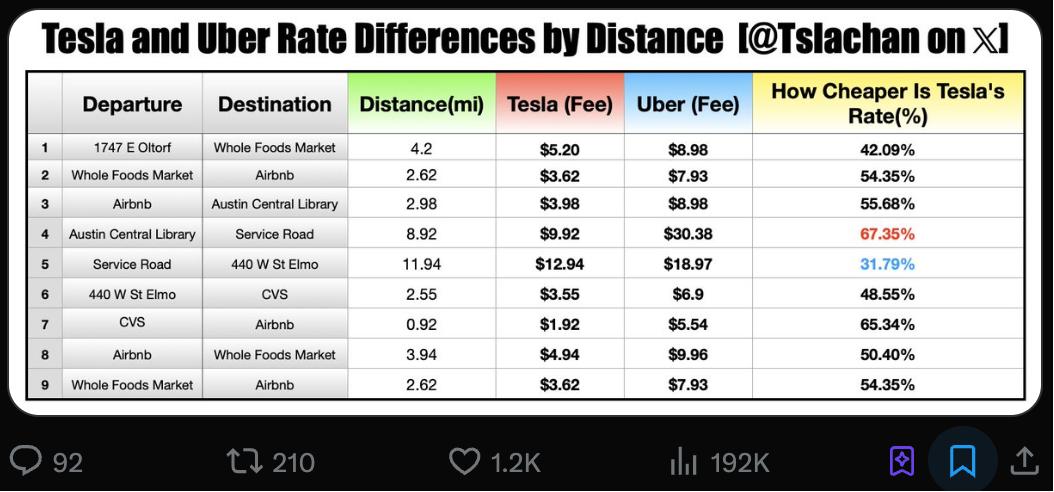
1家1000辆,百度联手Lyft、Uber推动Robotaxi全球化
3 6 Ke· 2025-08-05 01:05
联手Uber之后,百度又和另一家网约车国际巨头Lyft达成了合作。 8月4日,百度官方宣布旗下萝卜快跑与网约车平台Lyft达成战略合作,萝卜快跑将通过Lyft平台在欧洲提供无人驾驶出行服务。 双方计划于2026年率先在德国和英国部署萝卜快跑第六代无人车,并在欧洲市场逐步扩大规模至数千辆,实现无人驾驶规模化落地。 这是近期萝卜快跑又一个重大国际化举措。 7月15日,百度宣布,和与全球最大的出行平台Uber达成战略合作,在全球多个市场部署数千台无人驾驶汽车。 不过,两项合作的初始合作目标市场不同。与Uber的合作,重点是亚洲和中东地区;与Lyft的合作,目标先是英国和德国,最终目标是欧洲。 2022年之前,Lyft能在全球网约车平台中排名第二,仅次于Uber。但是,滴滴凭借庞大的中国市场跻身第二之后,Lyft退居第三。但在北美市场,Lyft是仅 次于Uber的存在。 此次百度与之联手开拓欧洲,对于Lyft也是重大挑战。Lyft此前在欧洲并没有多少"地盘"。但是,4月份,Lyft收购了德国网约车平台 FreeNow。 FreeNow并不知名,但也是出自名门,是宝马和奔驰联手创建的出行平台。FreeNow给了Lyft ...

Uber Eats Debuts AI Features for Restaurants
PYMNTS.com· 2025-08-04 19:28
Uber Eats has debuted a series of artificial intelligence (AI) features for restaurants.By completing this form, you agree to receive marketing communications from PYMNTS and to the sharing of your information with our sponsor, if applicable, in accordance with our Privacy Policy and Terms and Conditions .Complete the form to unlock this article and enjoy unlimited free access to all PYMNTS content — no additional logins required.The new offerings, introduced last week, allow restaurants to use AI to analyz ...
Why This Analyst Thinks Uber Is Set For A Strong Q2
Benzinga· 2025-08-04 16:31
Core Viewpoint - BoA Securities analyst Justin Post maintains a Buy rating on Uber Technologies Inc with a price target of $115, citing strong performance expectations ahead of the second-quarter earnings report [1] Financial Projections - The second-quarter gross bookings forecast has been raised to $47.1 billion, which is 2% above the consensus estimate of $46.4 billion. Revenue and adjusted EBITDA projections are set at $12.56 billion and $2.12 billion, respectively, both slightly above consensus [2] - Constant currency bookings growth is expected to be 19% year-over-year, ahead of the 18% consensus, driven by increased U.S. consumer spending and improved international results due to favorable foreign exchange conditions [2] Mobility Segment - In the Mobility segment, a 20% year-over-year constant currency growth is projected, consistent with first-quarter trends, supported by increasing transit spending [3] - Despite weak U.S. travel demand, a recovery is anticipated in the second half of 2025, which is expected to bolster future growth [3] - Uber's expanding autonomous vehicle ecosystem, including partnerships with Lucid Group, Nuro, Baidu, and Wayve, is gaining traction, particularly in Atlanta and Austin [3] Delivery Segment - For the Delivery segment, a 19% year-over-year growth is forecasted, slightly accelerating from the first quarter, attributed to strong adoption of Uber One and new perks launched in the second quarter [4] - The Advertising business is also showing strength, with a 60% year-over-year growth in the first quarter [4] - The upcoming acquisition of Trendyol GO in Turkey is expected to contribute to Delivery growth once finalized in the second half of 2025 [5] Future Outlook - Third-quarter bookings are projected to be in the range of $47.25 billion to $48.75 billion, indicating a 17% year-over-year growth at the midpoint, with EBITDA forecasted between $2.26 billion and $2.36 billion [5] - For the full year 2025, estimates have been raised to $190 billion in gross bookings, $51.1 billion in revenue, and $8.62 billion in EBITDA, all exceeding Street expectations [6] Valuation Perspective - Despite a 44% year-to-date stock gain, Uber's valuation remains attractive, trading at 17 times EV/EBITDA compared to its four-year average of 22 times and 18 times free cash flow, significantly lower than FANG peers at 43 times [7] - An expected bottom-line growth rate of 26% for 2026 is projected, compared to 19% for FANG, indicating potential for upside [7]
Will Gross Bookings Growth Lift UBER's Q2 Earnings Results?
ZACKS· 2025-08-04 15:26
Core Insights - Uber Technologies (UBER) is set to release its Q2 2025 results on August 6, with gross bookings being a critical performance metric [1] - The company has consistently beaten earnings estimates in the past four quarters, averaging a surprise of 212.3% [1] Q1 2025 Highlights - Uber reported mixed results for Q1 2025, with earnings per share of 83 cents surpassing the Zacks Consensus Estimate of 51 cents, while total revenues of $11.5 billion fell short of the estimate of $11.6 billion [2] - The revenue increased by 14% year-over-year on a reported basis and 17% on a constant currency basis [2] Revenue Breakdown - Mobility segment contributed 56.3% of total revenues, with a year-over-year increase of 15% on a reported basis and 18% on a constant currency basis, totaling $6.49 billion [3] - Delivery segment revenues rose by 18% year-over-year on a reported basis and 22% on a constant currency basis to $3.77 billion, driven by increased delivery gross bookings and advertising revenues [4] - Total gross bookings increased by 14% year-over-year on a reported basis and 18% on a constant currency basis to $42.81 billion, aligning with the guided range of $42-$43.5 billion [4] Q2 2025 Gross Bookings Outlook - Gross bookings for Q2 2025 are expected to be between $45.75 billion and $47.25 billion, indicating a growth of 16-20% on a constant currency basis compared to Q2 2024 [5] - The estimated gross bookings for Q2 2025 is $46.23 billion, slightly below the midpoint of the guidance [5] - Management anticipates a 1.5 percentage point impact from currency headwinds, with Mobility segment gross bookings expected to be $23.8 billion (16% growth) and Delivery segment gross bookings projected at $21.1 billion (16.4% growth) [6] Earnings and Revenue Estimates - The Zacks Consensus Estimate for Q2 2025 earnings is 62 cents per share, compared to 47 cents per share reported in Q2 2024 [8] - The consensus estimate for sales is $12.46 billion, reflecting a year-over-year increase of 16.41% [9] Competitive Landscape - Lyft (LYFT), a key competitor, is also set to report Q2 2025 results on August 6, with an Earnings ESP of 0.00% and a Zacks Rank 4 [11] - DoorDash (DASH), another competitor, has an Earnings ESP of +3.03% and a Zacks Rank 1, with a consensus revenue estimate of $3.16 billion, indicating a year-over-year growth of 20.3% [13][14]

Navigating the Robotaxi Revolution: Uber, Lyft, EPS Preview
ZACKS· 2025-08-04 14:35
Group 1: Market Overview - Uber Technologies and Lyft dominate the American rideshare market, with Uber holding approximately 75% of the market share and expanding into food delivery through Uber Eats [1] - Lyft primarily focuses on ridesharing but has also ventured into bike and scooter rentals [1] Group 2: Earnings Information - Uber is set to report earnings on August 6, with a consensus EPS estimate of $0.62, reflecting a year-over-year increase of over 31% from $0.47 [2] - Analysts forecast Uber's revenue to be around $12.46 billion, indicating a year-over-year growth of over 16% from $10.7 billion in Q2 2024 [2] - Lyft will also report earnings on August 6, with a consensus EPS estimate of $0.27, compared to $0.03 in the same quarter last year [6] - Lyft's revenue is projected to be approximately $1.61 billion, representing a year-over-year increase from $1.44 billion reported in Q2 2024 [7] Group 3: Gross Bookings and Performance - Uber's guidance for Gross Bookings is projected between $45.75 billion and $47.25 billion, indicating a growth of 16-20% on a constant-currency basis [3] - Uber has surpassed consensus estimates in four of the past five quarters, with an average surprise of 212.26% [4][5] - Lyft has beaten consensus estimates in eight of the past nine quarters, with an average surprise of 24.19% [8][9] Group 4: Stock Performance - In 2025, Uber's stock has gained 44.1%, significantly outperforming Lyft's 5.6% increase [10] Group 5: Robotaxi Developments - The emergence of robotaxis presents both threats and opportunities for Uber and Lyft, with companies like Waymo and Tesla leading the charge in autonomous ride-hailing services [13] - Uber is forming partnerships with robotaxi leaders such as Waymo and Baidu, aiming to deploy 20,000 new robotaxis by 2032 [14] - Lyft is adopting an asset-light model, partnering with Mobileye for autonomous ride-hailing services [15] Group 6: Strategic Focus - Investors will be keen to see if Lyft can maintain profitability with its 'growth with discipline' strategy and how its European expansion is progressing [16] - Uber's aggressive approach in the robotaxi market will be a focal point for investors [16]

Uber's Autonomy Bet Could Quietly Redefine Its Future
The Motley Fool· 2025-08-04 11:15
Core Insights - Uber is transitioning from developing its own autonomous vehicle technology to becoming a platform that integrates with existing autonomous vehicle providers, focusing on software and demand aggregation rather than hardware [2][4][6] - The company's partnerships with leading AV companies like Waymo and Pony.ai allow it to offer autonomous ride-hailing services in major cities, enhancing its strategic positioning in the autonomous vehicle market [5][10] - Uber's shift towards autonomy could significantly improve its long-term profitability by reducing driver payouts, which currently account for around 70% of ride costs, thereby increasing margins as more rides transition to autonomous vehicles [8][9] Strategic Shift - Uber's original ambitious plan to develop self-driving technology was abandoned due to high capital and talent requirements, leading to the sale of its Advanced Technologies Group in 2020 [4] - The new strategy involves leveraging partnerships to deploy autonomous rides, which is seen as a more pragmatic and strategic approach [5][10] - By focusing on the rider experience and operational efficiencies, Uber aims to become the essential layer for AV providers, allowing it to benefit from the growth of the autonomous vehicle market without the associated risks [6][7] Expansion Beyond Ride-Hailing - Uber is also exploring robotic delivery services through partnerships with companies like Avride and Coco, targeting urban areas where delivery costs are high [11][12] - The use of delivery robots could significantly reduce last-mile costs and improve profitability for Uber Eats, as robots can operate more efficiently than human workers [13][14] - Additionally, Uber is piloting autonomous freight solutions, indicating its ambition to automate logistics from start to finish [15] Implications for Investors - Uber's focus on autonomy positions it for future growth, allowing it to profit regardless of which AV company succeeds [16] - By integrating closely with end users, Uber aims to remain a vital part of the transportation value chain, ensuring its relevance in a rapidly evolving market [16]
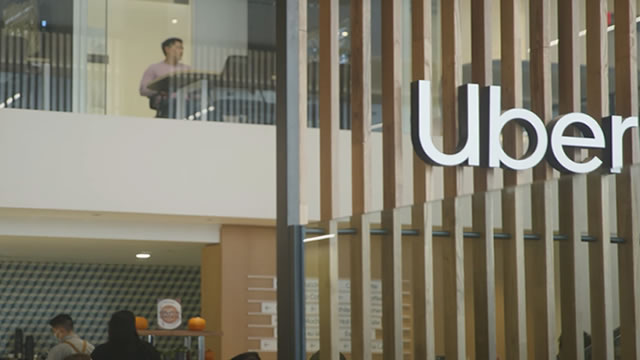
Buy or Sell Uber Technogies Stock Ahead of Earnings?
Forbes· 2025-08-04 10:15
Company Overview - Uber Technologies is set to announce its earnings on August 6, 2025, with a current market capitalization of $184 billion [2] - Over the past twelve months, Uber generated $45 billion in revenue, achieving operational profitability with $3.9 billion in operating profits and a net income of $12 billion [2] Historical Performance - In the last five years, Uber has recorded 19 earnings data points, with 10 positive and 9 negative one-day (1D) returns, resulting in a positive return rate of approximately 53% [5] - This positive return percentage increases to 58% when considering data from the last three years [5] - The median of the 10 positive returns is 6.2%, while the median of the 9 negative returns is -5.7% [5] Post-Earnings Return Strategy - A strategy to enhance returns involves analyzing the correlation between short-term (1D) and medium-term (5D) returns following earnings announcements [4][6] - If a positive 1D post-earnings return is observed, traders may consider taking a "long" position for the subsequent 5 days [6]