长电科技

Search documents
先进封装龙头积极抢滩布局,产业进入“扩产+提价”新阶段 | 投研报告
Zhong Guo Neng Yuan Wang· 2026-02-03 09:50
Core Insights - The semiconductor industry is experiencing a surge in demand for AI chips, leading to price increases of 5-20% by companies like ASE, while Taiwanese firms such as Powertech and Nan Ya are also raising prices by up to 30% due to full order books and near-capacity production [1][3] - TSMC has significantly raised its capital expenditure guidance for 2026 to between $52 billion and $56 billion, a 36.9% increase from 2025, with 10-20% allocated to advanced packaging and testing [2] - The demand for advanced packaging is expected to grow, with major companies like Changdian Technology and Tongfu Microelectronics actively expanding their production capacities to meet this demand [2][3] Industry Developments - The semiconductor packaging industry is seeing structural demand growth, particularly for AI and storage chips, which is tightening the capacity for standard storage chip packaging [3] - Rising prices of raw materials such as gold, silver, and copper are contributing to increased packaging costs, prompting packaging companies to raise prices to maintain profitability [3] - Companies are focusing on high-margin businesses and optimizing product structures in response to the favorable market conditions [3] Investment Recommendations - Investors are advised to focus on domestic companies actively investing in high-end advanced packaging, such as Changdian Technology and Tongfu Microelectronics, as well as the IPO progress of Shenghe Microelectronics [4] - Beneficiary stocks include Yongxi Electronics, Huatian Technology, Shenzhen Technology, and Huicheng Co., among others [4] - Equipment and materials beneficiaries include companies like Changchuan Technology, Jingzhida, and ASMPT, which are positioned to gain from the industry's growth [4]


半导体龙头ETF工银(159665)开盘涨1.46%,重仓股中芯国际涨1.39%,海光信息涨1.94%
Xin Lang Cai Jing· 2026-02-03 05:19
Group 1 - The semiconductor leading ETF, 工银 (159665), opened with a gain of 1.46%, priced at 2.010 yuan [1] - Key holdings in the ETF include 中芯国际 (up 1.39%), 海光信息 (up 1.94%), 寒武纪 (up 1.05%), 北方华创 (up 1.05%), 兆易创新 (up 3.75%), 中微公司 (up 2.41%), 澜起科技 (up 3.86%), 豪威集团 (up 1.49%), 拓荆科技 (up 2.02%), and 长电科技 (up 2.40%) [1] - The ETF's performance benchmark is the 国证半导体芯片指数收益率, managed by 工银瑞信基金管理有限公司, with a return of 97.89% since its inception on December 22, 2022, and a return of 10.68% over the past month [1]





重申看好先进封装-国产算力及CPU产业链
2026-02-03 02:05
Summary of Conference Call Notes Industry Overview - The semiconductor packaging and testing industry is entering a strong cycle, with price increases reported by both Taiwanese and mainland Chinese companies. Price hikes for storage packaging have started, with companies like Nanya increasing prices by 30%-40% and major players like ASE raising prices close to 20% [1][5][4]. Key Points on Advanced Packaging - Domestic companies are accelerating their positioning in advanced packaging, with 2026 expected to mark the transition from small-scale to large-scale production. Companies such as Changdian Technology, Tongfu Microelectronics, and others have made significant progress in 2.5D technology [1][6][8]. - The IPO of Shenghe Jingwei is anticipated to reshape the valuation system of the packaging and testing industry, with the company raising 8.4 billion yuan for the development of multi-chip integration packaging technology [1][8]. Domestic Computing Power - The domestic computing power sector is entering a period of intensive model releases, with companies like ByteDance launching new models that significantly drive demand for inference capabilities. ByteDance's average daily token consumption reached approximately 60 trillion in January, with a mid-term target of 180 trillion [1][10]. - Major cloud providers are shifting from single-card to super-node procurement strategies to enhance inference performance and cost-effectiveness, marking 2026 as a pivotal year for the domestic computing power industry [1][10]. CPU Market Trends - CPU demand continues to grow, driven by Microsoft's development of enterprise-level AI applications. The number of enterprise users spending over $1 million quarterly has increased by approximately 82%, with M365 new seat additions growing by 160% year-on-year [2][12]. - The transition to MRDIMM memory modules is noted, which are suitable for high-performance computing and AI applications, with peak bandwidth increasing by nearly 40% compared to standard DDR5 RDIMM [12]. Storage Market Dynamics - The storage market is experiencing robust growth, with contract prices exceeding expectations in Q1 and anticipated further increases in Q2. The strong demand in the storage industry has extended to the semiconductor packaging sector, with domestic packaging companies operating at full capacity [5][4]. Investment Recommendations - Recommended companies for investment include: - Advanced Packaging: Changdian Technology, Tongfu Microelectronics, and Huicheng Co. - Domestic Computing Power: Xinyuan Co. as a core beneficiary. - CPU-related: Guanghetong (PCB), Tongfu Microelectronics (PCB and memory interface chips), and others [9]. Additional Insights - The overall semiconductor packaging sector is in a strong cycle, with high capacity utilization and potential for further price increases. The advancements in 2.5D technology and the upcoming IPOs are expected to create significant investment opportunities [8][6].
2026年中国高带宽内存(HBM)行业政策、产业链、出货量、收入规模、竞争格局及发展趋势:行业正处于快速发展阶段,价值量占比在进一步提升[图]
Chan Ye Xin Xi Wang· 2026-02-03 01:28
Core Insights - The global High Bandwidth Memory (HBM) market is experiencing rapid growth, with shipments expected to increase from 1.5 billion gigabytes (GB) in 2023 to 5.7 billion GB by 2026, and revenues projected to rise from $4.35 billion in 2023 to $50 billion in 2026 [6][7][8]. HBM Industry Definition and Advantages - HBM is a high-performance semiconductor memory based on 3D stacking technology, offering high bandwidth and energy efficiency, primarily used in high-performance computing and networking applications [1][4]. - HBM has four main advantages over traditional DRAM: high bandwidth, high capacity, low power consumption, and small size [2][3]. HBM Industry Development Status - HBM technology is becoming a standard for AI acceleration cards (GPUs, TPUs, etc.), with its value share continuing to increase [4][6]. - The demand for HBM is driven by the needs of AI and high-performance computing, with significant growth expected in the coming years [6][10]. HBM Industry Chain - The HBM industry chain includes upstream materials (electrolytes, precursors, IC substrates) and semiconductor equipment (lithography machines, etching machines), with midstream focusing on HBM production and downstream applications in AI, data centers, and high-performance computing [8][9]. HBM Industry Competitive Landscape - The global HBM market is dominated by foreign manufacturers, with SK Hynix holding a 53% market share, followed by Samsung at 38% and Micron at 9% [14][15]. - Domestic companies in China, such as Changxin Memory, Changdian Technology, and others, are making significant progress in the HBM supply chain, aiming to increase local production capabilities [15][16]. HBM Industry Development Trends - HBM is positioned as a critical hardware component for AI and high-performance computing, with its unique 3D stacked structure providing superior bandwidth compared to traditional memory solutions [16][17]. - The future memory landscape will be heterogeneous, with HBM focusing on training scenarios, while other memory types will cater to specific workloads, creating a diverse memory ecosystem for the AI era [17].




芯片ETF(159995)开盘跌1.49%,重仓股中芯国际跌1.28%,海光信息跌1.68%
Xin Lang Cai Jing· 2026-02-02 16:37
Group 1 - The chip ETF (159995) opened down 1.49% at 1.980 yuan on February 2 [1] - Major holdings in the chip ETF include companies like SMIC, Haiguang Information, and Cambrian, with declines ranging from 0.47% to 4.47% [1] - The performance benchmark for the chip ETF is the National Securities Semiconductor Chip Index, managed by Huaxia Fund Management Co., with a return of 100.82% since its inception on January 20, 2020, and a recent one-month return of 14.61% [1]
集成电路ETF(159546)开盘跌3.02%,重仓股寒武纪跌0.79%,中芯国际跌1.28%
Xin Lang Cai Jing· 2026-02-02 03:51
Group 1 - The Integrated Circuit ETF (159546) opened down 3.02% at 2.084 yuan [1] - Major holdings in the ETF experienced declines, including Cambrian (down 0.79%), SMIC (down 1.28%), and others with significant drops such as Zhaoyi Innovation (down 4.47%) and Tongfu Microelectronics (down 2.88%) [1] - The ETF's performance benchmark is the CSI All-Share Integrated Circuit Index, managed by Guotai Fund Management Company, with a return of 115.09% since its inception on October 11, 2023, and a return of 15.33% over the past month [1]

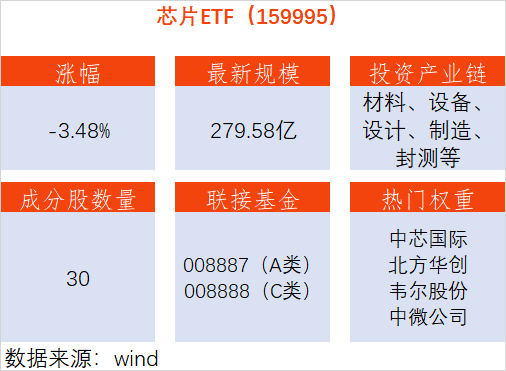
芯片ETF(159995.SZ)下跌3.53%,兆易创新跌8%,机构建议逢低布局
Mei Ri Jing Ji Xin Wen· 2026-02-02 03:22
Group 1 - The A-share market experienced a collective decline on February 2, with the Shanghai Composite Index dropping by 1.13%. The food and beverage, banking, and beauty care sectors showed positive performance, while non-ferrous metals and oil and petrochemicals faced significant declines. The chip sector remained sluggish, with the chip ETF (159995.SZ) down by 3.53% and key stocks like Wen Tai Technology down by 10.00%, Beijing Junzheng down by 9.14%, and Zhaoyi Innovation down by 8.25% [1][2] Group 2 - According to market research firm TrendForce, due to major DRAM manufacturers shifting advanced processes and new capacities to meet AI server demands, the overall supply in the market is severely tight. It is expected that the contract price of general-purpose DRAM will increase by 55% to 60% quarter-on-quarter in the first quarter of 2026 [3] - Donghai Securities indicated that industry demand is slowly recovering, with AI investments exceeding expectations and storage chip price increases also surpassing forecasts. The market currently has a relatively high level of funding enthusiasm, suggesting a strategy of buying on dips [3] - The chip ETF (159995) tracks the National Chip Index, which includes 30 constituent stocks representing leading companies in the A-share chip industry across materials, equipment, design, manufacturing, packaging, and testing, including SMIC, Cambricon, Changdian Technology, and Northern Huachuang [3]
芯片ETF广发(159801)开盘跌1.50%,重仓股中芯国际跌1.28%,海光信息跌1.68%
Xin Lang Cai Jing· 2026-02-02 03:12
Group 1 - The core viewpoint of the article highlights the performance of the chip ETF Guangfa (159801), which opened down by 1.50% at 0.982 yuan on February 2 [1] - Major holdings in the chip ETF experienced declines, with notable drops including ZTE International down 1.28%, Haiguang Information down 1.68%, and GigaDevice down 4.47% [1] - The performance benchmark for the chip ETF is the yield of the National Securities Semiconductor Chip Index, managed by Guangfa Fund Management Co., with a return of 99.10% since its inception on January 20, 2020, and a return of 14.65% over the past month [1]
LP周报丨50亿,县域“顶级玩家”又出手了
投中网· 2026-01-31 07:05
Core Viewpoint - The article highlights the emergence of significant investment funds in China, particularly focusing on the AI and technology sectors, driven by local governments and state-owned enterprises, showcasing the potential of county-level economies like Kunshan to lead in industrial investment and innovation [6][7][9]. Group 1: Investment Funds and Their Focus - Kunshan Artificial Intelligence Industry Fund has a total scale of 5 billion RMB, with the first phase at 2 billion RMB, targeting AI core hardware, computing power, large models, and AI+ manufacturing [6]. - The fund is led by Kunshan Chuangkong Group and collaborates with notable partners like Su Chuangtou and Hua Ying Capital, indicating a strong resource allocation [6]. - In addition to Kunshan's fund, 13 new funds were established in the same week, including a 2 billion RMB CVC sub-fund and a 20 billion RMB energy storage fund, reflecting a broader trend of fund establishment across various regions [9]. Group 2: Economic Context of Kunshan - Kunshan has ranked first among China's top counties for over a decade, with a GDP of 538.017 billion RMB in 2024, surpassing several provincial capitals [7]. - The city has an industrial output value of 1.24 trillion RMB, making it the first county-level city in China to exceed a trillion in industrial output [7]. - Kunshan has developed a world-class industrial cluster in electronics and high-end manufacturing, producing about one-third of the world's laptops and one-tenth of smartphones [8]. Group 3: Strategic Advantages - Kunshan's geographical location between Shanghai and Suzhou allows it to leverage resources from both cities, enhancing its role in AI research and financial resource absorption [8]. - The city has established a robust financial ecosystem with over 130 billion RMB in fund matrices, demonstrating effective collaboration between government, state-owned enterprises, and private capital [9]. Group 4: Other Notable Funds - The Beijing Beigong Zhizhi Venture Capital Fund, with a scale of 200 million RMB, focuses on AI+, new information technology, and smart manufacturing [11]. - The Hunan Jiangyuan Xiangneng Investment Fund has been established with a capital of 1 billion RMB, targeting private equity investments and asset management [12]. - The Wuxi Xichuang Yingtai Equity Investment Fund has been set up with a scale of 500 million RMB, emphasizing local investment and capital flow [13].

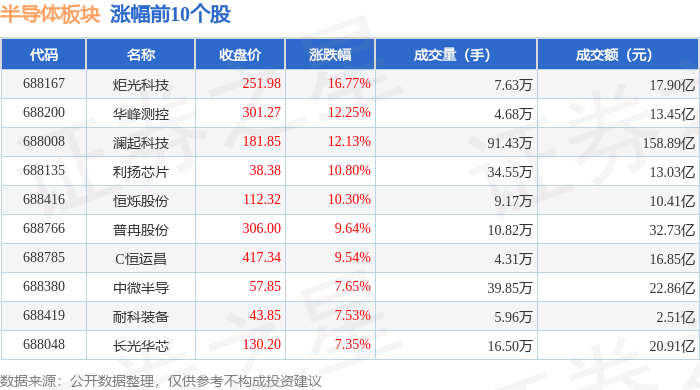
半导体板块1月30日涨0.91%,炬光科技领涨,主力资金净流出34.41亿元
Zheng Xing Xing Ye Ri Bao· 2026-01-30 08:54
Group 1 - The semiconductor sector experienced a rise of 0.91% on January 30, with Juguang Technology leading the gains [1] - The Shanghai Composite Index closed at 4117.95, down 0.96%, while the Shenzhen Component Index closed at 14205.89, down 0.66% [1] - Juguang Technology's stock price increased by 16.77% to 251.98, with a trading volume of 76,300 shares and a transaction value of 1.79 billion [1] Group 2 - The semiconductor sector saw a net outflow of 3.441 billion from institutional funds, while retail investors contributed a net inflow of 3.083 billion [2] - Notable declines included Ashi Chuang, which fell by 11.08% to 36.84, and Hangyu Micro, which decreased by 8.60% to 22.95 [2] - The trading volume for Ashi Chuang was 235,800 shares, with a transaction value of 884 million [2] Group 3 - Key stocks with significant net inflows from retail investors included Beijing Junzheng with a net inflow of 212 million, and Saimicroelectronics with 208 million [3] - Conversely, major stocks like Lanke Technology and Chuangxin Technology experienced substantial net outflows from institutional funds [3] - The overall market sentiment reflected a mixed response, with some stocks gaining while others faced declines in both institutional and retail investments [3]