Twilio Inc.

Search documents
AI 产品定价指南:按量定价的卡点到底是什么?
Founder Park· 2025-08-11 15:10
Core Viewpoint - AI is fundamentally changing the pricing logic of software, shifting from traditional seat-based pricing to usage-based or outcome-based pricing models [2][11][20]. Group 1: AI Pricing Transformation - The traditional seat pricing model is becoming less viable as AI increases efficiency, leading to fewer users and a need for new pricing strategies [11][12]. - Implementing usage-based pricing faces challenges such as the need for real-time billing systems, dynamic pricing models, and maintaining large volumes of accurate data [3][15]. - Pricing models for AI products can be analyzed based on attribution capability and autonomy, with stronger attribution and autonomy leading to greater pricing power [32][36]. Group 2: CEO Considerations for Pricing Transition - CEOs must focus on sales compensation structures and the division of sales responsibilities when transitioning to usage-based pricing [3][22]. - A hybrid business model, combining seat pricing and usage-based pricing, is expected to dominate in the coming years, especially for application-level products [3][13]. - The sales team's role must evolve to ensure that actual usage aligns with revenue recognition, avoiding the pitfalls of recording false revenue [22][23]. Group 3: Challenges in Implementing Usage-Based Pricing - Real-time monitoring is essential to manage the risk of unlimited spending in usage-based pricing models, as seen in cases like Segment [15][16]. - The dynamic nature of pricing models complicates the creation of a universal billing engine, as contracts often vary significantly [15][16]. - Maintaining a reliable data chain is crucial for accurate historical data storage, which is necessary for future pricing adjustments [15][16]. Group 4: Strategic Importance of Usage-Based Pricing - Usage-based pricing directly ties revenue to the value created for customers, allowing for a more flexible and responsive business model [17][20]. - Sales commissions in usage-based models must be adjusted to align with actual product usage, preventing cash flow mismatches [18][22]. - The integration of value creation across departments is essential for the success of usage-based pricing, requiring a shift in company culture and operations [19][21]. Group 5: Future of Pricing Models - The trend is moving towards a mixed pricing strategy, with a significant portion of companies expected to adopt outcome-based pricing in the next few years [37][49]. - Companies must enhance their products' autonomy and attribution capabilities to unlock greater commercial value [37]. - The evolution of pricing models reflects a broader shift in the industry, where agility and adaptability are key to maintaining competitive advantage [43][49].

We’ll Be a Big Beneficiary of AI, Says Twilio CEO
Bloomberg Technology· 2025-08-08 19:11
Financial Performance & Guidance - The company delivered a solid quarter with accelerated growth, record non-GAAP income from operations, and free cash flow [1] - The company raised its guidance for the year, expressing confidence in the outlook [2] AI Opportunity & Investment - The company is seen as a beneficiary of the generational AI opportunity [1][3] - The company sees an opportunity to make short-term investments in AI, particularly voice AI, to drive medium-term benefits [5][7][8] - The company is investing in making its platform as simple as possible for customers to get started, especially with voice [15] Growth Strategy & Market Position - The company is taking market share from competitors in a price-disciplined way [5] - The company is focused on running the business with discipline, not growth at all costs [4][11] - The company's product-led growth strategy is successful, with many customers self-starting on the platform [14] - The company sees international opportunities for expansion [13] M&A Considerations - The company is always considering acquisitions but there is nothing specific to announce [7] - The company would not comment on potential M&A activity, but will always act in the best interests of shareholders [10]


Pinterest Posts Downbeat Q2 Earnings, Joins Twilio, Trade Desk And Other Big Stocks Moving Lower In Friday Pre-Market Session
Benzinga· 2025-08-08 12:43
Group 1 - U.S. stock futures are higher, with Dow futures gaining around 100 points [1] - Pinterest reported second-quarter revenue of $998.23 million, exceeding estimates of $974.01 million, but adjusted earnings of 33 cents per share missed analyst expectations of 35 cents per share [2] - Pinterest shares fell 12.4% to $34.35 in pre-market trading following the earnings report [2] Group 2 - The Trade Desk, Inc. saw a decline of 29.6% to $62.19 in pre-market trading after reporting second-quarter financial results [4] - Iovance Biotherapeutics, Inc. shares fell 26.9% to $1.93 after worse-than-expected second-quarter results and FY25 sales guidance below estimates [4] - Sweetgreen, Inc. shares dropped 23.5% to $9.69 after reporting disappointing second-quarter results and cutting FY25 sales guidance [4] - Xponential Fitness, Inc. declined 21.1% to $7.59 following downbeat quarterly sales and reduced FY2025 sales guidance [4] - Sezzle Inc. shares fell 20.3% to $111.05 after releasing second-quarter financial results [4] - Twilio Inc. shares tumbled 12.8% to $106.75 after issuing third-quarter guidance below estimates [4] - Gray Media, Inc. declined 9% to $3.79 following downbeat quarterly earnings [4] - Firefly Aerospace Inc. dipped 8.6% to $55.14 after its recent IPO [4] - Microchip Technology Incorporated fell 7.9% to $60.97 following first-quarter results [4]


Jobless Claims, Q2 Productivity, Q2 Earnings All Higher
ZACKS· 2025-08-07 15:36
Economic Overview - U.S. pre-market futures are at peak highs, with the Dow up 185 points, S&P 500 up 35 points, and Nasdaq up 120 points, indicating a healthy market environment [1] - The small-cap Russell index is up 20 points, showing recovery from a previous selloff, with Q2 earnings season exceeding expectations across various industries [2] Productivity and Labor Costs - U.S. Productivity in Q2 increased by 2.4%, surpassing the expected 1.9%, marking a significant recovery from the previous quarter's -1.8% [3] - Unit Labor Costs rose by 1.6%, slightly above the estimated 1.3%, and down from a revised 6.9% in Q1, indicating improved economic conditions [4] Employment Data - Initial Jobless Claims rose to 226K, 5K higher than estimated, but still below the near-term high of 250K reported in early June [5] - Continuing Jobless Claims reached 1.974 million, the highest since November 2021, but still below the psychologically significant 2 million mark [6] Company Earnings Reports - Eli Lilly reported Q2 earnings of $6.31 per share, exceeding the $5.61 estimate, with revenues of $15.56 billion, up 5.5% [7] - Despite strong earnings, Eli Lilly's shares fell 7% due to disappointing performance of its new obesity pill, which had a 12% weight loss rate [8] - Warner Bros. Discovery reported earnings of $0.63 per share, significantly better than the expected -$0.16, with revenues of $9.81 billion [9] - Ralph Lauren's fiscal Q1 earnings were $3.77 per share, beating the $3.48 estimate, with revenues of $1.7 billion, up 14% year over year [10] Upcoming Economic Data - Wholesale Inventories for June and Consumer Credit data will be released later today, following a previous Consumer Credit increase of $5.1 billion [11]



他救了OpenAI、年赚过亿、三家明星CTO,却自曝跟不上AI发展了,硅谷大佬告诫:不是马斯克,就别碰大模型
3 6 Ke· 2025-08-07 10:47
Core Insights - Bret Taylor's involvement in OpenAI's crisis management highlights the complexity of decision-making in high-stakes environments, emphasizing the importance of understanding the nuances of the situation [2][3] - The AI market is expected to evolve into three main segments: foundational models, AI tools, and application-based AI, with a particular focus on the potential of AI agents [30][31][34] Group 1: Bret Taylor's Background and Role - Bret Taylor has a diverse background, having held multiple leadership roles in various tech companies, including Salesforce and Google, and is currently the chairman of OpenAI [1] - Taylor's decision to re-engage with OpenAI's board was influenced by personal reflections on the significance of the organization in the AI landscape [2] - His reputation as a "board problem fixer" positioned him uniquely to mediate the crisis at OpenAI, showcasing his ability to navigate complex corporate dynamics [2][3] Group 2: OpenAI Crisis Management - During the crisis, OpenAI employees expressed their discontent through a public letter, demanding the return of Sam Altman, which prompted a restructuring of the board [3] - Taylor's approach to resolving the crisis involved a thorough and independent review process to ensure transparency and accountability [3] Group 3: AI Market Segmentation - The foundational model market is characterized by high capital requirements, making it difficult for startups to compete, leading to a consolidation of major players [31][32] - The AI tools market, while promising, faces risks from larger infrastructure providers who may introduce competing products [33] - The application-based AI market is seen as the most promising, with a focus on AI agents that can deliver measurable business outcomes, thus aligning closely with customer goals [34][40] Group 4: Insights on Product Development and Management - Taylor emphasizes the importance of understanding user needs and creating differentiated products, as demonstrated by his experience with Google Maps [8] - The shift towards AI-driven solutions necessitates a reevaluation of traditional software development practices, focusing on system thinking and user experience [24][25] Group 5: Future of Software Development - The emergence of AI is expected to transform software development, with a shift towards code generation and system-level thinking becoming increasingly important [23][29] - The concept of "results-based pricing" is gaining traction, where companies charge based on the outcomes delivered by AI solutions, rather than traditional usage metrics [40]
Informatica Inc. (INFA) Lags Q2 Earnings Estimates
ZACKS· 2025-08-06 23:26
Core Viewpoint - Informatica Inc. reported quarterly earnings of $0.18 per share, missing the Zacks Consensus Estimate of $0.21 per share, and showing a decline from $0.23 per share a year ago, indicating an earnings surprise of -14.29% [1] Financial Performance - The company posted revenues of $407.34 million for the quarter ended June 2025, surpassing the Zacks Consensus Estimate by 1.68%, and showing an increase from $400.63 million year-over-year [2] - Over the last four quarters, Informatica has surpassed consensus revenue estimates three times [2] Stock Performance - Informatica shares have declined approximately 4.7% since the beginning of the year, contrasting with the S&P 500's gain of 7.1% [3] Future Outlook - The company's earnings outlook is crucial for investors, as it includes current consensus earnings expectations for upcoming quarters and any recent changes to these expectations [4] - The current consensus EPS estimate for the coming quarter is $0.35 on revenues of $436.93 million, and for the current fiscal year, it is $1.15 on revenues of $1.69 billion [7] Industry Context - The Internet - Software industry, to which Informatica belongs, is currently ranked in the top 32% of over 250 Zacks industries, suggesting a favorable outlook compared to lower-ranked industries [8]


Olo Inc. (OLO) Q2 Earnings Lag Estimates
ZACKS· 2025-08-04 22:41
Company Performance - Olo Inc. reported quarterly earnings of $0.07 per share, missing the Zacks Consensus Estimate of $0.08 per share, but showing an increase from $0.05 per share a year ago, resulting in an earnings surprise of -12.50% [1] - The company posted revenues of $85.72 million for the quarter ended June 2025, surpassing the Zacks Consensus Estimate by 4.20% and increasing from $70.5 million year-over-year [2] - Olo has surpassed consensus revenue estimates four times over the last four quarters [2] Stock Movement and Outlook - Olo shares have increased approximately 35.3% since the beginning of the year, significantly outperforming the S&P 500's gain of 6.1% [3] - The company's earnings outlook is crucial for investors, as it includes current consensus earnings expectations for upcoming quarters and any recent changes to these expectations [4] - The current consensus EPS estimate for the coming quarter is $0.08 on revenues of $85.82 million, and $0.31 on revenues of $339.4 million for the current fiscal year [7] Industry Context - The Internet - Software industry, to which Olo belongs, is currently ranked in the top 32% of over 250 Zacks industries, indicating a favorable outlook [8] - Empirical research suggests a strong correlation between near-term stock movements and trends in earnings estimate revisions, which can impact Olo's stock performance [5] - The Zacks Rank for Olo is currently 3 (Hold), suggesting that the shares are expected to perform in line with the market in the near future [6]


爆火的Lovable:AI建站工具,8个月达到1亿美元ARR,速度之快超过了Cursor
硬AI· 2025-08-04 09:46
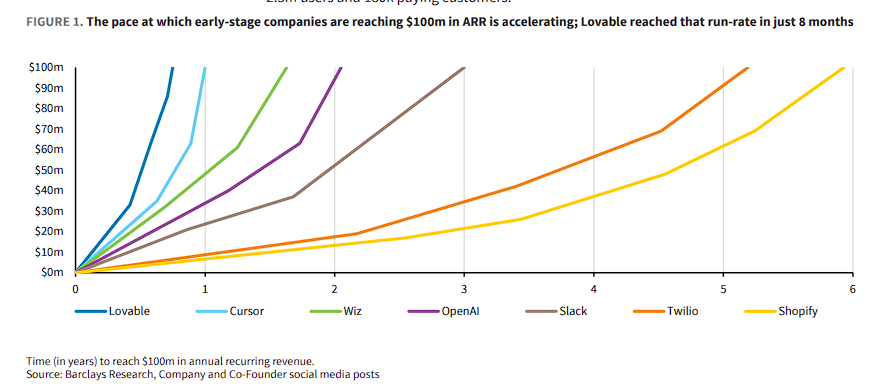
Core Insights - Lovable, an AI website building tool, is rapidly transforming the website development market, achieving significant milestones in a short time frame [3][5][15] - Barclays reports that Lovable reached $100 million in Annual Recurring Revenue (ARR) within 8 months, surpassing the growth rates of established AI tools like Cursor and OpenAI [3][5][13] - The rise of Lovable poses a substantial threat to traditional website builders such as Wix and GoDaddy, which are struggling to adapt to the fast-paced technological changes [3][15][16] Growth Metrics - Lovable created 2.5 million websites in June alone, with user numbers reaching 2.3 million by late July [2][3] - The company achieved $4 million in ARR within just 4 weeks of product launch, with 9,000 paying customers [7] - By February 2025, Lovable's ARR is projected to grow to $17 million, with over 300,000 users [8] - In March, the company added 1,500 new customers daily, marking a nearly 50% week-over-week growth, and increased paying customers to 45,000 [9] - After reaching $50 million ARR in June, Lovable doubled its revenue in just two months [10] - Current data shows Lovable has 2.3 million users and 180,000 paying customers [11] Market Impact - The rapid growth of Lovable indicates a strong market demand for AI-native website building tools, with a significant portion of this demand coming from non-programmers who can now create websites easily [13] - The emergence of Lovable has reignited discussions about the potential disruption of traditional web tool companies, particularly Wix and GoDaddy [15] - Despite the challenges posed by new entrants, GoDaddy and similar companies may still benefit from their established services in domain registration and email productivity applications [15][16]

爆火的Lovable:AI建站工具,8个月达到1亿美元ARR,速度之快超过了Cursor
Hua Er Jie Jian Wen· 2025-08-02 13:33
Core Insights - Lovable, an AI website building tool, has achieved unprecedented growth, reaching $100 million in annual recurring revenue (ARR) within just 8 months, surpassing the growth rates of established AI tools like Cursor [1][2] - The company completed a $200 million Series A funding round at an $18 billion valuation, indicating strong investor confidence in its business model and market potential [1][2] Growth Metrics - Lovable created 2.5 million websites in June alone, with user numbers reaching 2.3 million by late July, showcasing a rapid adoption rate [1][8] - The company reached $4 million ARR within 4 weeks of its product launch and had 9,000 paying customers [8] - By February 2025, ARR increased to $17 million with over 300,000 users, and by March, the company was adding 1,500 new customers daily, marking a nearly 50% week-over-week growth [8] Market Impact - The rise of Lovable poses a significant threat to traditional website builders like Wix and GoDaddy, as the demand for AI-driven solutions grows [1][9] - Barclays analysts note that while traditional companies are integrating AI features, they may struggle to adapt quickly during major technological shifts [9] - Despite the potential disruption, companies like GoDaddy may still benefit from their core services, such as domain registration and email productivity applications, which remain in demand [9]
Should You Invest in the Global X Cloud Computing ETF (CLOU)?
ZACKS· 2025-07-30 11:21
Core Viewpoint - The Global X Cloud Computing ETF (CLOU) provides broad exposure to the Technology - Cloud Computing segment, appealing to both institutional and retail investors due to its low costs and transparency [1][2]. Group 1: ETF Overview - CLOU is a passively managed ETF launched on April 12, 2019, with assets exceeding $333.37 million, categorizing it as an average-sized ETF in its sector [1][3]. - The fund aims to match the performance of the INDXX GLOBAL CLOUD COMPUTING INDEX, which includes companies benefiting from cloud computing technology [4]. Group 2: Costs and Performance - The annual operating expense ratio for CLOU is 0.68%, making it one of the more expensive ETFs in the cloud computing space [5]. - As of July 30, 2025, CLOU has experienced a year-to-date loss of approximately 2.13% but has gained about 17.6% over the past year, with trading prices ranging from $18.22 to $26.34 in the last 52 weeks [7]. Group 3: Holdings and Sector Exposure - Zscaler Inc (ZS) constitutes about 5.15% of CLOU's total assets, with the top 10 holdings representing approximately 43.44% of total assets under management [6]. - CLOU has a beta of 1.10 and a standard deviation of 27.91% over the trailing three-year period, indicating more concentrated exposure compared to its peers [7]. Group 4: Alternatives - CLOU holds a Zacks ETF Rank of 1 (Strong Buy), indicating strong potential for investors seeking exposure to the Technology ETFs segment [8]. - Other alternatives in the cloud computing ETF space include WisdomTree Cloud Computing ETF (WCLD) and First Trust Cloud Computing ETF (SKYY), with respective assets of $367.34 million and $3.59 billion [9][10].