中航沈飞

Search documents
军贸深度20250507
2025-07-16 06:13
Summary of Conference Call Notes Industry Overview - The conference call discusses the military conflict between India and Pakistan, particularly focusing on the Kashmir region, which has escalated due to recent terrorist attacks and military actions [1][3]. - The geopolitical landscape has been significantly affected by various conflicts, including the Russia-Ukraine war and the Israel-Palestine conflict, leading to increased military spending globally [4][5]. Key Points and Arguments - **Military Spending Trends**: Global military expenditure reached $238.66 billion in 2023, marking a nearly 10% increase year-over-year, the largest growth since 2009 [5]. - **Regional Military Growth**: The military spending growth rate in Europe and Central Asia was the highest at 20.88% in 2023, while Sub-Saharan Africa saw over 10% growth [5]. - **Arms Trade Dynamics**: From 2019 to 2023, Asia-Pacific countries accounted for 37% of global arms imports, with the Middle East at 30% and Europe at 21% [6]. - **China's Arms Exports**: China's military equipment has gained recognition in the global arms market, with significant exports to Asia-Pacific countries, which constitute 85% of its arms exports [10][12]. Potential Investment Opportunities - **Demand for Low-Cost Military Equipment**: The ongoing conflicts are expected to increase demand for low-cost military equipment, particularly from countries surrounding conflict zones [16][17]. - **Chinese Military Equipment Performance**: The performance of Chinese military equipment in recent conflicts has improved its attractiveness to potential buyers in the Middle East and Africa [22]. - **Key Companies to Watch**: Companies such as AVIC, China Aerospace Science and Industry Corporation, and others involved in drone and missile production are highlighted as potential beneficiaries of increased military orders [20][24]. Other Important Insights - **Impact of Geopolitical Tensions**: The escalation of conflicts in regions like Kashmir and the Middle East is likely to lead to increased military procurement from countries like Pakistan, which relies heavily on Chinese military supplies [21][22]. - **Future Orders and Market Dynamics**: The call suggests that the recent performance of Chinese military equipment in actual combat scenarios may lead to a surge in military orders from countries that have been hesitant due to a lack of combat experience with these systems [22][23]. - **Growth in Related Transactions**: Companies involved in military trade are expected to see significant increases in related transactions, indicating a robust outlook for military exports [23]. This summary encapsulates the key discussions and insights from the conference call, focusing on the military industry dynamics and potential investment opportunities arising from current geopolitical tensions.
国防军工行业点评报告:93阅兵在即,看好阅兵催化下的军工装备升级周期
Soochow Securities· 2025-07-15 15:12
Investment Rating - The report maintains an "Accumulate" rating for the defense and military industry, indicating a positive outlook for the sector in the next six months [1]. Core Insights - The upcoming military parade on September 3 is expected to catalyze the upgrade cycle of military equipment, highlighting the importance of new technologies such as unmanned systems and hypersonic weapons, which represent a revolution in warfare [5]. - The integration of military assets has evolved from pilot projects to a national strategic initiative aimed at addressing structural issues within military groups, enhancing resource allocation efficiency and innovation [5]. - China's military trade expansion is seen as a historic opportunity to reshape the global defense landscape, with Chinese equipment gaining competitiveness due to a complete industrial system and a shift towards a service-oriented business model [5]. - The report suggests focusing on ten key investment opportunities within the military sector, including companies involved in military aircraft, engines, ships, missiles, commercial aerospace, unmanned equipment, underwater security, military trade, large aircraft, and low-altitude economy [5]. Summary by Sections Industry Trends - The defense and military industry is experiencing a significant transformation driven by technological advancements and strategic asset integration [5]. Investment Opportunities - Key companies to watch include: 1. Military Aircraft: AVIC Shenyang Aircraft Corporation, AVIC Xi'an Aircraft Industry Group 2. Engine Manufacturing: Aero Engine Corporation of China 3. Shipbuilding: China Shipbuilding Industry Corporation 4. Missiles: North Navigation and Philihua 5. Commercial Aerospace: Aerospace Electronics, China Satellite 6. Unmanned Equipment: Aerospace Rainbow 7. Underwater Security: China Marine Defense 8. Military Trade: Zhongyun Drone, Guorui Technology 9. Large Aircraft: AVIC Gaoke, AVIC Aircraft 10. Low-altitude Economy: Zhongke Xingtou, Lais Information [5].
中证空天一体军工指数下跌0.01%,前十大权重包含中航机载等
Jin Rong Jie· 2025-07-15 13:06
Core Viewpoint - The China Securities Index for Aerospace and Military Industry (空天军工指数) shows mixed performance with a slight decline on the latest trading day, but has seen positive growth over the past month, three months, and year-to-date [1]. Group 1: Index Performance - The Aerospace and Military Industry Index closed at 2044.48 points, down 0.01% on the latest trading day, with a trading volume of 16.234 billion yuan [1]. - Over the past month, the index has increased by 3.76%, by 6.98% over the last three months, and by 6.27% year-to-date [1]. Group 2: Index Composition - The index includes leading companies related to the aerospace and military strategy, covering sectors such as aircraft, power and control systems, early warning systems, weapon systems, C4ISR systems, military digitalization, and aerospace materials [1]. - The top ten weighted companies in the index are: AVIC Shenyang Aircraft (9.05%), AVIC Optoelectronics (6.94%), Aero Engine Corporation of China (6.93%), AVIC Xi'an Aircraft (5.4%), AVIC Aircraft (4.08%), Aerospace Electronics (3.7%), Haige Communications (3.53%), Filihua (3.48%), AVIC Chengfei (3.42%), and Ruichuang Micro-Nano (3.38%) [1]. Group 3: Market and Sector Breakdown - The index's holdings are primarily listed on the Shanghai Stock Exchange (55.81%) and Shenzhen Stock Exchange (44.19%) [2]. - The industry composition of the index includes: Industrial sector (71.97%), Materials (13.79%), Information Technology (8.12%), and Communication Services (6.12%) [2]. Group 4: Index Adjustment Mechanism - The index samples are adjusted semi-annually, with adjustments occurring on the next trading day after the second Friday of June and December each year [2]. - Weight factors are generally fixed until the next scheduled adjustment, with special circumstances allowing for temporary adjustments [2]. Group 5: Related Investment Funds - Public funds tracking the Aerospace and Military Industry Index include Penghua China Securities Aerospace and Military Industry C and A [3].

冲突,出海,阅兵!大事件催化下的军工板块获资金涌入,ETF如何选择?
市值风云· 2025-07-15 10:02
Core Viewpoint - The military industry sector has seen significant growth due to geopolitical tensions, with a notable increase in stock prices and ETF investments, indicating strong market interest and potential opportunities [2][5][6]. Group 1: Market Performance - From April 8 to June 30, the defense and military sector experienced a price increase of 27.7%, with over 10% of listed companies reaching historical highs [2]. - The military leader ETF (512710.SH) saw a growth of 76.3 million shares in the first half of the year, ranking third among stock ETFs [2]. - The military ETF (512660.SH) also reported an increase of over 40 million shares, with several defense ETFs growing by more than 10 million shares this year [3]. Group 2: Industry Fundamentals - China's defense budget is projected to reach 1.78 trillion yuan in 2025, reflecting a year-on-year growth of 7.2%, with military spending accounting for 1.26% of GDP [6]. - The global military trade market is expected to grow to $111.6 billion in 2024, a 15.2% increase year-on-year, with China's military trade share estimated at approximately 220 billion yuan [9]. - The C919 aircraft's domestic production rate is at 60%, with a target of producing 150 aircraft annually by 2029, indicating strong growth potential in the aviation sector [9]. Group 3: Strategic Developments - The military sector is entering a phase of accelerated demand recovery, driven by the completion of the "14th Five-Year Plan" and the initiation of the "15th Five-Year Plan" [11]. - The upcoming military parade on September 3 is expected to showcase advanced military technologies, further boosting market sentiment and interest in the military sector [14]. - The military industry is anticipated to undergo significant upgrades, with a focus on intelligent and unmanned systems, aligning with global trends in military modernization [11][14]. Group 4: ETF Investment Landscape - Despite moderate returns, military ETFs have shown strong capital attraction, with all five military ETFs yielding over 8% this year [15]. - The largest military ETFs, including military ETF (512660.SH) and military leader ETF (512710.SH), reported returns of 8.2% and 8.7% respectively, outperforming the Shanghai Composite Index [15]. - The index tracking the military sector, the China Securities Military Index, has a cumulative return of 75.78% since its inception, indicating strong long-term performance [21].

流动性断层领先,航空航天ETF(159227)回调迎布局机会,中航沈飞上涨
Mei Ri Jing Ji Xin Wen· 2025-07-15 06:54
Group 1 - The A-share market experienced a slight rebound on July 15, with the communication industry performing strongly while the defense and military sector saw a pullback, indicating a trend of buying on dips [1] - The Aerospace ETF (159227) has recorded a net inflow of funds for 13 consecutive days, totaling 312 million yuan, reflecting significant growth in scale [1] - The military industry is heavily influenced by five-year plans, which are key drivers for market expectations and industry operations, with the upcoming "14th Five-Year Plan" expected to clarify development guidance for the next three to five years [1] Group 2 - The Aerospace ETF (159227) closely tracks the National Securities Aerospace Index, focusing on core areas of military and aerospace, with a high concentration of 98.2% in the first-level military industry [2] - The index's component stocks have a weight of 66.5% in aerospace equipment, significantly surpassing other military and defense indices, making it the largest product tracking the National Securities Aerospace Index [2]

近一个月规模增长1.4倍,全市场“军工含量”最高的航空航天ETF(159227)获资金抢筹
Mei Ri Jing Ji Xin Wen· 2025-07-15 06:41
Core Viewpoint - The A-share market shows mixed performance with the communication sector experiencing significant gains while the defense and military industry faces a pullback. The Aerospace ETF (159227) has seen a decline of 1.27% with a trading volume of 79.79 million yuan, indicating a strong interest in military stocks despite recent fluctuations [1]. Group 1: Market Performance - As of 13:33, the Shanghai Composite Index fell below 3500 points, while the communication sector rose against the trend [1]. - The Aerospace ETF has recorded a net inflow of funds for 13 consecutive trading days, totaling 312 million yuan, with a current scale of 563 million yuan, making it the largest in its category [1]. Group 2: Industry Insights - The Aerospace ETF tracks the National Aerospace Index, which has a strong military attribute with 98.2% of its components belonging to the defense sector. The weight of aerospace equipment in this index is 66.5%, significantly higher than other military indices [1]. - According to Zhonghang Securities, the military sector is expected to see performance recovery, driven by factors such as the "September 3 Parade" and geopolitical conflicts, indicating structural opportunities in the market [1].
国防ETF(512670)份额9连增累计吸金超10亿,9·3阅兵预期与装备升级催化行业景气
Xin Lang Cai Jing· 2025-07-15 02:45
Group 1 - The core viewpoint is that the military industry is experiencing significant investment interest due to global tensions and upcoming military events, leading to increased capital inflow into defense-related ETFs [1][2][4] - The National Defense ETF has seen a continuous net inflow of funds over the past nine days, with a peak single-day inflow of 275 million yuan, totaling 1.07 billion yuan, indicating strong market interest [1] - The upcoming military parade on September 3 will showcase both traditional and new combat forces, highlighting the importance of domestic military equipment and advanced technologies [2] Group 2 - Recent policies supporting deep-sea technology and marine economy development are expected to create investment opportunities in emerging sectors, particularly in unmanned underwater vehicles (UUVs) [2] - The military industry is projected to grow significantly from 2025 to 2027, driven by multiple factors including the "14th Five-Year Plan," the centenary of the military, and the push for domestic production and trade [4] - The National Defense ETF tracks the China National Defense Index, which includes stocks from major military groups and companies that supply equipment to the armed forces, reflecting the overall performance of the defense industry [5]

中证国新国企航空航天科技指数下跌0.6%,前十大权重包含中航沈飞等
Jin Rong Jie· 2025-07-14 14:17
Group 1 - The core index, the China Securities National New State-Owned Enterprise Aerospace Technology Index, experienced a decline of 0.6%, closing at 2448.02 points with a trading volume of 12.644 billion yuan [1] - Over the past month, the index has increased by 6.52%, by 10.78% over the last three months, and by 6.04% year-to-date [1] - The index comprises 40 representative listed companies from state-owned enterprises involved in aerospace equipment, materials, information, and security, reflecting the overall performance of state-owned enterprises in the aerospace technology sector [1] Group 2 - The top ten weighted stocks in the index include: Aero Engine Corporation (9.22%), AVIC Xi'an Aircraft Industry (8.54%), AVIC Optoelectronics (7.66%), AVIC Shenyang Aircraft Corporation (5.82%), Hongdu Aviation (4.65%), Northern Navigation (4.31%), AVIC Aircraft (3.97%), AVIC High-Tech (3.96%), Aerospace Electronics (3.90%), and Zhongke Star Map (3.84%) [1] - The market segment distribution of the index holdings shows that the Shanghai Stock Exchange accounts for 63.84%, the Shenzhen Stock Exchange for 35.51%, and the Beijing Stock Exchange for 0.65% [1] - In terms of industry composition, the index holdings are primarily in the industrial sector (82.73%), followed by materials (5.90%), information technology (5.08%), communication services (4.65%), and consumer discretionary (1.65%) [2] Group 3 - The index samples are adjusted biannually, with adjustments occurring on the next trading day after the second Friday of June and December each year [2] - Weight factors are adjusted in accordance with the sample changes, and generally remain fixed until the next scheduled adjustment [2] - In special circumstances, the index may undergo temporary adjustments, such as when a sample company is delisted or undergoes mergers, acquisitions, or splits [2]
中航沈飞连跌5天,华泰柏瑞基金旗下1只基金位列前十大股东
Sou Hu Cai Jing· 2025-07-14 10:28
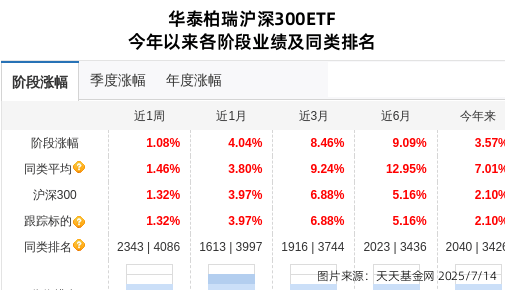
Group 1 - The core point of the article highlights that AVIC Shenyang Aircraft Company has experienced a decline in stock price over five consecutive trading days, with a cumulative drop of -3.98% [1] - The company is primarily engaged in the manufacturing of aviation products and is located in Shenyang, a significant national equipment manufacturing hub [1] - Huatai-PineBridge Fund's Huatai-PineBridge CSI 300 ETF is one of the top ten shareholders of AVIC Shenyang Aircraft, having reduced its holdings in the second quarter of this year [1] Group 2 - The performance of the Huatai-PineBridge CSI 300 ETF shows a year-to-date return of 3.57%, ranking 2040 out of 3426 in its category [2] - The fund's performance over various periods includes a weekly increase of 1.08%, a monthly increase of 4.04%, and a quarterly increase of 8.46% [2] - The average performance of similar funds for the year is 7.01%, indicating that the Huatai-PineBridge CSI 300 ETF is underperforming compared to its peers [2] Group 3 - The fund manager of Huatai-PineBridge CSI 300 ETF is Liu Jun, who has extensive experience in fund management, having worked in various roles since 2004 [3][4] - Liu Jun has managed multiple funds over his career, with a total fund size under management of 423.29 billion yuan and a return of 144.95% during his tenure [4]
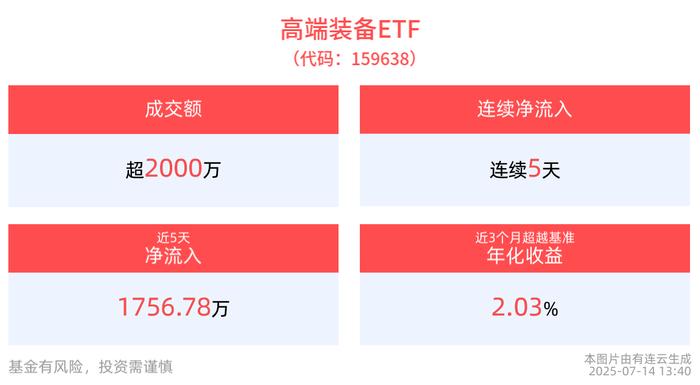
高端装备行业结构性成长机会显著,高端装备ETF(159638)近5天获得连续资金净流入
Xin Lang Cai Jing· 2025-07-14 06:12
Core Viewpoint - The high-end equipment sector is experiencing mixed performance, with notable movements in specific stocks and a positive outlook for military and defense industries due to global political tensions and domestic production trends [1][3][4]. Group 1: Market Performance - As of July 14, 2025, the CSI High-end Equipment Sub-index fell by 0.25%, with stocks showing varied performance; Huajin Technology led with a 4.56% increase, while companies like Les Information and Haige Communication saw declines [1]. - The High-end Equipment ETF (159638) recorded a turnover rate of 1.89% and a transaction volume of 22.41 million yuan, with an average daily transaction of 53.10 million yuan over the past month [3]. Group 2: Fund Flows and ETF Performance - The latest scale of the High-end Equipment ETF reached 1.187 billion yuan, with a net inflow of 17.57 million yuan over the past five days, including a single-day peak of 7.55 million yuan [3]. - The ETF has seen a 29.59% increase in net value over the past year, with the highest monthly return since inception being 19.30% and an average monthly return of 6.55% [3]. Group 3: Industry Outlook - According to Guosen Securities, the defense and aerospace equipment sector benefits from industrial upgrades and the trend towards self-sufficiency, with core equipment localization being fundamental for the industry's rise [4]. - Emerging fields such as humanoid robots and gas turbines are making significant breakthroughs, indicating long-term growth potential, while traditional sectors like shipbuilding and nuclear power equipment maintain stable demand [4]. - The top ten weighted stocks in the CSI High-end Equipment Sub-index account for 45.22% of the index, with significant players including AVIC Shenyang Aircraft, Aero Engine Corporation, and AVIC Optical [4][6].