青岛银行

Search documents
智通AH统计|2月3日
智通财经网· 2026-02-03 08:17
Group 1 - The top three AH premium rates are held by Northeast Electric (00042) at 831.03%, Zhejiang Shibao (01057) at 349.11%, and Sinopec Oilfield Service (01033) at 287.64% [1] - The bottom three AH premium rates are recorded by CATL (03750) at -13.68%, China Merchants Bank (03968) at -2.20%, and WuXi AppTec (02359) at 2.64% [1] - The highest deviation values are seen in Andeli Juice (02218) at 23.04%, Dongpeng Beverage (09980) at 20.81%, and Goldwind Technology (02208) at 14.41% [1] Group 2 - The top ten AH stocks by premium rate include companies like Hongye Futures (03678) at 270.81% and Beijing Mechanical and Electrical (00187) at 255.83% [1] - The bottom ten AH stocks by premium rate include companies like Hengrui Medicine (01276) at 2.75% and Weichai Power (02338) at 7.14% [1] - The top ten AH stocks by deviation value also feature Qingdao Bank (03866) at 13.73% and CanSino Biologics (06185) at 13.21% [1]
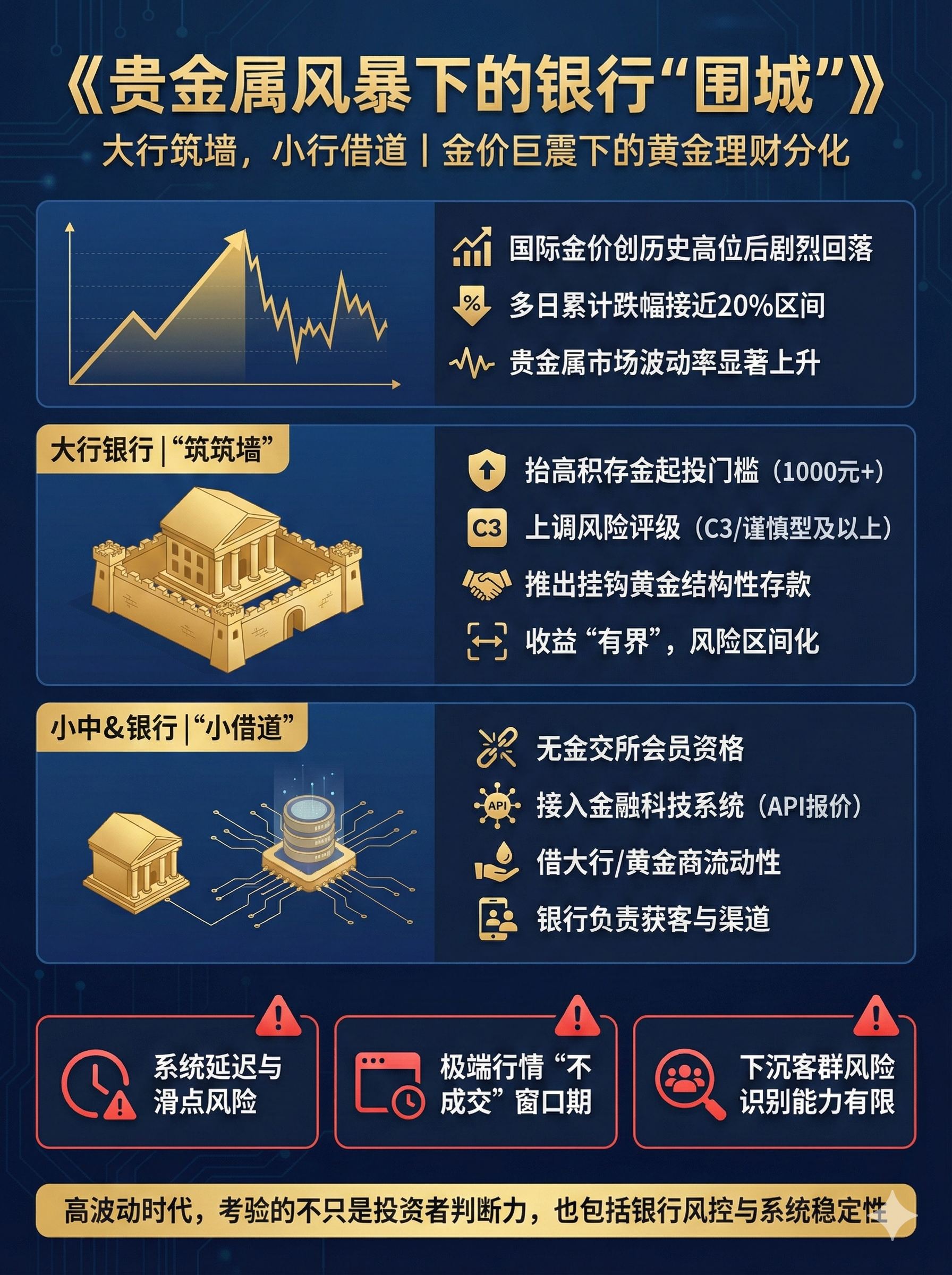
贵金属风暴下的银行“围城”:大行筑墙,小行借道
Hua Er Jie Jian Wen· 2026-02-03 07:14
年终奖即将到手的律师王植(化名),在二月初的寒意中感到了某种难言的燥热。那是金价巨震带给市场的余温,也是财富焦虑在特定节点下的投射。 2月2日,全球贵金属市场遭遇深幅回调,此前一度冲破5500美元/盎司大关的现货黄金,在短短数个交易日内掉头向下,多日累计跌幅接近20%区间。 尽管市场弥漫着对"史诗级暴跌"的恐慌,但对于王植而言,波动即是磁石——他既不甘心在这一轮黄金热潮中彻底缺位,又对当前高位的剧烈波动心存忌 惮,最终在多家大型银行推出的黄金挂钩结构性存款前,停下了目光。 这并非王植一个人的选择。 随着大量存款到期与年终奖发放季重合,在黄金行情余温尚存的背景下,各类挂钩贵金属的理财产品正成为银行获客揽储的"胜负手"。 在这场全民淘金热中,大型银行与中小型银行对于黄金业务的态度,正在呈现出微妙的分化: 一边是努力"降温"的国股行,正通过抬高门槛、强化风险评级来构筑防火墙; 一边是仍在"升温"的中小银行,试图在技术与渠道的缝隙中,借道分享这场盛宴。 大行"筑墙" 在金价立于高位、波动率放大的背景下,国有大行与头部股份制银行正悄然掀起一场"去散户"的运动; 这种策略并非拒绝客户,而是通过提高准入门槛与设计风险对冲产 ...



机构研报提示:银行板块高性价比时点到来!
Mei Ri Jing Ji Xin Wen· 2026-02-03 06:45
Group 1 - The core viewpoint of the articles indicates that the banking sector is currently experiencing a phase of price stabilization, with a focus on the cost-effectiveness of investments in bank stocks [1][2] - The China Securities Banking Index (399986) has seen a decline of 0.93% as of February 3, 2026, with mixed performance among constituent stocks [1] - The average forward P/B ratio for A-share banks has dropped to 0.54 times, below the average since 2018, while the dividend yield stands at 5.07%, indicating a high cost-effectiveness for investors [1] Group 2 - Market participants believe that the China Securities Banking Index is in a phase of consolidation, suggesting that investors consider buying on dips [2] - The Huaxia Bank ETF (515020) is noted for having the lowest comprehensive fee rate among ETFs tracking the China Securities Banking Index [2]
海致科技:AI除幻第一股,叩开产业级智能体深水区大门
智通财经网· 2026-02-03 05:49
Core Insights - The article highlights Haizhi Technology's unique graph-model fusion technology, which allows AI agents to integrate into core business processes across various industries, taking on high-precision tasks such as analysis, decision-making, and execution [1][10] - Haizhi Technology is positioned as a key player in the AI industry, focusing on the deep-water zone of industrial-grade AI agents, creating dual barriers in technology and commercialization, and capitalizing on the explosive growth of the industry [1][15] Technology and Innovation - Haizhi Technology is the first company in China to effectively reduce the hallucination problem of large models through knowledge graphs, enhancing accuracy, reducing hallucination rates, and improving complex logical reasoning capabilities [1][2] - The company's graph-model fusion technology addresses the hallucination issue at its source, integrating knowledge graphs with large models to provide verifiable factual bases for AI outputs [2][5] - The core competitiveness of Haizhi Technology lies in its "trinity" approach: superior graph computing capabilities, graph-model fusion technology, and application expertise [5][6] Market Position and Growth - Haizhi Technology has established a significant market presence, holding a 50% market share in China's graph-based AI agent market, far exceeding its competitors [15] - The industrial-grade AI solutions market in China is projected to grow from approximately RMB 654 billion in 2025 to about RMB 2,861 billion by 2029, with a compound annual growth rate of 44.6% [15] - The company's revenue is expected to reach RMB 503.1 million in 2024, with a compound growth rate of 26.8% from 2022 to 2024, indicating a strong growth trajectory [15][19] Application and Client Engagement - Haizhi Technology's solutions have successfully addressed core pain points for clients, leading to significant risk reduction in financial services, such as a 20% increase in fraud detection for Shanghai Bank [10][11] - The company has served over 360 government and enterprise clients across various sectors, establishing a high customer retention rate and willingness to pay for its services [11][21] Future Outlook - The company is in the process of an IPO, with funds aimed at enhancing its graph-model fusion technology, optimizing its Atlas AI agent, and expanding into new markets [22] - Haizhi Technology's focus on a niche vertical technology path differentiates it from larger competitors, positioning it for long-term growth in the industrial-grade AI sector [22]
机构:收入预测积极,银行基本面改善逻辑明确
Mei Ri Jing Ji Xin Wen· 2026-02-03 03:13
Core Viewpoint - The banking sector is experiencing a stabilization phase, with improvements in revenue growth expected for state-owned, joint-stock, and regional banks by 2026, driven by a favorable interest rate environment and cost management strategies [1] Group 1: Revenue and Profit Growth - According to CICC, the revenue growth rates for listed state-owned banks, joint-stock banks, and regional banks are projected to be 2.7%, 0.6%, and 5.0% respectively, with net profit growth rates of 2.0%, 0.2%, and 6.5%, showing improvement compared to 2025 estimates [1] - The improvement in revenue is primarily attributed to the repricing of deposits and a decline in liability costs exceeding asset yield rates, leading to a narrowing of net interest margin declines [1] Group 2: Credit Growth and Non-Interest Income - CICC anticipates that credit growth will remain stable in the first year of the 14th Five-Year Plan, with the industry's net interest income growth expected to turn positive for the year [1] - Non-interest income is expected to see slight increases due to the reallocation of household assets in a low-interest-rate environment, while other non-interest income is not expected to significantly drag down overall performance [1] Group 3: Market Sentiment and Investment Opportunities - Market participants believe that the CSI Bank Index is currently in a bottoming phase, presenting a potential opportunity for investment at lower levels [1] - The Huaxia Bank ETF, which tracks the CSI Bank Index, is noted for having the lowest comprehensive fee rate among ETFs, with associated funds available for investment [1]
银行业韧性凸显 增长可期
Jin Rong Shi Bao· 2026-02-03 01:49
Core Viewpoint - The performance reports of listed banks for 2025 reveal a resilient banking sector, with significant growth in profitability, particularly among small and medium-sized banks, providing insights for predicting the industry's trajectory in 2026 [1][2]. Group 1: Profitability and Growth - All ten listed banks reported positive growth in net profit, with nine achieving increases in both operating income and net profit [2]. - City commercial banks led the profitability growth, with Qingdao Bank showing a 21.66% increase in net profit, while Hangzhou Bank, Ningbo Bank, and Nanjing Bank reported growth rates of 12.05%, 8.13%, and 8.08% respectively [2]. - National joint-stock banks exhibited steady growth, with Shanghai Pudong Development Bank leading at 10.52% net profit growth, followed by CITIC Bank, China Merchants Bank, and Industrial Bank with growth rates of 2.98%, 1.21%, and 0.34% respectively [2]. Group 2: Revenue Structure Optimization - Revenue structure optimization was a key driver for many banks' performance, with Ningbo Bank's net fee and commission income reaching 6.085 billion yuan, a 30.72% year-on-year increase [3]. - Shanghai Pudong Development Bank improved its asset-liability management and reduced funding costs, stabilizing its net interest margin [3]. - Asset expansion was notable, with China Merchants Bank surpassing 13 trillion yuan in total assets, and several small and medium-sized banks showing significant growth rates in total assets, such as Qingdao Bank at 18.12% [3]. Group 3: Credit Growth and Asset Quality - Accelerated credit issuance was identified as a core driver for asset expansion among small banks, with strong demand in quality regions supporting growth [4]. - Asset quality remained stable, with five banks reporting a decrease in non-performing loan ratios, and overall fluctuations were kept within single-digit basis points [5][6]. - Notably, CITIC Bank and China Merchants Bank saw their non-performing loan ratios decrease by 1 basis point to 1.15% and 0.94% respectively, while the provisioning coverage ratios for several banks remained well above regulatory requirements [6]. Group 4: Future Outlook and Strategic Focus - Analysts predict a positive outlook for the banking sector in 2026, emphasizing the importance of loan growth, particularly in corporate lending, and the stability of asset quality [8]. - Major state-owned banks are focusing on developing differentiated strategies and enhancing operational efficiency as part of their 2026 goals [9][10]. - National joint-stock banks and local small and medium-sized banks aim to optimize their business structures and diversify income sources to improve profitability stability [10].
数字人民币2.0落地 如何攻克POS机与菜市场?
Xin Lang Cai Jing· 2026-02-02 23:09
Core Insights - The digital renminbi is transitioning from a 1.0 version as "electronic cash" to a more versatile 2.0 version, as outlined in the People's Bank of China's action plan [1] - Unlike mobile payment platforms like Alipay and WeChat Pay, which require bank account linkage, the digital renminbi is a legal digital currency that operates independently [1] - Despite its penetration into various sectors, the adoption of digital renminbi remains limited, with many users still relying on traditional mobile payment methods [2] User Experience - The upgraded digital renminbi wallet now offers interest on balances, transforming it into a cash management tool that enhances user engagement [3] - Features like dual offline payment and traceable transactions provide added security and convenience, especially in low-connectivity scenarios [3] - However, user experience issues persist, such as limited compatibility with existing payment apps, which hinders broader adoption [5][6] Business Impact - For small and medium enterprises, the digital renminbi offers cost-saving benefits by eliminating transaction fees typically charged by third-party payment platforms [6][7] - The programmable nature of digital renminbi through smart contracts enhances operational efficiency in various business scenarios, including supply chain finance [7] - Pilot programs in cities like Qingdao demonstrate the potential for digital renminbi to streamline prepayment scenarios and improve cash flow management for businesses [4][7] Cross-Border Potential - The establishment of the digital renminbi international operation center in 2025 aims to facilitate cross-border payments, with banks playing a crucial role in this initiative [8] - Successful pilot projects, such as the first digital renminbi trade settlement between China and Laos, highlight the currency's potential in international trade [8] Government Applications - The digital renminbi is being integrated into government services, providing efficient payment options for taxes, social security, and subsidies [9] - Various regions are implementing digital renminbi solutions for tax payments and refunds, enhancing transparency and efficiency in public finance [9] Adoption Challenges - Despite the expanding functionalities and applications, the overall adoption of digital renminbi is still slow, primarily due to safety concerns and limited user incentives [10][11] - The transition of digital renminbi from M0 to M1 in early 2026 is expected to enhance its appeal and encourage broader usage among banks and consumers [11] - The future of digital renminbi hinges on its seamless integration into daily payment habits and mobile devices, which could lower barriers to adoption [11]

机构扎堆调研上市银行 信贷投放、净息差等为“最关注”
Xin Lang Cai Jing· 2026-02-02 22:57
Core Viewpoint - The article highlights the ongoing institutional research on listed banks in January, focusing on credit issuance, net interest margin, asset quality trends, and bond investment strategies during the peak marketing season [1][2][7]. Group 1: Institutional Research and Credit Issuance - A total of 373 institutions conducted research on 11 A-share listed banks, with 49 research instances recorded by January 31 [1][7]. - The banks under review include Nanjing Bank, Ningbo Bank, Shanghai Bank, and others, with Nanjing Bank being the most favored, receiving 76 institutional inquiries [2][8]. - Institutions are particularly focused on credit issuance during the marketing peak, with many banks reporting better performance compared to the same period in 2025 [2][8]. - Key areas for credit issuance include manufacturing, infrastructure construction, and green low-carbon transformation projects [3][9]. Group 2: Net Interest Margin Stability - Net interest margin (NIM) is a critical indicator of banking performance, with banks focusing on stabilizing NIM through asset and liability management [4][11]. - Shanghai Bank anticipates a slight decline in NIM due to the expected decrease in loan market quotation rates (LPR) and competitive pressures on deposit pricing [11][12]. - Qilu Bank is optimizing its asset portfolio and enhancing low-cost deposit acquisition to stabilize NIM [11][12]. Group 3: Bond Investment Strategies - The bond market has been volatile since 2025, affecting the bond investment returns of regional small and medium-sized banks [6][12]. - Shanghai Bank expects bond rates to remain in a fluctuating range in 2026, with limited potential for a trend reversal [6][13]. - Hu Nong Bank plans to focus on bond investment for asset allocation while employing risk management strategies, including the use of derivatives [6][13]. Group 4: Asset Quality Management - Banks are implementing measures to maintain stable asset quality, including improving the quality of new loans and increasing efforts to manage non-performing loans [6][13].




机构扎堆调研上市银行信贷投放、净息差等为“最关注”
Zheng Quan Ri Bao· 2026-02-02 16:43
Group 1 - In January, 11 A-share listed banks were surveyed by 373 institutions, with a total of 49 survey instances, focusing on credit issuance, net interest margin, asset quality trends, and bond investment strategies during the peak marketing season [1] - The surveyed banks include Nanjing Bank, Ningbo Bank, Shanghai Bank, Hangzhou Bank, Suzhou Bank, Qingdao Bank, Qilu Bank, Xiamen Bank, Hu Nong Bank, Qing Nong Bank, and Zijin Bank, with six banks experiencing stock price increases, led by Qingdao Bank with over 16% growth [2] - Nanjing Bank was the most favored by institutions, receiving 76 surveys, while Shanghai Bank received 75 surveys, indicating strong interest in their credit issuance during the marketing peak [2] Group 2 - The focus of the credit issuance during the peak marketing season is on corporate credit, with banks reporting better performance compared to the same period in 2025, emphasizing manufacturing, infrastructure, and green transformation projects [2][3] - Shanghai Bank anticipates a continued decline in the Loan Prime Rate (LPR) in 2026, which may lead to a slight decrease in net interest margin due to competitive market factors [4] - Qilu Bank aims to stabilize its net interest margin by optimizing asset management and expanding low-cost deposits while managing liabilities effectively [4] Group 3 - The overall pressure on net interest margin for listed banks is expected to ease in 2026, with a narrowing decline anticipated, supported by improvements in funding costs [5] - Shanghai Bank predicts that bond yields will continue to fluctuate within a range in 2026, with low likelihood of a trend reversal [5] - Hu Nong Bank plans to focus on bond investments primarily for allocation, while also employing advanced technologies for trading and risk management [6]
黄金白银继续暴跌,轮到银行股机会了?
第一财经· 2026-02-02 15:31
本文字数:2425,阅读时长大约4分钟 作者 | 第一财经 亓宁 黄金、白银价格暴涨后暴跌价格大涨大跌加速板块轮动,深受避险资金偏爱的银行股又成市场焦点。进入2026年以来,此前涨势如虹的国有大行股价均 有大幅回调,农业银行、工商银行分别跌超12%、8%。 2026.02. 02 从近期表现来看,与国有大行、股份行扛起"护盘"大旗不同,受到业绩快报等消息影响,区域性银行表现明显优于全国性银行,近期多家城农商行宣布 了股东或高管增持计划及进展,也被市场视为重要信号。多位机构人士认为,目前银行板块资金流出高峰已过,配置价值开始显现。 银行股坚定"护盘" 黄金、白银跌势还在持续。面对外回落,但之后短线拉升,一度助力沪指跌幅收窄。全天来看,银行股"护盘"吃力但也较为坚定,在31个申万一级行业 中,食品饮料、银行成唯二飘红板块。 截至当天收盘,沪指跌2.48%,深证成指跌2.69%,创业板指跌2.46%。其中,有色金属以7.62%的跌幅领跌,钢铁、化工、煤炭、石油天然气等资 源周期板块集体重挫,跌幅均在5%以上,半导体板块同样大幅走弱。全市场超4600只个股下跌,成交额约2.61万亿元,较上一交易日缩量近2500亿 元 ...