Shake Shack Inc.

Search documents
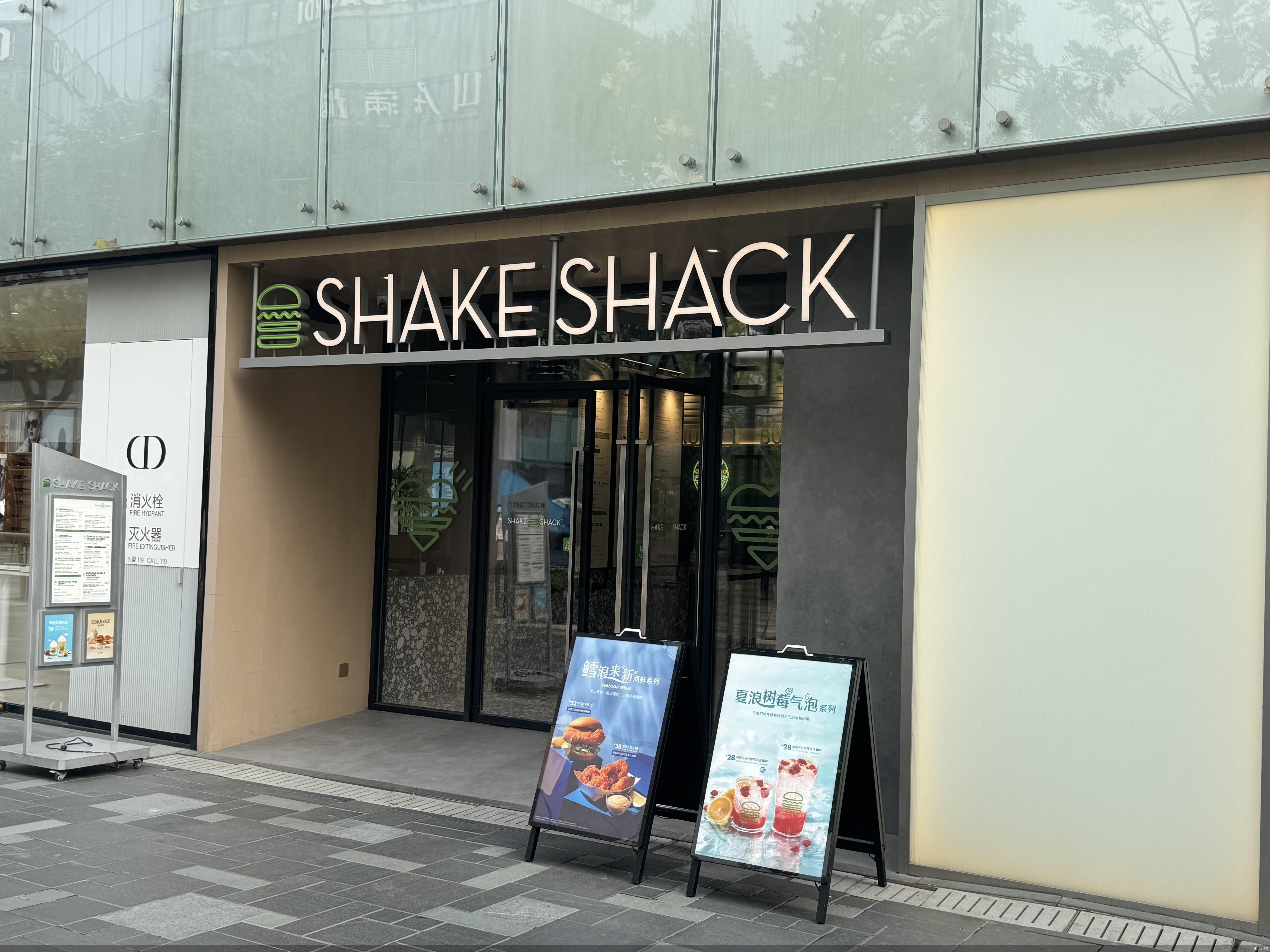
Shake Shack开起档口店 69元的汉堡也要接地气了?
Bei Jing Shang Bao· 2025-08-14 10:06
Core Viewpoint - Shake Shack is experimenting with a "takeout-focused" model by opening a small store in New York's Madison Square that only supports pickup and delivery, reflecting a localization strategy in response to market demands [1][12][13]. Company Summary - The new store format, located in Huadong Xincheng, operates as a central kitchen producing burgers and fries, with no dine-in service available [5][9]. - The menu at the new location includes signature items like the beef burger and crispy chicken burger, similar to offerings at the Sanlitun store, but with a more limited selection [5][10]. - Shake Shack's initial entry into the Chinese market was marked by long queues and high demand, but recent performance has been less favorable, with reports of store closures and food safety issues [10][12][13]. Industry Summary - The fast-food industry in China is highly competitive, and the rise of the delivery market has prompted brands to adapt their business models [12][13]. - The trend of opening delivery-focused stores is gaining traction, with companies like Meituan partnering with numerous brands to establish satellite stores that reduce operational costs by 50%-70% [14][16]. - Experts suggest that the future of restaurant growth may lie in lower-cost, flexible delivery models, as consumer preferences shift towards value [16].


Jim Cramer picks 3 stocks he likes right now
Finbold· 2025-08-05 11:37
Group 1: Stock Picks by Jim Cramer - Jim Cramer has identified Palantir, Shake Shack, and Cloudflare as stocks with strong upside potential [1][2] - Palantir reported exceptional second-quarter results with revenues exceeding $1 billion, leading to a stock surge of over 4% and a 500% rally over the past year [2][3] - Cramer predicts Palantir's stock could reach $200, indicating a potential upside of approximately 24% from its current price [3] Group 2: Shake Shack Insights - Cramer acknowledged Shake Shack's recent 14% decline but remains confident in its fundamentals under CEO Rob Lynch's leadership [4] - He emphasized the importance of long-term performance over short-term fluctuations, highlighting the company's strong social presence and value proposition [4] Group 3: Cloudflare Performance - Cloudflare reported second-quarter revenues of $512.3 million, reflecting a 28% year-over-year increase [5] - Cramer has previously praised Cloudflare's CEO Matthew Prince and expressed strong support for the company, indicating a positive outlook [5]



Is Chipotle's Unit Expansion Strategy Still a Recipe for Success?
ZACKS· 2025-08-01 15:46
Core Insights - Chipotle Mexican Grill (CMG) is aggressively expanding its unit count, opening 61 new restaurants in Q2 2025, including 47 with the high-efficiency Chipotlane format [1][11] - The company aims to reach 7,000 restaurants in the U.S. and Canada while exploring international markets like Europe and the Middle East [1] - Comparable sales decreased by 4% in Q2 2025, with full-year comps expected to be flat despite strong new store productivity [2][11] Expansion and Performance - Chipotle's infrastructure investments, including high-efficiency kitchen equipment, are designed to enhance throughput and prep efficiency [3] - Internationally, units in Kuwait are outperforming U.S. averages, and Canada is showing similar economic performance [3] - The challenge remains in converting expansion into consistent same-store growth while maintaining brand value [4] Competitive Landscape - Competition in the fast-casual sector is intensifying, with rivals like Shake Shack and Sweetgreen expanding aggressively [5][6][7] - Shake Shack is focusing on digital channels and format innovation, appealing to a similar customer base [6] - Sweetgreen targets health-conscious diners with a tech-enabled concept, posing a potential threat in suburban markets [7][8] Financial Metrics - Chipotle's shares have declined by 26.5% over the past six months, compared to a 5.4% decline in the industry [9] - The company trades at a forward price-to-sales ratio of 4.43X, higher than the industry average [12] - Zacks Consensus Estimates indicate an 8% and 17.4% year-over-year earnings growth for 2025 and 2026, respectively [13]

Final Trades: Dominion Energy, Agnico Eagle Mines, Ethan Allen and Shake Shack
CNBC Television· 2025-07-31 17:31
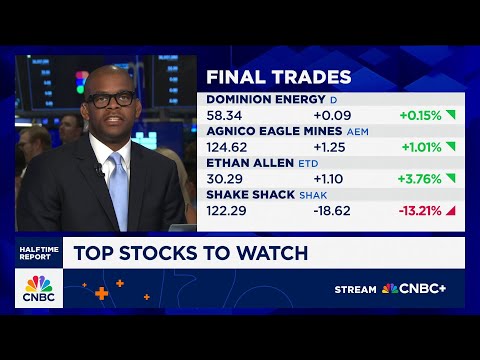
with final trades. Malcolm, you're up first. Yeah, I'm going Dominion Energy.We've been talking all show about increased capex from all the hyperscalers. That also means additional chips to build out data centers, but that's got to flow to things like energy and cooling. Bill Nico Mines, they reported a beat.They also almost doubled their free cash flow from the previous quarter. And what we're seeing here is a divergence from the weakness in gold. And so I I think gold's come back the second half of the ye ...
Trade Tracker: Josh Brown buys more Shake Shack
CNBC Television· 2025-07-31 17:18
Tom got some committee moves. Josh, you're buying some more Shake Shack. >> Yeah.Uh they reported a great quarter. The problem is the stock's up 100% going into the print from the April low. Was literally 72 and ran to almost 150.So today it's giving back some. But when you actually look at the numbers, they were really fantastic. And Rob Lynch is doing everything that this company brought him in to do.Um earnings were uh uh 44 cents per share um which beat the analyst consensus. revenue was 356.5% million ...

餐饮行业产品上新报告(2025年6月)
Hong Can Chan Ye Yan Jiu Yuan· 2025-07-31 14:27
Investment Rating - The report does not explicitly provide an investment rating for the restaurant industry Core Insights - The report analyzes the new product launch trends in the restaurant industry, focusing on six representative categories: Western fast food, noodles, tea drinks, coffee drinks, bakery, and hot pot. A total of 330 brands were monitored, with 177 brands launching new products in June 2025, accounting for 53.6% of the monitored sample. The total number of new products launched across these categories was 785, representing a 14.1% decrease compared to May 2025 [4][10][15]. Summary by Category Western Fast Food - In June 2025, 20 brands launched 66 new products, with dessert items leading at 24.2%. Innovations focused on filling and flavor, with 51.4% of new products emphasizing filling innovation, integrating local and healthy ingredients [24][17][22]. Noodles - Among 61 monitored brands, 21 launched 65 new products, with mixed noodles and dessert drinks forming a core launch strategy, together accounting for over 40%. The main innovation direction involved using local and wild ingredients as toppings, with 66.7% of innovations focusing on toppings [32][30]. Tea Drinks - A total of 64 brands launched 245 new products, with fruit tea leading the category. The report highlights the use of seasonal fruits and emphasizes the reduction of vegetable elements in new products. 73.1% of new products contained tea bases, with green tea being the most popular [35][36][40]. Coffee Drinks - 23 brands launched 78 new products, with fruit elements comprising 71.2% of the ingredients. Coffee liquid bases were predominant, making up 66% of new products. The report notes a trend towards complex flavor profiles in new coffee products [46][50][53]. Bakery - 33 brands launched 263 new products, with cakes being the most prevalent at 57.8%. The report indicates a focus on seasonal and health-oriented products, with a notable increase in the use of fruits and dairy ingredients [60][63]. Hot Pot - 16 brands launched 68 new products, with hot pot ingredients leading at 54.4%. The emphasis was on the quality of ingredients and traditional preparation methods, showcasing local specialties [66][64].
Cramer's Stop Trading: Shake Shack
CNBC Television· 2025-07-31 14:20
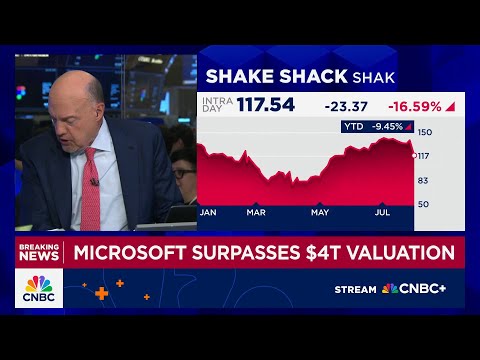
Market Trends - The consumer sector is weakening while the enterprise sector is strengthening [1] - Two distinct economies are currently in play [3] Company Performance & Challenges - Shake Shack's stock is down 23% due to rising beef prices [1] - Shake Shack and Chipotle are facing resistance to their price points [2] - Consumers are perceiving less value in their offerings, opting for cheaper alternatives like McDonald's [2] - Costco's short-term performance has been disappointing [3] Cost Analysis - Beef prices are up in the low teens percentage [1]
X @Forbes
Forbes· 2025-07-28 13:41
Danny Meyer made a name for himself running upscale NYC restaurants, but it was a hot dog stand he opened in 2001 to raise funds for a public park that led to Shake Shack. (Photo: Todd Williamson via Getty Images for Airbnb)https://t.co/nLzGsxBQ61 https://t.co/f4LXdQigu7 ...
如何抓住人工智能的第二序红利?
伍治坚证据主义· 2025-07-28 02:11
Core Viewpoint - The article emphasizes that the true beneficiaries of the AI revolution are not only the companies creating AI technologies but also those that effectively integrate AI into their operations to enhance efficiency and profitability, referred to as "second-order winners" [1][2][9]. Group 1: Historical Context and Examples - Historical examples illustrate that during technological revolutions, the greatest returns often come from companies that leverage new technologies rather than those that create them. For instance, the automotive industry saw more significant gains from downstream service providers than from car manufacturers [1][2]. - Gulf Refining's establishment of self-service gas stations exemplifies how companies can capitalize on technological advancements without being the creators of the technology [2]. Group 2: AI Integration in Companies - Companies like Shake Shack have successfully integrated AI and automation to enhance operational efficiency, reducing the time to prepare meals and lowering labor costs while increasing employee wages and profit margins [3]. - Ecolab's modeling indicates that it can automate approximately 50% of high-probability automation roles, leading to significant cost savings and improved profit margins without altering revenue [4]. Group 3: Chinese Companies Leveraging AI - JD Logistics has implemented the "Zhi Lang" system, which has tripled picking efficiency and significantly improved sorting accuracy, contributing to its profit growth [6]. - Ping An has effectively utilized AI in insurance processes, achieving rapid underwriting and claims processing, which has led to substantial cost reductions and enhanced customer experience [6]. Group 4: Investment Perspective - Investors are encouraged to focus on companies that have embedded AI into their operations, as these firms are likely to provide more stable returns compared to high-valuation AI technology creators [7]. - The characteristics of promising companies include labor-intensive operations that can benefit from AI cost reductions, clear and repetitive business processes, and the ability to scale AI applications effectively [7]. Group 5: Macro Economic Impact - The integration of AI is expected to reshape overall productivity in China, with projections indicating a potential GDP increase of about 8% by 2030 due to AI applications across various sectors [8]. - Companies that can quickly adapt and utilize AI to enhance efficiency are likely to continue benefiting from the efficiency dividends in the coming years [8]. Group 6: Conclusion - The article concludes that AI represents a revolution in efficiency, and investors should focus on companies that effectively integrate AI into their business models, as these "downstream" enterprises may yield better returns than those merely creating AI technologies [9].

塔斯汀“狂奔” 汉堡赛道加速洗牌
Zhong Guo Jing Ying Bao· 2025-07-25 21:12
Company Overview - Tasting has undergone significant equity changes, with all shares taken over by Tasting (HK) Holdings Limited, a company established in February 2023 [3][5] - The registered capital of Tasting surged from approximately 1.03 million to 119 million yuan, marking an increase of 11,323% [3] - Tasting aims to prepare for an IPO within the next five years, aligning with its previous statements and the current trend of restaurant companies going public in Hong Kong [3][4] Expansion and Market Position - As of June 11, Tasting operates 9,600 stores, nearing the "10,000 store" milestone, making it the third-largest hamburger chain in China by store count, surpassing McDonald's [3] - The company has experienced rapid expansion, with planned store openings of 2,315, 3,769, and 2,338 from 2022 to 2024 [4] - Tasting's strategy involves targeting lower-tier cities first, which allows it to avoid direct competition with major players like McDonald's and KFC [6][7] Competitive Landscape - The fast-food industry in China is highly competitive, with Tasting's differentiation stemming from its cost-effectiveness and localized Chinese-style hamburgers [8] - The market has seen a rise in price wars, with many brands struggling to maintain their market share, leading to closures of several high-end burger brands [8][9] - Major competitors, including KFC and McDonald's, are increasingly entering lower-tier markets, intensifying competition for Tasting [10] Challenges and Considerations - Tasting faces challenges related to supply chain management and food safety, which could impact its future IPO prospects [11] - The company must enhance its internal management and food safety protocols to ensure sustainable growth and compliance with industry standards [11]