平安银行

Search documents
《中国金融》|推动我国银行业供应链金融高质量发展
Sou Hu Cai Jing· 2025-11-05 10:35
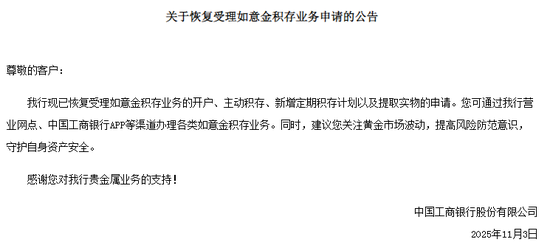
Core Viewpoint - Supply chain finance plays a crucial role in enhancing financial services for the real economy and alleviating financing difficulties for small and medium-sized enterprises (SMEs) in China. The banking sector, as a key participant, reflects the transformation of industrial structure and the innovative vitality of financial technology. The development of supply chain finance in China's banking industry is progressing towards a more standardized, intelligent, green, and inclusive high-quality development direction [1] Development Stages of Supply Chain Finance in China's Banking Industry - Initial Development Stage (2001-2009): The emergence of inventory pledge loans and factoring services in the late 19th century laid the groundwork for supply chain finance in China. The first pilot practices began in 2001, leading to a systematic development of supply chain finance services by banks, with financing scales ranging from hundreds of millions to billions [2] - Rapid Development Stage (2010-2017): Following several risk events, banks began to shift their focus from front-end to back-end operations, collaborating with core enterprises to provide financing for their upstream and downstream suppliers. The trend of platformization emerged, integrating information, goods, funds, and logistics to mitigate risks [3][4] - High-Speed Development Stage (2018-2024): The issuance of various national policies and the rapid advancement of financial technology have propelled the growth of supply chain finance. By 2023, the industry scale reached approximately 41.3 trillion yuan, with a year-on-year growth of 11.9% and a five-year compound annual growth rate of 20.88% [5][6] Challenges Facing Supply Chain Finance in China's Banking Industry - The precision of supply chain finance services needs improvement, as banks often lack in-depth research on the characteristics of different industrial chains, leading to homogenized financial products [9] - Customer acquisition and marketing strategies require enhancement, as traditional supply chain finance heavily relies on the credit endorsement of core enterprises, limiting service scope and increasing customer acquisition costs [9] - The overall level of digital application in supply chain finance needs to be elevated, with many banks facing challenges in data integration and application [9] - Cross-departmental and cross-regional cooperation, as well as the development of specialized talent, need strengthening to improve service efficiency and effectiveness [9] Policy Guidance for High-Quality Development - Recent policies emphasize the need for standardized development of supply chain finance, promoting collaboration among enterprises along the industrial chain. The focus is on enhancing the resilience and security of supply chains, aligning with national strategies for long-term development [10][11] Future Directions for Supply Chain Finance - The industry should innovate financial products tailored to the characteristics of technology-driven SMEs, support green transformation, and enhance accessibility for micro and small enterprises [13] - Exploring decentralized models and leveraging data credit and asset value can broaden financing channels for SMEs [14] - Strengthening technical empowerment and optimizing organizational structures will enhance service quality and accelerate the digital transformation of supply chain finance [15][16] - Promoting internationalization of supply chain finance will better serve China's advantageous industries and enterprises expanding abroad, necessitating compliance with cross-border regulations and the development of diverse financial products [17]
10月6家银行收到超千万罚单 行长任职资格罕见被否
2 1 Shi Ji Jing Ji Bao Dao· 2025-11-05 09:25
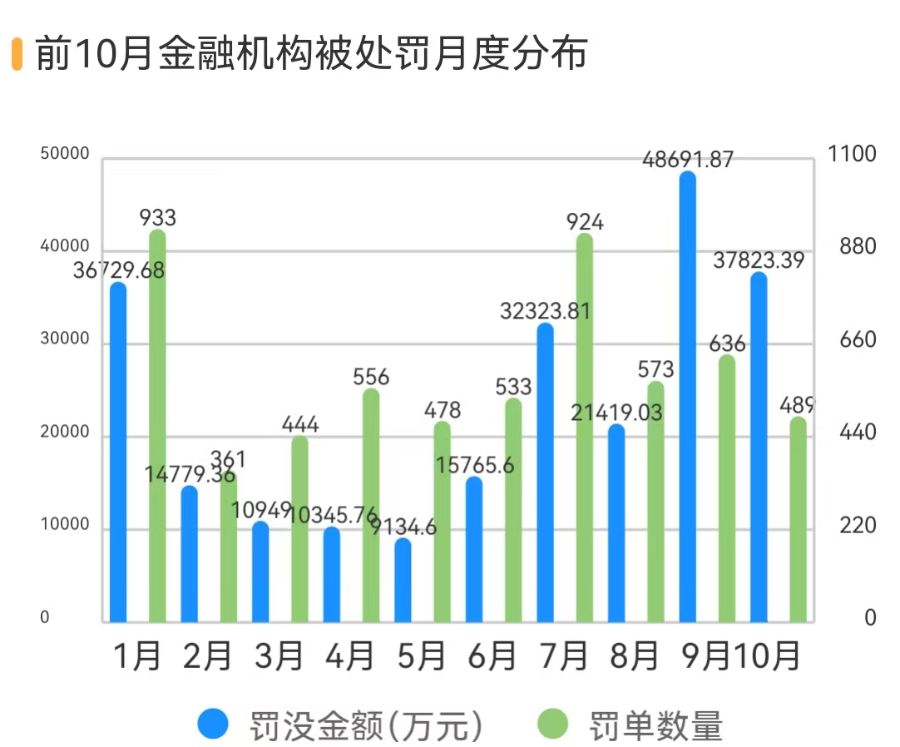
Core Insights - In October, financial institutions received 489 fines, a year-on-year decrease of 2.59%, but the total penalty amount reached 378 million yuan, a significant increase of 223.08% compared to the previous year [1][3] Summary by Categories Penalty Overview - The number of fines issued in October decreased compared to the first three months of the year, but the total penalty amount remains substantial, with October being the second highest for penalties this year, following September [1][3] Institution-Specific Penalties - Banks received 310 fines, a month-on-month decrease of 24.39% - Insurance companies received 108 fines, a month-on-month decrease of 16.92% - Securities firms received 16 fines, a month-on-month decrease of 42.86% - Futures and private equity fines also decreased, while insurance asset management companies remained stable compared to the previous month [5] Major Fines - Six fines in October exceeded 10 million yuan, with the largest fines against banks for issues related to corporate governance, loans, interbank transactions, and asset quality management [8][9] Compliance Cases - Five major compliance cases were highlighted, including: 1. Wenkang Securities faced criticism for issuing incorrect bond rates and results due to improper management of the issuance process [10] 2. Jintou Futures was ordered to rectify its operations after significant losses due to ineffective risk management [11] 3. A rare case of a bank president's qualification being denied due to non-compliance with regulatory requirements [13] Compliance Trends - There was a notable increase in penalties for improper loan issuance, with 19 fines issued, reflecting a year-on-year increase of 111.11% [14] - Penalties related to internal control management also rose, with 32 fines issued, a month-on-month increase of 52.38% [15] Penalty Rankings - China Agricultural Development Bank had the highest penalty amount in October, continuing its trend from the third quarter [18] - Zhongcheng Trust received the largest penalty among non-bank institutions, totaling 6.6 million yuan for various compliance violations [21]




平安银行股份有限公司关于聘任宋菁为资产托管部副总经理的公告
Zheng Quan Ri Bao Wang· 2025-11-05 04:49
平安银行股份有限公司 2025年11月5日 平安银行股份有限公司研究决定,聘任宋菁为平安银行股份有限公司资产托管部副总经理。 特此公告。 ...

平安银行股份有限公司关于资产托管部副总经理(主持工作)离任的公告
Zheng Quan Ri Bao Zhi Sheng· 2025-11-05 04:39
Core Viewpoint - Ping An Bank has announced that Huang Wei will no longer serve as the Deputy General Manager of the Asset Custody Department (acting) [1] Group 1 - The company has made a decision based on operational needs regarding the leadership of the Asset Custody Department [1] - The company will comply with regulatory requirements to manage the departure process of the Deputy General Manager of the Asset Custody Department [1]
黄金大消息!一银行宣布:今起暂停
Sou Hu Cai Jing· 2025-11-05 03:21
Core Viewpoint - Industrial and Commercial Bank of China (ICBC) will suspend certain "Ruyi Gold Accumulation" business applications starting November 3, 2025, due to macroeconomic policy impacts and risk management requirements [1][4]. Group 1: Business Suspension Details - ICBC will halt the acceptance of new accounts, proactive accumulation, new fixed accumulation plans, and requests for physical withdrawals for the "Ruyi Gold Accumulation" business starting November 3, 2025 [1][4]. - Existing customers with valid fixed accumulation plans will not be affected in terms of execution, redemption, or account closure [4]. Group 2: Recent Changes and Market Conditions - On October 11, ICBC announced an increase in the minimum investment amount for the "Ruyi Gold Accumulation" business from 850 yuan to 1000 yuan, while the minimum for accumulation by grams remains at 1 gram [4]. - The bank has advised investors to be aware of market fluctuations and to enhance risk awareness, suggesting that they consider their financial situation and risk tolerance when purchasing gold [6]. Group 3: Industry Trends - Several banks, including ICBC, Bank of China, Ping An Bank, and Industrial Bank, have raised the minimum investment thresholds for gold accumulation products since October [7][9]. - For instance, Bank of China increased its minimum purchase amount from 850 yuan to 950 yuan starting October 15, while Ping An Bank raised its minimum for fixed investment plans from 900 yuan to 1100 yuan [7][9]. - The banking sector is responding to rising gold prices and increased market volatility by adjusting thresholds and issuing risk warnings to better manage risks and protect consumer rights [9].


中国金融业 - 追踪行业风险,反内卷努力逐步且明确的进展愈发清晰-China Financials-Tracking industrial risks more clear evidence of gradual but definitive progress on anti-involution efforts
2025-11-05 02:30
Summary of Key Points from the Conference Call Industry Overview - **Industry Focus**: China Financials, specifically the manufacturing sector and industrial risks in Asia Pacific [1][6][8] Core Insights and Arguments - **Capital Expenditure (Capex) Trends**: In September, 20 sectors experienced a slowdown in fixed asset investment (FAI) growth, compared to 16 sectors in August. This trend is attributed to continued moderation in FAI growth, which has helped close the gap between manufacturing FAI and industrial production (IP) [2][8] - **Profit Growth**: Manufacturing profit growth improved to 9.9% year-over-year (YoY) in September from 7.4% in August. Year-to-date (YTD) industrial profit increased by 3.2% YoY, up from 0.9% in August. This indicates a shift from expansion to moderation in industrial credit risks [4][8] - **Anti-Involution Efforts**: The ongoing anti-involution efforts in China are believed to have contained intense price competition in certain sectors, leading to improved profit margins. The moderation in industrial liability growth is linked to these efforts and a gradual reduction in funding support since the first half of 2024 [3][4] - **Manufacturing FAI Growth**: YTD manufacturing FAI growth declined to 4.0% YoY in September from 5.1% in August, contributing to the closure of the gap between manufacturing FAI and IP [8][10] Additional Important Insights - **Sector Performance**: In September, 76.6% of sectors (in terms of liabilities) saw a slowdown in capex growth compared to the first half of 2024. Additionally, 39.5% of manufacturing sectors reported better profit trends [9][8] - **Producer Price Index (PPI)**: The PPI remained flat month-over-month in September, with the YoY decline narrowing to 2.3% from 2.9% in August [8] - **Loan Growth**: Medium- to long-term loan growth for industrial firms moderated to 9.7% YoY, while industrial firms' liability growth decreased to 5.2% YoY [8] Conclusion - The overall sentiment in the China financials sector is cautiously optimistic, with signs of gradual improvement in profit growth and a controlled approach to credit supply and investment. The anti-involution measures are playing a significant role in stabilizing the market dynamics and reducing risks associated with overcapacity and credit [3][4][6]
公告速递:银华惠增利货币基金A类基金份额暂停代销机构的机构投资者大额申购业务
Sou Hu Cai Jing· 2025-11-05 02:10
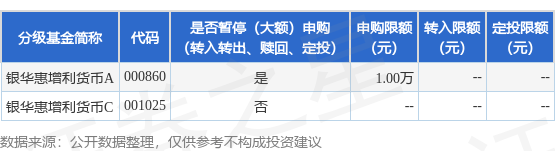
证券之星消息,11月5日银华基金管理股份有限公司发布《银华惠增利货币市场基金A类基金份额暂停代销机构的机构投资者大额申购(含定期定 额投资及转换转入)业务的公告》。公告中提示,为保护现有基金份额持有人利益,自2025年11月5日起银华惠增利货币市场基金A类基金份额暂 停代销机构的机构投资者大额申购(含定期定额投资及转换转入)业务,下属分级基金调整明细如下: | 分级基金简称 | 代码 | 是否暂停(大额)申购 | 申购限额 转入限额 定投限额 | | | --- | --- | --- | --- | --- | | | | (转入转出、赎回、定投) | (元) (元) | (元) | | 银丝事增利合币A 000860 | | 류 | 1.00万 | | | 银华惠增利倍币C 001025 | | 资 | | | 注:1、银华基金管理股份有限公司决定自2025年11月5日(含2025年11月5日)暂停本基金代销机构的机构投资者办理本基金A类基金份额1万元以 上的大额申购(含定期定额投资及转换转入)业务。在暂停代销机构的机构投资者办理银华惠增利货币市场基金A类基金份额的大额申购(含定 期定额投资及转换转入)业 ...
公告速递:银华多利宝货币基金B类基金份额暂停代销机构的机构投资者大额申购业务
Sou Hu Cai Jing· 2025-11-05 02:10
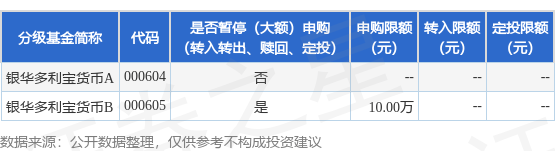
注:1、银华基金管理股份有限公司决定自2025年11月5日(含2025年11月5日)起暂停代销机构的机构投资者办理本基金B类基金份额10万元以上的 大额申购(含定期定额投资及转换转入)业务,敬请投资者留意。 2、在暂停代销机构的机构投资者办理银华多利宝货币市场基金B类份额10万元以上的大额申购(含定期定额投资及转换转入)业务期间,机构投 资者可分别从兴业银行股份有限公司、中国邮政储蓄银行股份有限公司、中信银行股份有限公司、平安银行股份有限公司、中国民生银行股份有 限公司、宁波银行股份有限公司、中国建设银行股份有限公司、招商银行股份有限公司、江苏银行股份有限公司、通华财富(上海)基金销售有限 公司、蚂蚁(杭州)基金销售有限公司、上海攀赢基金销售有限公司和其他代销机构分别办理不超过10万元的申购(含定期定额投资及转换转 入)业务。如单日每个基金账户的申购申请、转换转入、定期定额投资单笔或累计金额超过以上情况,本基金管理人有权拒绝。针对单笔申购业 务申请,仅有确认和不予确认两种处理方式,不存在对单笔申请的部分确认。敬请投资者留意。 3、在本基金B类基金份额限制代销机构的机构投资者大额申购(含定期定额投资及转换转入) ...
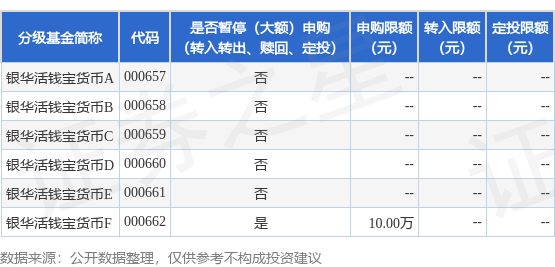
公告速递:银华活钱宝货币基金F类基金份额暂停代销机构的机构投资者大额申购业务
Sou Hu Cai Jing· 2025-11-05 02:07
证券之星消息,11月5日银华基金管理股份有限公司发布《银华活钱宝货币市场基金F类基金份额暂停代销机构的机构投资者大额申购(含定期定 额投资及转换转入)业务的公告》。公告中提示,为保护现有基金份额持有人利益,自2025年11月5日起银华活钱宝货币市场基金F类基金份额暂 停代销机构的机构投资者大额申购(含定期定额投资及转换转入)业务,下属分级基金调整明细如下: | 分级基金简称 | 代码 | 是否暫停(大额) | 申购 | 申购限额 | 转入限额 | 定投限额 | | --- | --- | --- | --- | --- | --- | --- | | | | (转入转出、赎回、 | 定投) | (元) | (元) | (元) | | 银华活钱宝货币A | 000657 | 音 | | | | | | 银华活钱宝货币B | 000658 | 高 | | | | | | 银华活钱宝贷币C 000659 | | KO | | | | | | 银华活钱宇货币D 000660 | | 版 | | | | | | 银华活钱宝资讯 000661 | | KO | | | | | | 银华活钱宝贸用F 000662 | | ...
黄金税收新规实施后,工行如意金积存业务暂停又恢复!招行金条价格已含税
Xin Lang Cai Jing· 2025-11-05 01:00
Core Viewpoint - Several banks have adjusted their gold accumulation businesses in response to recent macroeconomic policies and tax changes related to gold transactions, leading to temporary suspensions and subsequent restorations of certain services [1][17]. Group 1: Business Adjustments - On November 3, Industrial and Commercial Bank of China (ICBC) announced the suspension of its "Ruyi Gold Accumulation" business, which includes account openings, active accumulation, new fixed accumulation plans, and physical gold withdrawals [1][3]. - China Construction Bank (CCB) also announced similar suspensions on the same day, citing market volatility and risk management requirements [3][10]. - ICBC later restored its Ruyi Gold Accumulation services on the same evening, confirming that customers could resume various transactions through multiple channels [4][5]. Group 2: Tax Policy Changes - On November 1, the Ministry of Finance and the State Administration of Taxation released an announcement adjusting the value-added tax (VAT) policies related to gold transactions, which took effect on November 1 [1][17]. - The new tax policies specify that transactions involving standard gold at the Shanghai Gold Exchange and Shanghai Futures Exchange will be exempt from VAT under certain conditions, impacting how banks manage their gold accumulation services [17]. Group 3: Market Reactions - Following the announcement of tax policy changes, many banks, including ICBC and CCB, issued risk warnings regarding gold investments, advising customers to be cautious due to increased market volatility [16][18]. - As of now, ICBC's app indicates that physical Ruyi gold bars are temporarily out of stock, reflecting the impact of these adjustments on product availability [7][9]. Group 4: Customer Communication - Banks have been proactive in communicating changes to customers, with ICBC staff confirming the restoration of services and advising clients to stay informed about market fluctuations [5][6]. - Customer service representatives from various banks, including China Merchants Bank, have indicated that adjustments to gold bar prices now include tax costs, aligning with the new tax regulations [15].