
南京银行

Search documents
美联储一降息,银行利息和金价都坐不住了!普通人的钱该往哪放?
Sou Hu Cai Jing· 2025-10-21 05:16
Core Viewpoint - The recent interest rate cut by the Federal Reserve has led to a significant increase in gold prices, reaching over $3,700 per ounce, prompting discussions about the implications for savings and investment strategies [1][3]. Group 1: Impact of Federal Reserve's Rate Cut - The Federal Reserve's decision to cut interest rates has resulted in lower deposit interest rates at banks, with some rates dropping from around 4% to just above 3% [3][5]. - The reduction in interest rates decreases the opportunity cost of holding gold, making it a more attractive investment option as it does not generate interest [5][6]. - A weaker dollar, resulting from the rate cut, increases the price of gold, which is priced in dollars, leading to higher demand for gold as a safe haven asset amid economic uncertainty [6][10]. Group 2: Market Reactions and Predictions - Experts suggest that the gold price may continue to rise due to the ongoing low interest rate environment, with predictions of a prolonged period of increasing gold prices [3][6]. - There is a cautionary note regarding the stock market, as the anticipated benefits from the rate cut may already be priced in, potentially leading to a "buy the rumor, sell the news" scenario [8]. - The relationship between the dollar, oil prices, and gold is highlighted, indicating that both the dollar's strength and oil prices are crucial factors influencing gold's market dynamics [10][11]. Group 3: Long-term Considerations - The ongoing geopolitical tensions and the actions of global central banks, such as China's continued accumulation of gold, suggest a growing concern over the stability of the dollar and its credit system [13][15]. - The potential for rising oil prices could alter the current dynamics, impacting the strength of the dollar and subsequently the price of gold [11][15]. - The overall uncertainty in the market prompts individuals to reconsider their investment strategies, weighing the safety of cash savings against the potential benefits of diversifying into gold or other assets [15].


存款利率“倒挂”频现,存5年不如存3年
2 1 Shi Ji Jing Ji Bao Dao· 2025-10-20 12:41
Core Viewpoint - The recent trend of banks lowering deposit interest rates has become commonplace, particularly among small and medium-sized banks, with significant reductions in long-term deposit rates due to strong market expectations for future interest rate cuts [1][2][3]. Group 1: Deposit Rate Adjustments - Multiple banks, especially small and medium-sized ones, have recently announced reductions in deposit rates, with the most significant cuts observed in three-year and five-year deposit rates, decreasing by 15 to 40 basis points [1][2]. - Shanghai Huari Bank reduced its three-year fixed deposit rate from 2.3% to 2.15%, marking the seventh rate cut this year, with similar actions taken by other small banks [2][3]. - The overall trend shows that national banks' three-year and five-year fixed deposit rates have dropped to the 2% range, with some even falling below 1% [3][5]. Group 2: Reasons for Rate Cuts - The primary reasons for the recent deposit rate cuts include the need to address net interest margin pressures and the desire to reduce funding costs in a declining deposit rate environment [3][4]. - Analysts suggest that the adjustments are not coincidental but are related to the economic realities, indicating a potential improvement in the operational ecosystem of small and medium-sized banks [5][6]. Group 3: Interest Rate Inversion - A notable phenomenon is the frequent occurrence of interest rate inversion, where long-term deposit rates are lower than short-term rates, contrary to typical expectations [6]. - For instance, Shanghai Huari Bank's three-year deposit rate is 2.15%, while the five-year rate is slightly lower at 2.1%, highlighting this inversion trend [6]. - Analysts believe that banks are intentionally guiding depositors towards shorter-term deposits to manage the costs associated with long-term deposits, indicating a strategic shift in deposit pricing [6].

存款利率“倒挂”频现,存5年不如存3年
21世纪经济报道· 2025-10-20 12:33
Core Viewpoint - The recent trend of banks lowering deposit interest rates has become a norm, particularly among small and medium-sized banks, with significant cuts in long-term deposit rates, driven by strong market expectations for future interest rate reductions [1][4]. Group 1: Deposit Rate Adjustments - Multiple banks, especially small and medium-sized ones, have recently lowered their deposit rates, with the most significant reductions seen in long-term deposits, particularly three-year and five-year terms, with cuts ranging from 15 to 40 basis points [1][4]. - Shanghai Huari Bank announced a reduction in its three-year fixed deposit rate from 2.3% to 2.15%, marking its seventh rate cut this year [3]. - Other banks, such as Tianjin Jincheng Bank and Henan Luoyang Rural Commercial Bank, have also adjusted their deposit rates, with some reductions reaching up to 35 basis points [3][4]. Group 2: Net Interest Margin Pressure - The continuous narrowing of net interest margins is pressuring banks to lower deposit rates to alleviate costs on the liability side [5][7]. - Data from the National Financial Regulatory Administration shows that commercial banks' net interest margins have decreased from 1.52% at the end of last year to 1.42% by the end of the second quarter this year [7]. Group 3: Long-Short Rate Inversion - A notable phenomenon is the frequent occurrence of long-short rate inversion, where long-term deposit rates are lower than short-term rates, contrary to typical expectations [6][8]. - For instance, Shanghai Huari Bank's three-year deposit rate is 2.15%, while its five-year rate is slightly lower at 2.1% [8]. - Analysts suggest that banks are intentionally guiding depositors towards shorter-term deposits to manage the pressure from high-interest long-term deposits maturing in 2025 [8].

有银行今年降了七次!存款利率又双叒下调
2 1 Shi Ji Jing Ji Bao Dao· 2025-10-20 11:12
Core Viewpoint - The recent trend of banks lowering deposit interest rates has become a norm, particularly among small and medium-sized banks, with significant reductions in long-term deposit rates due to strong market expectations for future interest rate cuts [1][5]. Group 1: Deposit Rate Adjustments - Multiple banks, especially small and medium-sized ones, have recently announced reductions in deposit rates, with the most significant cuts observed in three-year and five-year deposit rates, decreasing by 15 to 40 basis points [1][3]. - Shanghai Huari Bank reduced its three-year fixed deposit rate from 2.3% to 2.15%, marking its seventh rate cut this year, with similar actions taken by other small banks [3][4]. - The overall trend shows that national banks have seen their three-year and five-year fixed deposit rates drop to the 2% range, with some even falling to the 1% range [5][6]. Group 2: Reasons for Rate Cuts - The primary reasons for the recent deposit rate cuts include the need to address net interest margin pressures and the desire of small banks to narrow the gap in funding costs compared to larger banks [5][6]. - Analysts suggest that the continuous narrowing of net interest margins has compelled small banks to lower deposit rates to alleviate funding costs [5][6]. Group 3: Interest Rate Inversion - A notable phenomenon is the frequent occurrence of interest rate inversion, where long-term deposit rates are lower than short-term rates, contrary to typical expectations [7]. - For instance, Shanghai Huari Bank's three-year deposit rate is 2.15%, while the five-year rate is slightly lower at 2.1%, indicating this inversion trend [7]. - Analysts believe that banks are strategically lowering long-term deposit rates to optimize their liability structure and manage the costs associated with long-term deposits [7].

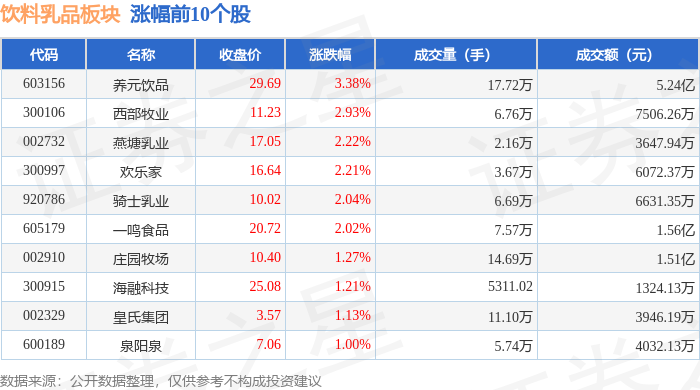
饮料乳品板块10月20日跌0.05%,新乳业领跌,主力资金净流入1.51亿元
Zheng Xing Xing Ye Ri Bao· 2025-10-20 08:30
Market Overview - The beverage and dairy sector experienced a slight decline of 0.05% on October 20, with New Dairy leading the drop [1] - The Shanghai Composite Index closed at 3863.89, up 0.63%, while the Shenzhen Component Index closed at 12813.21, up 0.98% [1] Stock Performance - Notable gainers in the beverage and dairy sector included: - Yangyuan Beverage: closed at 29.69, up 3.38% with a trading volume of 177,200 shares and a turnover of 524 million yuan [1] - Western Pastoral: closed at 11.23, up 2.93% with a trading volume of 67,600 shares and a turnover of 75.06 million yuan [1] - Other gainers included Caobo Daobu, Huanlejia, and Qishi Dairy, all showing positive performance [1] - Conversely, New Dairy saw a significant decline of 4.36%, closing at 17.10 with a trading volume of 73,000 shares and a turnover of 126 million yuan [2] Capital Flow - The beverage and dairy sector saw a net inflow of 151 million yuan from institutional investors, while retail investors experienced a net outflow of 66.42 million yuan [2] - Major stocks with significant capital flow included: - Yili Group: net inflow of 65.81 million yuan from institutional investors, but a net outflow of 51.30 million yuan from retail investors [3] - Dongpeng Beverage: net inflow of 56.42 million yuan from institutional investors, with retail investors also showing a net outflow [3] - Yangyuan Beverage and other stocks also reflected similar trends in capital flow [3]



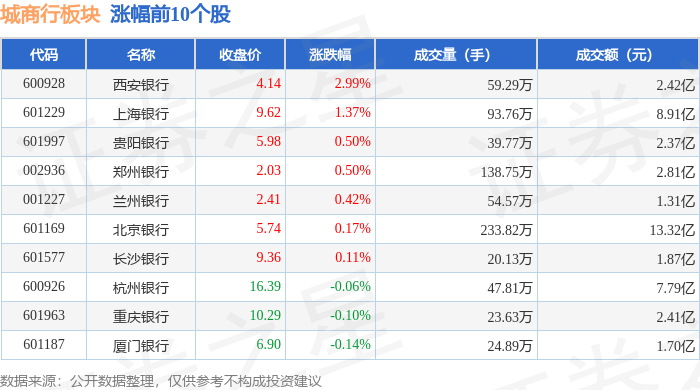
城商行板块10月20日跌0.32%,江苏银行领跌,主力资金净流入2317.93万元
Zheng Xing Xing Ye Ri Bao· 2025-10-20 08:27
Core Insights - The city commercial bank sector experienced a decline of 0.32% on October 20, with Jiangsu Bank leading the drop [1] - The Shanghai Composite Index closed at 3863.89, up 0.63%, while the Shenzhen Component Index closed at 12813.21, up 0.98% [1] Stock Performance - Xi'an Bank (600928) closed at 4.14, up 2.99% with a trading volume of 592,900 shares and a transaction value of 242 million [1] - Shanghai Bank (601229) closed at 9.62, up 1.37% with a trading volume of 937,600 shares and a transaction value of 891 million [1] - Jiangsu Bank (616009) closed at 10.79, down 1.82% with a trading volume of 1,603,000 shares and a transaction value of 173.3 million [2] Capital Flow - The city commercial bank sector saw a net inflow of 23.18 million from institutional investors, while retail investors contributed a net inflow of 52.95 million [2] - The sector experienced a net outflow of 76.12 million from speculative funds [2] Individual Stock Capital Flow - Qilu Bank (601665) had a net inflow of 63.84 million from institutional investors, while it faced a net outflow of 17.01 million from speculative funds [3] - Shanghai Bank (601229) saw a net inflow of 54.98 million from institutional investors, with a net outflow of 18.63 million from speculative funds [3] - Ningbo Bank (002142) recorded a net inflow of 51.83 million from institutional investors, while speculative funds had a net outflow of 45.06 million [3]





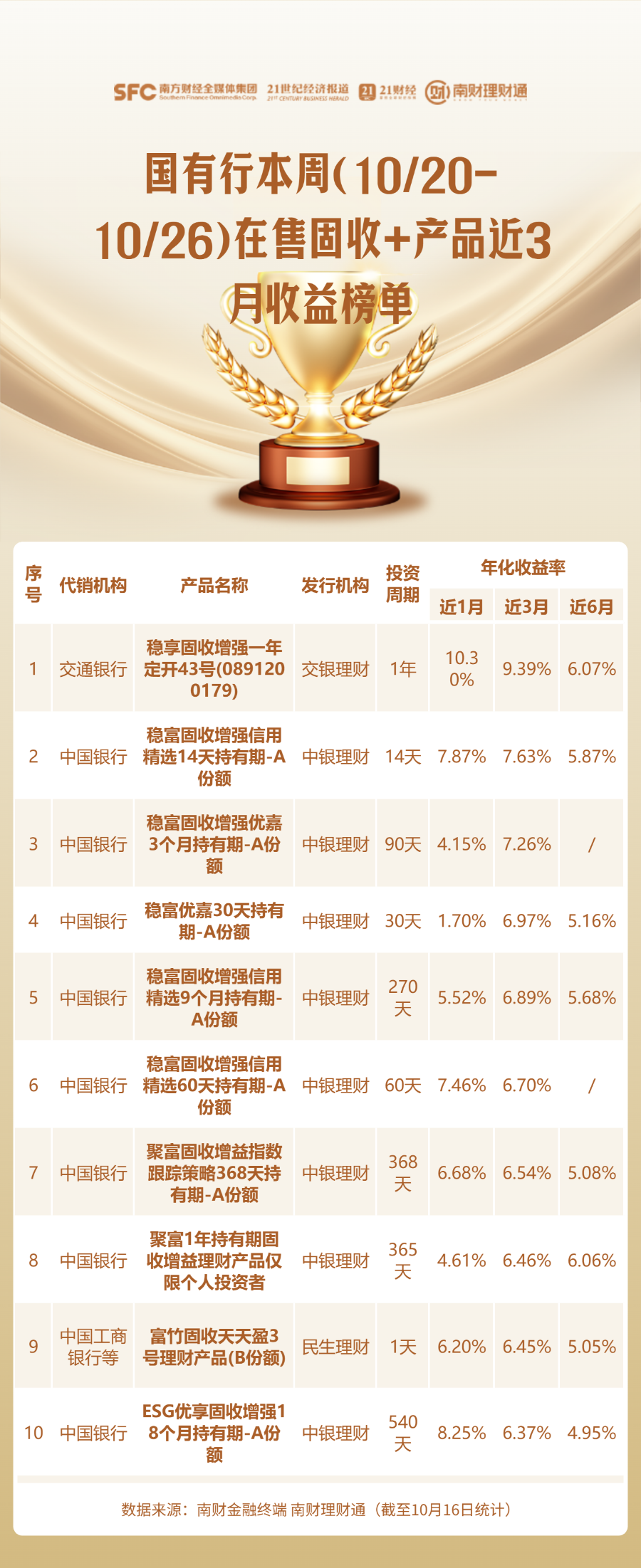
股份行、城商行本周均有近3月年化超14%固收+理财在售
2 1 Shi Ji Jing Ji Bao Dao· 2025-10-20 01:13
Core Insights - The article emphasizes the abundance of bank wealth management products with similar names and vague characteristics, urging investors to carefully select and differentiate among them [1] - The focus is on "fixed income +" products issued by wealth management companies, highlighting those with superior performance in the current market [1] Summary by Category Performance Metrics - The report provides a performance ranking of wealth management products based on their annualized returns over the past month, three months, and six months, sorted by the three-month annualized yield [1] - Notable products include: - China Bank's "Enhanced Fixed Income" with a 14-day holding period yielding 7.87% [4] - Industrial Bank's "Ruili Xingcheng Jinxin Daily Open" with a one-day holding period yielding 12.3% [6] Distribution Channels - The analysis includes 28 distribution institutions such as Industrial Bank, China Bank, Agricultural Bank, and others, indicating a wide range of available products [1] - The report suggests that the availability of products may vary based on actual sales conditions and customer-specific offerings [1] Recommendations for Investors - Investors are advised to refer to the actual product listings on the distribution banks' apps for the most accurate purchasing information, as the report's assessment of "on-sale" status is based on investment cycle projections [1]
青春华章丨读懂宁!行走城墙70里,丈量环城诗意
Nan Jing Ri Bao· 2025-10-20 00:38
Core Viewpoint - The "Walking Nanjing 70 Miles" charity walking event aims to promote the protection of the Nanjing City Wall while fostering community engagement and cultural appreciation [1][4]. Group 1: Event Overview - The event took place on October 19, 2025, with over a thousand participants walking along a 35-kilometer route around the Nanjing City Wall [1]. - This annual cultural walking event has been ongoing for ten years, linking the historical significance of the city wall with modern community efforts [1][4]. Group 2: Community Engagement - Participants expressed excitement about the historical significance of the city wall, with one international student noting its 600-year history and the changes in the city over time [4]. - The event featured interactive elements, such as a photo-taking app that allowed participants to create personalized images in traditional Hanfu attire [6]. Group 3: Charity and Public Welfare - All registration fees from the event were donated to support the protection of the Nanjing City Wall, emphasizing the integration of health and cultural initiatives [8]. - A charity market was set up, where local students sold items to raise funds for sick children, showcasing community spirit and involvement in charitable causes [8]. Group 4: Event Highlights - The event included various surprises for participants, such as interactions with mascots and special activities like tea tasting, enhancing the overall experience [10]. - The event was organized by multiple entities, including the Nanjing Media Group and the Nanjing City Wall Protection Management Center, with support from various local organizations [10].


江苏53家主体发行527亿元
Xin Hua Ri Bao· 2025-10-19 21:42
Group 1 - The issuance of technology innovation bonds in Jiangsu has reached a total of 94 bonds with a total issuance amount of 52.7 billion yuan since the new regulations were implemented on May 7 [1] - Long-term bonds are becoming more prevalent, with 64% of the bonds having a maturity of over 3 years and approximately 27% over 5 years [1] - A diverse range of issuers is participating, including AAA-rated manufacturing leaders and AA-rated venture capital groups, with funds primarily allocated for working capital needs [1] Group 2 - Private equity investment institutions have emerged as a significant issuer category under the new regulations, with the first private venture capital institutions successfully issuing technology innovation bonds [2] - The first bank-intermediated technology innovation bonds were issued by Yuanhe Holdings, featuring a 3-year term and a coupon rate of 1.92%, setting a new low for similar bonds [2] - Financial institutions are actively participating, with Dongwu Securities issuing 1.2 billion yuan in technology innovation bonds at a rate of 1.74%, attracting significant interest from various institutional investors [2]




如何展望银行股行情的持续性?
2025-10-19 15:58
Summary of Conference Call on Banking Sector Outlook Industry Overview - The conference call focuses on the banking sector, particularly the performance and outlook of bank stocks in the context of macroeconomic conditions and policy support [1][3][7]. Core Insights and Arguments - **Sustained Performance of Bank Stocks**: The banking sector is expected to maintain a positive trajectory, benefiting from the establishment of risk bottom lines in urban investment real estate, policy support for debt resolution, and capital replenishment in small and medium-sized banks [1][3]. - **Valuation Recovery**: The foundation for valuation recovery in the banking sector is solid, supported by effective risk control in urban investment real estate and high growth in net interest income. Major urban commercial banks are leading in balance sheet expansion and have stabilized net interest margins [1][5]. - **Market Discrepancies on Interest Rate Outlook**: There is a divergence in market views regarding future interest rate trends. Some investors are concerned about potential negative impacts on the bond market if rates rise. However, leading banks have shifted focus from non-interest income to net interest income growth, which is expected to continue into the next year [6]. - **Investment Recommendations**: The fourth quarter is identified as a key period for investment. Recommended stocks include quality urban commercial banks such as Nanjing Bank, Jiangsu Bank, Qilu Bank, and Hangzhou Bank due to their low valuations, high dividend yields, and strong profit growth. Large commercial banks like China Merchants Bank are suggested as core holdings [1][7]. - **Attractive Dividend Yields**: In the H-share market, large state-owned commercial banks like Industrial and Commercial Bank of China (ICBC) offer attractive dividend yields close to 6%, making them worthy of attention for their valuation recovery potential [1][7]. Additional Important Insights - **Capital Flows**: Despite a general outflow of active funds in the third quarter, local state-owned enterprises and industrial capital have been increasing their holdings in bank stocks, indicating optimism about the sector's future performance. For instance, Shanghai Pudong Development Bank received investment from an Asset Management Company (AMC), and several urban commercial banks have seen significant share purchases by major shareholders [8]. - **Performance Comparison**: In the recent trading week, bank stocks ended a continuous decline since July 10, achieving a 5% absolute return, outperforming the broader market indices [2]. This summary encapsulates the key points discussed in the conference call regarding the banking sector's outlook, investment strategies, and market dynamics.