浦发银行

Search documents
AMC与险资的投资交集:银行股何以成为“核心锚点”
Zhong Guo Zheng Quan Bao· 2025-12-03 20:28
Core Viewpoint - AMC has increased its stake in China Everbright Bank, raising its holding to 9% as part of a strategic investment plan, while insurance funds have also significantly increased their investments in the banking sector, indicating a strong interest in bank stocks as a core investment option for long-term capital [1][2][3] Group 1: AMC's Investment Actions - China Everbright Bank announced that CITIC Financial Asset has increased its holdings by 275 million A-shares and 315 million H-shares, raising its total stake from 8% to 9% [1] - CITIC Financial Asset's previous increase in July raised its stake from 7.08% to 8% through the acquisition of 264 million A-shares and 279 million H-shares [1] - The total assets of China Everbright Bank reached 7.2 trillion yuan by the end of Q3 2025, showing steady growth [1] Group 2: Insurance Capital Involvement - Insurance capital has been actively increasing its holdings in bank stocks, with a total market value exceeding 400 billion yuan by the end of Q3 [1][3] - Insurance funds have acquired an additional 2.689 billion shares of bank stocks in Q3 compared to Q2, bringing the total holdings to over 47 billion shares [3] Group 3: Investment Rationale - The stable high dividend returns of bank stocks are a key attraction for institutional investors, with the average dividend yield of A-share listed banks exceeding 4% [3] - The banking sector is characterized by low valuations and low volatility, with most banks trading below a price-to-book ratio of 1, indicating a "broken net" status [3][4] - Despite challenges such as narrowing interest margins, banks have maintained stable profitability through asset structure optimization and risk management [4] Group 4: Future Outlook - Analysts suggest focusing on banks with diversified businesses, complete licenses, and strong performance stability for long-term investments [4]

银行集体公告!“资金通道”风险暗藏
证券时报· 2025-12-03 08:48
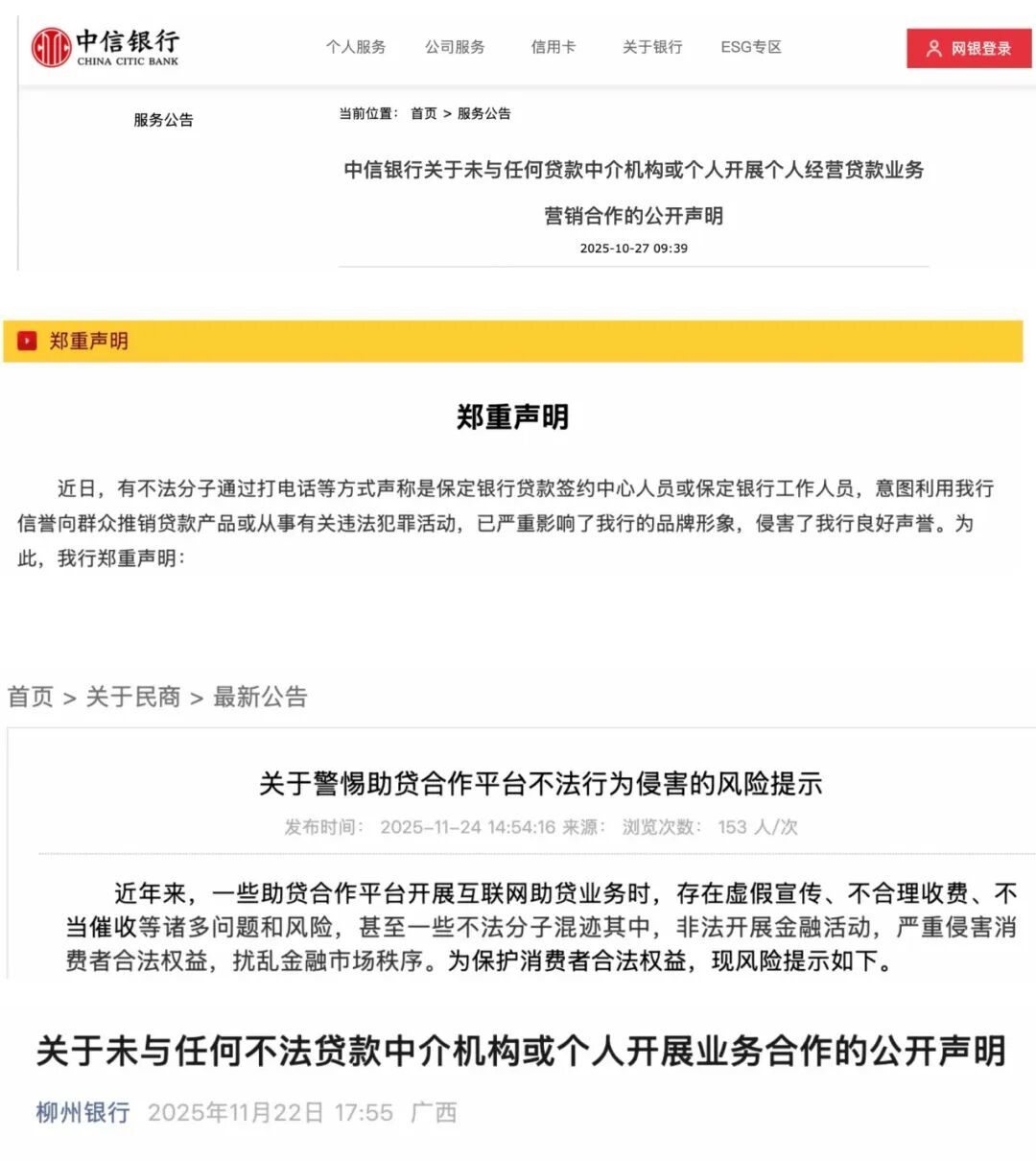
Core Viewpoint - The article highlights the increasing activity of illegal loan intermediaries as the year-end approaches, prompting banks to issue warnings to customers about potential risks associated with these intermediaries [1][4]. Group 1: Bank Responses - Over ten banks, including Citic Bank and Baoding Bank, have issued announcements stating they do not collaborate with loan intermediaries and have warned customers about fraudulent activities [4]. - Citic Bank specifically noted that it does not charge any fees beyond the interest explicitly stated in the loan contract and does not bundle other products with its loans [4]. Group 2: Reasons for Illegal Intermediaries - The persistence of illegal loan intermediaries is attributed to several factors: insufficient effective financing demand, increased difficulty in credit issuance, and a lack of understanding among consumers regarding financial products and services [5]. - The financial information asymmetry allows consumers to be misled by intermediaries, and the covert nature of many intermediary operations complicates regulatory enforcement [5]. Group 3: Risks Associated with Loan Intermediaries - Risks linked to illegal loan intermediaries include high service fees, false advertising, and potential personal information leaks [6]. - Some platforms engage in deceptive practices, advertising low surface interest rates while imposing actual annualized rates that exceed regulatory limits [6]. Group 4: Regulatory Changes - The implementation of new regulations in October 2025 aims to strengthen the management of internet loan services by requiring banks to maintain a list of approved partner institutions [7]. - As of late October, 120 financial institutions have disclosed their lists of approved loan service partners, with many regional banks significantly reducing their number of partnerships [8]. Group 5: Future Implications - The new regulations are expected to create significant operational adjustments for banks, particularly smaller ones that heavily rely on loan intermediaries, pushing them to focus on core business practices and high-quality development [8][9]. - Banks are encouraged to enhance their internal management systems, improve risk assessment capabilities, and ensure transparent fee structures to comply with the new regulations [9].


解码货币经纪新价值 陆家嘴金融沙龙第39期即将开启
Di Yi Cai Jing· 2025-12-03 08:29
袁志刚,上海宏观经济学会副会长、复旦大学就业与社会保障研究中心主任、华东师范大学经济与管理 学部学术委员会主任,法国巴黎高等社会科学研究学校经济学博士,教育部长江学者特聘教授,国家教 学名师,博士生导师,享受国务院政府特殊津贴。 曹啸,上海财经大学讲席教授、博士生导师、金融学院副院长,量化金融研究中心主任,曾主持完成国 家社科重点以及财政部、发改委、中国人民银行、上海市等委托的课题研究,研究成果多次获得国家主 要领导和省部级领导的批示。 本期沙龙的主嘉宾薛宏立,浦发银行金融市场总监、总行首席经济学家、浦发研究院执行院长,经济学 博士,正高级经济师,在金融行业从业超20年,深入研究市场交易、债券投资、量化交易、衍生品对冲 套保、产业基金与PPP、流动性风险管理、市场风险管理、ALM、FTP等领域,获2019年上海市领军人 才等荣誉,并入选2023年东方英才计划领军项目。 本期沙龙圆桌对话的主持人由浦发银行金融市场部总经理彭松担任。他于2003年加入浦发银行,历任浦 发银行总行金融市场部总经理助理、副总经理,浦发银行伦敦分行筹备组副组长、副行长、行长,深耕 金融市场领域超20年,是极具国际视野的金融市场业务专家。 ...

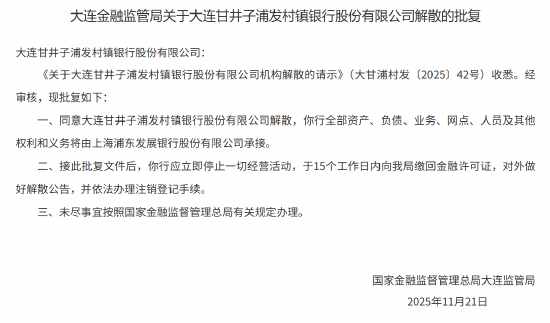
大连甘井子浦发村镇银行获批解散 浦发银行承接其全部资产负债
Xin Lang Cai Jing· 2025-12-03 08:25
12月3日金融一线消息,大连金融监管局发布关于大连甘井子浦发村镇银行股份有限公司解散的批复, 同意大连甘井子浦发村镇银行股份有限公司解散,大连甘井子浦发村镇银行股份有限公司全部资产、负 债、业务、网点、人员及其他权利和义务将由上海浦东发展银行股份有限公司承接。 责任编辑:秦艺 12月3日金融一线消息,大连金融监管局发布关于大连甘井子浦发村镇银行股份有限公司解散的批复, 同意大连甘井子浦发村镇银行股份有限公司解散,大连甘井子浦发村镇银行股份有限公司全部资产、负 债、业务、网点、人员及其他权利和义务将由上海浦东发展银行股份有限公司承接。 责任编辑:秦艺 ...

保险行业周报(20251124-20251128):万科债务展期,险资地产风险预计可控-20251203
Huachuang Securities· 2025-12-03 08:15
Investment Rating - The industry investment rating is "Recommended," indicating an expected increase in the industry index exceeding the benchmark index by more than 5% in the next 3-6 months [22]. Core Insights - The insurance index rose by 0.21% this week, underperforming the market by 1.43 percentage points. Individual stock performances varied, with AIA up by 4.95% and China Pacific down by 3.5% [2]. - The report highlights that the risk associated with real estate investments by insurance companies is expected to be manageable, with a focus on the debt extension of Vanke [2][5]. - The report anticipates that while performance may fluctuate in the short term due to equity market trends, a growth trend is expected to continue into 2025, although 2026 may see performance pressure from investment factors [5]. Summary by Sections Market Performance - The insurance index's absolute performance over the last month is 0.8%, with a 6-month performance of 13.7% and a 12-month performance of 12.8% [8]. - The relative performance against the benchmark shows a 2.2% outperformance over one month, but underperformance of -5.5% over six months and -3.2% over twelve months [8]. Company Analysis - The report provides earnings per share (EPS) estimates for key companies, with China Life at 6.34 CNY for 2025E and China Pacific at 5.68 CNY for the same year. The price-to-earnings (PE) ratios for these companies are also provided, with China Life at 6.89x and China Pacific at 6.20x [11]. - The price-to-book (PB) ratios indicate that China Life has a PB of 1.97, while China Pacific has a PB of 1.12, both rated as "Recommended" [11]. Real Estate Investment Risk - The report analyzes the exposure of listed insurance companies to real estate investments, noting that the overall exposure remains relatively small compared to total investment assets. For instance, Ping An's real estate investment exposure is 3.5%, a decrease of 0.3 percentage points from the previous year [5]. - The report indicates that the increase in real estate investment exposure for China Pacific is primarily due to a rise in investment properties [5]. Long-term Outlook - The long-term outlook suggests that improvements in life insurance costs may drive valuation recovery, with a shift towards dividend insurance and easing solvency requirements expected to enhance long-term investment returns [5].




银行集体公告,“资金通道”风险暗藏
Zheng Quan Shi Bao· 2025-12-03 06:02
Core Viewpoint - The rise of illegal loan intermediaries has prompted multiple banks to issue warnings to customers about potential risks associated with these entities, as they falsely claim to represent legitimate banking institutions [1][5][7]. Summary by Sections Illegal Loan Intermediaries - Numerous banks, including Citic Bank and Baoding Bank, have reported incidents of fraud where individuals impersonate bank employees to promote loan products, leading to public warnings [6][7]. - The prevalence of these scams has forced banks to clarify that they do not collaborate with any loan intermediaries [7]. Reasons for the Proliferation of Illegal Intermediaries - The current economic environment has led to a shortage of effective financing demand, making it difficult for banks to extend credit, which in turn drives some bank staff to seek customers through intermediaries [7]. - There is a significant information asymmetry in the financial sector, with consumers often lacking knowledge about financial products and services, making them vulnerable to scams [8]. - The covert nature of many loan intermediary operations complicates regulatory enforcement, and there are gaps in the regulatory framework regarding the classification and oversight of these entities [8]. Risks Associated with Loan Intermediaries - Illegal loan intermediaries often charge exorbitant service fees and may engage in deceptive practices, including false advertising and the unauthorized sharing of personal information [10]. - Some platforms misrepresent their loan products, advertising low interest rates while imposing hidden fees that exceed regulatory limits [10]. - The emergence of unlicensed intermediaries has led to issues such as aggressive debt collection practices and high-interest traps [10]. Regulatory Response and New Guidelines - The implementation of new regulations in October 2025 aims to strengthen the management of internet loan services by requiring financial institutions to maintain a list of approved partners [11][12]. - As of late October, 120 financial institutions have disclosed their approved loan service partners, with many regional banks significantly reducing their number of collaborations [13]. - The new regulations are expected to challenge banks, particularly smaller ones reliant on loan intermediaries, but also present an opportunity for them to refocus on core banking activities and improve operational quality [14]. Future of the Loan Intermediary Market - The competition in the loan intermediary market is anticipated to shift from a focus on volume and scale to a greater emphasis on risk management, financial technology capabilities, and customer relationship management [14]. - Banks are encouraged to enhance their internal management systems and ensure compliance with new regulations, particularly regarding transparent fee structures and risk assessment processes [14].

多行业联合红利资产11月报:从红利年化10%看收益来源-20251203
Huachuang Securities· 2025-12-03 05:42
策略研究 证 券 研 究 报 告 【策略月报】 从红利年化 10%看收益来源 ——多行业联合红利资产 11 月报 策略月报 2025 年 12 月 03 日 华创证券研究所 证券分析师:姚佩 邮箱:yaopei@hcyjs.com 执业编号:S0360522120004 证券分析师:吴一凡 邮箱:wuyifan@hcyjs.com 执业编号:S0360516090002 证券分析师:徐康 电话:021-20572556 邮箱:xukang@hcyjs.com 执业编号:S0360518060005 证券分析师:杨晖 证券分析师:马野 邮箱:maye@hcyjs.com 执业编号:S0360523040003 相关研究报告 邮箱:yanghui@hcyjs.com 执业编号:S0360522050001 证券分析师:欧阳予 邮箱:ouyangyu@hcyjs.com 执业编号:S0360520070001 证券分析师:韩星雨 邮箱:hanxingyu@hcyjs.com 执业编号:S0360525050001 证券分析师:单戈 邮箱:shange@hcyjs.com 执业编号:S0360522110001 证券 ...
银行集体公告!“资金通道”风险暗藏
券商中国· 2025-12-03 05:22
Core Viewpoint - The article highlights the increasing activity of illegal loan intermediaries as the year-end approaches, prompting banks to issue warnings to customers about potential risks associated with these intermediaries [1][2][5]. Group 1: Illegal Loan Intermediaries - Numerous banks, including Citic Bank and Baoding Bank, have issued announcements stating they do not collaborate with loan intermediaries, as these intermediaries falsely claim to represent the banks to promote loan products [5][6]. - The rise of illegal loan intermediaries is attributed to several factors, including insufficient effective financing demand, information asymmetry in financial products, and the covert nature of many intermediary operations [6][7]. Group 2: Risks Associated with Loan Intermediaries - Users are exposed to risks such as high service fees, false advertising, and personal information leakage when dealing with illegal loan intermediaries or non-compliant lending platforms [7][8]. - The article mentions that some platforms engage in deceptive practices, advertising low interest rates while charging annualized rates that exceed regulatory limits, and may even disappear after collecting fees [7][8]. Group 3: Regulatory Response and New Guidelines - The implementation of new regulations in October 2025 aims to strengthen the management of internet lending services by requiring financial institutions to maintain a list of approved partners for loan facilitation [8][9]. - Following the new regulations, 120 financial institutions have disclosed their lists of approved lending partners, significantly reducing the number of collaborating institutions for many banks [9][10]. Group 4: Future Implications for Banks - The new regulations are expected to create significant operational adjustments for banks, particularly smaller ones that heavily rely on intermediary services, pushing them to focus on core business and improve risk management capabilities [9][10]. - Banks are encouraged to enhance their internal management systems, ensure compliance with new regulations, and improve transparency in fees and loan terms to protect consumers [10][11].

年轻人为何抛弃信用卡?权益缩水,临近年末积分兑条毛巾都靠抢
Bei Jing Ri Bao Ke Hu Duan· 2025-12-03 03:57
Core Viewpoint - The decline in credit card attractiveness among consumers, particularly younger individuals, is attributed to reduced benefits, increased redemption thresholds, and aggressive marketing tactics by banks [1][5][9]. Group 1: Consumer Experience - Many credit cardholders report a significant reduction in benefits, such as access to airport lounges and lower redemption rates for rewards, leading to dissatisfaction [3][4]. - The requirements for promotional offers have become more stringent, with higher spending thresholds and additional tasks needed to qualify for benefits, causing frustration among users [3][4]. - Complaints about the difficulty of redeeming points for rewards have increased, with many items quickly going out of stock or requiring more points than before [3][4]. Group 2: Bank Policies and Adjustments - Several banks have announced plans to adjust credit card benefits, including reducing the number of times certain perks can be used and eliminating popular rewards [4][5]. - The adjustments are primarily driven by banks' need to control costs and respond to low usage rates of certain benefits [5]. Group 3: Marketing and Consumer Trust - Aggressive marketing tactics, including misleading promotions and persistent sales calls, have led to a decline in consumer trust towards credit card offerings [6][7]. - Consumers have reported feeling pressured into unnecessary spending or services, such as installment plans, without clear communication of the associated costs [6][7]. Group 4: Market Trends - The shift in consumer preferences towards alternative credit products, particularly among younger demographics, is evident as they favor flexible, fee-free options that align better with their spending habits [9]. - Banks are encouraged to explore differentiated customer targeting and improve service offerings to retain and attract credit card users [9].

浦发银行再出手!
券商中国· 2025-12-03 03:53
Core Viewpoint - The recent dissolution of Zezhou Pudong Rural Bank and its assets being taken over by Shanghai Pudong Development Bank reflects a broader trend of restructuring and consolidation within China's rural banking sector, aimed at enhancing financial stability and optimizing market structure [1][4][5]. Group 1: Dissolution and Consolidation of Rural Banks - The approval for the dissolution of Zezhou Pudong Rural Bank was issued by the Shanxi Regulatory Bureau of the National Financial Supervision Administration, mandating the bank to cease operations and return its license within 15 working days [1][2]. - This is not an isolated case; on November 26, the Dalian Regulatory Bureau approved the dissolution of Dalian Ganjingzi Pudong Rural Bank, with its assets also being taken over by Shanghai Pudong Development Bank [4]. - The National Financial Supervision Administration has been actively approving the acquisition and establishment of branches by Shanghai Pudong Development Bank, including the acquisition of Chongqing Tongliang Pudong Rural Bank [4]. Group 2: Accelerated Reform and Restructuring - The restructuring of rural banks has accelerated, with several banks being absorbed and converted into branches of their parent banks, indicating a shift towards a more market-oriented and legal framework for the exit and integration of small financial institutions [6][10]. - In 2023, multiple provinces, including Guangdong, Liaoning, Heilongjiang, and Hainan, have initiated market-driven exit and consolidation processes for rural banks [7]. - The trend of merging smaller rural banks into larger institutions is seen as a way to enhance operational efficiency and reduce costs, as many of these banks face challenges such as unclear positioning and inadequate capital [9][10]. Group 3: Financial Resource Optimization - Financial regulatory authorities are working to optimize the allocation of financial resources while maintaining systemic risk stability through market-oriented and legal methods [8]. - The consolidation of high-risk small financial institutions is viewed as a means to purify the financial ecosystem and redirect resources to more efficient areas [10]. - The restructuring process has established standardized operational pathways, including absorption and merger or equity acquisition, to achieve centralized management and better integration into the parent bank's service and risk control network [10].