华兰生物

Search documents
卫光生物定增扩产背后:浆源、资金与消化三重风险叠加
Xin Lang Zheng Quan· 2025-12-05 10:17
Core Viewpoint - The company is initiating a non-public offering plan to raise up to 1.5 billion yuan, with 1.2 billion yuan allocated for a smart industrial base project capable of processing 1,200 tons of plasma annually, amidst increasing industry competition and declining performance [1] Group 1: Capacity and Plasma Source Gap - The planned smart factory aims for an annual plasma processing capacity of 1,200 tons, but the company currently has only 9 plasma collection stations, leading to an estimated plasma collection of only 1,180 tons by 2033, resulting in a shortfall of approximately 700 tons post-project completion [2] - The approval process for new plasma collection stations is becoming increasingly stringent, and the company needs to secure approvals for 8 new stations and identify acquisition targets, making plasma source expansion challenging [2] - The total investment for the project is 2.308 billion yuan, with a construction period of 4.5 years, leaving a funding gap of over 1.1 billion yuan even if the 1.2 billion yuan is successfully raised [2] Group 2: Production and Sales Imbalance - In 2024, the company is facing difficulties in capacity digestion, with a 24.72% increase in blood product production but a 5.42% decrease in sales, leading to a more than 70% increase in inventory, reaching 2.2651 million bottles [3] - The blood product industry has entered a competitive phase with large-scale production capabilities, with leading companies like Tian Tan Biological, Shanghai Raist, and Hualan Biological having established or are in the process of building large production bases, often ahead of the company [3] - Since 2025, the industry has seen a decline in net profits for several companies due to falling product prices, indicating increasing pressure from price wars [3] Group 3: Performance Decline and Expansion Timing - The company is experiencing a significant decline in performance, with a 7.4% year-on-year decrease in revenue and a 13.6% drop in net profit attributable to shareholders in the first three quarters of 2025, including a 31.06% year-on-year plunge in net profit for the third quarter [4] - Accounts receivable have increased by 32.1%, and credit impairment losses have surged by 411%, while the expense ratio has risen across the board, further squeezing profit margins [4] - The question of whether large-scale expansion can be supported by sufficient market foundation and operational capability is becoming a focal point for investors amid ongoing performance pressures [4]

欧林生物拟“A+H”两地上市:业绩上市即巅峰净利率低于行业 控股股东递表前大规模减持
Xin Lang Zheng Quan· 2025-12-05 02:46
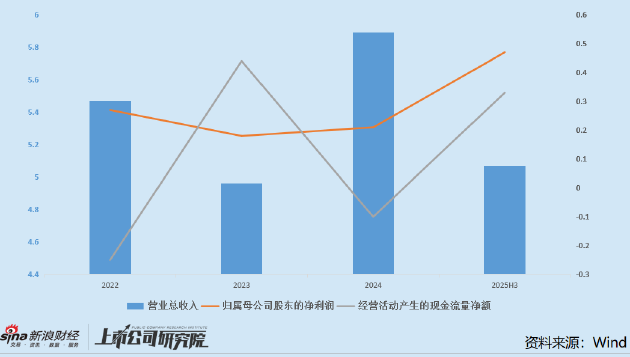
Core Viewpoint - A domestic innovative vaccine company, Olin Bio, is exploring cross-market financing by applying for a dual listing on the Hong Kong Stock Exchange after its initial public offering on the Sci-Tech Innovation Board in 2021, amidst increasing competition and market differentiation in the vaccine industry [1] Financial Performance - Olin Bio achieved a net profit of 108 million yuan in its first year of listing in 2021, but subsequent years saw a decline in net profit, with figures of 26.58 million yuan, 17.56 million yuan, and 20.76 million yuan projected for 2022 to 2024, despite a slight revenue increase from 547 million yuan to 589 million yuan [2] - The company's main revenue sources are its three vaccines, with the adsorbed tetanus vaccine accounting for 90.99% of total revenue in 2024, highlighting a significant reliance on a single product [2] Cash Flow and Receivables - Olin Bio's cash flow situation is deteriorating, with trade receivables rising from 492 million yuan in 2022 to 665 million yuan by Q3 2025, consistently exceeding 90% of revenue [3] - The efficiency of collections is weakening, with accounts receivable turnover days increasing from 272.29 days in 2022 to 327.91 days in Q3 2025, leading to ongoing pressure on operating cash flow [5] Profitability Metrics - The company maintains a high gross margin of 92% to 94%, but its net profit margin remains low at 2% to 5%, significantly below comparable companies in the industry, which exceed 20% [6] - High sales and research expenses are compressing profits, with sales and distribution expenses consistently over 50% of revenue, reaching 48.56% in the first three quarters of 2025 [6][7] Research and Development - Olin Bio has a research expense ratio exceeding 20%, with annual R&D spending over 100 million yuan, as it develops new vaccine candidates that require substantial ongoing investment [8] Fundraising and Shareholder Actions - The company plans to use funds from its IPO for various developmental projects, including clinical trials and production upgrades, but recently terminated an A-share fundraising plan, raising concerns about funding gaps [9] - Prior to the IPO, the controlling shareholder significantly reduced their stake, raising questions about confidence in the company's future and valuation [10][11]


12月3日医疗健康R(480016)指数跌0.42%,成份股人福医药(600079)领跌
Sou Hu Cai Jing· 2025-12-03 10:05
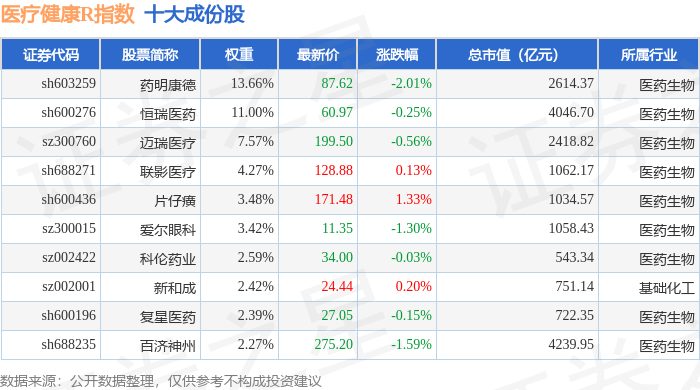
Core Points - The Medical Health R Index (480016) closed at 7284.72 points, down 0.42%, with a trading volume of 17.046 billion yuan and a turnover rate of 0.61% [1] - Among the index constituents, 23 stocks rose while 26 fell, with TeBao Bio leading the gainers at 2.85% and Renfu Pharmaceutical leading the decliners at 3.33% [1] Index Constituents Summary - The top ten constituents of the Medical Health R Index include: - WuXi AppTec (sh603259) with a weight of 13.66%, latest price at 87.62, down 2.01%, and a market cap of 261.437 billion yuan [1] - Hengrui Medicine (sh600276) with a weight of 11.00%, latest price at 60.97, down 0.25%, and a market cap of 404.670 billion yuan [1] - Mindray Medical (sz300760) with a weight of 7.57%, latest price at 199.50, down 0.56%, and a market cap of 241.882 billion yuan [1] - United Imaging Healthcare (sh688271) with a weight of 4.27%, latest price at 128.88, up 0.13%, and a market cap of 106.217 billion yuan [1] - Pianzai Shou (sh600436) with a weight of 3.48%, latest price at 171.48, up 1.33%, and a market cap of 103.457 billion yuan [1] - Aier Eye Hospital (sz300015) with a weight of 3.42%, latest price at 11.35, down 1.30%, and a market cap of 105.843 billion yuan [1] - Kelun Pharmaceutical (sz002422) with a weight of 2.59%, latest price at 34.00, down 0.03%, and a market cap of 54.334 billion yuan [1] - Xinhecheng (sz002001) with a weight of 2.42%, latest price at 24.44, up 0.20%, and a market cap of 75.114 billion yuan [1] - Fosun Pharma (sh600196) with a weight of 2.39%, latest price at 27.05, down 0.15%, and a market cap of 72.235 billion yuan [1] - Ziji Shenzhou (sh688235) with a weight of 2.27%, latest price at 275.20, down 1.59%, and a market cap of 423.995 billion yuan [1] Capital Flow Analysis - The Medical Health R Index constituents experienced a net outflow of 1.159 billion yuan from institutional investors, while retail investors saw a net inflow of 999 million yuan [1] - Detailed capital flow for specific stocks shows: - Health元 (600380) had a net inflow of 34.2431 million yuan from institutional investors [2] - Hengrui Medicine (600276) had a net inflow of 29.9909 million yuan from institutional investors [2] - Long Spring High-tech (000661) had a net inflow of 19.8154 million yuan from institutional investors [2] - The index constituents underwent adjustments, adding four new stocks and removing one [2]






水稻胚乳里的生物密码:
Tai Ping Yang Zheng Quan· 2025-12-03 07:44
医药行业 证券研究报告 |深度报告 2025/12/01 水稻胚乳里的生物密码: 禾元生物重组蛋白技术的产业化革命 | 证券分析师: | 程晓东 | | --- | --- | | 分析师登记编号: | S1190511050002 | | 证券分析师: | 李忠华 | | 分析师登记编号: | S1190524090001 | P2 报告摘要 核心结论:禾元生物是国内植物源重组蛋白药物领军者,以独创水稻胚乳细胞生物反应器技术打破血浆依赖,核心产品 HY1001(重组人白蛋白)国内先发上市、美国推进III期,成本远低于血浆来源,120吨产能+全球化布局支撑2030年营 收超30亿,技术壁垒与商业化确定性突出,具备高投资价值。 一、公司与核心技术:植物源蛋白产业化闭环,指标全球领先。公司拥有二大核心技术平台:1、重组蛋白高效表达平 台:历经三代迭代,重组蛋白表达量达20-30g/kg,核心依赖胚乳特异性启动子改造等专利技术;2、蛋白纯化平台:纯 度达99.9999%,内毒素符合中美药典,纯化成本较微生物体系降30%+。 二、产品管线:HY1001领跑,多梯队支撑增长。(1)核心产品 HY1001:2025年7月 ...
2025年中国生物制剂行业政策、产业链、市场规模、研发支出、竞争格局及未来发展趋势研判:已成为医药行业增长最快的领域之一,市场规模将达到6752亿元[图]
Chan Ye Xin Xi Wang· 2025-12-03 01:24
Core Insights - The biopharmaceutical sector is one of the fastest-growing areas in the pharmaceutical industry, driven by an aging population and increased public health awareness [1][5] - China's biopharmaceutical market is projected to grow from CNY 312 billion in 2019 to CNY 587.1 billion in 2024, and is expected to reach CNY 675.2 billion by 2025, with a potential to hit CNY 1.149 trillion in the next five years [1][5][6] - Innovation remains the core driver of growth in the biopharmaceutical industry, which is capital-intensive and requires significant R&D investment [1][6] Industry Definition and Classification - Biopharmaceuticals are medical products manufactured using biological methods, aimed at replicating the activity of natural substances [2][4] - They can be categorized into vaccines, blood products, biopharmaceutical drugs, diagnostic reagents, and others, with further subdivisions based on source or mechanism of action [2] Current Industry Status - The global biopharmaceutical market is expected to grow from USD 286.4 billion in 2019 to USD 461.6 billion in 2024, with the original biopharmaceutical market projected to increase from USD 268.9 billion to USD 427.9 billion in the same period [5] - China plays a significant role in the global biopharmaceutical market, with rapid growth driven by favorable policies, increased R&D investment, and advancements in biotechnology [5][6] Industry Development Environment - Policies - The Chinese government has implemented various laws and policies to encourage biopharmaceutical R&D, including the Drug Registration Management Measures and regulations for clinical research and application of biomedical technologies [7] Competitive Landscape - The biopharmaceutical sector is recognized as a "new frontier" in the pharmaceutical industry, with major global players actively entering the market [9] - Key companies in China's biopharmaceutical industry include WuXi AppTec, Hengrui Medicine, ZhiFei Biological, BeiGene, and others, with a competitive landscape characterized by differentiated strategies [9] Future Development Trends - Market demand for biopharmaceuticals is expected to continue growing, supported by policy backing, technological advancements, and increased health awareness [10] - Domestic companies are transitioning from biosimilars to First-in-Class drugs, with examples like Hengrui Medicine's ADC drug showing superior efficacy [10][11] - Personalized medicine based on genetic testing is anticipated to become a trend, with increasing international recognition of Chinese innovative drugs [11]




防治流感,上市药企有什么“手段”?
Shang Hai Zheng Quan Bao· 2025-12-01 19:24
Core Insights - The flu positive rate in China has reached nearly 45%, indicating a significant rise in flu cases, with some provinces experiencing high epidemic levels [1] - Investors are closely monitoring the supply and sales of flu medications and vaccines from listed pharmaceutical companies, which are actively preparing to meet public health needs [1] Group 1: Drug and Vaccine Supply - Multiple listed companies have reported sufficient reserves of flu medications and vaccines, ensuring stable supply capabilities [2] - Renhe Pharmaceutical has initiated a priority supply mechanism for Oseltamivir, while Dajia Weikang has adjusted production capacity based on market demand [2] - The entire supply chain, including raw material suppliers like Rhine Bio, is collaborating to ensure a robust response to market needs [2] Group 2: Vaccine Development - Companies are focusing on flu vaccines as a key area for development, with several achieving significant progress by 2025 [3] - Zhejiang Tianyuan Biopharmaceutical's quadrivalent flu vaccine "Yufening" has been approved for sale, alongside its trivalent vaccine "Yuganning" [3] - Baike Bio has innovated with a freeze-dried nasal spray flu vaccine, which has been upgraded to a liquid form for easier administration [3] Group 3: Treatment Options - Companies are building a diverse matrix of flu medications to address various symptoms and treatment needs [5] - Zhongsheng Pharmaceutical is advancing the commercialization of Anladiwei tablets for treating uncomplicated influenza, while Jichuan Pharmaceutical is developing a novel flu treatment [5] - Oseltamivir remains a commonly used antiviral, with multiple companies like Renfu Pharmaceutical and Dajia Weikang actively involved in its production [5][6] Group 4: Symptomatic Relief - Several companies are providing symptomatic treatments for flu, including Lisheng Pharmaceutical's Acetaminophen and various products from Zhenbaodao for symptom relief [6] - Companies like Foci Pharmaceutical produce a range of cold and flu medications, ensuring comprehensive treatment options for patients [6]


生物制品板块12月1日涨0.23%,禾元生物领涨,主力资金净流出2.73亿元
Zheng Xing Xing Ye Ri Bao· 2025-12-01 09:09
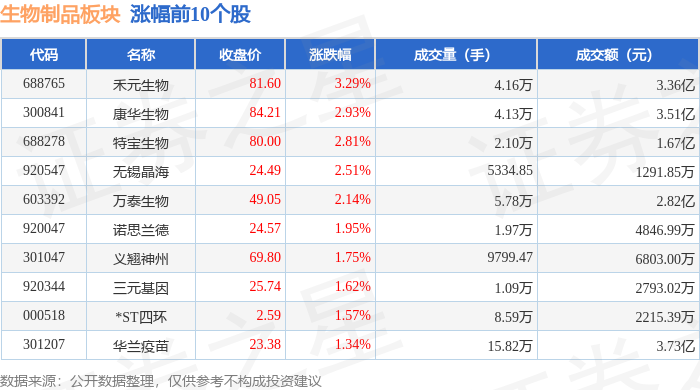
Core Viewpoint - The biopharmaceutical sector experienced a slight increase of 0.23% on December 1, with He Yuan Bio leading the gains. The Shanghai Composite Index rose by 0.65%, while the Shenzhen Component Index increased by 1.25% [1]. Group 1: Market Performance - The biopharmaceutical sector's performance on December 1 showed a mixed trend, with notable gainers including He Yuan Bio, which closed at 81.60 with a rise of 3.29%, and Kanghua Bio, which closed at 84.21 with a rise of 2.93% [1]. - The overall trading volume in the biopharmaceutical sector was significant, with He Yuan Bio achieving a transaction amount of 336 million yuan and Kanghua Bio reaching 351 million yuan [1]. Group 2: Individual Stock Performance - The table of individual stock performance indicates that several companies in the biopharmaceutical sector saw positive price movements, with Te Bao Bio and Wu Xi Jing Hai also recording increases of 2.81% and 2.51%, respectively [1]. - Conversely, some companies faced declines, such as Rong Chang Bio, which fell by 4.47%, and Bai Pu Sai Si, which decreased by 3.65% [2]. Group 3: Capital Flow - The biopharmaceutical sector experienced a net outflow of 273 million yuan from institutional investors, while retail investors contributed a net inflow of 178 million yuan [2]. - The capital flow data highlights that He Yuan Bio attracted a net inflow of 51.47 million yuan from institutional investors, despite a net outflow from retail investors [3].


禽流感概念下跌0.76%,主力资金净流出18股
Zheng Quan Shi Bao Wang· 2025-11-28 10:06
Core Insights - The avian influenza concept sector experienced a decline of 0.76%, ranking among the top losers in the market, with major stocks like Zhongsheng Pharmaceutical hitting the limit down, while a few stocks like Wens Foodstuff and Weilan Biology saw gains of 1.80% each [1][2] Market Performance - The top-performing concept sectors included Titanium Dioxide with a gain of 4.31%, and Hainan Free Trade Zone with a gain of 3.54%, while the avian influenza sector was among the worst performers [1] - The avian influenza sector saw a net outflow of 784 million yuan, with 18 stocks experiencing net outflows, led by Zhongsheng Pharmaceutical with a net outflow of 684 million yuan [1] Stock Performance - Stocks with significant net outflows included: - Zhongsheng Pharmaceutical: -10.00% with a turnover rate of 18.78% and a net outflow of 683.65 million yuan - Yiling Pharmaceutical: -2.40% with a net outflow of 35.71 million yuan - Lianhuan Pharmaceutical: -1.79% with a net outflow of 25.69 million yuan - Hualan Biological: -6.60% with a net outflow of 18.13 million yuan [1] - Conversely, stocks with net inflows included: - Tiankang Biological: +1.26% with a net inflow of 16.52 million yuan - Shanghai Kaibao: -1.70% with a net inflow of 5.06 million yuan - Jinhai Biological: +0.16% with a net inflow of 3.82 million yuan [2]


流感「抬头」,疫苗价「雪崩」,行业协会坐不住了
3 6 Ke· 2025-11-26 13:48
Core Insights - The price war in the vaccine industry is driven by changes in supply and demand dynamics, leading to significant price reductions and financial losses for companies [2][10][15] Group 1: Price Trends - The price of a three-valent flu vaccine has dropped to 5.5 yuan, lower than the price of a cup of milk tea, indicating a drastic reduction in vaccine prices [3][7] - The price of the four-valent flu vaccine has decreased from 128 yuan to 88 yuan, with further reductions expected as competition intensifies [7][8] - HPV vaccines have also seen significant price drops, with the two-valent HPV vaccine priced at 27.5 yuan, down over 90% from previous prices [8] Group 2: Industry Response - The China Vaccine Industry Association issued an initiative to combat "involutionary" competition, urging members to avoid bidding below cost and maintain price stability [4][5] - The association's initiative aims to stabilize price expectations but may not address the underlying issue of overcapacity in the industry [3][10] Group 3: Market Dynamics - The vaccine market is experiencing overcapacity due to an influx of companies entering the sector, leading to intense competition and price wars [10][11] - Demand for vaccines is under pressure, with declining public trust in vaccines and a decrease in birth rates affecting the market for childhood vaccines [11][12] Group 4: Financial Impact - Vaccine companies have reported significant financial losses, with overall revenue for listed vaccine companies dropping by 60% and net profits declining by 113% in the first half of 2025 [12][14] - Major companies like Zhifei Biological and Wantai Biological have reported substantial revenue declines and net losses, reflecting the severe impact of the price war [12][14] Group 5: Future Outlook - Experts suggest that the industry may need to undergo a period of consolidation and restructuring, which could last five to ten years, to address the current challenges [15] - Companies are exploring international markets and differentiation strategies to navigate the competitive landscape, with some reporting significant increases in exports [15]




流感「抬头」,疫苗价「雪崩」,行业协会坐不住了
36氪· 2025-11-26 13:39
Core Viewpoint - The article discusses the ongoing price war in China's vaccine industry, driven by changes in supply and demand dynamics, leading to significant price reductions and financial losses for companies [4][15][22]. Group 1: Price War Dynamics - The price of a three-valent flu vaccine has dropped to 5.5 yuan, cheaper than a cup of milk tea, indicating a severe price competition in the vaccine market [5][11]. - The China Vaccine Industry Association has issued an initiative to combat "involution-style" competition, urging members to avoid bidding below cost and threatening penalties for violations [6][8][10]. - The price war has persisted for two years, with the association's initiative being the first formal stance against low-price competition, although it may not resolve the underlying issue of overcapacity [6][10][22]. Group 2: Supply and Demand Changes - The supply side is characterized by homogenization and overcapacity, with many companies entering the vaccine market, leading to intense competition and price wars [16][17]. - Demand is also under pressure, with declining public trust in vaccines and a decrease in vaccination rates, particularly for flu vaccines, which averaged below 4% in China from 2020 to 2023 [17][19]. - The shift in focus from childhood vaccines to adult vaccines due to declining birth rates has intensified competition in the adult vaccine market [17][19]. Group 3: Financial Impact on Companies - The financial repercussions of the price war are evident, with vaccine companies experiencing a 60% drop in revenue and a 113% decline in net profit in the first half of 2025 [19][20]. - Major companies like Zhifei Biological and Wantai Biological have reported significant losses, with Zhifei's revenue down 66.53% and net profit loss of 12.06 billion yuan [20][21]. - Despite some companies showing growth in sales, the overall trend indicates that increased revenue does not equate to increased profit due to drastic price reductions [21][22]. Group 4: Future Outlook and Strategies - Experts suggest that the industry is in a "deep cold moment," requiring a period of consolidation and restructuring that could last five to ten years [23]. - Companies are exploring two main strategies to navigate the competitive landscape: expanding into emerging markets and focusing on differentiated products to meet unmet clinical needs [24].