
微创医疗

Search documents
港股异动 | 微创心通-B(02160)盘中涨超9% 微创心通TAVI核心产品在摩洛哥获批上市
智通财经网· 2025-12-29 06:26
Group 1 - The core viewpoint of the article highlights the significant stock price increase of MicroPort Cardiac Rhythm Management (02160), which rose over 9% during trading and is currently up 6.06% at HKD 1.05, with a trading volume of HKD 4.48 million [1] - MicroPort's VitaFlow Liberty aortic valve and retrieval system has received approval for sale in Morocco, marking its first entry into the African market, which is heavily reliant on imported medical devices [1] - The acquisition of Cardiac Rhythm by MicroPort Medical has been finalized, which will enhance the integration of its structural heart disease and cardiac rhythm management business segments, accelerating the development of a comprehensive device management solution for heart failure [1]
医疗器械行业研究:政策推动创新器械应用,脑机接口加速商业落地
SINOLINK SECURITIES· 2025-12-27 15:39
Investment Rating - The report suggests a positive investment outlook for the medical device sector, particularly in brain-computer interface devices, which are expected to see accelerated commercialization due to supportive policies [1][3]. Core Insights - Recent policies have significantly increased support for innovation in medical devices, with the National Medical Products Administration actively promoting faster market entry for brain-computer interface devices, indicating a diverse application landscape and substantial future potential [1][3]. - The pharmaceutical sector is witnessing positive developments, such as GSK's approval of mepolizumab for a new indication in COPD patients, marking it as the first monthly administered biologic in China, which is expected to reduce the annual incidence of severe exacerbations significantly [1][32]. - The report highlights the approval of Wegovy® tablets in the U.S. for weight management, emphasizing its potential impact on the market as the first oral GLP-1 receptor agonist for this purpose [37][40]. Summary by Sections Pharmaceutical Sector - Mepolizumab has been approved for COPD treatment in China, with a monthly dosing schedule, targeting a significant patient population [1][32]. - The A/H share innovation drug sector maintains high activity levels, with new drug approvals and cross-border transactions remaining robust [16][28]. Biologics - Wegovy® tablets have been approved in the U.S. for weight management, showing similar weight loss efficacy to its injectable counterpart, with a significant portion of participants achieving substantial weight loss [37][40]. CXO and Pharmaceutical Supply Chain - The CXO sector continues to show upward momentum, supported by a stable order backlog, with November financing levels slightly above the annual average [44][46]. Medical Devices - The centralized procurement process for high-value medical consumables is progressing steadily, with high selection rates in multiple rounds of bidding, indicating a favorable environment for leading domestic companies [2][52]. Retail Pharmacy - The industry is undergoing a consolidation phase, with leading companies expected to benefit from increased market share through mergers and acquisitions [2][3]. Medical Services and Consumer Healthcare - Aier Eye Hospital's acquisition of 39 institutions for 960 million yuan strengthens its market position, with the acquired entities showing signs of financial recovery [2][3].



以临床驱动模式,打造医疗科技成果转化高地
Xin Lang Cai Jing· 2025-12-27 07:23
Core Viewpoint - The article emphasizes the integration of clinical needs with technological innovation in the medical field, highlighting Shanghai Ninth People's Hospital's (Shanghai Jiu Hospital) unique "clinical-driven" model for medical technology transformation [5][6]. Group 1: Innovation and Technology - Shanghai Jiu Hospital has established itself as a leader in medical technology transformation, consistently ranking high in China's hospital innovation transformation rankings [5]. - The hospital has developed several innovative medical devices, including the "Honghu" surgical robot, which has been exported to 26 countries and has completed over 3,000 surgeries globally [6][7]. - The hospital's approach involves a collaborative model where clinical insights from doctors are combined with engineering capabilities to create innovative solutions [6]. Group 2: Ecosystem for Transformation - Shanghai Jiu Hospital has built a comprehensive ecosystem covering the entire process from idea generation to research and development, validation, and transformation, aimed at lowering barriers for inventors [7][8]. - The hospital has established a dedicated office for technology transfer, which serves as a crucial link between medical innovation and its application in practice [8]. - A professional team has been formed to provide full-process support for technology transfer, including roles such as technology brokers and patent agents [8]. Group 3: Policy and Incentives - The hospital has implemented a robust system of 45 institutional documents to ensure compliance in the management of intellectual property and technology transfer processes [9]. - A revenue-sharing mechanism has been established, allocating 80% of net income from technology transfer to reward the technical teams involved, thereby encouraging participation in innovation [9]. - The hospital provides a "Knowledge Property Transformation Pocket Manual" to all medical and research staff, serving as a guide for connecting laboratory innovations with market opportunities [9].

中国的创新耗材国际化到什么阶段了?
2025-12-26 02:12
Summary of Key Points from Conference Call Records Industry Overview - The high-value consumables market in China has reached a bottom, with international markets showing growth potential. Companies with internationalization capabilities in high-value consumables are seen as having investment potential, especially under the influence of centralized procurement policies accelerating domestic substitution [1][2]. - The commercial model of high-value consumables is advantageous, with stable pricing that is not easily iterated. After the completion of centralized procurement in the Chinese market, combined with overseas R&D progress, the high-value consumables sector is expected to present investment opportunities. The market capitalization of innovative consumables companies in Hong Kong is currently low, with expectations for improved profitability post-2026 [1][2]. Core Insights and Arguments - By 2025, the domestic high-value consumables industry is expected to mature with stable pricing due to centralized procurement. Some products are undergoing clinical trials in Europe and the U.S., indicating potential for overseas market entry or partnerships [2]. - The valuation of the global medical consumables market is high, particularly for leading companies. The pricing of high-value consumables in the U.S. is approximately double that in China, indicating lower elasticity compared to innovative drugs [2]. - The total market capitalization of 15 leading innovative consumables companies in Hong Kong is estimated at around 70-80 billion HKD, which is considered low. It is anticipated that by 2026, around 60% of consumables will be included in centralized procurement [2][8]. Internationalization Progress - Several domestic high-value consumables companies have made significant strides in internationalization. For instance, products from companies like Times Angel and MicroPort are seeing rapid sales growth overseas, particularly in non-European and American markets [3]. - To enter the European and American markets, clinical trials and local approvals are necessary. Collaborations, such as that between Edwards and Jianxi Medical, highlight the growing recognition of Chinese companies' R&D capabilities [3]. Advantages and Catalysts in High-Value Consumables - The domestic high-value consumables sector benefits from low clinical costs and high surgical volumes, which facilitate product improvements. Chinese companies can conduct R&D and production at lower costs, enhancing competitiveness [4]. - Key catalysts to watch include: 1. MicroPort's Firehawk heart stent, expected to receive FDA approval in 2026. 2. Jianxi Technology's tricuspid valve treatment device, anticipated to gain European approval in 2026 while seeking global business development partners [4]. Financial Performance and Industry Impact - The innovative device sector reported positive profits in the first half of 2025, with MicroPort playing a crucial role. It is expected that MicroPort will achieve profitability by 2026 through operational and debt control, positively impacting the entire sector [6]. - The FDA breakthrough certifications for domestic medical devices have become significant barriers for international collaboration, attracting more investment and attention [5]. Impact of Centralized Procurement Policies - Centralized procurement policies have led to an import substitution effect, increasing the market share of domestic products. By 2026, it is projected that about 60% of consumables will fall under centralized procurement, with orthopedic products already reaching 90% [8]. - Companies in the neuro-interventional field, such as Guichuang Tongqiao, are expected to benefit significantly from these policies [8]. Comparison with Innovative Drugs - The development paths of domestic innovative drugs and high-value consumables differ, with both sectors actively exploring international markets. Future focus areas include neuro-interventional, valve, and PFA high-value consumables [9]. Investment Selection Criteria - When selecting investment targets, factors such as surgical volume growth, foreign capital share, centralized procurement expectations, and internationalization potential should be considered. Companies like Guichuang Tongqiao and Peijia in the neuro-interventional field are highlighted as worthy of attention [10]. Insights from U.S. NGS Industry - The U.S. NGS (Next-Generation Sequencing) industry is experiencing strong growth, with companies like Grell and Garden exceeding sales expectations. This sector's development may provide valuable insights for the domestic market [11].
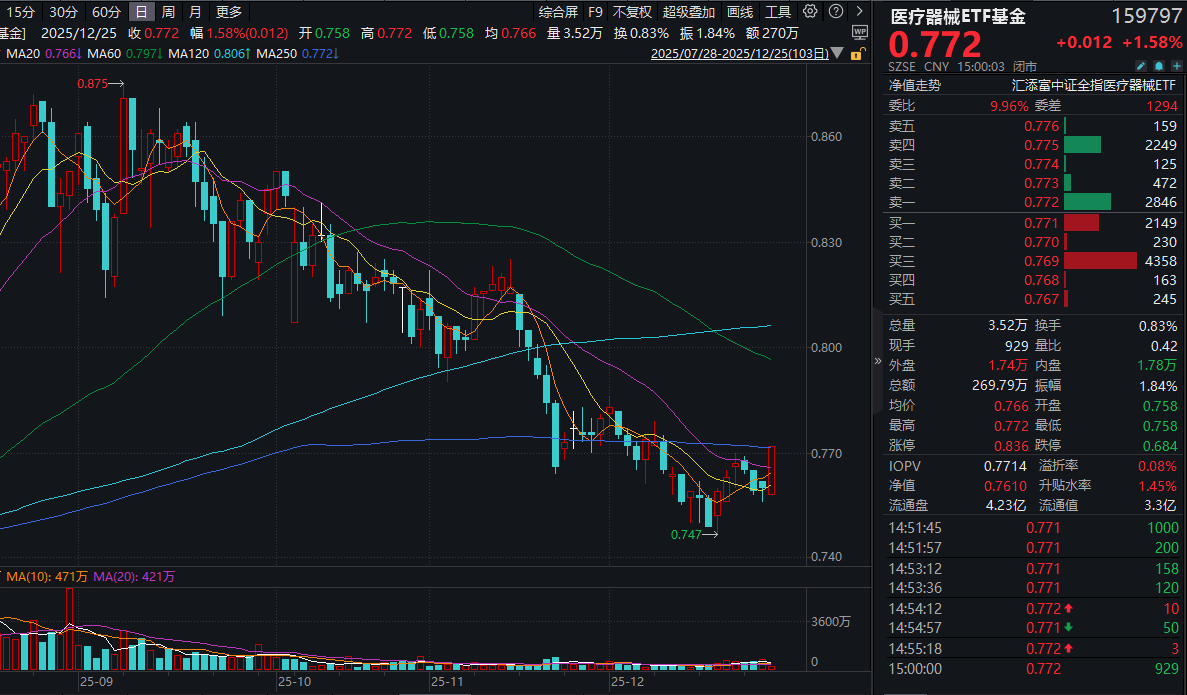
第六批医用耗材国采文件发布!低费率的医疗器械ETF基金(159797)收涨超1.5%轻松反包前三日阴线,资金已连续6日净流入!
Xin Lang Cai Jing· 2025-12-25 09:54
Core Viewpoint - The medical device sector is experiencing a rebound, with significant inflows into the medical device ETF fund, indicating positive market sentiment and potential investment opportunities [1][3]. Group 1: Market Performance - The Shanghai Composite Index recorded a seven-day rise, with the medical device ETF fund (159797) increasing by 1.58% for two consecutive days [1]. - The medical device ETF fund has seen a net inflow for six consecutive days, accumulating over 31 million yuan in the last ten days [1]. - Most component stocks of the medical device ETF fund closed in the green, with notable gains from companies such as SINO Medical (up over 14%) and Xiangyu Medical (up over 6%) [3]. Group 2: Procurement Policy - The National Organization for High-Value Medical Consumables announced a centralized procurement document for drug-coated balloons and urological intervention consumables, with submission deadlines set for January 13, 2026 [3]. - The procurement cycle will last until December 31, 2028, indicating a long-term commitment to cost control in the medical device sector [3]. Group 3: Industry Outlook - The outlook for 2026 suggests a focus on innovation and international markets, with domestic demand expected to recover gradually [6]. - The medical device sector is anticipated to benefit from policy support and the increasing market share of leading companies, despite current pressures on domestic demand [6]. - The strategy for 2026 will emphasize overseas expansion and innovative products, which are expected to sustain profit margins amid price declines in traditional business areas [6]. Group 4: Specific Sector Insights - The medical device sector's growth will increasingly rely on domestic manufacturers' technological advancements and expansion into rural healthcare markets [7]. - The high-value consumables market is expected to see continued policy-driven changes, with a focus on optimizing bidding mechanisms and expanding product categories [7]. - The low-value consumables segment is adapting to global trade changes by accelerating overseas production to regain market share lost due to tariffs [8]. Group 5: Future Trends - The in-vitro diagnostics market is experiencing a shift towards domestic brands, which are gaining market share through competitive pricing and distribution advantages [8]. - The home medical device sector is prioritizing internationalization, with leading companies pursuing acquisitions and product registrations abroad to enhance growth prospects [8].
国泰海通晨报-20251225
国泰海通· 2025-12-25 03:46
Macro Research - The core viewpoint of the report indicates that the US economy showed resilience in Q3 2025, with a GDP growth rate of 4.3%, surpassing expectations of 3.3% and the previous value of 3.8% [3][20] - Key drivers of this resilience include strong personal consumption, increased public spending, and enhanced export contributions, with capital market wealth effects supporting consumer spending [3][20] - The report highlights a "K" shaped economic divergence, characterized by income disparities affecting consumption, varying business conditions between large and small enterprises, and differences in investment growth between new and old economies [4][21] Strategy Research - The report emphasizes that Chinese companies are entering a new phase of globalization, aiming to capture high-value segments of the global value chain [9][25] - It notes that the acceleration of Chinese enterprises going abroad is a strategic response to rising domestic costs and tightening external market access, which is essential for high-quality development [9][25] - The report predicts that the demand for capital goods in China will remain strong, driven by industrialization and infrastructure investment in emerging markets [11][27] Biopharmaceutical Research - The report discusses the release of the sixth batch of medical device procurement documents, indicating a moderate expected price drop and a favorable situation for domestic manufacturers to increase market share [13][29] - It provides specific data on the expected demand for various medical devices, highlighting the market shares of different companies in the procurement process [30][32] - The report maintains a "buy" rating for companies likely to benefit from the procurement, such as Lepu Medical and Mindray Medical [29][30]




国泰海通 · 晨报1225|宏观、策略、医疗器械
国泰海通证券研究· 2025-12-24 13:38
Macro Analysis - The US GDP growth rate for Q3 2025 is 4.3%, exceeding expectations of 3.3% and the previous value of 3.8%, indicating strong economic resilience [3] - Key drivers of this resilience include robust personal consumption, increased public spending, and enhanced export contributions [3] - Personal consumption is supported by the wealth effect from capital markets, with major stock indices reaching historical highs in Q3 2025 [3] - Government spending, particularly in defense, and investments in companies like Intel have also contributed to economic strength [3] - A recovery in global economic activity has boosted US exports, aided by trade agreements that have reduced or eliminated tariffs [3] K-Shaped Recovery - The US economy exhibits a "K" shaped recovery, characterized by income and consumption disparities [4] - Income inequality has been exacerbated by policies affecting the job market, leading to higher unemployment rates among minority groups [4] - Large enterprises are faring better than small businesses, as indicated by the S&P Global Composite PMI remaining above the neutral line, while the NFIB small business optimism index has declined [4] - Investment and growth disparities are evident, with strong performance in private non-residential investments, particularly in equipment and intellectual property, while construction investment growth has slowed [4] Future Economic Outlook - The US government shutdown from October 1 to November 12, 2025, is expected to impact Q4 2025 economic performance, but resilience is anticipated in 2026 [5] - The shutdown will reduce government procurement and investment activities, affecting economic performance directly and indirectly [5] - A recovery in Q1 2026 is likely due to pent-up demand and continued strength in consumption and new economic investments [5] - The Federal Reserve is expected to lower interest rates 2-3 times in 2026, despite a strong economy, due to structural weaknesses in the labor market [5] Globalization of Chinese Enterprises - Chinese enterprises are entering an accelerated phase of globalization, driven by the need to occupy high-value segments of the global supply chain [9] - The transition from a GDP-driven growth model to a GNI-driven model emphasizes innovation and accelerated globalization [9] - China's trade competitiveness has improved significantly, particularly in capital and technology-intensive sectors, with exports exceeding expectations since 2025 [10] - Chinese companies are shifting from product exports to a more integrated approach involving capacity, branding, and distribution [10] Capital Expenditure Trends - A global upturn in industrial and infrastructure capital expenditure is expected, driven by easing monetary policies and increased demand in emerging markets [11] - Southeast Asian countries are experiencing rapid industrialization and urbanization, leading to significant demand for power and infrastructure [11] - Developed markets are also seeing a surge in demand for energy infrastructure updates due to green transitions and AI-driven needs [11] - The resilience of overseas demand for Chinese products is projected to exceed market expectations in 2026 [11] Industry Recommendations - Recommended sectors include power equipment, machinery, automotive, new materials, innovative pharmaceuticals, and gaming [12] - Emerging market industrialization is expected to drive demand for power and infrastructure, while developed markets will continue to update energy infrastructure [12] - High-value components are recommended due to China's technological and cost advantages, with a focus on communication equipment and automotive parts [12] - The urbanization in emerging markets is anticipated to create new demand for consumer products, enhancing the global presence of Chinese cultural and service sectors [12]

12月24日深港通医疗(983035)指数涨0.17%,成份股微创医疗(00853)领涨
Sou Hu Cai Jing· 2025-12-24 11:45
Group 1 - The core index of the Shenzhen-Hong Kong Stock Connect Medical Index (983035) closed at 4447.92 points, with a slight increase of 0.17% and a trading volume of 8.188 billion yuan, resulting in a turnover rate of 1.02% [1] - Among the constituent stocks, 31 companies experienced an increase, with MicroPort Medical leading the gain at 4.91%, while 22 companies saw a decline, with Yimai Sunshine leading the drop at 3.96% [1] Group 2 - The net outflow of main funds from the Shenzhen-Hong Kong Stock Connect Medical Index constituents totaled 154 million yuan, while retail investors saw a net inflow of 232 million yuan [2] - Over the past 10 days, there have been adjustments in the constituent stocks of the Shenzhen-Hong Kong Stock Connect Medical Index, with 2 new stocks added [2]

12月24日深港通医疗(港币)(983036)指数涨0.28%,成份股微创医疗(00853)领涨
Sou Hu Cai Jing· 2025-12-24 11:45
Group 1 - The core index of the Shenzhen-Hong Kong Stock Connect Medical Index closed at 4383.64 points, with a gain of 0.28% and a trading volume of 9.071 billion HKD, resulting in a turnover rate of 1.02% [1] - Among the constituent stocks, 31 stocks increased, with MicroPort Medical leading the gain at 4.91%, while 22 stocks decreased, with Yimai Sunshine leading the decline at 3.96% [1] - The net outflow of main funds from the Shenzhen-Hong Kong Stock Connect Medical Index constituents totaled 154 million HKD, while retail investors saw a net inflow of 232 million HKD [2] Group 2 - The Shenzhen-Hong Kong Stock Connect Medical Index has made adjustments in the last 10 days, adding 2 new stocks to its constituents [2]
国金证券:第六批医用耗材国采文件发布 规则细节及报量符合预期
Zhi Tong Cai Jing· 2025-12-23 03:28
Core Viewpoint - The centralized procurement of high-value medical consumables, including drug-coated balloons and urological intervention materials, is expected to standardize procurement and usage behaviors, improve industry ecology, and lead to short-term price declines impacting profit margins for some companies, while benefiting leading domestic enterprises that can gain more market share through successful bids [1] Group 1: Procurement Announcement - The National Organization for High-Value Medical Consumables announced the centralized procurement document for drug-coated balloons and urological intervention materials, with submission of application materials and information disclosure scheduled for January 13, 2026 [1] - The procurement cycle will run from the actual execution date of the selected results until December 31, 2028 [1] Group 2: Demand Data - Annual demand for drug-coated balloons includes 614,778 for coronary drug-coated balloons, 6,884 for peripheral drug-coated balloons (for arteriovenous fistula dialysis access), 61,434 for peripheral drug-coated balloons (above the knee), and 7,002 for peripheral drug-coated balloons (below the knee) [2] - Annual demand for urological intervention materials includes 1,372,386 for ureteral intervention guidewires, 500,833 for ureteral intervention sheaths (without physiological pressure measurement), 49,279 for ureteral intervention sheaths (with physiological pressure measurement), 15,881 for ureteral balloon dilation catheters, 284,665 for stone retrieval baskets, 326,518 for disposable ureteral soft endoscopes (without physiological pressure measurement), 18,442 for disposable ureteral soft endoscopes (with physiological pressure measurement), and 188,317 for kidney kits [2] Group 3: Market Share and Domestic Production - The bidding results indicate that leading domestic companies have a high market share, with Lepu Medical (300003) at 16% and Shandong Jiwei (subsidiary of Blue Sail Medical, 002382) at 8% for coronary drug-coated balloons, while other companies like MicroPort and Sientra have relatively lower shares [3] - For peripheral drug-coated balloons, the top three domestic companies (Sientra, Guichuang Tongqiao, and Xinmai Medical) hold 71% of the market share, indicating that the bidding situation for leading domestic enterprises meets expectations [3] Group 4: Bidding Rules - The procurement process will classify products into A and B bidding units based on the demand from medical institutions, with the top 85% of cumulative demand entering the A unit, while others will enter the B unit [4] - The selection rules will involve multiple rounds of bidding to enhance the selection rate of enterprises, with the first rule focusing on selecting companies with the lowest bid prices [5] - If companies do not qualify under the first rule, they can re-bid under the second rule, which has specific price conditions to ensure competitiveness [6]
