速卖通

Search documents
速卖通:启用首个全自动物流园区,国内段提速6小时
Xin Lang Ke Ji· 2025-08-13 07:45
Core Insights - AliExpress has upgraded its logistics warehouse in Dongguan, Guangdong, becoming the first fully automated cross-border logistics park, primarily serving domestic transit for packages destined for European consumers [1] Group 1: Automation and Efficiency - The warehouse features a "black technology" conveyor belt matrix that replaces traditional manual handling and vehicle allocation, allowing for a fully automated process from picking, consolidation, distribution to delivery without human intervention [1] - The domestic transportation time for cross-border packages can be improved by up to 6 hours [1] Group 2: Market Adaptation and Service Expansion - Ahead of last year's Double 11 shopping festival, AliExpress established country-specific cargo pallets and utilized flow warehouses tailored to different national markets to enhance shipping efficiency [1] - Currently, AliExpress's flow warehouses cover 15 key countries across Europe, America, and Asia, serving merchants in regions like East and South China [1] Group 3: Delivery Performance - With the country-specific cargo pallets and flow warehouse model, packages can be delivered from outbound to mainline in an average of less than 24 hours after an overseas consumer places an order [1] - Over the past two years, the global average delivery time for AliExpress has been reduced by 50%, and the "Global 5-Day Delivery" service now covers over 50 key countries in Europe, America, Asia, and the Middle East [1]
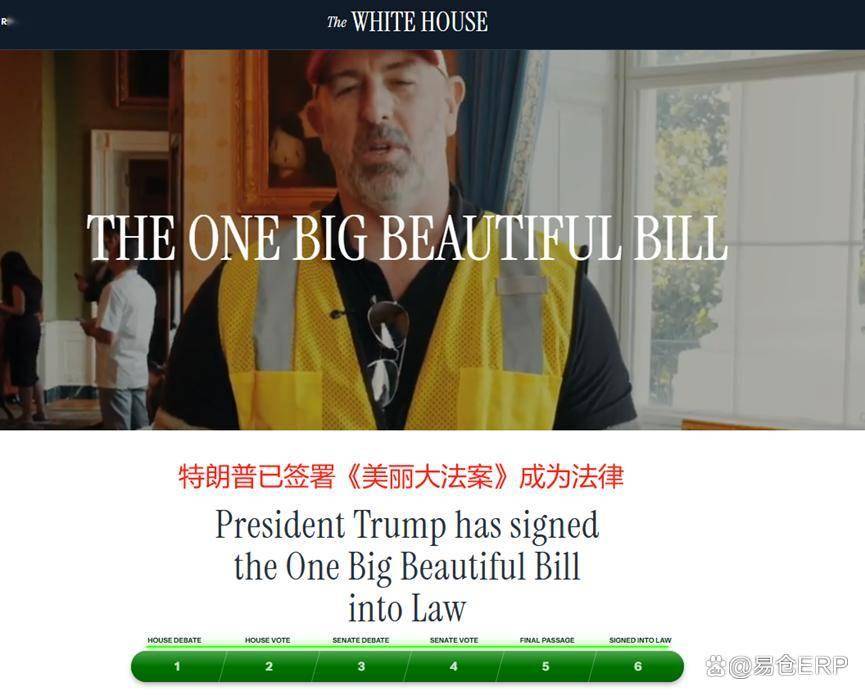
特朗普税改法案来了,中国跨境电商卖家也要纳税
Sou Hu Cai Jing· 2025-08-12 03:19
Core Viewpoint - The implementation of the "One Big Beautiful Bill," also known as the Trump tax reform, significantly impacts the global cross-border e-commerce ecosystem by tightening tax regulations and increasing compliance challenges for sellers, particularly those from China [1][3]. Group 1: Tax Reform Implications - The Trump tax reform extends the 2017 tax reduction policy but fills the fiscal gap by expanding tariff collections, aiming to raise $300 billion over the next ten years [1]. - Cross-border e-commerce sellers face unprecedented tax compliance challenges, as the IRS classifies income from using Amazon FBA warehouses or holding U.S. trademarks as "Effectively Connected Income (ECI)," requiring tax declarations [3]. - Failure to submit the 1120-F form on time results in a mandatory 30% tax on total sales, with the IRS retroactively collecting historical taxes [3]. Group 2: Compliance Strategies - Sellers need to establish three defensive lines: restructuring tax identity by registering U.S. companies or applying for tax treaties to lower rates; separating sensitive business components like warehousing and intellectual property from U.S. jurisdiction; and ensuring financial data transparency by maintaining transaction records for audits [4]. - The tax reform increases compliance costs but accelerates industry consolidation, with sellers who achieve tax compliance gaining a competitive edge [4]. Group 3: Data Management Solutions - Effective response to the tax reform requires data integration and cost control, with cross-border e-commerce businesses needing to accurately calculate profits across platforms and differentiate costs [4]. - EasyCang ERP offers a global sales compass feature that integrates sales data from over 70 cross-border e-commerce platforms, aiding in market strategy adjustments and providing a data foundation for tax declarations [4][5].

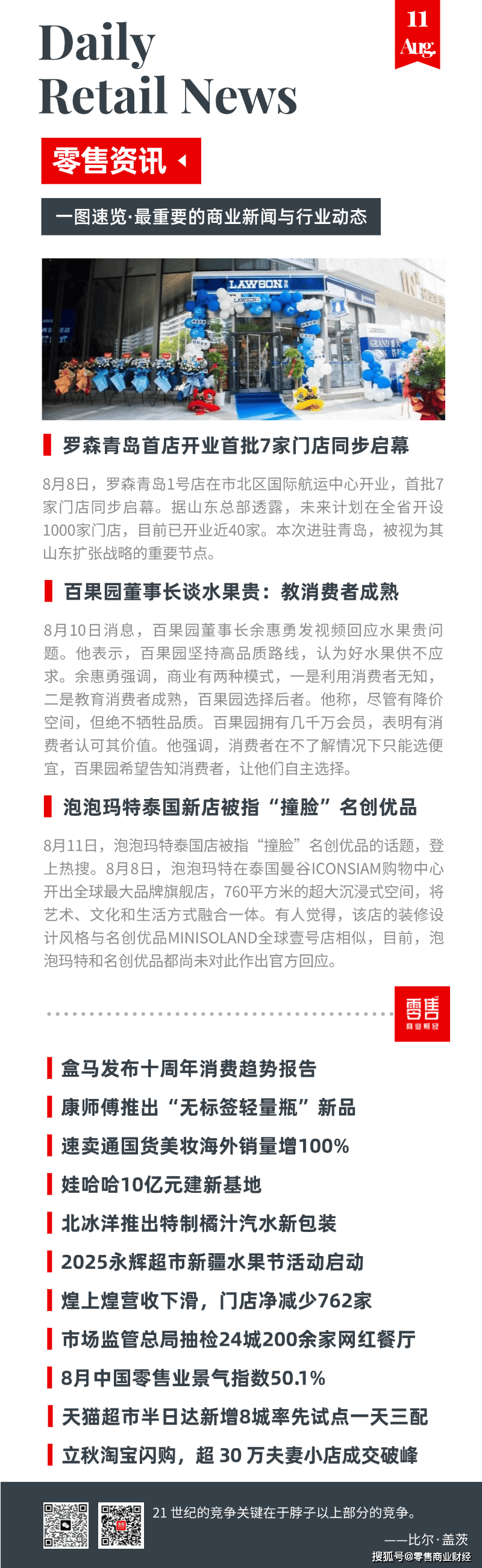
罗森青岛首店开业;余惠勇回应百果园水果太贵
Sou Hu Cai Jing· 2025-08-11 21:27
Group 1 - Lawson opened its first store in Qingdao, with a total of 7 stores launched simultaneously, marking a significant step in its expansion strategy in Shandong, aiming to establish 1,000 stores in the province [7] - Baiguoyuan's chairman addressed the issue of high fruit prices, emphasizing the company's commitment to quality and consumer education, stating that good fruit is in high demand and that they will not compromise on quality despite potential price reductions [9] - Pop Mart's flagship store in Thailand, which is the largest globally at 760 square meters, has been criticized for resembling Miniso's design, although neither company has officially responded to the claims [10] Group 2 - Hema released a consumption trend report for its 10th anniversary, focusing on "freshness, health, and self-satisfaction" as key product directions, and has built a large supply chain network to ensure the quality of fresh produce [12] - AliExpress reported a 100% year-on-year increase in overseas sales of domestic beauty products, with Europe, Mexico, Brazil, and Japan being the main growth markets [13] - Wahaha announced a 1 billion yuan investment in a new beverage production base in Xi'an, which will include multiple production lines for various beverages [14] Group 3 - The retail industry in China saw a CRPI of 50.1 in August, indicating a return to expansion, with a 0.5 percentage point increase from the previous month [19] - Tmall Supermarket expanded its same-day delivery service to 8 new cities, achieving a delivery punctuality rate of over 97%, with plans for further expansion [21] - On August 7, over 300,000 small restaurant businesses achieved peak sales on Taobao Flash Sale, with delivery riders on Ele.me increasing to 3.5 times last year's numbers [23]


埃及计划到2030年绿色能源生产电力到24%;TikTok Shop日本首月GMV破2450万;上半年全球电视出货量同比增长2%|一周「出海参考」
Tai Mei Ti A P P· 2025-08-11 12:25
Group 1 - MGX, an Abu Dhabi investment group, plans to raise up to $25 billion for AI infrastructure investments, aiming to become one of the largest entities in this sector globally [1] - Egypt aims to achieve 42% of its electricity from renewable sources by 2030, attracting over $10 billion in private investments and has already raised about $4 billion [2] - Vietnam's Prime Minister has announced a plan to establish international financial centers in Ho Chi Minh City and Da Nang by the end of 2025, emphasizing the importance of attracting foreign investment and enhancing the country's competitiveness [3] Group 2 - Indonesia is planning to expand the digital park on Batam Island to attract global data center investments, with a projected market growth rate of 15.2% annually, reaching $3.43 billion by 2028 [4] - TikTok has integrated Amazon's "Buy with Prime" checkout system into its advertising platform, allowing users to complete purchases without leaving TikTok [5] - TikTok Shop in Japan achieved a GMV of approximately $3.36 million in its first month, with mobile and digital products leading sales [6][7] Group 3 - TikTok Shop Thailand announced new fulfillment rules effective October 2025, imposing penalties for delayed shipments [8] - TikTok Shop in the U.S. is upgrading its logistics system to enhance efficiency and reduce costs for cross-border merchants [9] - TikTok has partnered with Booking.com to allow users to search and book accommodations directly through the platform, marking a significant step in its local services strategy in the U.S. [10] Group 4 - Amazon is intensifying compliance checks, targeting sellers with problematic brand authorizations and address inconsistencies, with potential account suspensions for violations [11] - Amazon Mexico launched a low-price shopping section called "Amazon Bazaar," featuring products primarily under 199 pesos [12] - Amazon Global Logistics has introduced a new cross-border shipping service between China and Japan to enhance delivery efficiency [13] Group 5 - Temu has partnered with Korea's FITI Research Institute to enhance quality control for textiles sold on its platform [14] - AliExpress reported a 100% increase in sales of Chinese beauty products overseas, with significant growth in Europe, Mexico, Brazil, and Japan [15] - Alibaba International Station has implemented a "three-day design" service standard to improve response times for custom product requests [16] Group 6 - Shopee Philippines launched an Express Air Local service to expedite order delivery times between islands [17] - Shopee announced the establishment of three new logistics hubs in Brazil, enhancing service capabilities in the Rio de Janeiro metropolitan area [18] - eBay introduced a new policy to automatically delete negative reviews caused by customs delays, aiming to support international sellers [19] Group 7 - eBay is restructuring its core business departments to optimize seller service experiences [20] - Ozon is implementing a special fee rate policy for products priced below 300 rubles, reducing seller costs by 50% [22] - Global TV brand shipments reached 92.5 million units in the first half of 2025, showing a 2% year-on-year increase [23] Group 8 - Global tablet shipments grew by 9% in Q2 2025, with Huawei, Lenovo, and Xiaomi showing significant growth [24] - Chinese mobile game publishers accounted for 34% of the global revenue of the top 100 mobile game publishers in July 2025 [26] - PingPong will support Wero transactions, covering 75% of core customers in Europe [27][28]

网经社:《2025年平台经济“反内卷”分析报告》发布
Sou Hu Cai Jing· 2025-08-11 08:58
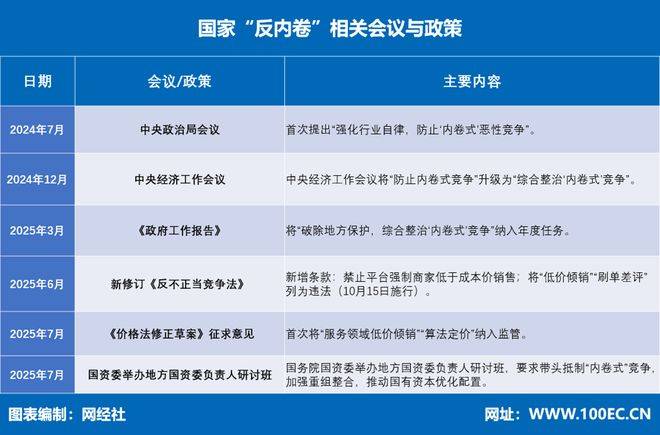
Core Viewpoint - The platform economy is facing severe "involution" competition characterized by price wars and subsidy battles, which hinders healthy industry development and threatens long-term consumer interests [1] Group 1: Government Actions and Policies - The government has initiated multiple measures to address "involution" competition, including the introduction of the revised Anti-Unfair Competition Law, effective from October 15, 2025, which prohibits platforms from forcing merchants to sell below cost [2][3] - Key meetings and policies include the Central Political Bureau meeting in July 2024, which emphasized the need for industry self-discipline, and the Central Economic Work Conference in December 2024, which escalated the response to "involution" competition [2] Group 2: Characteristics of Involution Competition - Involution competition manifests in various forms across the platform economy, including price wars, subsidy battles, and severe homogeneity in business models [4][5] - The competition is driven by algorithmic manipulation, leading to market entry barriers and a closed ecosystem that favors established platforms [5][6] Group 3: Root Causes and Conflicts - The root causes of involution competition include market structure imbalance, capital-driven distortions, and regulatory lag [7][8] - Core conflicts arise from the tension between homogeneous competition and innovation incentives, as well as the disparity between capital profit motives and market fairness [7][9] Group 4: Multi-layered Impacts of Involution - Involution competition has negative effects on economic efficiency, social equity, and national economic security, leading to resource misallocation and erosion of tax bases [10][11] - The impact on platforms includes weakened profitability and innovation, while industries face supply chain disruptions and declining employment quality [10][11] Group 5: Transition from Involution to Value Creation - The platform economy must shift from zero-sum competition to value creation, focusing on technological innovation, cultural empowerment, and ecological collaboration [20][21] - Key strategies for this transition include optimizing ecological structures, innovating service models, and fostering equitable cooperation among stakeholders [20][21] Group 6: Legal Framework Challenges - The current legal framework faces significant limitations in addressing involution competition, particularly in areas like price dumping and algorithmic collusion [22][23] - Recommendations for improvement include refining platform-specific regulations, enhancing data governance, and optimizing enforcement mechanisms [23][24]
第四届数贸会筹备进入冲刺阶段
Hang Zhou Ri Bao· 2025-08-07 02:46
Group 1 - The fourth Global Digital Trade Expo will open on September 25 in Hangzhou, with significant preparations underway and a notable increase in exhibitor participation [1] - A total of 1,614 exhibitors have registered, surpassing last year's total, and pre-registered professional buyers have exceeded 24,047, including 7,012 international buyers from 50 countries and regions [1] - The expo aims to attract over 40,000 professional buyers, with international buyers expected to exceed 10,000, targeting a growth of over 50% compared to last year [1] Group 2 - The expo will feature a first-time procurement list for buyers, with an initial release of international procurement needs totaling $190 million from 23 countries, and an additional 300 procurement demands amounting to approximately 2.3 billion yuan [1] - The event will showcase cutting-edge technologies and products, particularly in the artificial intelligence sector, with a larger exhibition area and broader industry coverage [1] - The expo coincides with the 10th anniversary of the first cross-border e-commerce pilot zone in Hangzhou, leveraging its advantages to host activities from global platforms like Amazon, AliExpress, TikTok, and SHEIN [1] Group 3 - During the expo, authoritative reports such as the "Global Digital Trade Development Report 2025" and "China Digital Trade Development Report 2025" will be released, along with the global and national TOP 100 digital trade enterprises list [2] - The event will also introduce the "Top Ten Young Digital Trade Innovators Under 35" list, establishing a three-dimensional evaluation system covering talent, enterprises, and ecosystems [2] - A "Digital Trade Investment Day" will be held to match 100 core technology digital trade projects with 100 global quality venture capital firms, promoting innovation projects and teams in Hangzhou [2]
第四届数贸会进入50天倒计时
Mei Ri Shang Bao· 2025-08-06 22:55
Core Insights - The fourth Global Digital Trade Expo (referred to as "Digital Trade Expo") will take place from September 25 to September 29, 2025, in Hangzhou, focusing on enhancing digital trade as a new engine for global economic growth [1] Group 1: Trade Promotion - The expo will feature 1,614 exhibitors, surpassing last year's total, and is expected to attract over 40,000 professional buyers, including more than 10,000 international buyers [2] - A significant increase in international procurement demand has been noted, with nearly 300 new procurement requests totaling approximately 2.3 billion yuan following the initial release of a $190 million procurement list from 23 countries [2] - The expo will leverage its location in Hangzhou, which celebrates the 10th anniversary of its first cross-border e-commerce pilot zone, to host activities involving major global platforms like Amazon, TikTok, and Facebook [2] Group 2: Technology Empowerment - The expo aims to showcase cutting-edge digital technologies and products, focusing on generative AI and multimodal sensory interaction, while eliminating traditional national pavilions to highlight leading digital trade enterprises [3] - The "Artificial Intelligence+" concept will be a central theme, demonstrating applications of AI across various sectors such as cross-border e-commerce, green transportation, and medical diagnostics [3] - New products and technologies, including the "Turing One" cleaning robot and XR glasses, will be presented, providing immersive experiences for attendees [3] Group 3: Investment Cooperation - The expo will facilitate global resource integration and promote bilateral investments, responding to the demand for global interconnected development [6] - Special events will be organized, including a focus on trade exchanges with the UAE as the guest country and the establishment of a "BRICS Special Economic Zone Cooperation Week" [6] - New initiatives like "International Bulk Commodities and Derivatives Dialogue" will support the development of a smart trading hub for bulk commodities, enhancing financial, technological, and talent empowerment [6]
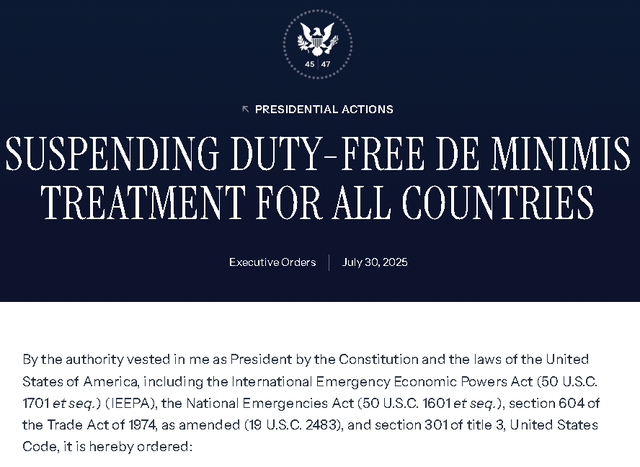
8月29日起,美国800美元免税政策全面取消!跨境卖家迎来规则博弈
Sou Hu Cai Jing· 2025-08-01 10:49
Core Viewpoint - A significant policy change in the U.S. will reshape the global small package cross-border trade landscape by eliminating the long-standing $800 tax exemption for imports starting August 29 [1][3]. Summary by Sections Policy Changes - The new regulation will impose applicable tariffs on all packages not shipped through the international postal system, with specific duties based on the country of origin and effective tax rates [3][4]. - The previous exemption for packages valued under $800 will no longer be the default option, although travelers can still bring back personal items worth up to $200 and receive gifts valued under $100 tax-free [3][4]. Impact on Cross-Border E-commerce - The termination of the exemption is expected to significantly impact sellers who previously exploited loopholes through third-country transshipment and other gray market operations [4][6]. - Over the past decade, the $800 exemption has fueled rapid growth in global cross-border e-commerce, with the number of low-value shipments entering the U.S. skyrocketing from 134 million in 2015 to 1.36 billion in 2024, a 600% increase [4][6]. Market Dynamics - The U.S. government views the previous exemption as a means for Chinese sellers to dump cheap goods, harming local retail and manufacturing, and leading to issues like smuggling and tax evasion [6]. - The new policy is likely to eliminate sellers who rely on policy arbitrage and lack brand strength, pushing the industry towards compliance and value-based competition [6]. Strategic Adjustments for Sellers - Sellers will need to enhance supply chain management, local compliance capabilities, and focus on high-value products to adapt to the new environment [6]. - Building strong independent brands and diversifying sales channels will be crucial for survival in the evolving market landscape [6]. Broader Economic Context - Recent positive developments in U.S.-China trade relations, including a 90-day extension of existing tariffs, provide a temporary respite for cross-border sellers amid the impending policy changes [7][9]. - The end of the $800 exemption marks a shift away from a low-price-driven growth model, favoring businesses with resilient supply chains and strong product development capabilities [9].
又一硬科技类目在速卖通爆发:HiFi耳机增长8倍,带火音频相关设备
Cai Jing Wang· 2025-08-01 06:18
Core Insights - The HiFi audio equipment market is experiencing significant growth as it becomes a notable opportunity in niche markets, particularly for overseas consumers who prioritize high-fidelity sound quality when choosing headphone brands [1] - During the overseas 618 shopping festival, sales of HiFi headphones on the AliExpress platform surged, with daily sales increasing eightfold, MP3 sales growing sixfold year-on-year, and audio amplifiers rising by 150% [1] - Chinese brands such as HIFIMAN, MOONDROP, and KZ have successfully entered the HiFi headphone market on AliExpress, with several brands achieving annual sales exceeding one million USD [1] Group 1 - AliExpress is enhancing its support for HiFi audio brands through initiatives like the "100 Billion Subsidy for Brand Going Abroad" plan and "Overseas Custody" model, which aim to promote high-quality Chinese products and brands in international markets [1] - The platform's strong foundation in consumer electronics and its focus on high-quality, high-ticket "hard technology" products are expected to create new opportunities for HiFi audio equipment [1] Group 2 - AliExpress is providing dedicated resources such as subsidies and tailored strategies for different markets, which have led to significant growth and local consumer recognition for various HiFi audio brands [2] - In Brazil, price-sensitive consumers prefer mid-range products, leading brands like KZ to excel in the market by leveraging high cost-performance products, with 80% of their sales coming from specific promotional channels [2] - Japanese consumers are more willing to invest in high-quality audio experiences, favoring mid-to-high-end HiFi devices, which has allowed brands like HIFIMAN and DUNU to penetrate the market effectively through influencer collaborations [2] Group 3 - The growth of HiFi headphones has also driven explosive growth in related categories such as audio amplifiers, MP3 players, and decoders on AliExpress, with brands like TOPPING achieving over 200,000 USD in sales during the overseas 618 event [3] - Despite the presence of leading brands on the platform, there remains significant untapped potential for independent HiFi brands, indicating a vast opportunity for industry development [3]
中国(厦门)国际跨境电商展折射厦门跨境电商产业发展路径
Sou Hu Cai Jing· 2025-07-30 06:44
Group 1: Cross-Border E-Commerce Growth - Xiamen's cross-border e-commerce exports have exceeded a growth rate of 50% for six consecutive years, with exports reaching 6.58 billion yuan in the first quarter of this year, and local port exports increasing by 53%, accounting for over 40% of the province's total cross-border e-commerce exports [1][5] - In 2024, Xiamen ranked among the top in the comprehensive evaluation of 165 pilot zones by the Ministry of Commerce [1][5] Group 2: Industry Cluster Development - Xiamen has attracted major international cross-border e-commerce platforms such as Amazon, Google, JD.com, and AliExpress, fostering a cluster of nearly 6,000 cross-border e-commerce sellers [1][5] - The city has established industrial clusters in areas like Zhaishang and Software Park Phase III, enhancing the local e-commerce ecosystem [5][6] Group 3: Trade Shows and Events - The China (Xiamen) International Cross-Border E-Commerce Expo, initiated in 2021, has become one of the most influential and comprehensive cross-border e-commerce exhibitions in the country, showcasing over 1,500 international standard booths [3][4][5] - The fifth edition of the expo highlighted over 30 specialty industrial belts and mainstream cross-border e-commerce platforms, achieving record highs in both foot traffic and business transactions [4][5] Group 4: Logistics and Supply Chain - Xiamen has developed a mature cross-border logistics system, with 20 all-cargo air routes and various maritime routes, enhancing its connectivity to major global markets [6][10] - The city has also launched the first "Silk Road Maritime" e-commerce express line, exporting over 14.71 billion yuan worth of goods since its inception in 2022 [4][10] Group 5: Emerging Trends in E-Commerce - Print on Demand (POD) has emerged as a significant trend in the cross-border e-commerce sector, allowing consumers to customize products with their designs, leading to a surge in demand [7][8] - Companies like Xiamen Sidi Technology have reported a two to threefold increase in orders for customized products, primarily from markets in Europe and the United States [7][8] Group 6: Industry Advantages and Future Prospects - Xiamen's sanitary ware industry is a key player in the global market, exporting to over 180 countries and regions, with significant contributions from local brands [9][10] - The city is also focusing on enhancing its cross-border e-commerce ecosystem by improving policies and support mechanisms for local businesses [14][15]