
大成基金

Search documents
基金发行依然分化 指数与固收唱主角
Zheng Quan Shi Bao· 2025-04-27 17:39
Core Insights - The recent fundraising activities in the mutual fund market indicate a strong preference for fixed-income products, with the top fund,浦银安盛普航3个月定开债基, raising nearly 6 billion units, making it the "king of issuance" for April [1] - The overall fundraising for newly established funds reached 24.58 billion units, with passive index funds accounting for nearly half, while actively managed equity products faced challenges with less than 1 billion units raised [1][3] - The market is experiencing structural differentiation, with a significant shift in investor risk appetite towards fixed-income products amid increased volatility in the equity market [1][3] Fundraising Trends - The average issuance of new funds last week was 8.78 billion units, with浦银安盛普航3个月定开 leading at 59.99 billion units, followed by中欧稳航90天持有A at 31.80 billion units and招商稳健策略优选3个月持有A at 29.71 billion units [1] - Over 90% of the newly issued products had a 3-month lock-up period, catering to investors' liquidity needs while providing fund managers with a stable period for building positions [2] - The successful issuance of华泰苏州恒泰租赁住房REIT at 5 billion units highlights the ongoing expansion of the public REITs market in the affordable rental housing sector [3] Market Behavior and Outlook - The issuance of mid-to-long-term pure bond funds reached 73.59 billion units, reflecting a risk-averse sentiment among investors, while passive index funds totaled 65.77 billion units, indicating a preference for low-cost, diversified investment tools [3] - Fund companies are actively preparing for the second quarter market, with expectations that a potential recovery in equity market sentiment could drive both passive index and active management strategies [3] - The continued development of innovative products like REITs and FOFs is expected to inject differentiated momentum into the new issuance market [3]
权益投资渐热:公募非货规模TOP20都有谁?
Sou Hu Cai Jing· 2025-04-27 11:36
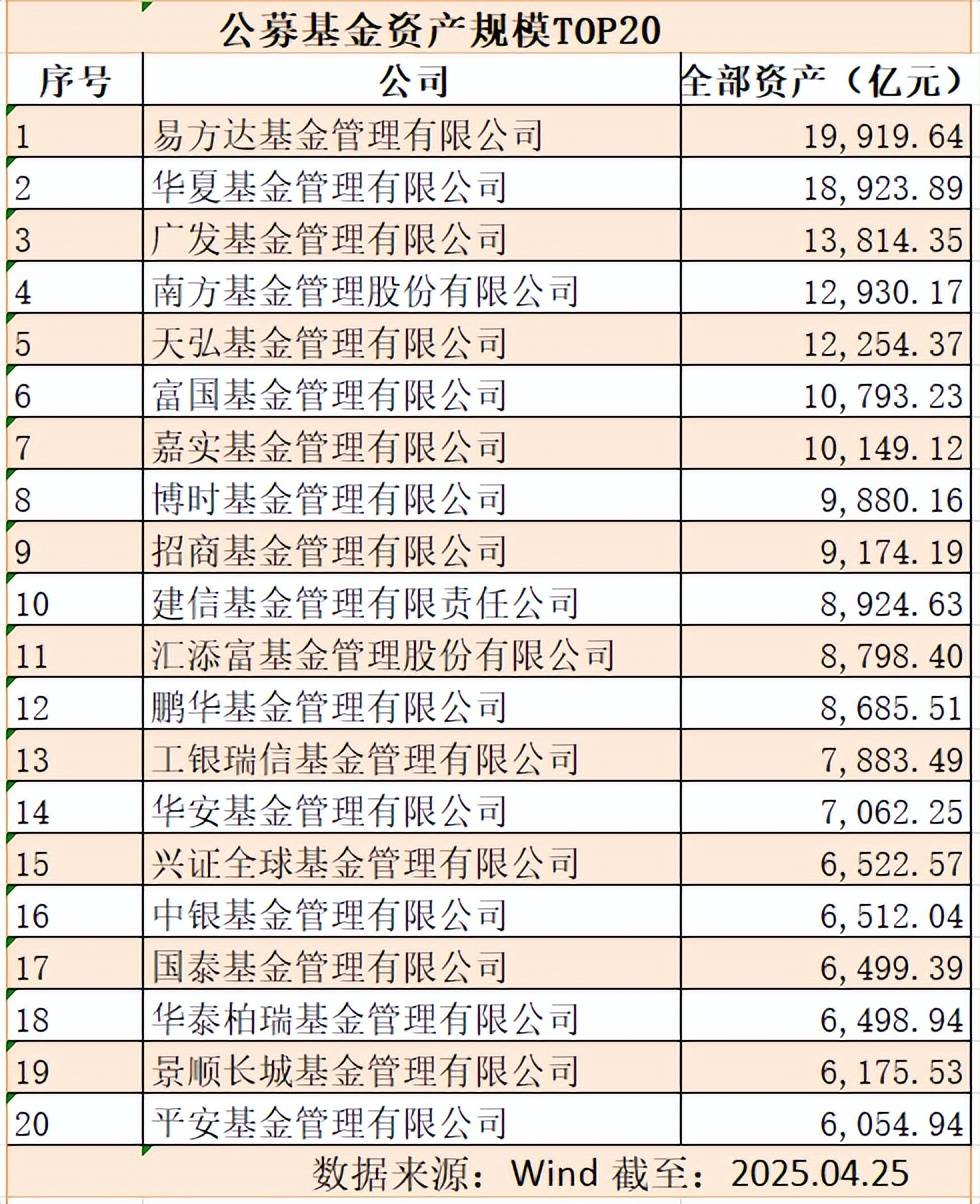
Core Viewpoint - The recent growth of certain equity funds by billions is notable, especially in the context of a generally poor performance in equity investments over recent years. This contrasts sharply with the booming market four years ago when new fund issuances often exceeded hundreds of billions [1]. Group 1: Fund Company Scale - As of April 25, the number of public fund companies in China has reached 200, with seven companies in the "trillion yuan club," including E Fund, Huaxia, and GF Fund, among others [1]. - The top 20 public fund companies by total assets have a minimum threshold of over 600 billion yuan [2]. Group 2: Non-Money Market Fund Scale - The top five companies by non-money market fund scale are E Fund (1.36 trillion yuan), Huaxia (1.19 trillion yuan), GF Fund (0.79 trillion yuan), and others, indicating a significant variation in rankings compared to total asset rankings [3][4]. - Among the top 20 companies, 19 have non-money market fund scales exceeding 300 billion yuan, with only one company, Xingzheng Global Fund, below this threshold [4]. Group 3: Non-Money Market Fund Proportion - The top five companies by non-money market fund proportion are Huatai-PB (90.15%), Jingshun Great Wall (70.14%), and others, highlighting a shift in focus towards non-money market assets [6][7]. - All top 20 companies have a non-money market fund proportion above 50%, indicating a strong emphasis on these assets among leading fund companies [7]. Group 4: Recent Performance of Fund Products - The analysis of fund performance over the past six months shows that the top-performing products are diversified across various themes, including artificial intelligence, North Exchange-listed companies, and gold ETFs [9][10][13]. - The top five products by performance include E Fund's advanced manufacturing fund with a return of 93.74%, and Penghua's carbon neutrality fund with 87.67% [9].

百亿权益基金经理五年业绩盘点:闫思倩总回报257.32%断层领先,韩创年化回报23.36%领跑
Xin Lang Ji Jin· 2025-04-27 10:23
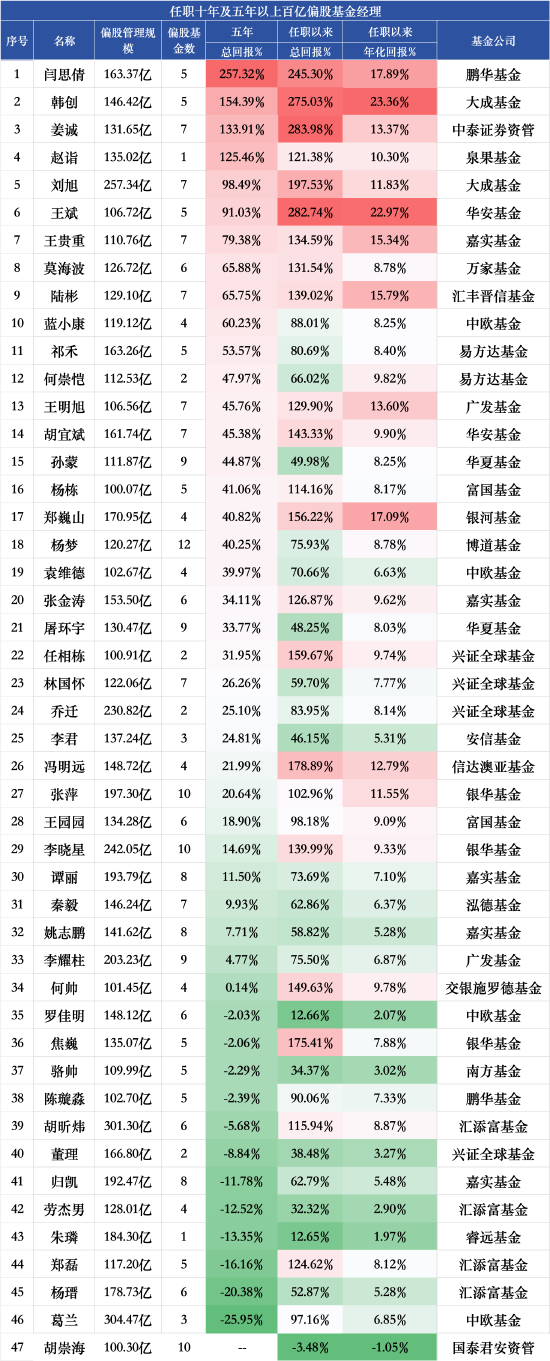
Core Insights - The A-share market has experienced significant volatility, making it challenging for fund managers to maintain outstanding performance over the long term [1] - There are 47 fund managers managing over 10 billion in equity funds with ten years or more of experience [1] Fund Manager Performance - Yan Enqian from Penghua Fund leads with a five-year total return of 257.32% and an annualized return of 17.89% [4][5] - Han Chuang from Da Cheng Fund has a five-year total return of 154.39% and the highest annualized return of 23.36% among the top ten [5] - Liu Xu from Da Cheng Fund manages the largest fund size at 257.34 billion, with a five-year return of 98.49% and an annualized return of 11.83% [5][11] - Jiang Cheng is noted for a stable investment approach, achieving a five-year total return of 133.91% and an annualized return of 13.37% [7] - Wang Bin from Huazhong Fund has a five-year total return of 91.03% and an annualized return of 22.97%, demonstrating strong risk control [7] Risk and Return Analysis - Yan Enqian exhibits a high return of 257.32% but also a significant maximum drawdown of -63.17%, indicating an aggressive investment style [9] - Liu Xu shows a lower maximum drawdown of -25.00% and a high Sharpe ratio of 0.9750, reflecting a more conservative investment approach [9] - Wang Guizhong has a decent return of 79.38% but faces a larger maximum drawdown of -50.24%, suggesting potential downside risks [9] Fund Management Strategies - The top fund managers exhibit diverse investment styles, with some focusing on short-term opportunities while others emphasize long-term value investing [11][12] - Yan Enqian and Wang Guizhong are more inclined to capitalize on market fluctuations, whereas Han Chuang and Wang Bin excel in navigating market cycles for sustained returns [12]
百亿权益基金经理五年业绩盘点:葛兰近五年回报跌25.95%垫底,汇添富基金经理倒数前十占据四席
Xin Lang Ji Jin· 2025-04-27 10:18
Core Viewpoint - The A-share market has experienced significant volatility in recent years, making it challenging for fund managers to maintain outstanding performance over the long term [1] Group 1: Fund Manager Performance - There are 47 fund managers managing over 10 billion yuan in equity funds with ten years or more of experience [1] - The top-performing fund managers over the past five years include Yan Enqian and Han Chuang, who achieved high returns with moderate fund sizes [4] - Liu Xu, managing a large fund size, also demonstrated that scale and returns can coexist [4] - The worst performer in the past five years was Guo Lan from China Europe Fund, with a total return of -25.95% [4] - Other poorly performing managers include Yang Zhen and Zheng Lei from Huatai PineBridge, with returns of -20.38% and -16.16%, respectively [6] Group 2: Fund Size and Management - The top ten fund managers by equity management scale are: Ge Lan (30.447 billion), Hu Xinwei (30.130 billion), Liu Xu (25.734 billion), and others [3] - The data indicates that even experienced fund managers can face challenges due to market changes or inappropriate investment strategies [6] Group 3: Risk and Return Analysis - The risk-return analysis shows that while Guo Lan has high interval returns, her Alpha value is negative, indicating poor performance relative to market benchmarks [8] - Zhu Lin and Gui Kai also reported negative interval returns, suggesting significant market challenges or misalignment of investment strategies [8] - The analysis highlights that fund managers' investment styles vary, with some facing substantial market challenges [8] Group 4: Representative Fund Comparisons - Guo Lan's fund, China Europe Medical Health A, has shown stable long-term performance but has low recent returns and high maximum drawdown, indicating a need for better risk control [10] - Zheng Lei's fund, Huatai PineBridge Innovation Medicine, has performed well recently but has lower long-term returns and high maximum drawdown [10] - Zhu Lin's fund, Ruiyuan Growth Value A, while large in scale, has not performed well long-term, with low recent returns and high maximum drawdown [10] Group 5: Investment Strategy Insights - The historical performance of fund managers does not guarantee future success, as market dynamics require continuous adjustment of investment strategies [11] - Investors should consider the underlying investment philosophies and management styles of fund managers to make informed decisions [11]
振华B股:2025一季报净利润2.55亿 同比增长50%
Tong Hua Shun Cai Bao· 2025-04-27 10:11
Financial Performance - The company reported a basic earnings per share of 0.0480 yuan for Q1 2025, representing a 54.84% increase compared to 0.0310 yuan in Q1 2024 [1] - Net profit for Q1 2025 was 2.55 billion yuan, a 50% increase from 1.7 billion yuan in Q1 2024 [1] - Operating revenue for Q1 2025 was 85.17 billion yuan, showing a slight increase of 0.85% from 84.45 billion yuan in Q1 2024 [1] - The return on equity (ROE) improved to 1.62% in Q1 2025 from 1.08% in Q1 2024, marking a 50% increase [1] Shareholder Structure - The top ten unrestricted shareholders collectively hold 259,282.6 million shares, accounting for 49.22% of the circulating shares, with a decrease of 995.58 million shares compared to the previous period [2] - Major shareholders include China Communications Group (Hong Kong) Holdings Limited with 91,675.58 million shares (17.40%), and China Communications Construction Company Limited with 85,554.20 million shares (16.24%), both remaining unchanged [2] - Hong Kong Central Clearing Limited saw a reduction of 1,699.02 million shares, while the Huaxia Guozheng Free Cash Flow ETF entered the top ten shareholders with 2,660.90 million shares [2] Dividend Policy - The company has announced that it will not distribute dividends or transfer shares this time [3]

恒银科技:2024年报净利润0.4亿 同比增长119.23%
Tong Hua Shun Cai Bao· 2025-04-24 12:51
一、主要会计数据和财务指标 前十大流通股东累计持有: 31166.6万股,累计占流通股比: 59.87%,较上期变化: -452.98万股。 | 名称 | 持有数量(万股) | 占总股本比例 | 增减情况(万 | | --- | --- | --- | --- | | | | (%) | 股) | | 恒融投资集团有限公司 | 24167.00 | 46.43 | 不变 | | 王淑琴 | 5669.95 | 10.89 | 不变 | | 江浩然 | 344.58 | 0.66 | 不变 | | 华宝中证金融科技主题ETF | 201.04 | 0.39 | 新进 | | 梁留生 | 179.15 | 0.34 | 新进 | | 周哲 | 170.87 | 0.33 | 新进 | | 张云峰 | 139.43 | 0.27 | 新进 | | 顾春梅 | 100.05 | 0.19 | 新进 | | 沈芸 | 100.00 | 0.19 | 新进 | | 张学连 | 94.53 | 0.18 | 新进 | | 较上个报告期退出前十大股东有 | | | | | 罗宗曼 | 398.66 | 0.77 | 退出 | ...

自由现金流ETF不愁卖 发行节奏主打“速战速决”
Zheng Quan Shi Bao· 2025-04-23 18:12
Core Viewpoint - The recent surge in interest for ETFs focused on free cash flow reflects a growing market emphasis on the quality of corporate earnings, with major fund companies actively launching new products in this category [1][2]. Group 1: Market Trends - There is a notable differentiation in the scale of free cash flow ETFs, with leading fund companies raising over 1.1 billion units for individual products, while smaller firms face challenges in attracting investment [1]. - More than ten public fund companies, including E Fund, Fuguo Fund, and Yinhua Fund, have filed for free cash flow-themed products, covering various indices such as the National Index and the STAR Market [1]. Group 2: Product Design and Distribution - The nine newly launched ETFs feature a three-month lock-up period to minimize short-term capital fluctuations and focus on index replication [2]. - Distribution channels for these ETFs are extensive, utilizing both offline and online platforms, including major securities firms and internet platforms, ensuring broad access to retail investors [2]. Group 3: Investor Sentiment and Strategy - The rapid issuance of these ETFs indicates a strong demand for cash flow management tools among institutions, reflecting a shift in industry competition towards niche segments [2]. - The quick fundraising success of these products, such as the Fuguo CSI 800 Free Cash Flow ETF completing its fundraising in just five days, highlights institutional confidence in this investment strategy [2][3]. Group 4: Investment Value - The focus on free cash flow is driven by the need for stable assets in a low-interest-rate environment, with institutions like pension funds and insurance companies increasingly favoring high-dividend assets [3]. - Fund managers emphasize that cash flow metrics may provide a more accurate reflection of a company's profitability, suggesting that firms with stable cash flows are likely to be healthier and more sustainable in the long term [3].
永赢基金一季度大丰收!单赛道押注捧红新星、“固收+”转型激活老将
Sou Hu Cai Jing· 2025-04-23 05:39
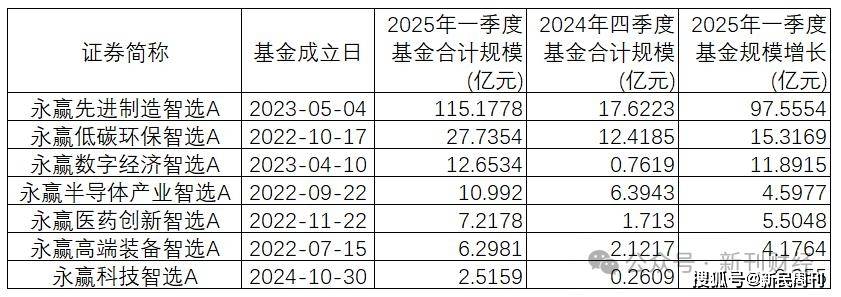
Core Insights - The transformation of Gao Nan signifies a breakthrough in his career and indicates that "fixed income +" will evolve from a "quasi-financial" tool to a more adaptable mainstream asset class in the market, entering a new phase driven by professional capabilities and differentiated strategies [1][21]. Group 1: Industry Trends - The competitive landscape of the public fund industry is changing, with several funds, including Yongying Fund, experiencing significant growth in active equity fund management scale, with Yongying Fund leading with an increase of 16.433 billion yuan [1][2]. - As of the end of Q1 2025, Yongying Fund's public fund management scale reached 502.651 billion yuan, ranking 23rd in the industry, with mixed funds showing a remarkable increase of 86.54% compared to the end of Q4 2024 [2]. Group 2: Yongying Fund's Performance - Yongying Fund's strategic foresight in product layout has been evident, particularly with the launch of the Yongying Smart Selection series, which focuses on core areas of new productivity, gaining significant market attention [2][3]. - The Yongying Smart Selection series saw substantial growth in Q1 2025, with the Yongying Advanced Manufacturing Smart Selection A fund increasing by 97.56 billion yuan in scale [2][3]. Group 3: Gao Nan's Role and Strategy - Gao Nan, the Chief Investment Officer of Yongying Fund, has adopted a balanced investment style focused on absolute returns, successfully managing both equity and bond funds, with his managed products returning to a scale exceeding 10 billion yuan [5][19]. - Gao Nan's investment strategy emphasizes the ability to continuously generate alpha returns across both equity and bond markets, which may become a core competitive advantage for "fixed income +" funds in the future [21].
公募最新规模排名出炉!谁掉队?谁突围?
券商中国· 2025-04-22 15:27
Core Viewpoint - The public fund industry is experiencing significant changes in scale and competition, with a notable shift of funds from stable bond and money market funds to equity funds, reflecting changing investor preferences and market conditions [2][5]. Group 1: Overall Industry Performance - As of the end of Q1 2025, the total scale of public fund management in China reached 31.81 trillion yuan, a decrease of approximately 600 billion yuan from the end of last year, primarily due to significant reductions in bond and money market fund sizes [2][4]. - The competition landscape among public fund companies is intensifying, with some firms gaining ground while others are falling behind [2]. Group 2: Company-Specific Performance - The top ten companies by non-money fund scale include E Fund, Huaxia Fund, GF Fund, and others, with E Fund and Huaxia Fund being the only firms with non-money management scales exceeding 1 trillion yuan [7][8]. - Notably, the non-money fund scale of Fuguo Fund increased by nearly 30 billion yuan in Q1, allowing it to enter the top four for the first time [8][9]. - Several companies, including Yongying Fund and Fuguo Fund, saw substantial growth in their active equity fund management scales, with increases exceeding 70 billion yuan [3][14]. Group 3: Fund Type Performance - Active equity funds experienced a rebound in scale, with a total increase of 18 billion yuan in Q1, driven by strong performance in sectors like technology [12][14]. - Conversely, bond and money market funds saw significant reductions, with bond funds shrinking by 438.8 billion yuan and money market funds by 277.7 billion yuan [5]. - The demand for diversified asset allocation is evident, as overseas investment funds and commodity funds continued to grow, with increases of 25.5 billion yuan and 51.6 billion yuan, respectively [5]. Group 4: Market Dynamics - The market is witnessing a "seesaw effect" in fund sizes, with funds shifting from lower-risk categories to higher-risk equity funds amid a volatile A-share market [4][5]. - The trend of passive funds outpacing active funds continues, with passive equity index funds reaching 3.96 trillion yuan, surpassing active equity funds at 3.44 trillion yuan by the end of 2024 [11].

宏信证券ETF日报-20250421
Hongxin Security· 2025-04-21 09:01
Report Industry Investment Rating No relevant content provided. Core View of the Report On April 21, 2025, the Shanghai Composite Index rose 0.45% to 3291.43, the Shenzhen Component Index rose 1.27% to 9905.53, and the ChiNext Index rose 1.59% to 1944.32. The total trading volume of A-shares in the two markets was 1.0738 trillion yuan. The top-performing sectors were non-ferrous metals (3.79%), computer (2.72%), and beauty care (2.11%), while the worst-performing sectors were banking (-1.23%), food and beverage (-0.59%), and real estate (-0.46%) [2][6]. Summary by Directory Market Overview - The Shanghai Composite Index rose 0.45% to 3291.43, the Shenzhen Component Index rose 1.27% to 9905.53, and the ChiNext Index rose 1.59% to 1944.32 [2][6]. - The total trading volume of A-shares in the two markets was 1.0738 trillion yuan [2][6]. - The top-performing sectors were non-ferrous metals (3.79%), computer (2.72%), and beauty care (2.11%), while the worst-performing sectors were banking (-1.23%), food and beverage (-0.59%), and real estate (-0.46%) [2][6]. Stock ETF - The top three stock ETFs by trading volume were Southern CSI A500 ETF (up 0.42%, discount rate 0.55%), Huaxia CSI A500 ETF (up 0.44%, discount rate 0.52%), and Huatai-PineBridge CSI 300 ETF (up 0.05%, discount rate 0.24%) [3][7]. Bond ETF - The top three bond ETFs by trading volume were Penghyang ChinaBond 30-Year Treasury Bond ETF (down 0.35%, discount rate -1.43%), Fuguo ChinaBond 7-10 Year Policy Financial Bond ETF (down 0.06%, discount rate -0.11%), and Haifutong CSI Short-Term Financing Bond ETF (up 0.01%, discount rate 0.01%) [4][9]. Gold ETF - Gold AU9999 rose 1.96% and Shanghai Gold rose 1.69%. The top three gold ETFs by trading volume were Huaan Gold ETF (up 1.86%, discount rate 2.05%), E Fund Gold ETF (up 1.86%, discount rate 2.04%), and Bosera Gold ETF (up 1.88%, discount rate 2.09%) [12]. Commodity Futures ETF - The top three commodity futures ETFs by trading volume were Huaxia Feed Meal Futures ETF (up 0.87%, discount rate 0.86%), Dacheng Non-Ferrous Metals Futures ETF (up 1.46%, discount rate 1.39%), and Jianxin Yisheng Zhengzhou Commodity Exchange Energy and Chemical Futures ETF (up 0.48%, discount rate 0.64%) [13]. Cross-Border ETF - The US and German stock markets were closed the previous trading day, and the Hong Kong stock market was closed today. The top three cross-border ETFs by trading volume were Huaxia Hang Seng Tech ETF (up 1.05%, discount rate 0.78%), Huatai-PineBridge Southern Dongying Hang Seng Tech ETF (up 1.06%, discount rate 1.43%), and Huaxia Hang Seng Internet Technology Industry ETF (up 0.89%, discount rate 0.62%) [15]. Money ETF - The top three money ETFs by trading volume were Yin Hua Day Profit ETF, Hua Bao Add Benefit ETF, and Money ETF [17].