Arm Holdings plc

Search documents
5 Leading Tech Stocks to Buy in 2025
The Motley Fool· 2025-04-06 08:15
Core Viewpoint - The article highlights five technology companies poised for significant growth from 2025 onward, driven by advancements in AI, cybersecurity, semiconductors, and the gaming industry [1][2]. Group 1: Arm Holdings - Arm Holdings specializes in chip design intellectual property, with over 310 billion chips shipped globally [3]. - The company increased its market share from 43% to 47% between 2022 and 2024, with analysts projecting nearly 31% annualized earnings growth over the next three to five years [4]. Group 2: CrowdStrike - CrowdStrike is recognized as a leading next-generation cybersecurity vendor, protecting over 74,000 organizations, including more than half of Fortune 500 companies [5]. - The company reported nearly $4 billion in trailing-12-month revenue, with an addressable market expected to grow to $250 billion by 2029, and analysts anticipate 34% annualized long-term earnings growth [6]. Group 3: Nvidia - Nvidia has capitalized on the AI boom, with trailing-12-month revenue exceeding $130 billion, projected to reach $250 billion by the end of next year [7]. - Analysts expect 35% annualized long-term earnings growth, driven by steady chip demand and expansion into new AI applications such as self-driving vehicles and humanoid robotics [8]. Group 4: Broadcom - Broadcom is diversifying its business, with a current split of approximately 60% semiconductor solutions and 40% infrastructure software [10]. - The company is focusing on AI inference chips and has established partnerships with AI hyperscalers, with analysts predicting an average annual earnings growth of 21% [11]. Group 5: Nintendo - The global gaming industry is valued at approximately $217 billion, with Nintendo being a major player known for franchises like Mario and Pokémon [12]. - The upcoming launch of the Switch 2 in June is expected to be a growth catalyst, as the gaming industry is projected to grow at an annual rate of 13% through 2030 [13].



Should You Buy the 44% Dip on Arm Holdings?
The Motley Fool· 2025-04-05 09:20
Core Viewpoint - Arm Holdings experienced a significant stock price decline of 44% since reaching a high on January 22, 2025, despite delivering stronger-than-expected results, primarily due to high valuation and economic uncertainties [1][2]. Company Overview - Arm does not manufacture semiconductor chips but develops technology and maintains intellectual property (IP) that is licensed to various companies for chip design and manufacturing [3]. - Major customers include Apple, Qualcomm, Nvidia, Microsoft, Amazon, Alphabet, Samsung, and Taiwan Semiconductor Manufacturing, with Arm holding over 99% market share in mobile application processors [4]. Market Position and Growth Potential - Arm aims to capture a 50% share of the data center CPU market in 2025, a significant increase from 15% in 2024, driven by adoption from major tech companies [5]. - The lower power consumption of Arm's designs has attracted chipmakers like Nvidia and Amazon, who are utilizing Arm's architecture for their custom AI processors [6]. Strategic Initiatives - Arm is involved in the Stargate Project, which anticipates $500 billion investment in AI infrastructure over the next four years, potentially boosting its cloud revenue [8]. - The cloud CPU market was valued at $21 billion at the end of fiscal 2024, with expectations for growth in the current fiscal year [9]. Financial Performance and Valuation - Analysts expect Arm's earnings growth to accelerate following a 26% increase in fiscal 2025, with a significant jump in data center CPU revenue anticipated due to increased licensing deals [9]. - The stock's pullback has made it relatively cheaper, trading at 132 times trailing earnings, down from 205 times at the end of 2024, with a forward earnings multiple of 50 [10]. - The median price target for Arm stock is $177.50, suggesting potential gains of 77% over the next 12 months [11].
Nasdaq Bear Market: 2 Brilliant Stocks Down 53% and 67% to Buy Before They Double, According to Wall Street
The Motley Fool· 2025-04-05 07:03
Group 1: Arm Holdings - Arm Holdings has a median target price implying a 106% upside from its current share price of $86, with analysts optimistic about its growth potential [3][11] - The company reported a 19% increase in revenue to $983 million, driven by strong growth in royalties and adoption of its latest CPU architecture, Armv9 [5] - Arm's technology is gaining traction in data centers, particularly for AI workloads, as major public clouds have deployed Arm-based chips [4][6][7] Group 2: The Trade Desk - The Trade Desk has a median target price suggesting a 124% upside from its current share price of $46, despite a 67% decline from its high [9][11] - The company reported a 22% revenue increase to $741 million, but fell short of its own sales guidance for the first time in 33 quarters [10] - Wall Street expects The Trade Desk's earnings to grow at 14% annually through 2026, with potential for faster growth due to increasing adtech spending [12][13]


Should You Hold on to SNPS Stock Despite its 7% Dip in a Month?
ZACKS· 2025-04-04 16:06
Core Viewpoint - Synopsys Inc. (SNPS) has experienced a 6.8% decline in stock value over the past month, underperforming the Zacks Computer-Software industry's decline of 4.9, raising questions about whether investors should exit or hold the stock. Despite near-term challenges, the long-term growth potential for Synopsys remains strong, suggesting that holding the stock is advisable [1]. Performance Analysis - The decline in Synopsys' stock is attributed to broader market weaknesses and concerns over additional tariffs, particularly a 10% tariff on imports from China, which has negatively impacted investor sentiment. Revenues from China accounted for over 15% of total revenues in 2024, 2023, and 2022 [4]. - The Design Automation segment, a key growth driver, saw only a 3.5% year-over-year sales increase in Q1 fiscal 2025, reaching $1.02 billion, which is significantly lower than the double-digit growth rates seen in previous years [5]. - The stagnation in the Design Automation segment raises uncertainties about maintaining competitive advantages, as these tools are essential for semiconductor design [6]. Economic Context - The decline in segment revenue is partly due to economic uncertainties, with semiconductor companies reducing R&D spending amid fears of an economic slowdown, leading to investor skepticism about sustaining past growth trajectories [7]. Strategic Initiatives - Despite current macroeconomic and regulatory challenges, Synopsys is focusing on long-term value creation by leveraging trends in AI-driven semiconductor design [8]. - The company has developed an AI-powered tool, VSO.ai, aimed at improving verification times and design accuracy, catering to the increasing demand for sophisticated chips [9]. - Synopsys has formed partnerships with major semiconductor companies, including Taiwan Semiconductor Manufacturing, NVIDIA, and Arm Holdings, to advance AI, high-performance computing, and next-generation semiconductor designs [10]. - Collaborations with Taiwan Semiconductor Manufacturing have led to the development of production-ready design processes, while partnerships with NVIDIA and Arm Holdings aim to enhance design capabilities and reduce development time and costs [11][12]. Conclusion - Despite recent stock declines, Synopsys' long-term prospects remain positive due to its strategic focus on AI innovations and partnerships, making it worthwhile for investors to hold the stock [13].

Arm Holdings Aims for 50% Data Center Market Share
MarketBeat· 2025-04-04 11:36
Core Insights - Arm Holdings aims to capture 50% of the data center CPU market by the end of 2025, up from an estimated 15% in 2024, marking a significant strategic shift [1][2][18] Market Dynamics - This initiative directly challenges the dominance of Intel and AMD in the high-margin data center CPU market, driven by increasing demand for AI [2][9] - Arm's architecture is noted for its power efficiency, which is crucial for managing the energy demands of AI workloads, providing a competitive edge over traditional x86 architectures [3][4] Adoption and Ecosystem - Major tech companies, including NVIDIA, AWS, Google Cloud, and Microsoft, are increasingly adopting Arm's technology, indicating strong momentum in the hyperscaler segment [5][6][7] - The software ecosystem is shifting towards prioritizing Arm platforms, which is essential for broader adoption in data centers and allows Arm to charge higher royalty rates [8] Competitive Landscape - If successful, Arm's market share growth could significantly impact Intel and AMD, potentially forcing them to adapt their strategies in product development and pricing [10][11] - Arm's growth may also lead to a more diverse AI hardware ecosystem, influencing the strategies of chip designers and cloud service providers [11] Challenges Ahead - Despite its ambitions, Arm faces substantial challenges, including competition from established x86 infrastructure and the need for comprehensive software compatibility [12][13] - Regulatory and legal challenges could introduce uncertainties that may affect Arm's operations and partnerships [13] Financial Outlook - Arm's stock is currently trading at $97.72, with a 12-month price target of $163.41, suggesting a potential upside of approximately 67.22% [14][17] - The stock's high valuation multiples indicate market expectations for significant future growth, making success in the data center market critical to justifying these metrics [15][16]

NVIDIA GTC 2025:GPU、Tokens、合作关系
Counterpoint Research· 2025-04-03 02:59
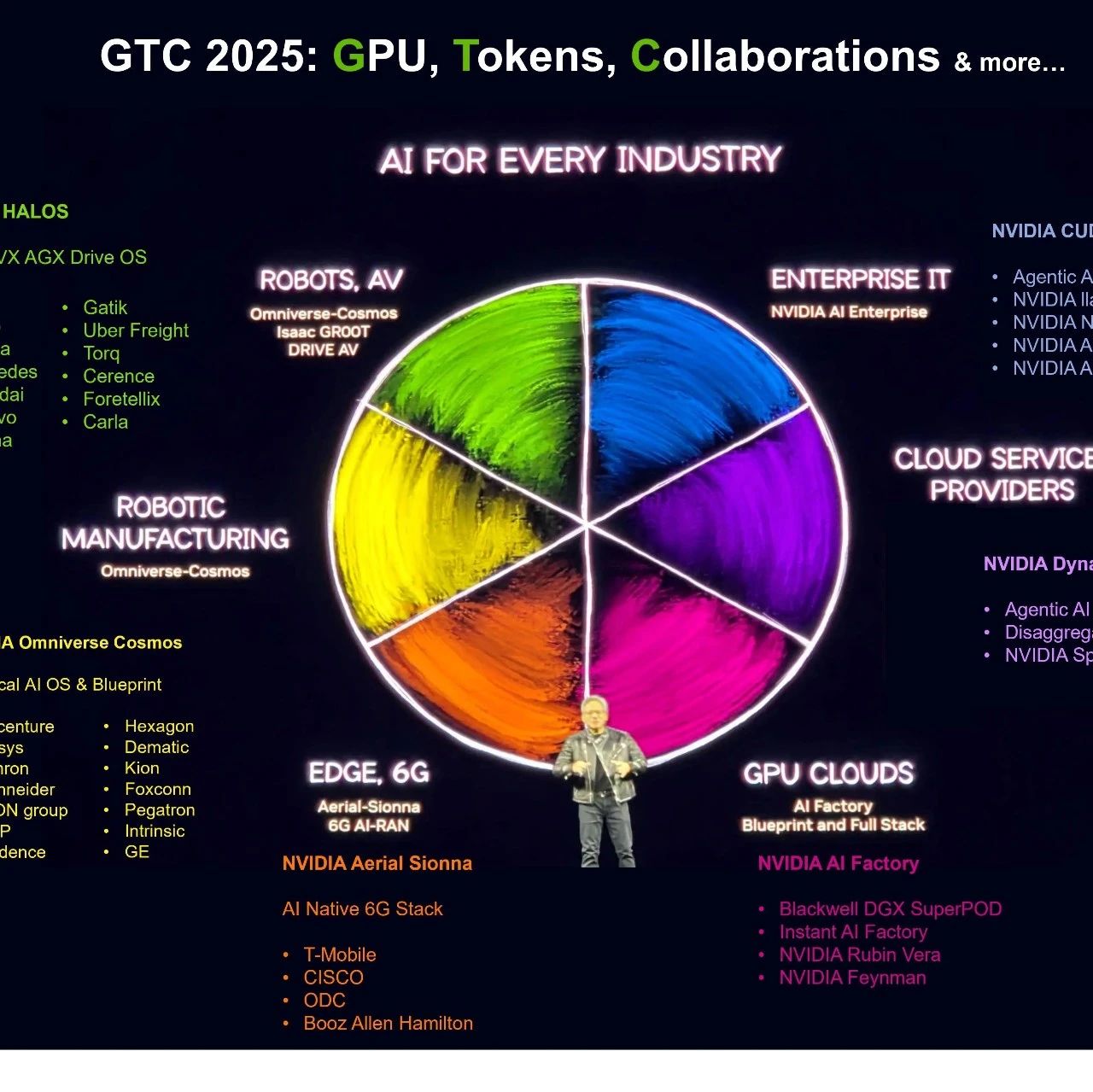
图片来源:NVIDIA NVIDIA 的芯片产品组合涵盖了中央处理器(CPU)、图形处理器(GPU)以及网络设备(用于纵 向扩展和横向扩展)。 NVIDIA 发布了其最新的 " Blackwell超级AI工厂" 平台 GB300 NVL72,与 GB200 NVL72 相比,其 AI性能提升了 1.5 倍。 NVIDIA 分享了其芯片路线图,这样一来,行业内企业在现在采购 Blackwell系统时,便可以谨慎 规划其资本性支出投资,以便在未来几年内有可能从 "Hopper" 系列升级到 "Rubin" 系列或 "Feynman" 系列。 "Rubin" 和 "Rubin Ultra" 两款产品分别采用双掩模版尺寸和四掩模版尺寸的图形处理器(GPU), 在使用 FP4 精度运算时,性能分别可达 50 petaFLOPS(千万亿次浮点运算)和 100 petaFLOPS,分 别搭载 288GB 的第四代高带宽存储器(HBM4)和 1TB 的 HBM4e 存储器,将分别于 2026 年下半 年和 2027 年推出。 全新的 "Vera" 中央处理器(CPU)拥有 88 个基于Arm公司设计打造的定制核心,具备更大的 ...
NVIDIA GTC 2025:GPU、Tokens、合作关系
Counterpoint Research· 2025-04-03 02:59
Core Viewpoint - The article discusses NVIDIA's advancements in AI technology, emphasizing the importance of tokens in the AI economy and the need for extensive computational resources to support complex AI models [1][2]. Group 1: Chip Developments - NVIDIA has introduced the "Blackwell Super AI Factory" platform GB300 NVL72, which offers 1.5 times the AI performance compared to the previous GB200 NVL72 [6]. - The new "Vera" CPU features 88 custom cores based on Arm architecture, delivering double the performance of the "Grace" CPU while consuming only 50W [6]. - The "Rubin" and "Rubin Ultra" GPUs will achieve performance levels of 50 petaFLOPS and 100 petaFLOPS, respectively, with releases scheduled for the second half of 2026 and 2027 [6]. Group 2: System Innovations - The DGX SuperPOD infrastructure, powered by 36 "Grace" CPUs and 72 "Blackwell" GPUs, boasts AI performance 70 times higher than the "Hopper" system [10]. - The system utilizes the fifth-generation NVLink technology and can scale to thousands of NVIDIA GB super chips, enhancing its computational capabilities [10]. Group 3: Software Solutions - NVIDIA's software stack, including Dynamo, is crucial for managing AI workloads efficiently and enhancing programmability [12][19]. - The Dynamo framework supports multi-GPU scheduling and optimizes inference processes, potentially increasing token generation capabilities by over 30 times for specific models [19]. Group 4: AI Applications and Platforms - NVIDIA's "Halos" platform integrates safety systems for autonomous vehicles, appealing to major automotive manufacturers and suppliers [20]. - The Aerial platform aims to develop a native AI-driven 6G technology stack, collaborating with industry players to enhance wireless access networks [21]. Group 5: Market Position and Future Outlook - NVIDIA's CUDA-X has become the default programming language for AI applications, with over one million developers utilizing it [23]. - The company's advancements in synthetic data generation and customizable humanoid robot models are expected to drive new industry growth and applications [25].
2 AI Stocks Caught Up in Tariff-Driven Selloff
Schaeffers Investment Research· 2025-03-31 14:36
Market Overview - Arm Holdings PLC (NASDAQ:ARM) and Palantir Technologies Inc (NASDAQ:PLTR) shares are experiencing significant declines amid a broader market selloff triggered by President Donald Trump's announcement of reciprocal tariffs targeting all countries imposing tariffs on U.S. imports [1] Arm Holdings (ARM) - ARM shares are down 4.8% at $102.65, marking the lowest level since August and on track for a fifth consecutive daily loss [2] - The stock breached a critical support level at $110 and has decreased over 35% in the last nine months [2] - The Schaeffer's put/call open interest ratio (SOIR) for ARM is 1.27, indicating that short-term options traders are leaning bearish, with this ratio higher than 87% of readings from the past 12 months [2] Palantir Technologies (PLTR) - PLTR shares are down 6.4% to $80.40, also on track for a fifth consecutive daily loss after failing to maintain a surge past the $100 level [3] - The stock is currently testing long-term support from its 100-day trendline, but it still shows a substantial year-over-year gain of 243.5% [3] - There is significant bearish activity in PLTR options, with 203,000 puts traded, which is double the typical volume, compared to 115,000 calls [4] - The most active options are the weekly 4/25 60-strike puts, with new positions being opened at the 70-strike in the same series [4]


【产业互联网周报】 阿里通义千问与DeepSeek开源两款新模型;谷歌发布旗舰推理模型,单次可处理百万token;OpenAI推出GPT-4o图像生成功...
Tai Mei Ti A P P· 2025-03-31 02:47
Domestic News - BMW Group announced a strategic AI collaboration with Alibaba Group in China, focusing on AI language models and intelligent voice interaction to develop solutions tailored to Chinese user needs [2] - Zhejiang provincial government signed a strategic cooperation agreement with Alibaba Group and Ant Group, aiming to promote platform economy development and collaboration in AI and other fields [4] - Kuaishou's AI model is expected to reduce the cost of producing short video marketing materials for clients by 60-70% [6][7] - Kuaishou's CEO revealed that the cumulative revenue of its AI service, Keling AI, exceeded 100 million yuan, with partnerships established with thousands of companies including Xiaomi and Amazon Cloud [8] - China Telecom plans a capital expenditure of 836 billion yuan for 2025, with a 22% increase in spending on computing power [9] - China Telecom's smart computing resources are expected to reach 35 EFLOPS, with significant investments in cloud network infrastructure [9] - Ant Group is shifting its investment strategy towards AI, having divested from traditional investments to focus on AI models and computing power [13] - The China Development Forum highlighted that AI will be one of the most significant investment opportunities in the next decade, with a focus on international collaboration and governance [14] Technology Developments - Huawei introduced a new video AI note-taking feature in collaboration with Baidu Netdisk, marking a significant advancement in educational technology [17] - Alibaba released the Qwen2.5-Omni, an end-to-end multimodal AI model capable of processing various inputs and generating outputs in real-time, outperforming competitors [16] - OpenAI announced the integration of advanced image generation capabilities into GPT-4o, enhancing its functionality for users [25] - Nvidia is reportedly planning to acquire Lepton AI, a startup founded by a former Alibaba Cloud executive, to strengthen its position in the cloud and enterprise software market [34] Investment and Financing - DigiCore Real Estate Trust announced a 20% stake acquisition in a data center in Japan for 13 billion yen [21] - The startup TARS completed a $120 million angel round financing, marking a record in China's embodied intelligence sector [29] - Original Force completed a 200 million yuan angel round financing, focusing on embodied intelligence technology [30] - OpenAI is nearing a $40 billion financing round led by SoftBank, which would value the company at $300 billion [32] Policy and Trends - The Ministry of Industry and Information Technology reported that China's telecom business revenue reached 295 billion yuan in the first two months of 2025, with a 0.9% year-on-year growth [34] - The State-owned Assets Supervision and Administration Commission emphasized the need for central enterprises to increase investment in AI and optimize talent development [36][37] - The cloud infrastructure service expenditure in mainland China is projected to grow by 15% in 2025, driven by the rapid application of AI models [41]



这个国家大力发展芯片,但是……
半导体行业观察· 2025-03-31 01:43
Core Viewpoint - Malaysia's potential as a hub for advanced semiconductor manufacturing, packaging, and processing heavily relies on talent development, despite its advantages in infrastructure, business-friendly policies, and geopolitical neutrality [2][3]. Group 1: Talent Development Challenges - The semiconductor industry faces significant challenges, particularly a shortage of engineers and integrated circuit (IC) designers, with 72% of companies hiring in Q1 2025 [2][3]. - Only 0.3% of the electrical and electronics workforce holds advanced degrees, indicating room for growth in the sector [2]. Group 2: Government Initiatives - The Malaysian government has allocated approximately 10% of a 25 billion ringgit fund to train and upskill 60,000 engineers by 2030 to support advanced manufacturing and R&D in the semiconductor industry [3][4]. - Measures to attract and retain talent include establishing a university focused on STEM, providing job opportunities for foreign STEM students, and incentivizing foreign talent [3]. Group 3: Industry Opportunities - There is increasing interest from Chinese semiconductor companies to expand into Malaysia, leveraging local infrastructure for global exports [3][4]. - Malaysia is actively seeking high-value foreign direct investment and encouraging local private sector collaboration to strengthen the semiconductor ecosystem, particularly in advanced packaging [4]. Group 4: Strategic Partnerships and Investments - Malaysia has formed a strategic partnership with Arm Holdings plc, committing to invest $250 million over ten years to acquire chip design blueprints and training [4]. - The country aims to transition from chip assembly and testing to high-value semiconductor design and production, necessitating further investment in the semiconductor supply chain [4].