三六零

Search documents
GPT5来了,OpenAI、谷歌、Anthropic纷纷更新,压力给到国产大模型;这40种工作最可能被AI取代|混沌AI一周焦点
混沌学园· 2025-08-09 04:08
Core Trends - OpenAI's open-source strategy is driving competition among giants like Google and Anthropic, accelerating AI application across industries and blurring the lines between open and closed source, indicating a potential reshaping of the business model in a highly uncertain ecosystem [2] - Applications such as browsers and maps are evolving from mere information tools to intelligent partners with action capabilities, transforming user interaction from entry points to personalized service hubs, intensifying the competition for user engagement [3] - The impact of AI on the job market is showing significant differentiation, with information processing roles facing automation risks while physical jobs remain relatively stable, leading to a restructuring of skill training markets and the emergence of new career models [4] - AI is evolving from single-point intelligence to multi-agent collaboration, with technologies like 360 swarm intelligence demonstrating near L4-level autonomous efficiency, expected to release significant efficiency potential across various sectors [5] Major Events - OpenAI has launched the new GPT-5 model, which integrates previous model capabilities into a more versatile personal assistant, significantly reducing the "hallucination" phenomenon by 80%, enhancing its reliability and programming capabilities [6][7] - OpenAI has re-entered the open-source arena with the release of the gpt-oss-120b and gpt-oss-20b models, which utilize MoE architecture and demonstrate impressive inference speeds, potentially reshaping the AI industry landscape [9] - Google DeepMind has introduced the revolutionary Genie 3 model, capable of real-time generation of 720p dynamic worlds from simple text prompts, marking a significant advancement in world simulation AI [10] - Anthropic has released Claude Opus 4.1, achieving a remarkable 74.5% on the SWE-bench programming benchmark, maintaining its price while enhancing performance, positioning itself as a strong competitor to GPT-5 [12] - Songyan Power has secured over 2,000 commercial orders in the first half of the year, becoming the second domestic company to enter the "thousand-unit club" for humanoid robots, with a goal of delivering 10,000 units next year [13][15] AI Applications - The 2025 update of Gaode Map has integrated AI navigation and AR features, redefining the user experience in navigation and positioning itself as a personalized digital twin world [23] - A recent Microsoft study revealed that 40 job types, including translators and sales roles, are at high risk of being automated by AI, while physical labor jobs remain less affected, challenging conventional perceptions of AI's impact on employment [24] - 360 Group has announced the launch of its L4 swarm intelligence system, marking a significant evolution in AI productivity and potentially reshaping industry competition [25][26]


360集团创始人周鸿祎:打造安全智能体 推动安全与AI深度融合
Zhong Guo Zheng Quan Bao· 2025-08-09 00:44
Core Viewpoint - The integration of security and AI is essential for the future of digitalization, with 360 Group focusing on a dual development strategy of security and AI to drive transformation in the security industry [1][2]. Group 1: AI and Security Integration - 360 Group emphasizes that without AI capabilities, analyzing security big data is impossible [2]. - The company has developed AI search products and aims to combine AI with security to address new challenges posed by AI [2]. - The emergence of large models is seen as a milestone in AI development, but their application in enterprises has been limited due to insufficient reasoning capabilities and lack of independent operational abilities [2]. Group 2: Development of Intelligent Agents - Intelligent agents are viewed as an evolution of large models, addressing two main issues: autonomous understanding of tasks and the ability to use various tools through standardized APIs [2][3]. - The company predicts that general intelligent agents will be difficult to achieve, while specialized intelligent agents will be more viable [3]. - The development of intelligent agents will require collaboration among multiple foundational models and specialized knowledge [3]. Group 3: Multi-Agent Swarm Concept - 360 Group has introduced the concept of a "multi-agent swarm," which allows multiple intelligent agents to collaborate on complex tasks, enhancing their capabilities beyond individual agents [4]. - The performance of the multi-agent swarm has been impressive, achieving a task success rate of 95.4% [4]. - The company aims to provide the necessary infrastructure for enterprises to build their own intelligent agents and multi-agent swarms through its intelligent agent factory [4]. Group 4: Impact on Cybersecurity - Intelligent agents are expected to serve as virtual security experts, allowing companies to deploy numerous security agents to address talent shortages [5]. - The year 2025 is anticipated to be a pivotal year for the emergence of security intelligent agents [5]. - However, there are concerns that intelligent agents could also be exploited by hackers, leading to a new form of cyber warfare where machines and algorithms play a significant role [5].

2024年中国威胁情报行业发展研究报告
艾瑞咨询· 2025-08-09 00:07
Core Viewpoint - The report emphasizes the importance of "threat intelligence" in the context of increasing cybersecurity threats, shifting from passive to proactive security strategies, and highlights the need to clarify its definition and scope within the broader cybersecurity industry [1][2]. Market Overview - The report provides a comprehensive analysis of the current state of the threat intelligence market in China, including market size, growth trends, and key players such as 微步在线. It examines both supply and demand sides, assessing the capabilities and market shares of major threat intelligence vendors [1][2][36]. Development Insights - Future trends in the threat intelligence industry are explored, focusing on three main areas: international expansion of intelligence services, the impact of AI large models, and the integration of vulnerability intelligence. The report analyzes how these trends may reshape the industry landscape and create potential market opportunities [2][68][75]. Background on Cyber Threats - Cyber threats are on the rise globally, with an increase in both the number of attackers and the frequency of attacks. Reports indicate a 76% increase in the number of victims of large-scale ransomware attacks, with the technology, consulting, and financial sectors being the most targeted [3][7]. Corporate Perspective - As digital transformation accelerates, companies face increasing cybersecurity risks. The number of IoT connections is expected to grow from 16 billion in 2023 to 40 billion by 2033, leading to more vulnerabilities and longer patching times for critical software [7][10]. Policy Perspective - The government is actively promoting enhanced cybersecurity measures across enterprises, shifting from passive to proactive defense strategies. This includes the need for advanced detection and response capabilities to mitigate potential threats [10]. Definition of Threat Intelligence - Threat intelligence is defined as the collection and analysis of data to identify threats, attack vectors, and malicious actors. It can be categorized into tactical, operational, and strategic intelligence, each serving different roles in cybersecurity defense [13][19]. Value of Threat Intelligence - The report highlights that threat intelligence enhances proactive defense capabilities and overall security operations for enterprises. It enables organizations to anticipate threats and share information across departments, thereby maximizing security resources [19]. Comparison of Domestic and International Development - The development trajectory of the threat intelligence industry in China mirrors that of international markets but lags in maturity and speed due to its later start. Differences in product integration and usage levels are noted, with domestic firms still catching up to their international counterparts [22][25]. Product Commercial Models - The domestic market primarily utilizes threat intelligence through direct data consumption or integration with security monitoring products. Various models exist, including standardized API interfaces and threat intelligence platforms [26]. Product Capabilities and Vendor Competitiveness - Key product capabilities include accuracy, richness, and timeliness of threat intelligence. Vendor competitiveness is driven by data collection and analysis capabilities, with a focus on utilizing big data and AI technologies [29]. Vendor Characteristics - Major vendors in the threat intelligence space are differentiating their offerings based on their unique data sources, service experiences, and business characteristics. The report outlines the capabilities of several leading firms, including 微步在线 and 奇安信 [32][34]. Market Size and Growth - The threat intelligence market in China experienced a temporary decline due to the pandemic, with a projected market size of 1.61 billion yuan in 2024, reflecting a slight decrease from 2023. However, long-term growth is expected as security needs and product integration continue to rise [36][37]. Competitive Landscape - The market is characterized by low concentration, with leading firms like 微步在线, 腾讯安全, and 奇安信 actively expanding their product offerings and enhancing their competitive positions. Innovation and competition are anticipated to drive future industry dynamics [40]. Threat Intelligence Solutions - Various companies are developing comprehensive threat intelligence solutions, leveraging advanced technologies to enhance detection and response capabilities. For instance, 微步在线's NGTIP platform focuses on proactive threat detection through multi-source log analysis [44][47]. Emerging Trends - The report identifies two key emerging trends: the international expansion of threat intelligence services and the integration of AI large models to enhance operational efficiency and broaden application scenarios [68][72]. Additionally, the increasing focus on vulnerability intelligence is highlighted as a critical area for improving enterprise security [75].




360集团创始人周鸿祎: 打造安全智能体 推动安全与AI深度融合
Zhong Guo Zheng Quan Bao· 2025-08-08 21:16
Core Viewpoint - The integration of security and AI is essential for the future of digitalization, with 360 Group emphasizing a dual development strategy of security and AI to drive transformation in the security industry [1][2]. Group 1: AI and Security Integration - 360 Group aims to combine AI with security to address new challenges posed by AI technologies, asserting that security is the foundation of digitalization while AI represents its pinnacle [2]. - The company has developed the 360 Security Large Model and 360 Security Intelligent Agent to enhance security capabilities through AI [1][5]. - The emergence of large models has been a milestone in AI development, but 360 Group identifies limitations in their application within enterprises, particularly regarding reasoning capabilities and independent task execution [2][3]. Group 2: Intelligent Agents Development - Intelligent agents are seen as an evolution of large models, capable of understanding tasks autonomously and utilizing various tools through standardized APIs [2][3]. - 360 Group has been working on intelligent agents for two years and predicts that specialized intelligent agents will be more viable than general ones, requiring collaboration among multiple foundational models [3]. - The company has introduced the concept of a "multi-agent swarm," which allows multiple intelligent agents to work together to complete complex tasks, achieving a task success rate of 95.4% [4]. Group 3: Intelligent Agent Factory - 360 Group is establishing an "Intelligent Agent Factory" to provide essential infrastructure for businesses to develop their own intelligent agents, addressing challenges in resource allocation [5]. - The intelligent agents can serve as virtual security experts, potentially compensating for talent shortages in cybersecurity [5]. Group 4: Security Implications of Intelligent Agents - While intelligent agents can enhance security operations, there is a risk that they could also be exploited by hackers, leading to a new form of cyber warfare where machines and algorithms play a significant role [5]. - 360 Group is committed to using intelligent agents to reshape digital security, offering customizable security intelligent agents for various business needs [5].
打造安全智能体 推动安全与AI深度融合
Zhong Guo Zheng Quan Bao· 2025-08-08 21:03
Core Viewpoint - The integration of security and AI is essential for the future of digital transformation, with 360 Group focusing on developing security and AI in tandem to drive industry change [1][2]. Group 1: AI and Security Integration - 360 Group emphasizes that security is the foundation of digitalization, while AI represents its pinnacle, leading to a dual development strategy of security and AI [1]. - The company has launched the 360 Security Large Model and 360 Security Intelligent Agent to address new security challenges posed by AI [1]. - The emergence of large models has been a milestone in AI development, but their application in enterprises has faced challenges, particularly in reasoning capabilities and independent task execution [1][2]. Group 2: Intelligent Agent Development - 360 Group has been working on intelligent agents for two years and has identified key trends, including the viability of specialized intelligent agents over general ones and the need for collaborative base models [2]. - The concept of "multi-agent swarm" is introduced, where multiple intelligent agents work together to complete complex tasks, enhancing efficiency and effectiveness [2][3]. - The performance of the multi-agent swarm has shown a task success rate of 95.4%, demonstrating significant advancements in collaborative capabilities [3]. Group 3: Intelligent Agent Factory - 360 Group aims to enable enterprises to create their own reasoning and multi-agent swarms through the establishment of an Intelligent Agent Factory, providing essential infrastructure in the cloud [3]. - The Intelligent Agent Factory includes eight foundational elements necessary for building intelligent agents, addressing the challenges enterprises face in acquiring these resources [3]. Group 4: Impact on Cybersecurity - The development of intelligent agents could replace human security experts, allowing companies to deploy numerous virtual security agents to mitigate talent shortages [4]. - However, there is a concern that intelligent agents could also be exploited by hackers, transforming the landscape of cyber warfare into a confrontation between humans and machines [4]. - 360 Group is committed to using intelligent agents to enhance digital security, offering customizable security agents and ready-to-use solutions for businesses [4].
360发布纳米AI多智能体蜂群,引领智能体进入协同进化新阶段
Sou Hu Cai Jing· 2025-08-08 18:02
Core Insights - The core viewpoint presented by Zhou Hongyi at the ISC.AI 2025 conference is that 2025 marks the beginning of the era of intelligent agents, which will evolve from their current primitive stage to a swarm or cluster form, becoming the main players in the AI field [1] - 360 Group has already launched the "Nano AI Multi-Agent Swarm" technology, which represents a significant shift from individualistic AI operations to collaborative group efforts, fundamentally changing traditional AI work models [1][5] Development Stages of Intelligent Agents - The development of intelligent agents is categorized into five levels (L1 to L5), with L1 agents functioning as basic "chat assistants" that lack proactive problem-solving capabilities [2] - L2 agents operate on a "tool logic" level, completing tasks through preset modules but still requiring human intervention for final outputs [2] - At L3, agents gain true reasoning abilities, capable of goal planning and logical breakdowns, but face efficiency drops when tasks exceed their knowledge boundaries [4] Introduction of the "Nano AI Multi-Agent Swarm" - The "Nano AI Multi-Agent Swarm" technology prioritizes collaborative capabilities over individual strengths, allowing for flexible grouping and nested collaboration among multiple agents to tackle complex workflows [4][5] - This technology introduces a "swarm collaboration framework," where each agent acts as an independent participant in a unified goal-directed task, enhancing overall productivity [5] Practical Applications and Industry Impact - The multi-agent swarm technology has already been implemented across various product lines of 360, including video generation, translation, industry analysis, and knowledge summarization, serving both consumer and business needs [7] - Zhou Hongyi emphasized that collaboration among different specialized agents is essential for overcoming the limitations of individual agents, positioning multi-agent systems as the future direction of development [7] - The launch of the "Nano AI Multi-Agent Swarm" at the ISC conference signifies 360's commitment to defining AI as an "organizational productivity tool" through collaborative intelligent systems [7]
三六零股价下跌3.55% 公司推出全球首个L4级企业智能体工厂
Jin Rong Jie· 2025-08-08 17:31
Group 1 - As of August 8, 2025, the stock price of 360 Technology is reported at 10.60 yuan, down 0.39 yuan from the previous trading day, representing a decline of 3.55% [1] - The trading volume on the same day reached 1.861 million hands, with a transaction amount of 1.984 billion yuan [1] - 360 Technology operates in the software development industry, focusing on internet security technology research and the provision of network security products and services, positioning itself as a leading network security enterprise in China [1] Group 2 - On August 7, 360 Digital Security announced the launch of the world's first L4-level enterprise intelligent factory, SEAF, aimed at addressing technical bottlenecks and application challenges in the implementation of intelligent entities in government and enterprise scenarios [1] - The SEAF platform has already seen extensive application in urban industries, security clouds, and government-enterprise clients [1] Group 3 - On August 8, the net outflow of main funds for 360 Technology was 457 million yuan, accounting for 0.62% of the circulating market value [1] - Over the past five trading days, the cumulative net outflow reached 589 million yuan, representing 0.79% of the circulating market value [1]
360数字安全集团CTO潘剑锋:跳出通用模型框架,要打造真正的安全垂直大模型
Xin Lang Ke Ji· 2025-08-08 09:31
Core Insights - The security industry is transitioning from rapid integration of large models to a more in-depth "practical" phase, necessitating the development of vertical large models tailored for the security domain [1] - 360 Group is focusing on achieving superior performance of small parameter models in specialized scenarios compared to general large models, aiming for breakthroughs in practical effectiveness and efficiency [3] Group 1: Model Development and Innovation - The approach involves categorizing security tasks into "fast thinking" and "slow thinking" tasks, allowing for targeted processing and comprehensive application [1] - The "fast thinking" tasks leverage large models' ability to make intuitive judgments based on vast amounts of labeled data, while "slow thinking" tasks require deep reasoning and complex analysis [1] - The first phase of development focuses on single security tasks, creating specialized models for unique data and task attributes, exemplified by a terminal behavior multi-modal judgment model achieving a 99.42% accuracy rate [3] Group 2: Multi-Model Coordination - The second phase introduces a "CoE" (Center of Excellence) large model architecture, which allows for modular integration of different expert partitions, optimizing parameter usage and reducing application costs [3] - This architecture addresses the challenges of multi-model collaboration by enabling selective activation of parameters during task execution [3] Group 3: Training Framework Innovation - The third phase emphasizes innovation in training frameworks, with the introduction of the first open-source RL-LoRA training framework, developed in collaboration with Berkeley BAIR Lab [4] - This framework significantly reduces memory and bandwidth costs, enhancing training efficiency and reducing training cycles [4]
ISC.AI 2025 在京闭幕:政企校共筑 AI 安全人才培养“新基建”
Huan Qiu Wang· 2025-08-08 09:16
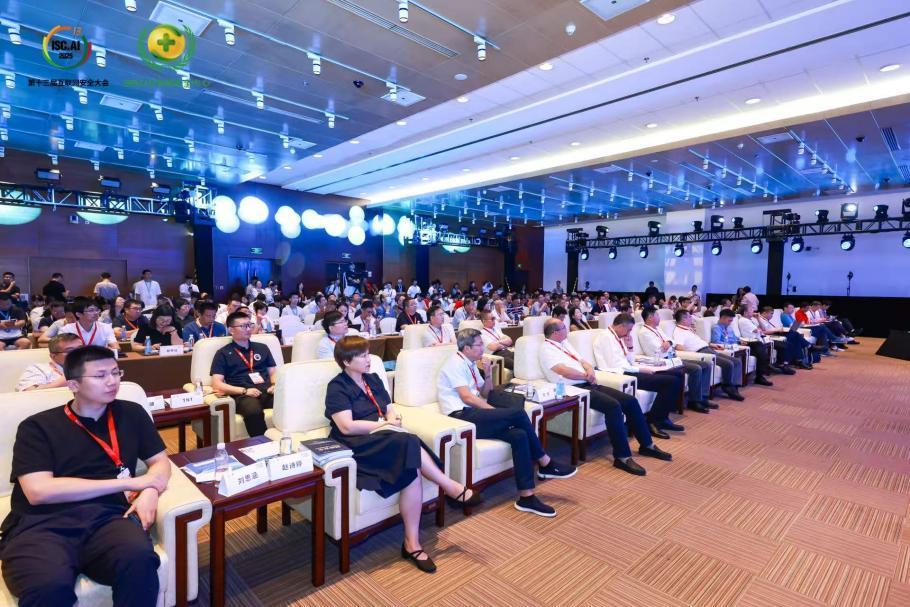
Core Insights - The ISC.AI 2025 National Information Security Industry-Education Integration Development Conference focused on the theme of "industry-education integration," discussing trends in the industry, technology application scenarios, and the construction of a composite talent training system in the context of artificial intelligence [1] Group 1: Talent Development Challenges - Representatives discussed the "structural shortage" of talent in information security, emphasizing the need for collaborative mechanisms and resource platforms to address issues of talent cultivation and industry demands [3] - The Ministry of Industry and Information Technology highlighted the dual growth of industry scale and quality, while also pointing out the existing structural talent shortages and disconnection in training [3] - The call for a fusion of "education - talent - innovation" was made to drive industry upgrades and cultivate high-quality skilled talent suitable for the digital economy [3] Group 2: Educational Innovations and Practices - 360 Digital Security Group proposed a vision of "technology feeding back education," aiming to shift from "one-way output" to "two-way empowerment" in talent cultivation [5] - Experts shared innovative practices in vocational education reform, emphasizing the need for information security professionals to possess composite skills, including AI understanding and ethical governance [6] - Various educational institutions are forming collaborative models with enterprises to create a closed-loop ecosystem for talent cultivation, integrating cutting-edge technologies into their curricula [6][7] Group 3: Initiatives and Collaborations - The launch of the "Extreme Wing Growth Plan" aims to integrate technical talent ecosystems with regional security construction, establishing a matrix of instructors from various backgrounds [7] - The conference introduced significant initiatives to solidify the foundation of industry-education integration, including the establishment of dual-teacher practice workstations in 11 institutions [7] - The ISC.AI Academy's "Co-creation and Co-operation" partner program was announced, with seven companies joining to build an AI security education service system [8] Group 4: Future Directions and Ecosystem Building - A roundtable discussion highlighted the need for a collaborative regulatory framework between academia and industry to address challenges in AI and security talent development [9] - The conference provided systematic solutions for industry-education integration in information security, emphasizing the importance of collaborative efforts to innovate curricula and empower practical training [9] - The implementation of initiatives like the "Extreme Wing Growth Plan" is expected to foster a more vibrant and sustainable AI security talent ecosystem, laying a solid foundation for high-quality development in the digital economy [9]
AI搜索半年盘点:夸克元宝豆包会不会掀了百度的桌子?
3 6 Ke· 2025-08-08 08:49
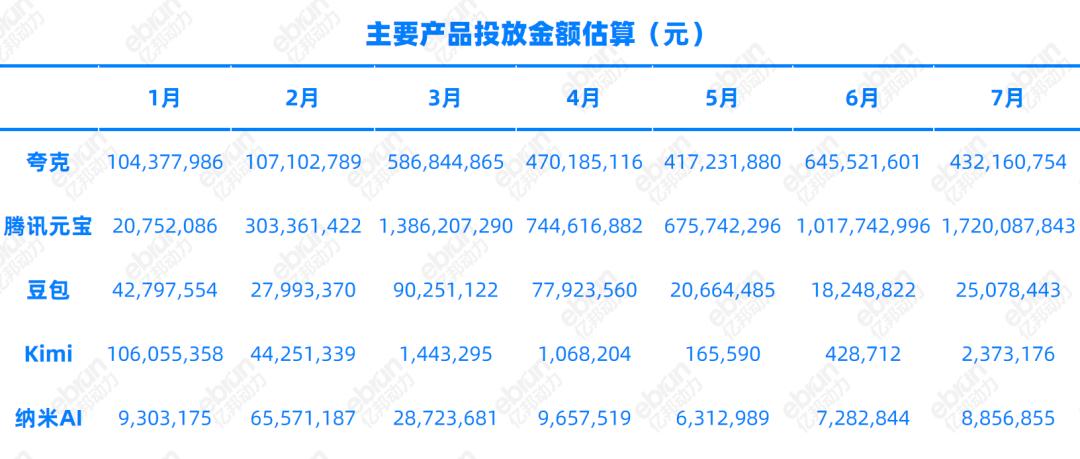
Core Viewpoint - The competition for traffic in the AI era is intensifying, with companies like Quark and Yuanbao taking the lead in advertising spending, while traditional search engines are being challenged by AI-driven solutions [1][3][21]. Group 1: Advertising Spending and Market Dynamics - In the first half of 2025, Quark's monthly advertising spending exceeded 100 million, peaking in June, while Yuanbao's spending in June and July surpassed 1 billion [1][3]. - DataEye reported that before February 15, the advertising material volume of Doubao and Kimi was 2-3 times that of Tencent Yuanbao, which saw a 345.1% increase in material volume in late February [3][5]. - Tencent Yuanbao's advertising spending surged from approximately 20 million in January to over 1.7 billion in July, with 70% directed towards Tencent Ads [3][5]. Group 2: User Engagement and Growth Metrics - Quark's monthly active users (MAU) increased from 148 million in February to 156 million in June, while Doubao's MAU grew from 81.98 million in February to 125 million in June [6][7]. - DeepSeek's mobile MAU reached over 100 million in April but dropped to 90 million by June, indicating volatility in user engagement [6][7]. - The overall active user count for AI-native apps reached 270 million in March 2025, with a net increase of 115 million users from January to February [6][7]. Group 3: Evolution of Search and AI Integration - The traditional search paradigm is shifting towards an AI-driven "Agent" model, where search engines are redefined as tools that provide direct answers rather than merely serving as information gateways [14][19]. - Quark's CEO stated that the search box has evolved to become a "super agent," capable of executing complex tasks beyond traditional search functions [15][19]. - Major players like Baidu and 360 are integrating AI capabilities into their search frameworks, enhancing user experience by providing comprehensive solutions rather than just search results [18][19]. Group 4: Financial Performance and Monetization Challenges - Despite the rapid growth of AI functionalities, monetization remains a challenge in the domestic market, with companies struggling to convert user engagement into revenue [23][24]. - Quark's revenue is still heavily reliant on cloud storage subscriptions, and its commitment to a "no ads" model limits its income potential [24]. - The competitive landscape suggests that the future of AI search may hinge on cash flow reserves, as companies navigate unclear commercialization paths [25].