成都银行

Search documents
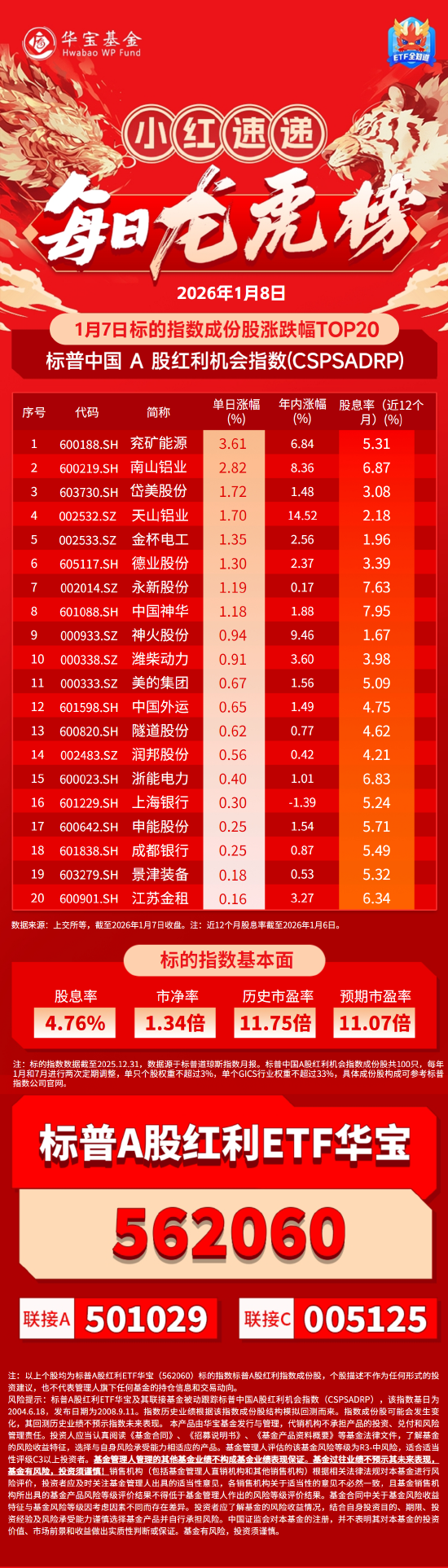
小红日报 | 红利板块小幅回调,标普A股红利ETF华宝(562060)标的指数收跌0.6%
Xin Lang Cai Jing· 2026-01-08 01:14
Group 1 - The article presents the top 20 stocks in the S&P China A-Share Dividend Opportunity Index (CSPSADRP) based on their daily and year-to-date performance as of January 7, 2026 [1][5] - The top performer is Tuke Mining (600188.SH) with a daily increase of 3.61% and a year-to-date increase of 6.84%, along with a dividend yield of 5.31% [1][5] - Nanshan Aluminum (600219.SH) ranks second with a daily increase of 2.82% and a year-to-date increase of 8.36%, offering a dividend yield of 6.87% [1][5] Group 2 - Other notable stocks include Daimay Co. (603730.SH) with a daily increase of 1.72% and a year-to-date increase of 1.48%, and Tianshan Aluminum (002532.SZ) with a daily increase of 1.70% and a year-to-date increase of 14.52% [1][5] - The list also features companies like Midea Group (000333.SZ) and China Shenhua (601088.SH), which have year-to-date increases of 1.56% and 1.88%, respectively, with dividend yields of 5.09% and 7.95% [1][5] - The data is sourced from the Shanghai Stock Exchange and reflects the closing prices as of January 7, 2026, with dividend yields calculated up to January 6, 2026 [1][5]





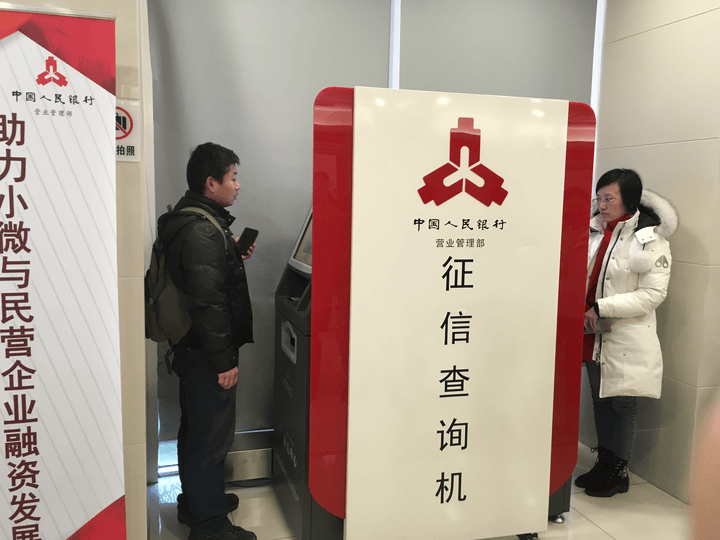
一次性信用修复政策落地!网友晒出“对比图”
Xin Hua She· 2026-01-07 23:49
今年伊始,一次性信用修复政策落地,你的个人信用报告更新了吗? 在甘肃临夏州,东乡族群众马哈麦带着刚打印的征信报告,来到甘肃银行临夏分行准备办理个人住房贷 款。 "去年底我还不敢想贷款买房,因为我的个人信用报告上有好几笔逾期记录,今年这些已结清欠款的逾 期记录不再显示,我的房贷也有着落了。"马哈麦说。 不过,也有个别网友表示自己的信用报告没发生变化。记者了解到,享受此次政策需要符合一定条件: 近日,记者采访了解到,不少在规定时间内还清贷款的人发现个人信用报告已经更新,1万元以下逾期 记录已不在信用报告中显示。 "新年新气象,从信用报告更新开始!"在四川自贡做瓷砖生意的张先生告诉记者,2021年因为经营困 难,他的信用卡一度出现逾期,虽然额度不大且已结清,但因为有逾期记录他很难在银行获得贷款。今 年初,他惊喜地发现信用报告已经更新,逾期记录不再显示,"贷款资金有眉目了"。 去年12月,中国人民银行发布一次性信用修复政策,明确自2026年1月1日起,符合相关条件的逾期信 息,将不会在个人信用报告中予以显示。 这几天,已经有不少网友在社交平台上晒出了个人信用报告的"对比图"。 一位山西网友去年9月份的个人信用报告显示 ...
一次性信用修复政策落地,你的信用报告更新了吗?
Sou Hu Cai Jing· 2026-01-07 11:58
近日,记者采访了解到,不少在规定时间内还清贷款的人发现个人信用报告已经更新,1万元以下逾期 记录已不在信用报告中显示。 今年伊始,一次性信用修复政策落地,你的个人信用报告更新了吗? "新年新气象,从信用报告更新开始!"在四川自贡做瓷砖生意的张先生告诉记者,2021年因为经营困 难,他的信用卡一度出现逾期,虽然额度不大且已结清,但因为有逾期记录他很难在银行获得贷款。今 年初,他惊喜地发现信用报告已经更新,逾期记录不再显示,"贷款资金有眉目了"。 去年12月,中国人民银行发布一次性信用修复政策,明确自2026年1月1日起,符合相关条件的逾期信 息,将不会在个人信用报告中予以显示。 这几天,已经有不少网友在社交平台上晒出了个人信用报告的"对比图"。 一位山西网友去年9月份的个人信用报告显示,她有2个账户发生过贷款逾期,但这两笔逾期贷款已分别 于2024年4月和2025年6月结清。2026年1月1日更新的报告则显示,贷款"发生过逾期的账户数"变为了"- -",这表示此前2次逾期记录已不再显示。 在甘肃临夏州,东乡族群众马哈麦带着刚打印的征信报告,来到甘肃银行临夏分行准备办理个人住房贷 款。 "去年底我还不敢想贷款买房 ...
城商行板块1月7日涨0%,杭州银行领涨,主力资金净流出1.7亿元
Zheng Xing Xing Ye Ri Bao· 2026-01-07 08:58
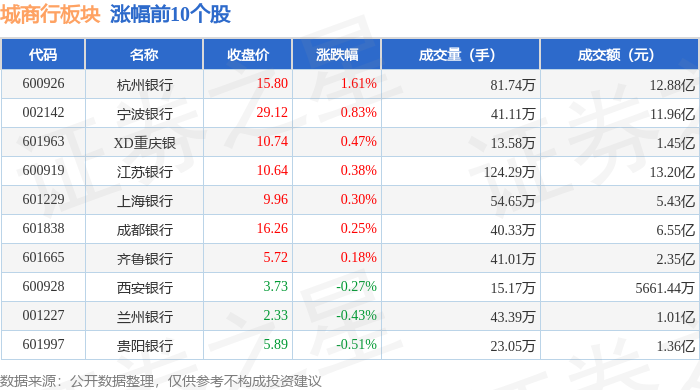
Market Performance - The city commercial bank sector experienced a slight increase of 0.0% on January 7, with Hangzhou Bank leading the gains [1] - The Shanghai Composite Index closed at 4085.77, up 0.05%, while the Shenzhen Component Index closed at 14030.56, up 0.06% [1] Individual Stock Performance - Hangzhou Bank (600926) closed at 15.80, with a rise of 1.61% and a trading volume of 817,400 shares [1] - Ningbo Bank (002142) closed at 29.12, up 0.83%, with a trading volume of 411,100 shares [1] - Other notable performances include Jiangsu Bank (601963) at 10.64 (+0.38%) and Shanghai Bank (601229) at 9.96 (+0.30%) [1] Capital Flow Analysis - The city commercial bank sector saw a net outflow of 170 million yuan from institutional investors, while retail investors contributed a net inflow of 188 million yuan [2] - The overall capital flow indicates a mixed sentiment, with institutional investors withdrawing funds while retail investors increased their positions [2] Detailed Capital Flow by Bank - Jiangsu Bank had a net inflow of 123 million yuan from institutional investors, while retail investors saw a net outflow of 27 million yuan [3] - Hangzhou Bank experienced a net inflow of 84 million yuan from institutional investors, but retail investors had a significant outflow of 132 million yuan [3] - Chengdu Bank recorded a net inflow of 55 million yuan from institutional investors, with retail investors also experiencing a net outflow [3]




成都农商行挤入万亿俱乐部,59岁王晖要全力冲刺IPO了
Xin Lang Cai Jing· 2026-01-06 11:17
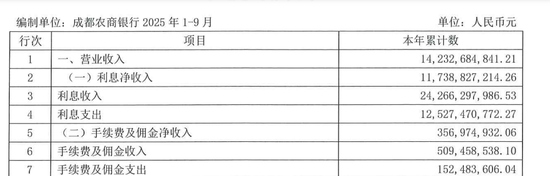
Group 1 - Chengdu Rural Commercial Bank's chairman, Wang Hui, is actively engaged in strategic partnerships, as evidenced by a recent signing ceremony with the Qionglai Municipal Government [1][17] - The market is curious about the future development of Chengdu Rural Commercial Bank following the leadership change with Chengdu Bank [2][18] - Wang Hui, who has extensive management experience, previously led Chengdu Bank to significant growth and was instrumental in its IPO [3][20] Group 2 - Chengdu Rural Commercial Bank has surpassed 1 trillion yuan in total assets, becoming the fifth rural commercial bank to join the trillion-yuan club [6][22] - The bank is currently pursuing an IPO, having initiated the process in December 2022, but has not made significant progress in three years [7][25] - Despite its size, Chengdu Rural Commercial Bank's profitability lags behind peers like Chongqing and Shanghai Rural Commercial Banks, with a net profit of 6.009 billion yuan in the first three quarters of 2025, reflecting a growth of 7.20% [11][27] Group 3 - The bank has been expanding its revenue streams, including the merger of six village banks in July 2025 [13][29] - Chengdu Rural Commercial Bank has outlined its investment plans for 2026, which will be discussed in an upcoming shareholders' meeting [15][31] - The bank's net profit growth has slowed compared to previous years, with growth rates of 16.89%, 15.25%, 11.87%, and 11.46% from 2021 to 2024 [11][28]
42家A股上市银行,全面告别监事会!
Sou Hu Cai Jing· 2026-01-06 10:35
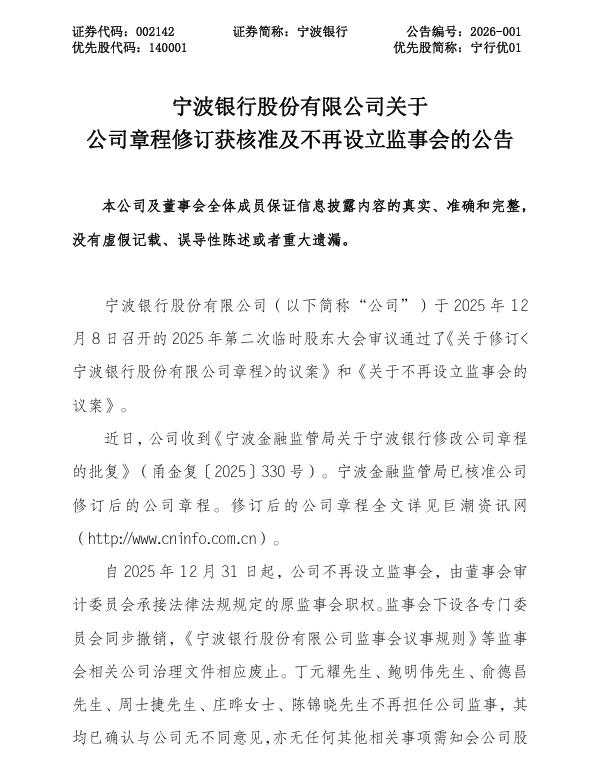
在岁末年初的关键时间节点,又有多家中小银行宣布撤销监事会。 "自2025年12月31日起,公司不再设立监事会,由董事会审计委员会承接法律法规规定的原监事会职 权。"1月4日,宁波银行发布的公告显示,近日,该行收到《宁波金融监管局关于宁波银行修改公司章 程的批复》,宁波金融监管局已核准宁波银行修订后的公司章程。 2025年最后一天,成都银行也发布了该行监事长孙波辞任的公告。根据公告内容,因工作调动另有任 用,孙波辞去成都银行第八届监事会监事长、职工监事、监事会提名委员会委员、监事会监督委员会委 员职务,自2025年12月31日起生效。 《金融时报》记者注意到,自2025年以来,这场由新《公司法》引发的公司治理体系变革,已从国有大 行全面蔓延至股份制银行及中小银行。 实际上,此次银行业集中"去监事会"并非偶然,而是顶层法制设计与监管政策协同推进的必然结果。 2024年7月1日,新修订的《公司法》正式实施,其中明确规定,股份有限公司可以按照公司章程规定在 董事会中设置审计委员会,行使监事会职权,不设监事会或者监事。 政策配套的密集落地则为改革铺路搭桥。同年12月,国家金融监督管理总局发布了《关于公司治理监管 规定与 ...
成都银行股份有限公司 关于监事长离任的公告
Zhong Guo Zheng Quan Bao - Zhong Zheng Wang· 2026-01-05 16:54
Group 1 - The resignation of Mr. Sun Bo from his positions as Chairman of the Supervisory Board, employee supervisor, and member of the Supervisory Board Nomination Committee will take effect on December 31, 2025, due to job relocation [1] - Mr. Sun Bo confirmed that there are no disagreements with the Supervisory Board and no matters related to his resignation that need to be disclosed to shareholders and creditors [1] - Mr. Sun Bo has completed the handover process in accordance with the company's regulations [1] Group 2 - During his tenure, Mr. Sun Bo emphasized the integration of party leadership and corporate governance, adhering to regulatory requirements and fulfilling his duties diligently [2] - He led the Supervisory Board in proactively assessing economic and financial conditions, focusing on strategic development and risk management, and enhancing the supervision mechanism [2] - The company and the Supervisory Board expressed their heartfelt gratitude for Mr. Sun Bo's hard work and significant contributions during his tenure [2]

银行-保险-券商年度策略
2026-01-05 15:42
Summary of Conference Call Records Industry Overview - **Insurance Industry**: The insurance sector is expected to continue its recovery in 2026, with concerns over interest margin losses easing. Regulatory adjustments have lowered the preset interest rates, and the return on universal insurance products has decreased. Investment returns for insurance stocks are projected to exceed 5%, surpassing the intrinsic value assumptions, indicating a turning point for interest margin losses [1][4]. - **Brokerage Sector**: The brokerage industry is anticipated to benefit from the migration of household deposits, increased market activity, and relaxed regulatory policies. It is expected that the return on equity (ROE) for brokerages will enter an upward cycle from 2025 to 2026, driven by wealth management, investment banking, and international derivatives [1][10]. Key Insights and Arguments - **Investment in A-shares**: Insurance companies are expected to allocate 30% of new premiums to the A-share market annually, resulting in an influx of approximately 300-400 billion yuan, which will support capital market growth and enhance investment returns [1][4]. - **Property Insurance**: The top three property insurance companies maintain a stable market share, with auto insurance being a core growth area. The penetration rate of new energy vehicles is expected to drive an increase in average premiums. China Pacific Insurance anticipates a growth rate of over 4% in auto insurance business, aligning with GDP growth [1][5]. - **Non-auto Insurance Growth**: The non-auto insurance sector is benefiting from increased health insurance coverage, with premium growth expected to approach 10% in 2026 as certain low-base businesses recover. The comprehensive cost ratio for leading insurance companies is projected to stabilize around 97% [1][7]. - **Brokerage Performance Drivers**: Key performance drivers for brokerages include robust growth in wealth management, a recovering investment banking sector, and active proprietary trading. The anticipated improvement in ROE for brokerages could reach 9% under neutral conditions and exceed 10% in optimistic scenarios by 2027 [2][14]. Additional Important Points - **Market Dynamics**: The trend of household deposits moving away from traditional savings products is creating a competitive advantage for participating insurance products, which offer higher returns compared to fixed deposits [1][4]. - **Valuation Recovery**: The insurance sector's valuation is expected to recover significantly, with a potential P/EV (price-to-embedded value) ratio reaching 1.0 in the medium term. The average insurance stock in A-shares has about 40% room for recovery based on 2026 dynamic PEV estimates [8]. - **Recommended Companies**: Key insurance companies to watch include China Ping An, New China Life, China Taiping, China Life, and China Pacific Insurance, with China Ping An being highlighted for its diversified business model and high dividend characteristics [9]. - **Banking Sector Changes**: The banking sector is expected to undergo significant changes driven by policy adjustments, improved fundamentals, and favorable funding conditions, which will support valuation recovery [16]. - **Investment Recommendations**: In the current market environment, it is advisable to focus on stable high-dividend stocks and quality core assets, including major state-owned banks and leading commercial banks [17].

2025年主动权益产品排名出炉,广发基金6只产品年度跌幅超过10%
Xin Lang Cai Jing· 2026-01-05 10:38
Core Insights - In 2025, approximately 75 actively managed equity funds achieved a net value increase of over 100%, but there was significant disparity, with several funds reporting negative returns exceeding 10% [2][8] - Among the underperformers, six funds from GF Fund were highlighted, all managed by Wang Mingxu, indicating a potential issue with his management strategy [2][8] Fund Performance Analysis - Wang Mingxu managed a total of eight funds, with six showing negative annual returns, including the flagship fund, GF Domestic Demand Growth, which reported a -16.31% return for the year [10] - The fund underwent a significant style shift in its holdings throughout 2025, moving from a focus on real estate, liquor, and banking stocks in Q1 to a more diversified approach in Q2, yet the results remained unsatisfactory [3][11] Managerial Challenges - Wang Mingxu's management faced criticism as his long-held fund, GF Domestic Demand Growth, became a significant underperformer despite his overall fund management experience and a reported best-term return of 115.25% [10] - The fund's quarterly reports indicated attempts to adjust the portfolio by selling overvalued stocks and increasing positions in high-end liquor and IT services, but these adjustments did not yield the desired improvement in performance [4][11] Performance of Other Managers - Zheng Chengran, another manager at GF Fund, also faced challenges, with his funds showing a wide performance range; one fund achieved over 70% returns while five others fell below 20% [5][12] - His investment strategy included a mix of sectors that did not align with his expertise, leading to underwhelming results, particularly in the healthcare and steel sectors [12]
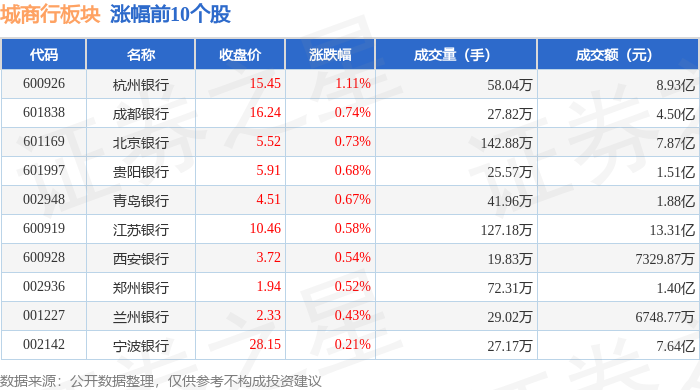
城商行板块1月5日涨0.26%,杭州银行领涨,主力资金净流入3.8亿元
Zheng Xing Xing Ye Ri Bao· 2026-01-05 09:09
Market Overview - The city commercial bank sector increased by 0.26% on January 5, with Hangzhou Bank leading the gains [1] - The Shanghai Composite Index closed at 4023.42, up by 1.38%, while the Shenzhen Component Index closed at 13828.63, up by 2.24% [1] Individual Bank Performance - Hangzhou Bank (600926) closed at 15.45, with a rise of 1.11% and a trading volume of 580,400 shares, amounting to a transaction value of 893 million yuan [1] - Chengdu Bank (601838) closed at 16.24, up by 0.74%, with a trading volume of 278,200 shares and a transaction value of 450 million yuan [1] - Beijing Bank (601169) closed at 5.52, increasing by 0.73%, with a trading volume of 1,428,800 shares and a transaction value of 787 million yuan [1] - Guizhou Bank (601997) closed at 5.91, up by 0.68%, with a trading volume of 255,700 shares and a transaction value of 151 million yuan [1] - Qindao Bank (002948) closed at 4.51, increasing by 0.67%, with a trading volume of 419,600 shares and a transaction value of 188 million yuan [1] - Jiangsu Bank (616009) closed at 10.46, up by 0.58%, with a trading volume of 1,271,800 shares and a transaction value of 1.331 billion yuan [1] - Xian Bank (600928) closed at 3.72, increasing by 0.54%, with a trading volume of 198,300 shares and a transaction value of 73.3 million yuan [1] - Zhengzhou Bank (002936) closed at 1.94, up by 0.52%, with a trading volume of 723,100 shares and a transaction value of 140 million yuan [1] - Lanzhou Bank (001227) closed at 2.33, increasing by 0.43%, with a trading volume of 290,200 shares and a transaction value of 67.5 million yuan [1] - Ningbo Bank (002142) closed at 28.15, up by 0.21%, with a trading volume of 271,700 shares and a transaction value of 764 million yuan [1] Capital Flow Analysis - The city commercial bank sector saw a net inflow of 380 million yuan from main funds, while retail funds experienced a net outflow of 134 million yuan [2] - The main funds' net inflow and outflow for individual banks include: - Jiangsu Bank (600919) had a net inflow of 10.4 million yuan, with a 7.78% share of main funds [3] - Shanghai Bank (601229) had a net inflow of 87.04 million yuan, with a 13.64% share of main funds [3] - Hangzhou Bank (600926) had a net inflow of 79.04 million yuan, with an 8.86% share of main funds [3] - Nanjing Bank (600000) had a net inflow of 67.86 million yuan, with a 9.68% share of main funds [3] - Ningbo Bank (002142) had a net inflow of 58.14 million yuan, with a 7.61% share of main funds [3] - Qilu Bank (601665) had a net inflow of 57.72 million yuan, with a 14.60% share of main funds [3] - Qingdao Bank (002948) had a net inflow of 22.18 million yuan, with an 11.82% share of main funds [3] - Suzhou Bank (002966) had a net inflow of 6.29 million yuan, with a 2.71% share of main funds [3] - Xiamen Bank (601187) had a net inflow of 520,450 yuan, with a 5.25% share of main funds [3] - Xian Bank (600928) had a net inflow of 287,550 yuan, with a 3.92% share of main funds [3]